-
-
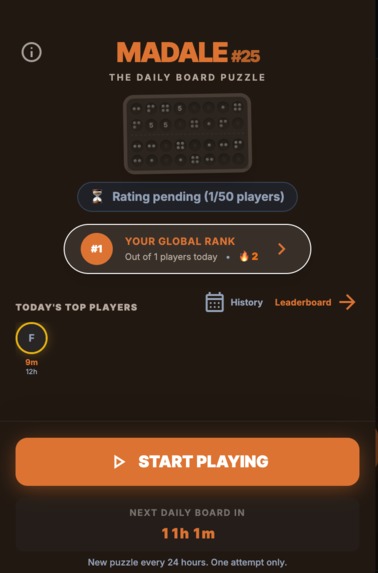
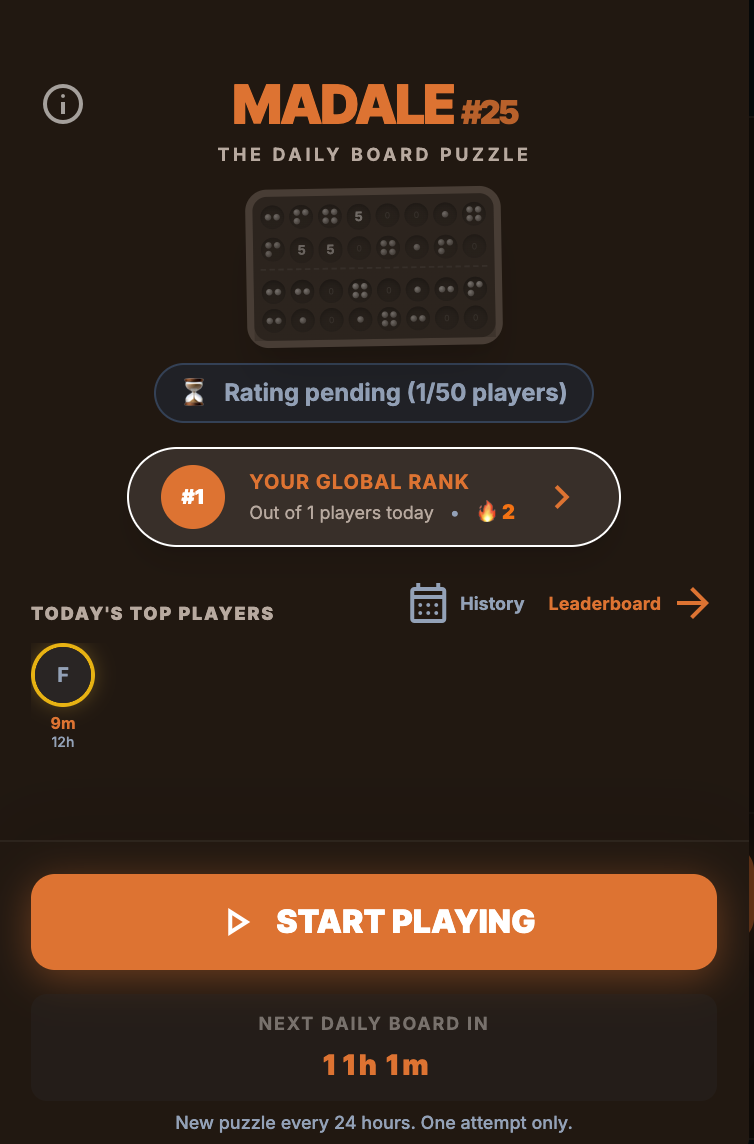
Intro Screen (Home) One board, one chance, every 24 hours. Preview today's unique puzzle layout and check your global rank before you start.
-
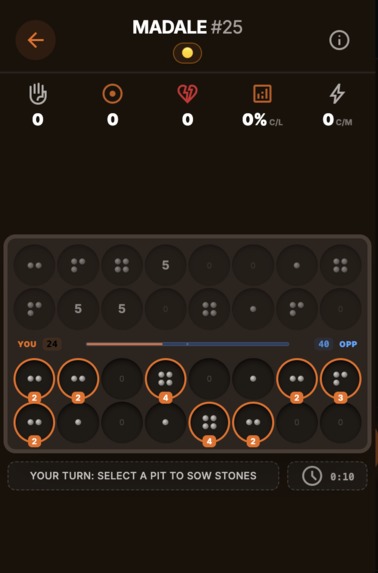
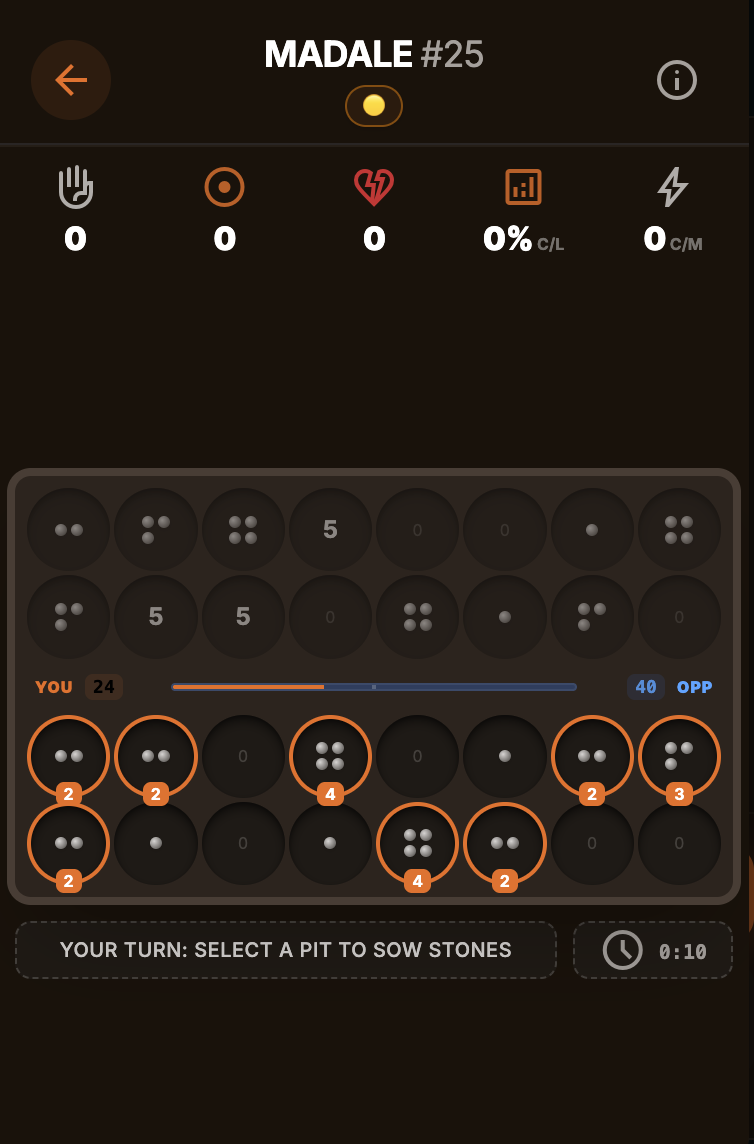
Active Gameplay (The Board) Authentic 4-row Kisolo mechanics. Plan complex multi-lap captures in this ancient strategy game.
-
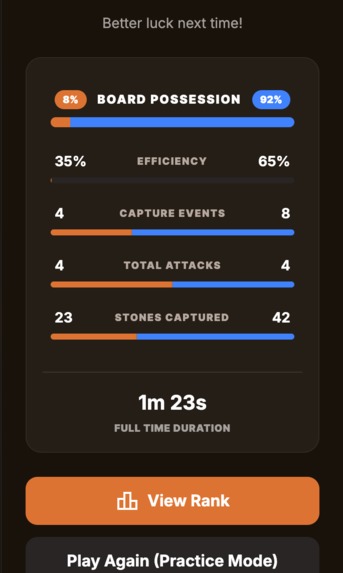
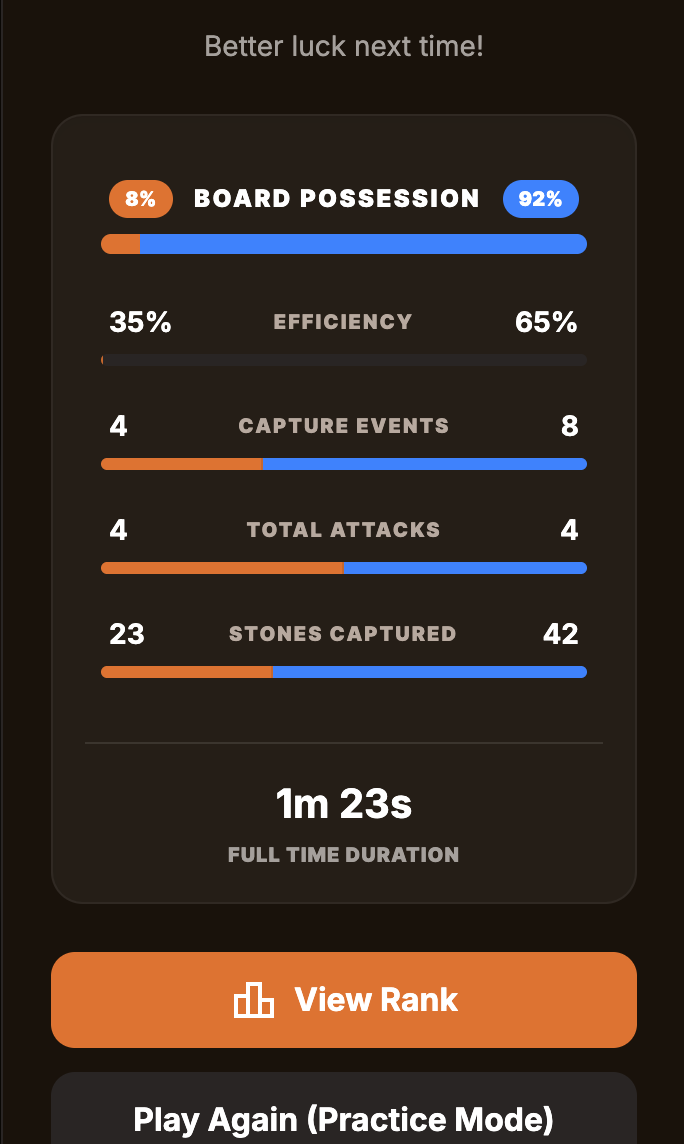
Game Over & Stats Analyze your game with stats like Efficiency and Capture Rates.See exactly where you won or lost against the daily puzzle.
-

Global Leaderboard Compete globally on the daily leaderboard. Watch the dynamic difficulty rating evolve in real-time as the community plays

Inspiration
As kids, we played this game in the dust. We'd dig pits in the ground with our hands and play with stones or marbles we found. I learned the deep strategies of Kisolo (a 4-row Mancala variant) from my grandpa, who had an old wooden board at his place. It wasn't just a simple pastime... it was a fierce mental battle, comparable to chess, requiring us to plan traps and captures many moves ahead.
Years later, I searched everywhere online for the exact version we played - specifically the authentic 2-rows-per-player variant... but I couldn't find it. The Mancala community is fragmented, with everyone playing by different local rules.
I realized that if I wanted to play my grandpa's version again, I had to build it myself. This hackathon was the push I needed to finally preserve that memory and digitize the rules I grew up with. MADALE is that effort: an attempt to centralize strategy enthusiasts under one definitive, high-stakes standard.
What it does
MADALE is a profound 2-player strategy game, often called "African Chess," digitized and modernized. At its core, it is a high-skill competitive engine, enriched by a community-driven Daily Challenge layer.
The Strategic Core:
Unlike simpler Mancala versions, Madale uses an authentic 4-row layout (2 rows per player) that demands deep tactical thinking:
- One-Way Strategy: You can only move on your side of the board; you must "capture" to attack the opponent.
- The Empty Pit Trap: Landing in an empty spot ends your turn, requiring careful planning to avoid dead-ends.
- Chain Reactions: Experienced players can trigger "multi-lap" moves where one sowing cycle leads into another, often resulting in devastating triple or quadruple captures in a single turn.
The Daily Twist:
On top of this engine, we built a daily competitive loop:
- Daily Shared Puzzle: Every 24 hours, the entire world solves the same board state. Since everyone plays the same puzzle, it's perfect for community strategy discussion and "How did you solve it?" threads.
- Smart Difficulty: Boards aren't just "set" to hard—difficulty is community-rated. If the global win rate is low, the board naturally earns a "Brutal" badge.
- Professional Metrics: We track Efficiency (how well you protected your pieces) and Precision (how effective each move was), giving the game a professional ELO-like feel.
How we built it
We focused on building a robust strategy engine that could handle both high-level AI play and real-time multiplayer.
- Smart Strategy Engine: A custom logic layer that handles multi-lap moves, captures, and turn transitions with perfect circular index mapping.
- Learning Difficulty System: A backend analysis layer that processes community success rates to dynamically rate every board.
- Real-Time Leaderboards: Powered by Redis sorted sets to handle global rankings and streaks with sub-millisecond latency.
- State-Synced Animations: A custom system to ensure that every "jump" of a stone and every capture sound is perfectly synchronized with the underlying logic.
Tech Stack
- Frontend: React + TypeScript + Vite
- Backend: Express.js on Reddit Devvit serverless
- Database: Redis (sorted sets for leaderboards, JSON for metrics)
- Styling: Tailwind CSS with custom "Zanzibar Night" dark mode
- Game Logic: Pure, deterministic TypeScript shared between client and server.
Challenges we faced
- The S-Curve Challenge: Animating the movement of stones across four rows in a continuous loop required complex geometric mapping to ensure it felt as natural as moving stones on a physical board.
- Fair Rankings: Creating a formula that balances move counts and time to reward "Deep Thinking" over just "Fast Clicking."
- Mobile Performance: Maintaining 60fps animations while the AI simulates thousands of potential moves in the background for high-difficulty levels.
- Circular Logic Visualization: Translating the abstract 32-pit game state into a mirrored UI for opposing players, ensuring moves always flow "clockwise" from both perspectives.
Accomplishments we're proud of
- Digitized Heritage: We successfully preserved the "Grandpa's Rules" version of Kisolo that was previously missing from the digital world.
- Authentic Rules, Zero Compromise: We didn't simplify the game; we embraced its complexity to appeal to strategy purists.
- Community-Driven Difficulty: A system that trusts the community to determine how hard a challenge is, rather than using arbitrary settings.
- Mobile-First Professionalism: A web app that feels like a native package, complete with haptic-like sound feedback and responsive design.
What we learned
- Devvit's Potential: Redis is an incredible tool for building high-stakes leaderboard systems on a serverless architecture.
- Data as Storytelling: Showing a player they are in the "Top 5% of Precision" for a board that only 12% of people beat creates a powerful sense of accomplishment.
- Heritage Digitization: There's a profound responsibility in coding oral-tradition rules into a permanent digital format.
What's next for MADALE
The Daily Board was just the beginning—a way to train the community. The future of MADALE is to become the Chess.com of Kisolo:
1. 1v1 Online Arena (The Core)
- Real-Time Multiplayer: Instant matchmaking for live 1v1 battles.
- Ranked Play: A permanent ELO system to find the true Grandmasters.
2. Global Leaderboards
- Persistent Standings: Moving beyond daily resets to all-time rankings.
- Regional Rankings: See who determines the strategy in your country or city.
3. Challenge Mode
- "Beat This Board": Send specific, difficult board states to friends to solve.
- Asynchronous Play: Correspondence games for long-term strategic battles.
Built With
- devvit
- react
- redis
- tailwindcss
- typescript
- vite

Log in or sign up for Devpost to join the conversation.