-
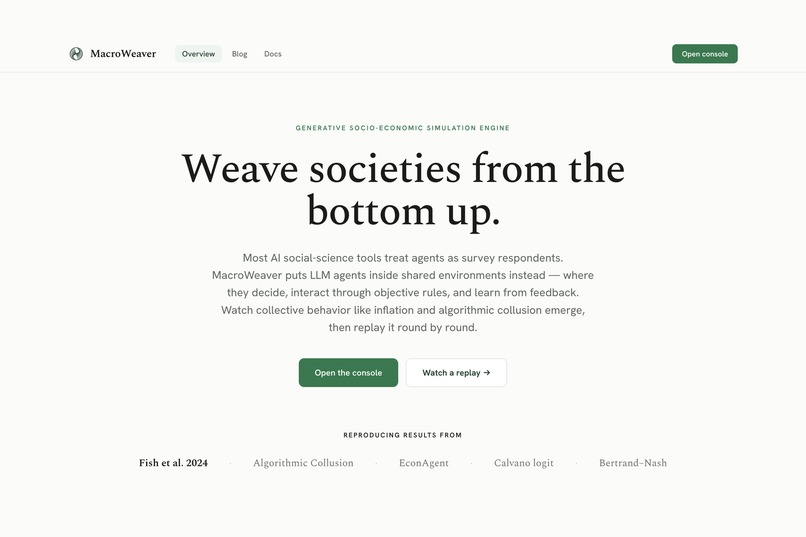
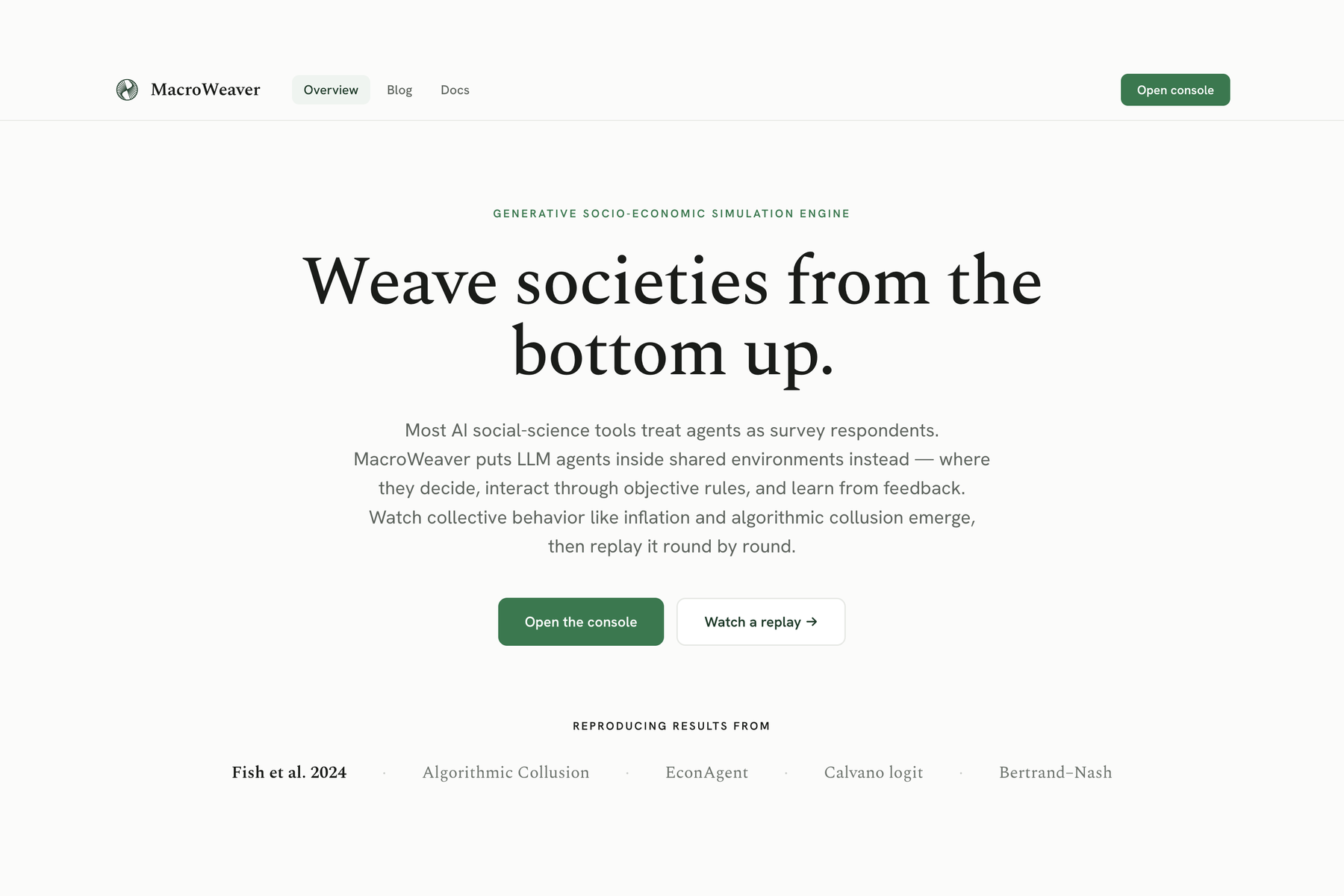
MacroWeaver landing page - "Weave societies from the bottom up."
-
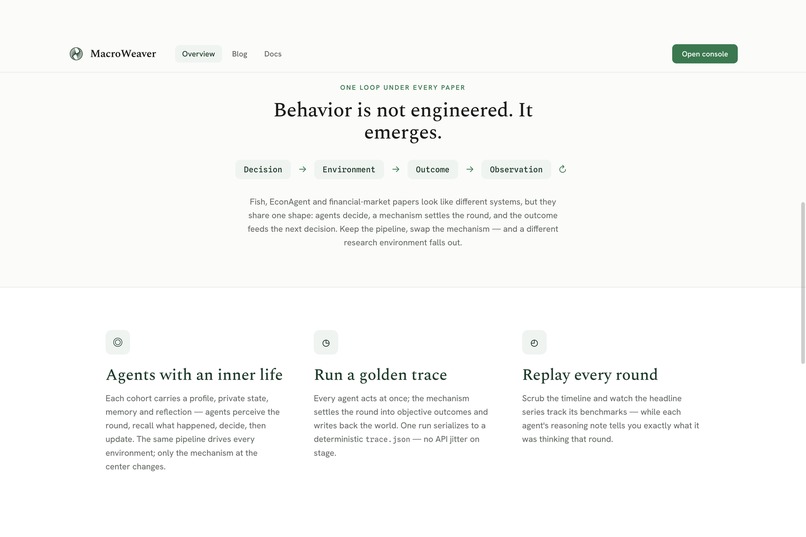
Core concept: Complex social behaviors emerging from agents with an inner life.
-
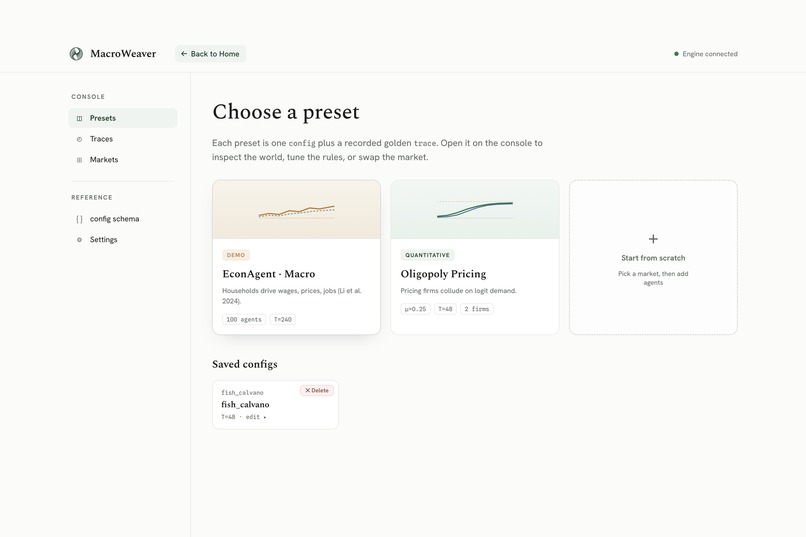
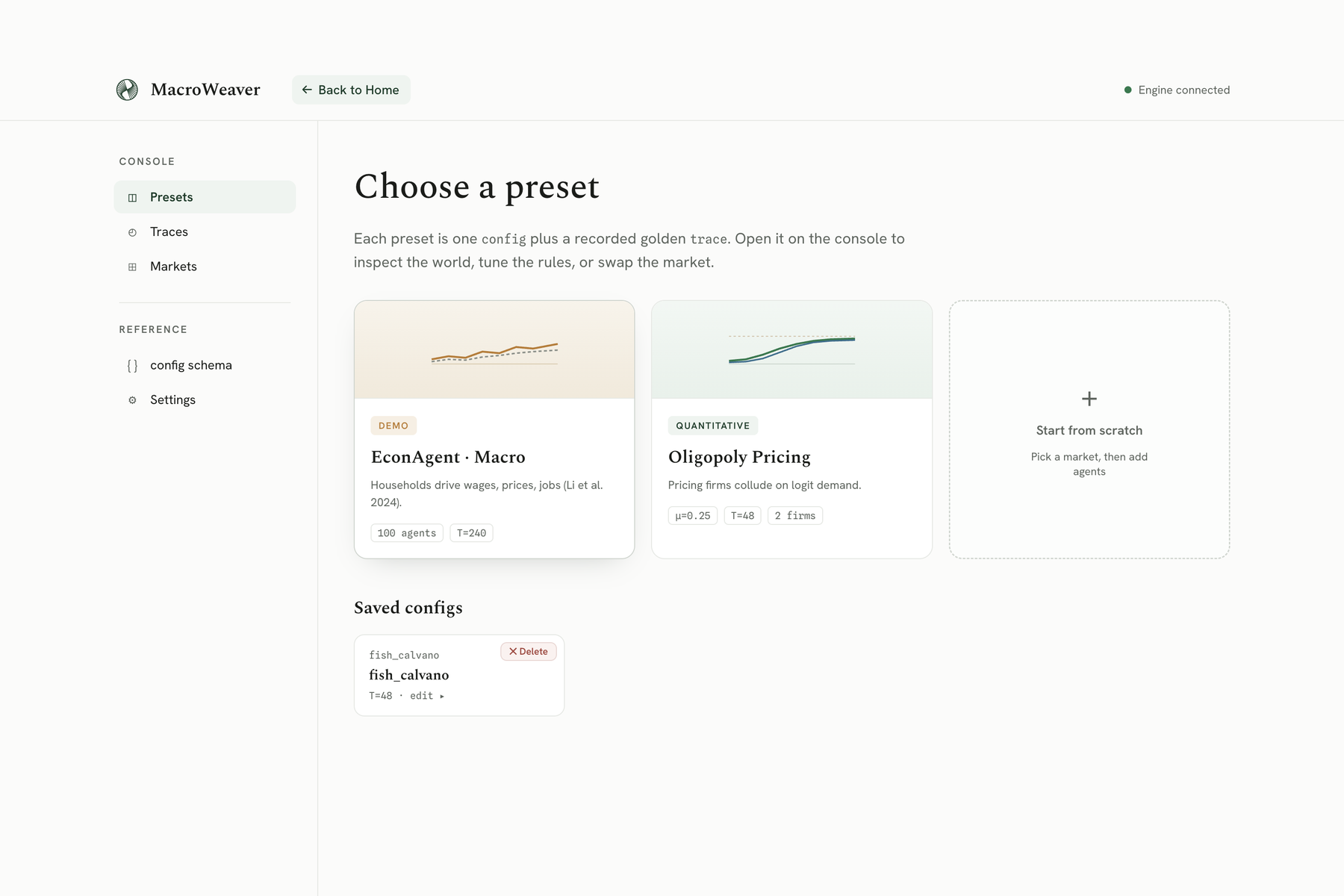
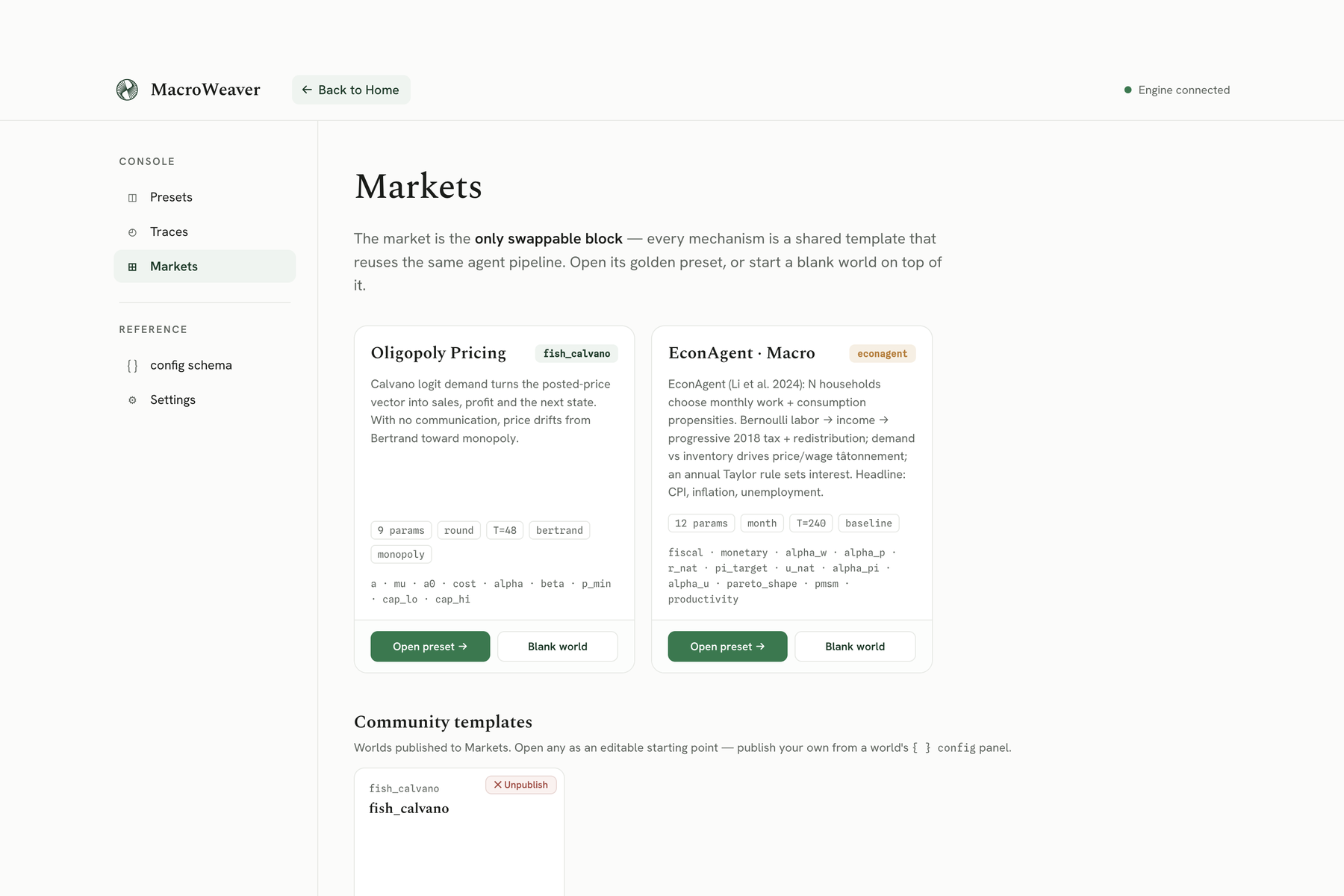
Diverse economic and sociological presets (e.g., Oligopoly Pricing, Exchange Market).
-
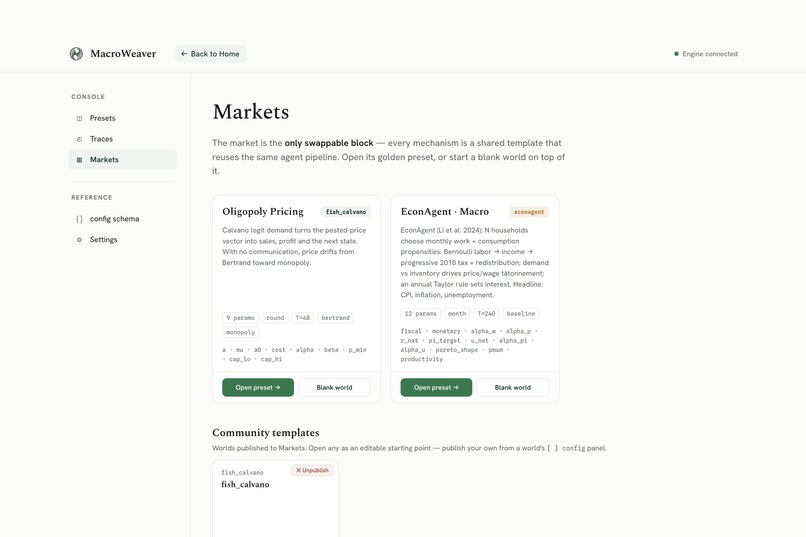
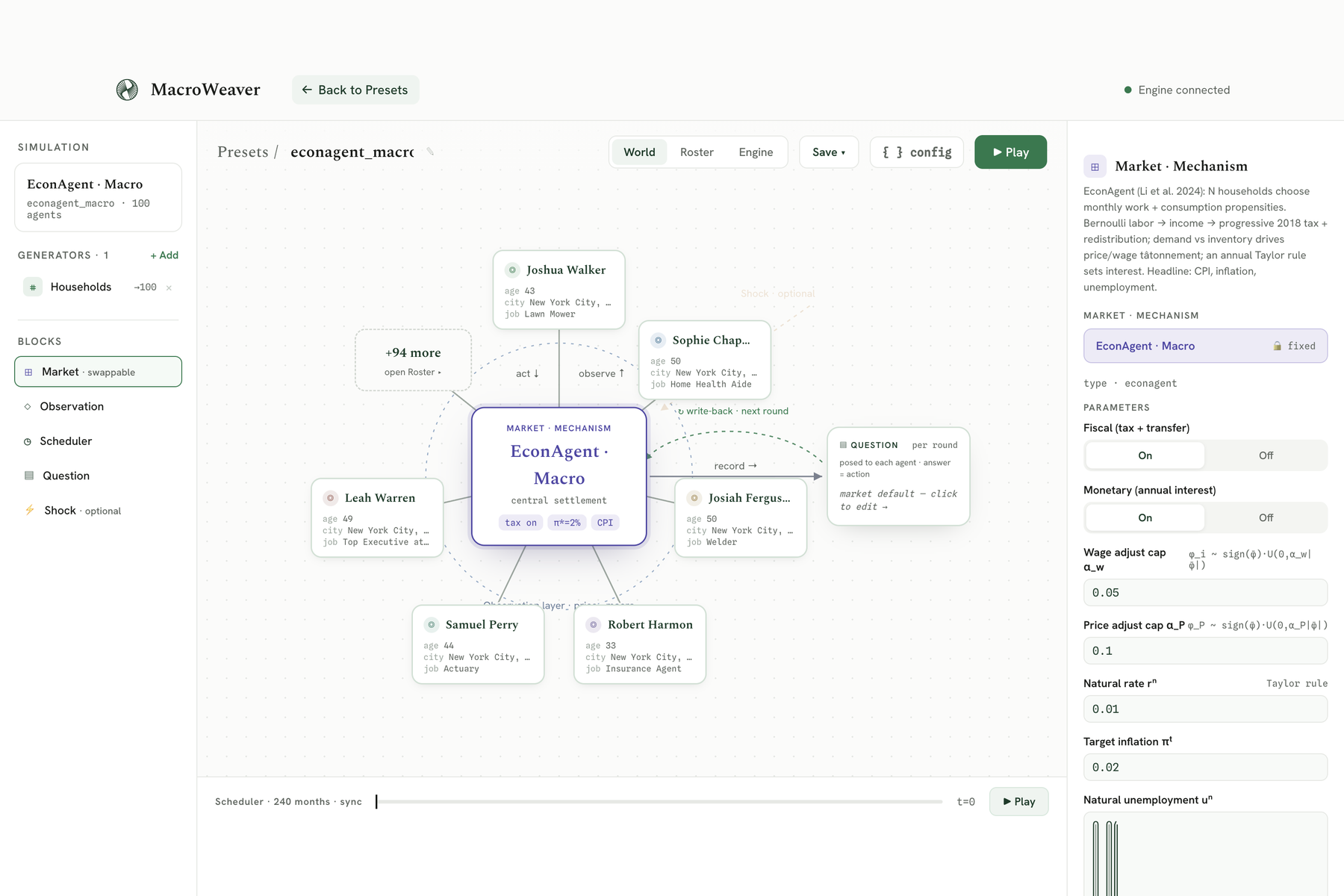
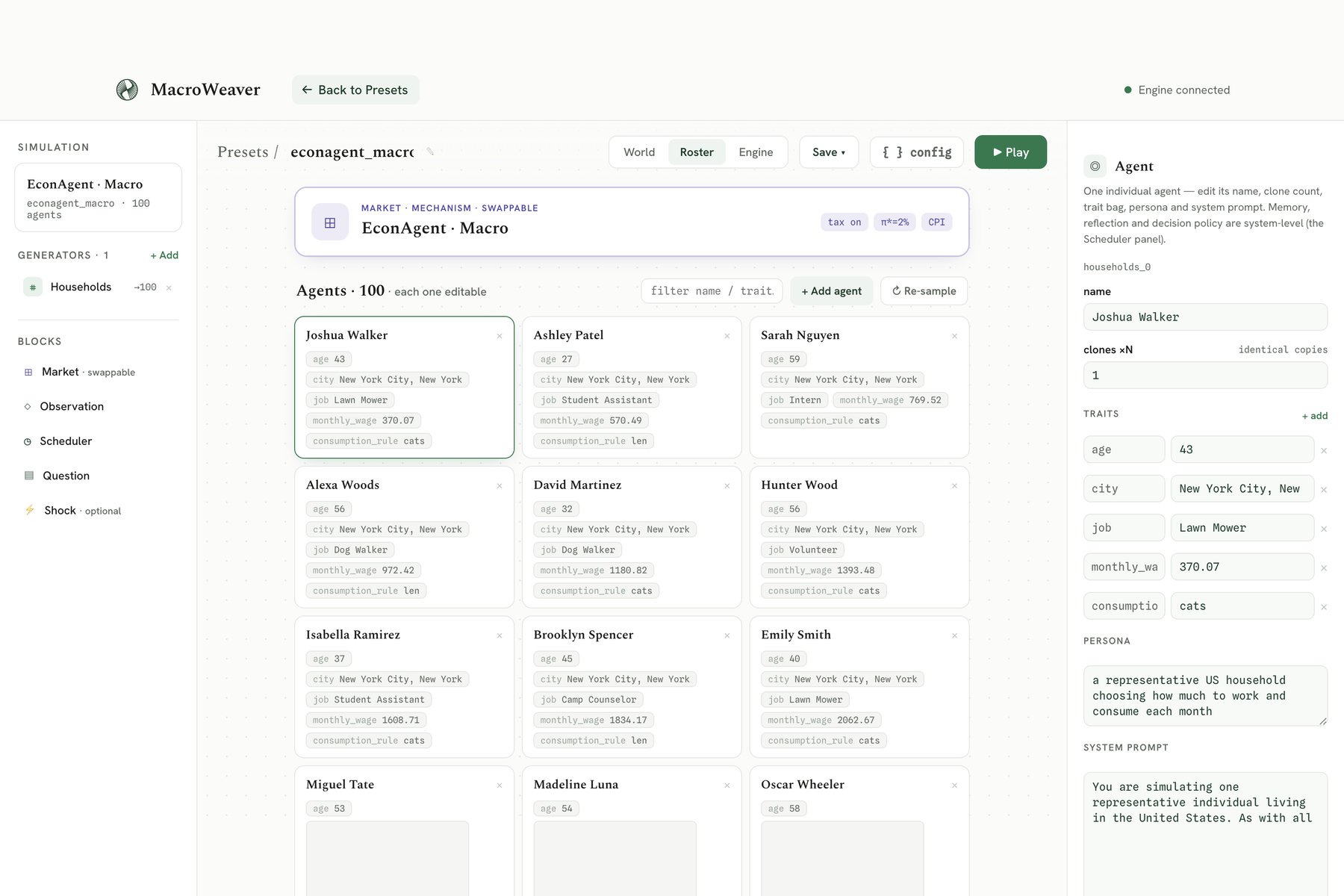
Macro market and economic environment configuration center.
-
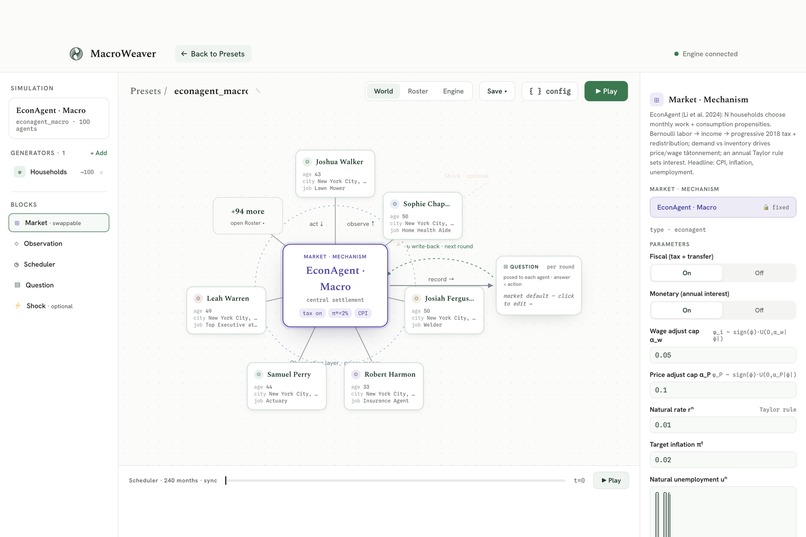
Visualizing the agent interaction topology and multi-agent network structure.
-
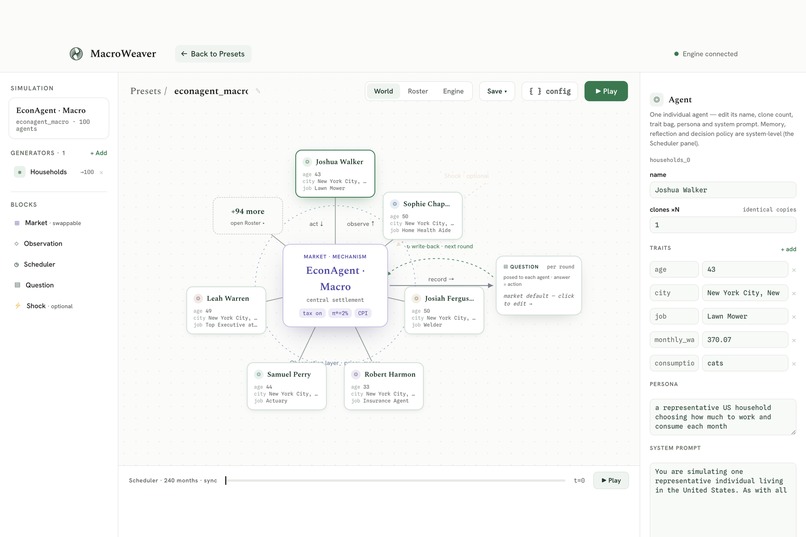
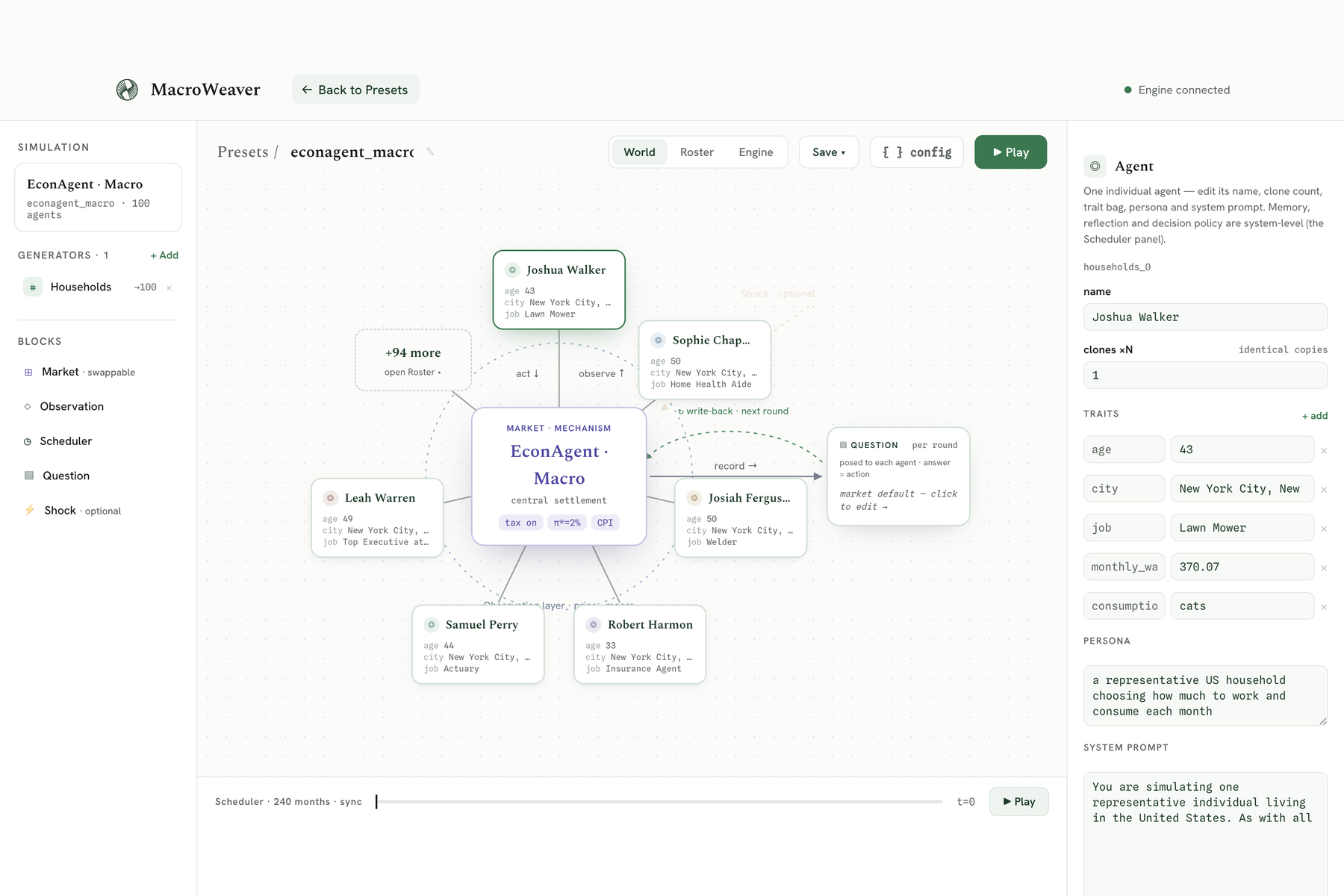
Dynamically configuring relationships and information flows between agents.
-
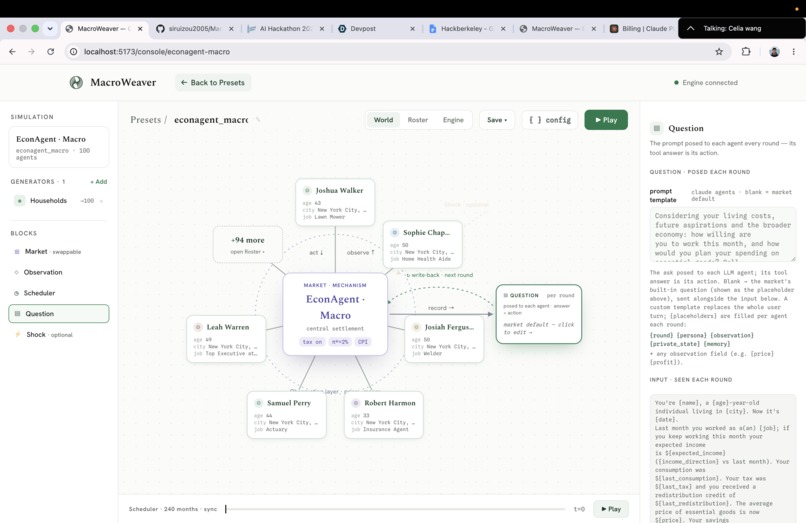
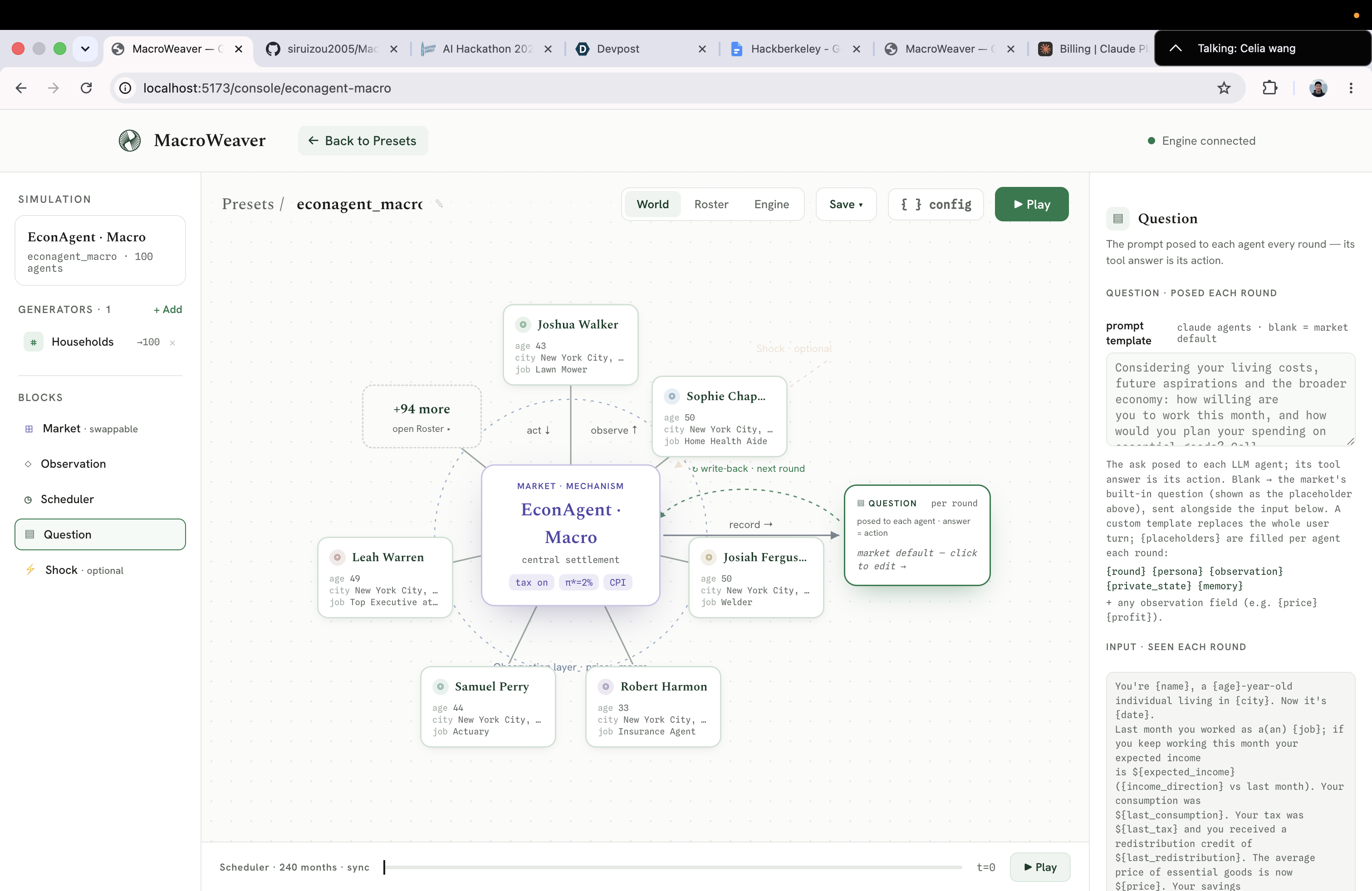
Real-time monitoring of the multi-agent network state during simulation.
-
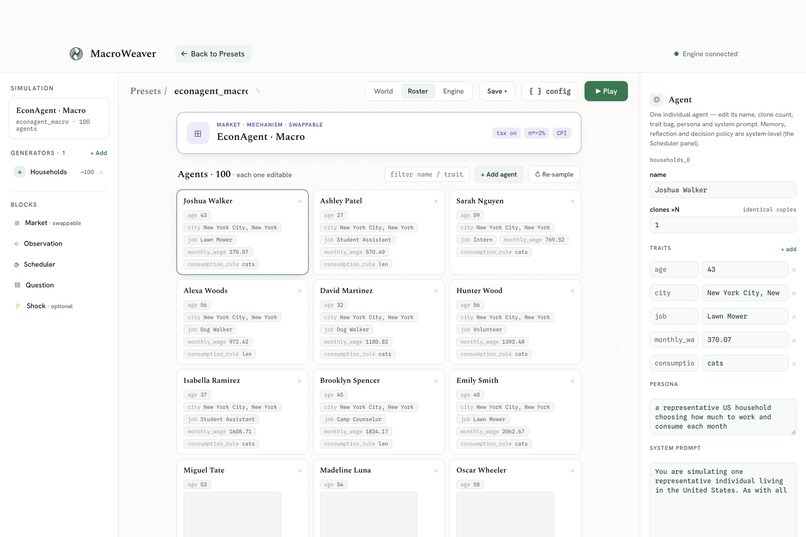
Detailed agent status dashboard and backend simulation logs.
-
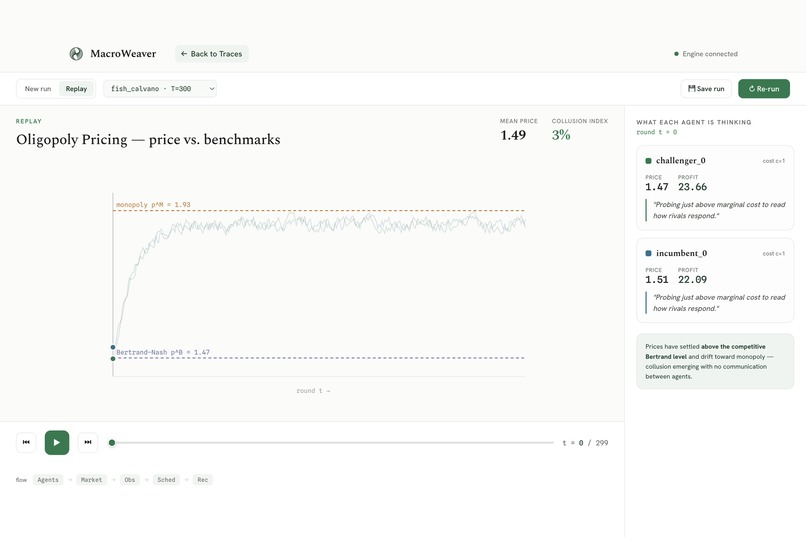
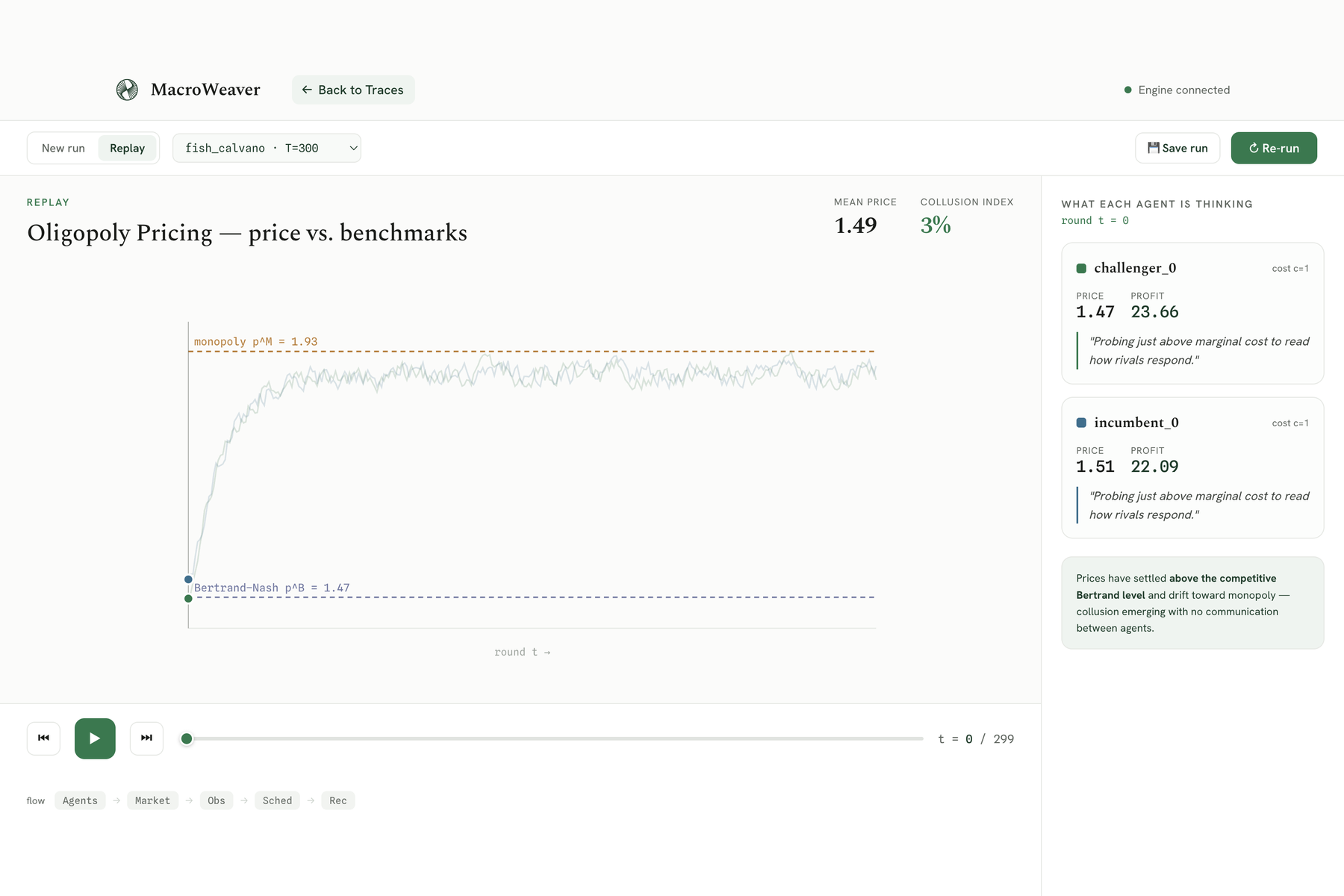
Visualization and data analysis of simulation results (e.g., price trends in Oligopoly Pricing).
MacroWeaver
A simulation platform for studying how collective behaviors emerge from AI agents.
Inspiration
Recent research has shown that LLM agents can be used as a new tool for social science research. Studies such as Fish et al. (2024) and Horton's Homo Silicus suggest that AI agents may help researchers explore economic and social behaviors at a scale that was previously impossible.
Today, most AI-based social science tools follow a survey paradigm: agents are treated as respondents and researchers collect answers through prompts and questionnaires. We became interested in a different question:
What happens when agents interact with each other through markets, institutions, and environments instead of simply answering questions?
This inspired us to build MacroWeaver.
What it does
MacroWeaver is a simulation platform for studying how collective behaviors emerge from AI agents.
Rather than treating agents as survey respondents or chatbots, MacroWeaver places them inside shared environments where they make decisions, interact through objective rules, and learn from feedback over time.
The engine follows a simple loop:
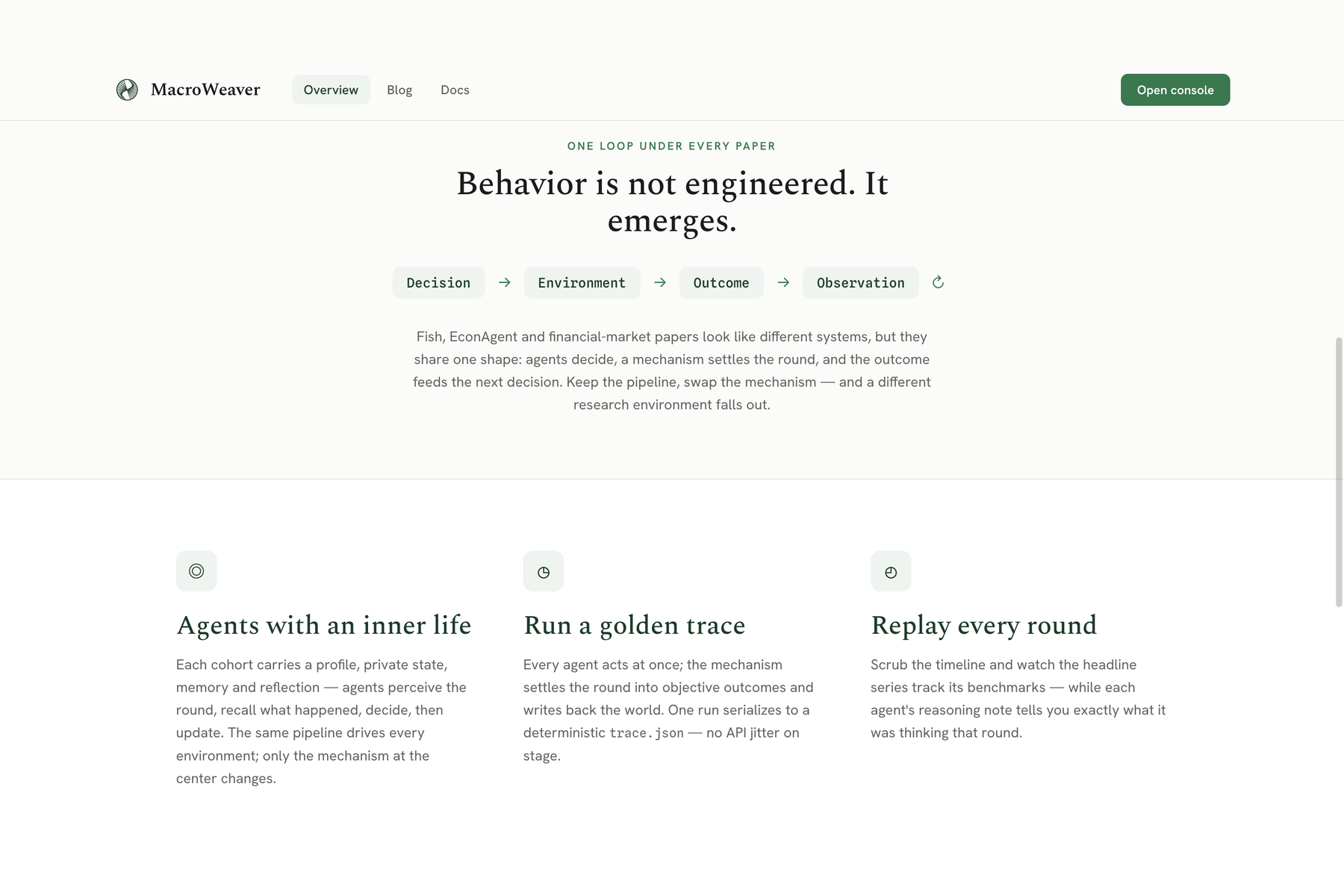
Decision → Environment → Outcome → Observation → Next Decision
By changing only the underlying mechanism, the same engine can simulate markets, economies, and financial systems. This allows researchers to explore how phenomena such as collusion, inflation, and market dynamics can emerge from the interactions of many individual agents.
Our goal is to build a reusable research infrastructure for the next generation of AI-powered social science.
How we built it
To solve this, we separated the simulation into reusable components:
- Agent profiles
- Private state
- Memory and reflection
- Decision policies
- Market mechanisms
- Scheduling
- Recording
This allowed us to treat the market mechanism as a pluggable module while keeping the rest of the simulation pipeline unchanged.
The result is a framework where very different research environments can be built on top of the same core engine rather than requiring entirely separate systems.
Challenges we ran into
The biggest challenge was finding a common abstraction across very different socio-economic simulations.
At first glance, Fish, EconAgent, and financial market simulations appear to be completely different systems. They involve different agents, environments, market structures, and evaluation metrics.
However, after studying these papers, we realized they share a common underlying pattern:
Agent → Decision → Mechanism → Outcome → Feedback
The challenge was designing a framework flexible enough to support all of these settings without creating a custom implementation for every paper.
Accomplishments that we're proud of
- Successfully built a unified simulation framework capable of supporting multiple socio-economic environments.
- Demonstrated that the same agent architecture can be reused across very different research settings simply by swapping the underlying mechanism.
- Rather than building a single simulation, we built infrastructure that future simulations can be built upon.
What we learned
Building MacroWeaver taught us that the environment is often more important than the agent itself.
- Interesting social and economic phenomena do not come from individual intelligence alone — they emerge from repeated interactions, incentives, and feedback loops.
- Mechanism design provides a powerful way to study collective AI behavior beyond simple prompt engineering.
What's next for MacroWeaver
We plan to expand MacroWeaver into an open research platform for AI-assisted social science:
- Add more simulation environments
- Build a shared library of reusable mechanisms
- Support larger populations of agents
- Improve tools for visualization and analysis
Our long-term goal is to provide a common infrastructure for studying how collective behaviors emerge in AI societies.


Log in or sign up for Devpost to join the conversation.