Nobody has ever touched an ocean like this.
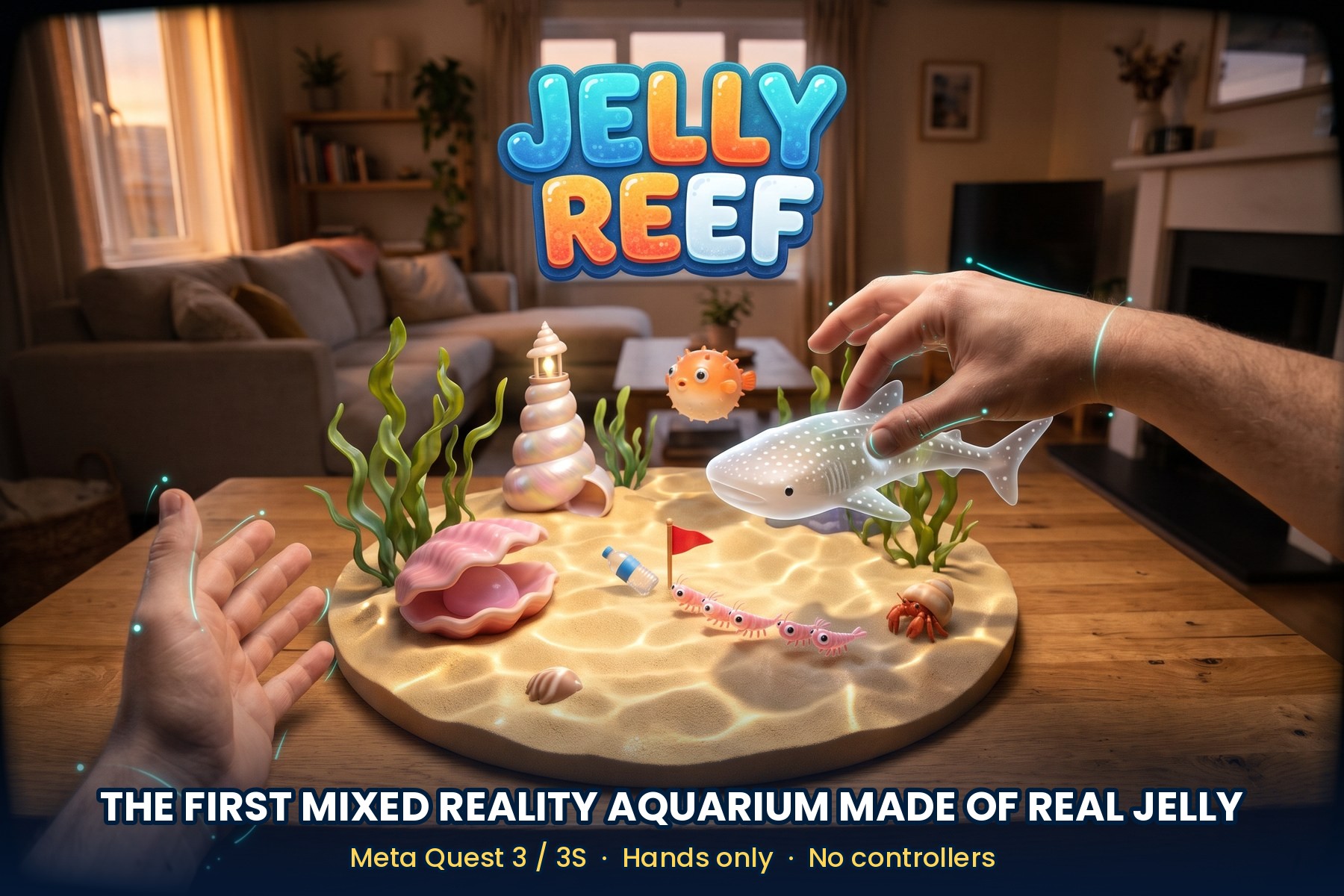
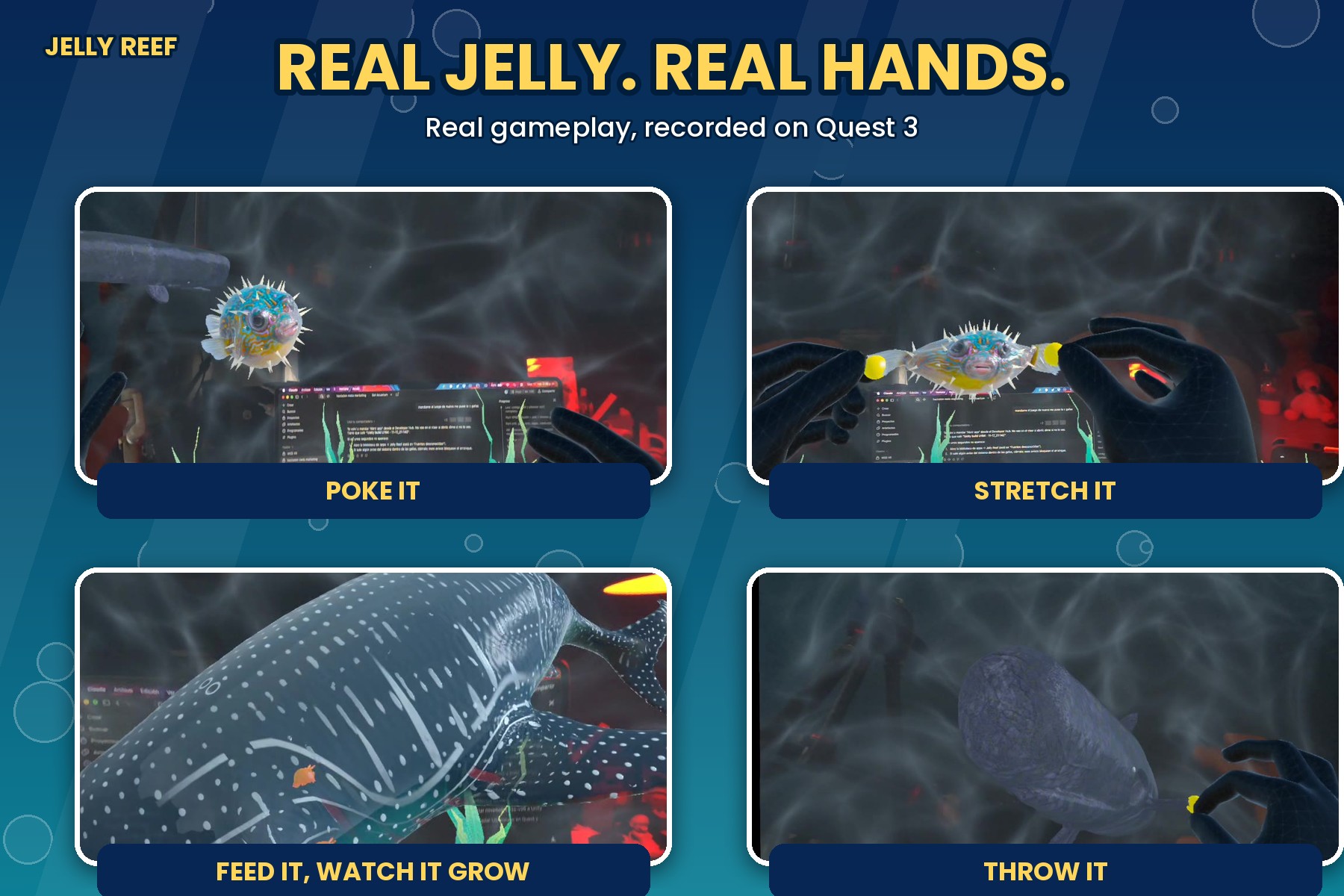
Put both palms on your table and a tiny reef appears beneath them. A whale shark the size of a water bottle glides past your fingers, and when you press it, it squashes, wobbles and springs back. It is not an animation: every big animal in Jelly Reef is a real-time soft body made of thousands of jelly tetrahedra, and every bone of every finger collides with it. Pinch a fin, stretch a tail, squeeze a whale with both hands, and the reef answers back.
Inspiration
We wanted the most touchable experience possible on Quest: animals that feel soft, a world small enough to fit on a desk, and a game you can enjoy seated - on the sofa, at the kitchen table, during a short break - with nothing but your hands. We also wanted a cozy story with a message: the ocean is full of human trash, and a tiny army can make a difference.
What it does
Aquarium mode - your living-room ocean
- Place the reef anywhere with two flat palms (table or floor); move it any time from the wrist menu.
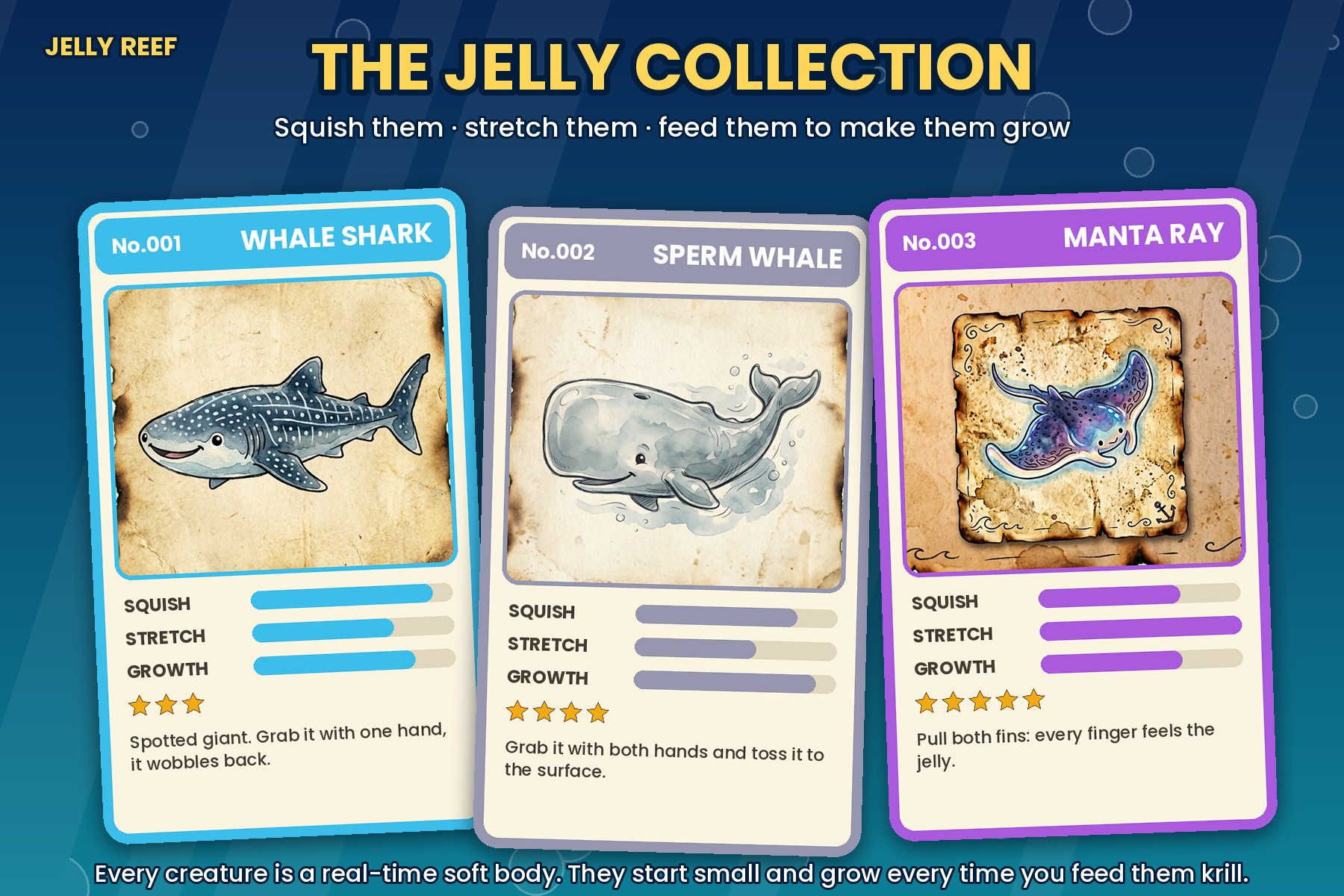
- Choose your star animal - a whale shark, a sperm whale or a manta ray - all made of jelly you can push, pinch, stretch and squash.
- Hand-feed krill and watch your animal grow from a small, pale baby to full size; growth is saved between sessions.
- A gel pufferfish and a goldfish swim around, eat on their own, grow, and every so often swim up to your face to say hello. Squeeze the pufferfish four times (or with both hands) and it deflates.
- "Follow the food": grab a big krill and lead your whale around the room.
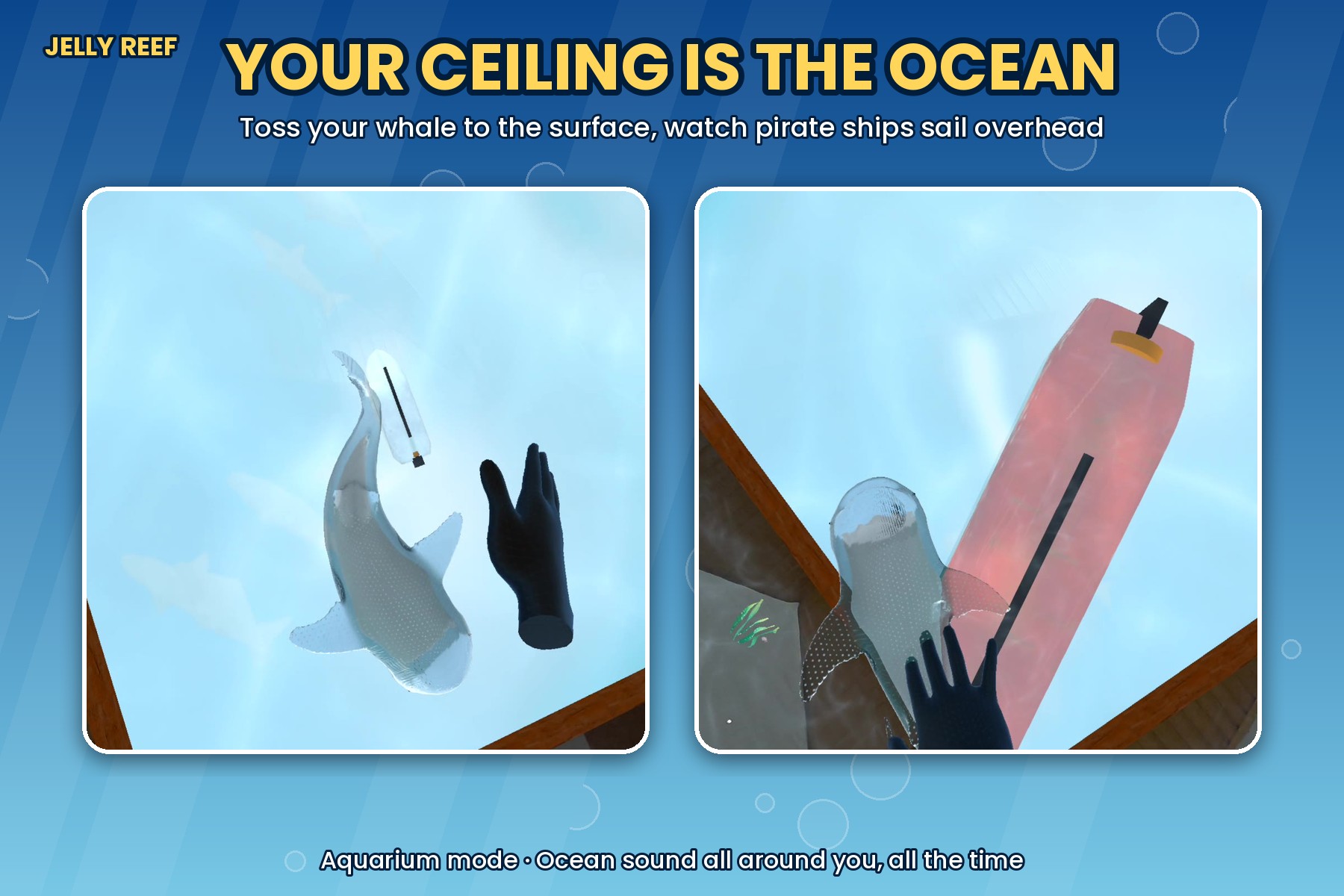
- Jellyfish drift, kelp sways when you brush it, a crab and a lobster wander the sand, a giant clam opens and closes, and caustic light ripples over everything. A wooden frame and an ocean ceiling with ships turn your room into an aquarium.
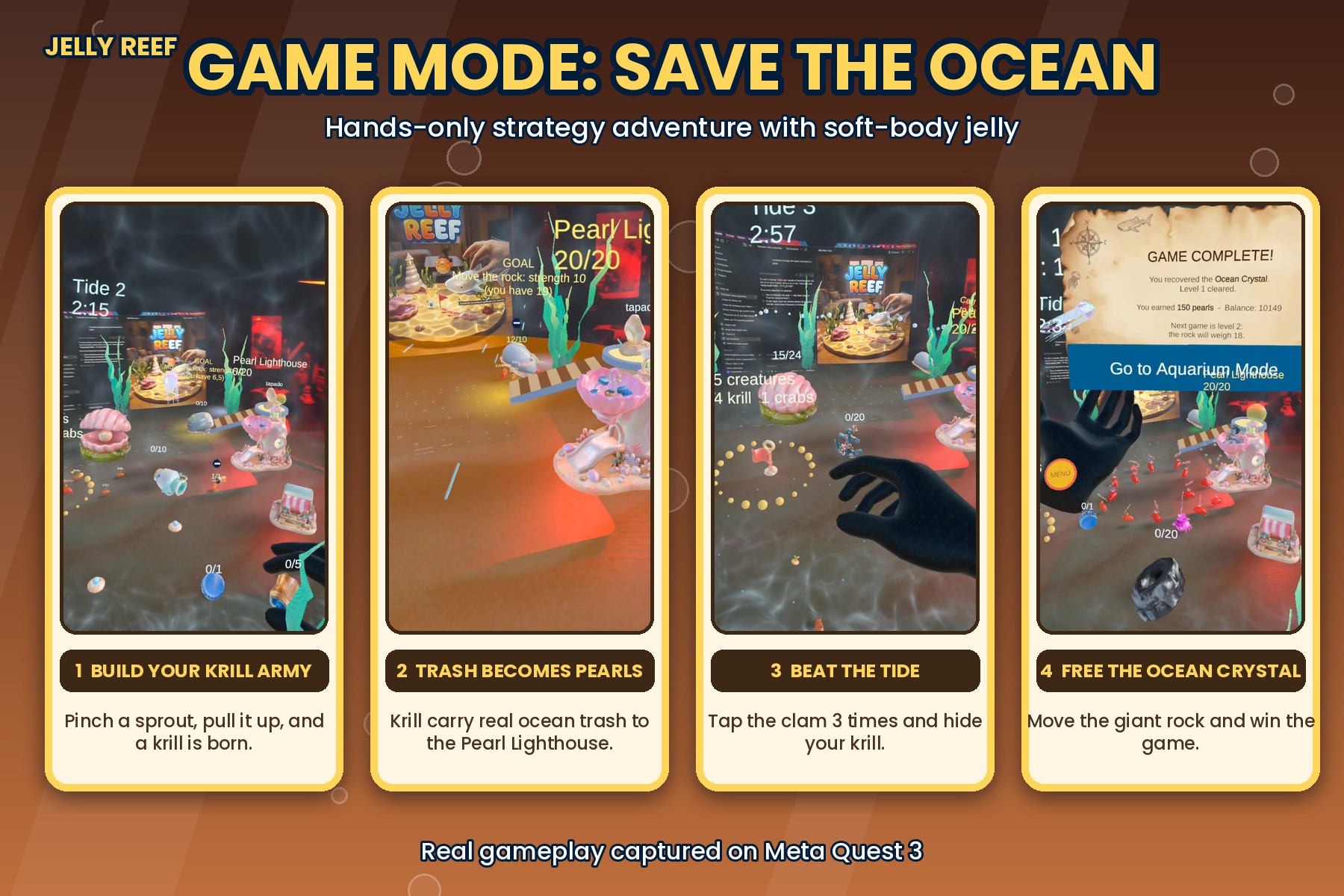
Game mode - Free the Ocean Crystal (a Pikmin-style strategy game under the sea)
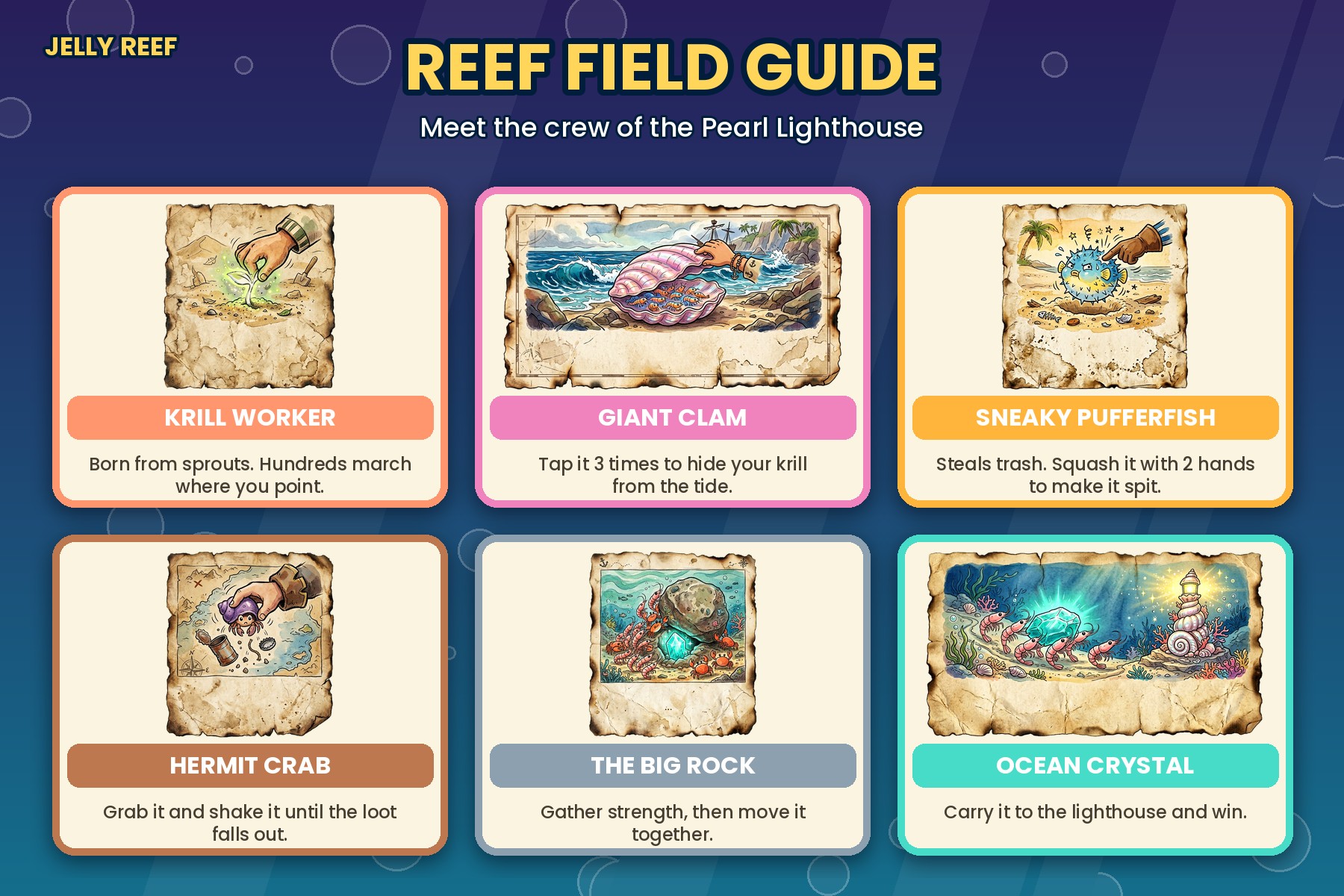
- Pinch and pull a sprout: a tiny krill with big eyes is born. Every krill is a worker (larva → baby → juvenile → adult, each stronger).
- Gather your army at the flag, then hold a pinch on trash - caps, cans, bottles, tires - and the krill carry it together to the Pearl Lighthouse. Heavier trash needs more krill; hold the minus button to call the extras back.
- The Lighthouse turns trash into seeds (more sprouts, more krill) and pearls (money for your aquarium).
- The tide arrives after 2 minutes and then every 3 minutes: krill outside the Mother Shell get swept away.
- Troublemakers: a pufferfish buries your trash in a hole and inflates on top until you squash it; a hermit crab steals loads and naps in its shell until you grab it and shake it out.
- Raise an open palm to whistle everyone back to the flag.
- When your army is strong enough, move the great rock, carry the Ocean Crystal home and win. Each level makes the rock heavier. Pearls you earn buy food, so every game makes your reef grow.
- Contextual tips: illustrated "before / after" cards appear in the world the first time each thing happens (first krill, first trash, the pufferfish, the hermit crab, the incoming wave...), so you learn by playing, never by reading a manual. The game never pauses for them.
- A wrist menu with big illustrated cards lets you switch modes, feed, choose your animal, or exit the game at any time.
How we built it
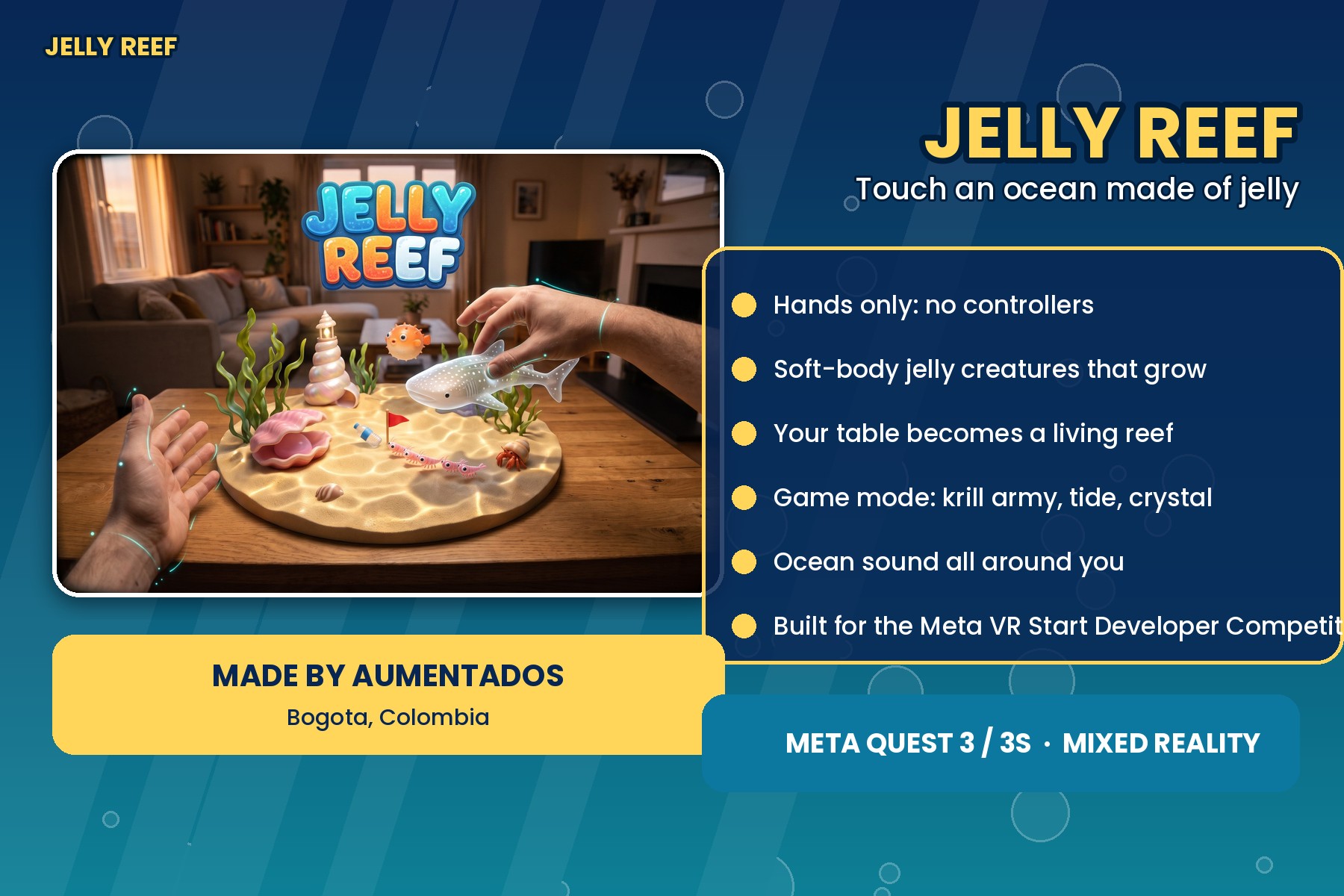
- Unity 6 + Meta XR SDK (OpenXR) on Quest 3 / 3S, passthrough mixed reality, hand tracking only.
- Custom XPBD soft-body solver on tetrahedral lattices (Burst job). The big animal's physics runs on a worker thread in parallel with rendering, with adaptive substeps, so the whole reef holds 72 fps.
- Bodies are baked from signed-distance volumes of our own models (Tripo + Blender + Nomad Sculpt), then skinned to high-resolution meshes with a refractive jelly shader (absorption, milky core, procedural markings).
- Every finger bone, palm and the head are colliders, so touch is physical, not a button press.
- Fixed foveated rendering, performance-level hints and render-scale tuning keep the GPU in budget.
- All in-game sound is synthesized in code (ocean ambience, pops, chimes, pufferfish voices).
Tools we used
- Engine and SDK: Unity 6, C#, Meta XR SDK (OpenXR, MR Utility Kit), Meta Quest Developer Hub.
- 3D and art: Blender, Nomad Sculpt, Tripo (AI 3D models) and the Adobe Creative Cloud suite.
- Generative AI: Google Nano Banana, used through Magnific (our browser-based AI creation workspace), for the tutorial cards, menu art, posters and cover; Magnific was also used for the AI voice-over of the trailer.
- AI coding and analysis partners: ChatGPT and Claude helped us design, program, analyze and debug the game.
- Testing: we ran many rounds of analysis and testing, on the headset and in the editor, to reach an advanced, fully working codebase.
Challenges we ran into
- Getting thousands of tetrahedra plus several gel creatures to run at a stable 72 fps on a standalone headset: we went from ~24 fps to 72 fps by re-baking coarser lattices, threading the solver and moving work off the main thread.
- Making hand collisions feel soft and stable instead of explosive.
- Designing a strategy game that is fully playable seated, within about 60 cm, with hands only.
- Our biggest challenge: making everything fully functional. Soft bodies, hand tracking, game loop, tutorial, audio and saving all had to work together on a standalone headset, which took many rounds of testing and analysis.
Accomplishments that we're proud of
- Jelly animals you can genuinely squeeze, at full frame rate, in your own room.
- A complete game loop - army, economy, enemies, tide, win state - that feeds back into a cozy aquarium.
- A tutorial that teaches through play.
What we learned
Soft, physical touch is the most magical thing hand tracking can offer. When the virtual world gives way under your fingers, it stops being a screen and becomes a place.
What's next
More levels and species, a lying-down "under the sea" mode, room-aware caustics on walls and furniture, decorations you place around your real room, and shared reefs with friends.
Credits: goldfish colour guide "Goldfish variety 3" by Picasty (CC BY 4.0).
Built With
- adobe-creative-sdk
- blender
- burst
- c#
- chatgpt
- claude
- google-nano-banana
- hand-tracking
- magnific
- meta
- meta-xr-sdk
- mixed-reality
- mruk
- nomad-sculpt
- openxr
- passthrough
- quest
- tripo
- unity
- xpbd


