Inspiration
As experienced industrial technicians retire, years of practical troubleshooting knowledge are disappearing faster than new technicians can replace them. When critical machines fail, companies face: • Expensive production downtime • Delays waiting for expert engineers • Inaccurate fault diagnosis • Costly unnecessary part replacements • Increased safety risks • Loss of valuable "tribal knowledge" built over decades We built MachMind AI to bridge this expertise gap by turning any smartphone into an AI-powered maintenance assistant that can diagnose machine faults, guide repairs with AR, and verify successful repairs using multimodal AI reasoning.
What it does
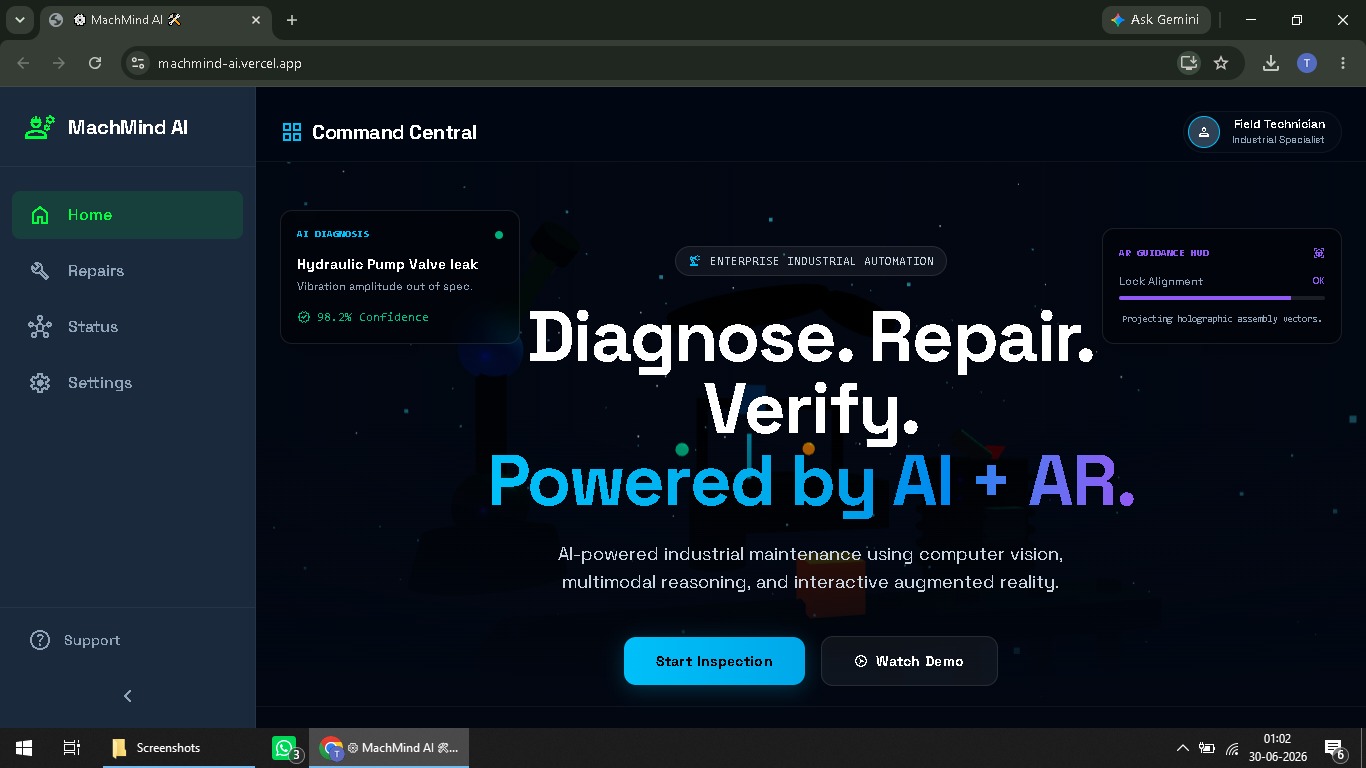
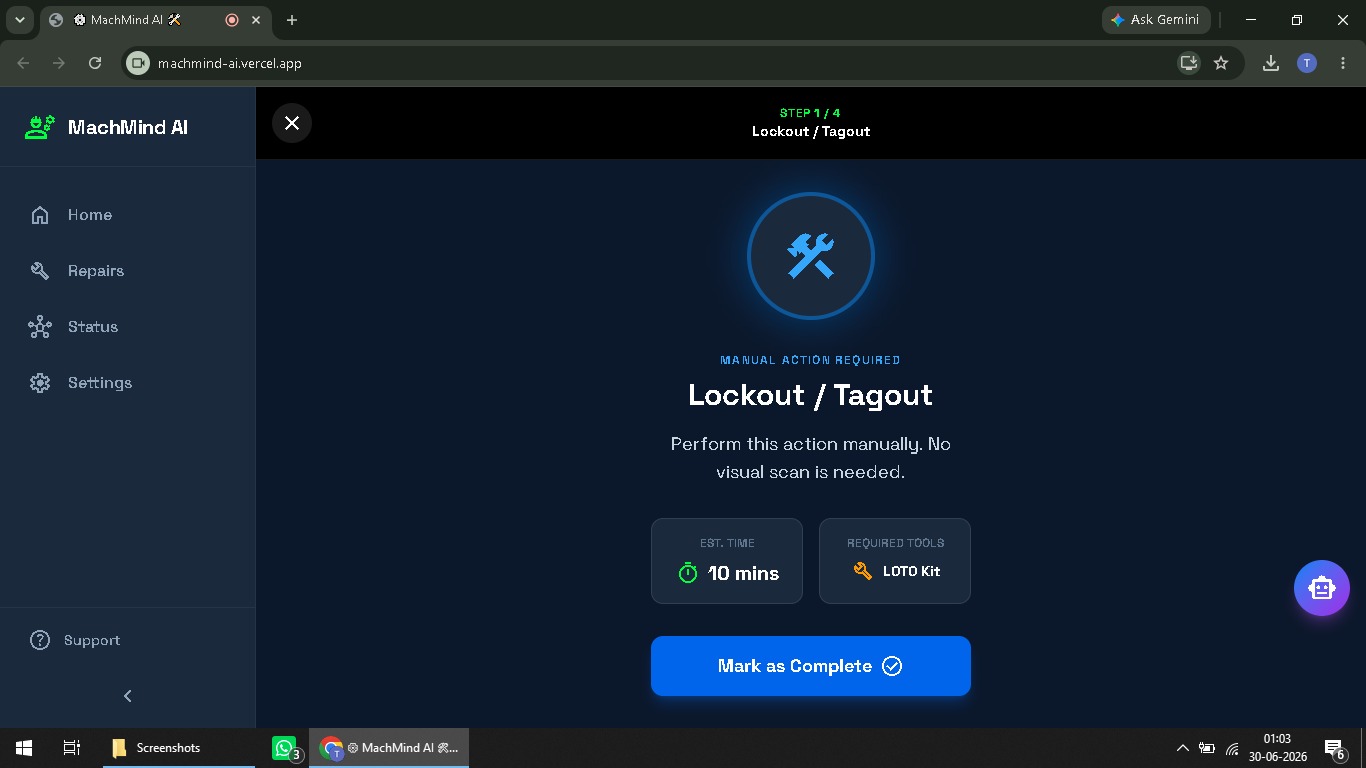
MachMind AI is an AI-powered industrial maintenance assistant that transforms a smartphone into an expert field technician. It captures video, audio, and vibration data from malfunctioning machines, uses multimodal AI to identify the most likely fault, retrieves relevant technical information, and provides step-by-step AR repair guidance. After the repair, it verifies whether the issue has been successfully resolved by comparing before-and-after machine conditions. It also securely stores maintenance history, AI diagnostics, and repair evidence in the cloud, enabling faster troubleshooting, reduced downtime, and smarter predictive maintenance.
The Future Crisis we're Solving
By 2030, 2.1 million manufacturing jobs will go unfilled in the US due to skilled worker retirement—the "Silver Tsunami." We're losing 30-year veterans who can diagnose a loose bearing by sound alone faster than we can train replacements. When machines break, companies face: $260B+ annual downtime costs in manufacturing $200-500 service call fees for simple repairs Days of delays waiting for experts to arrive Lost "tribal knowledge" that exists only in retiring experts' heads
How we built it
We built "MachMind AI"as a full-stack web application using Next.js, React, and TypeScript, and deployed it on Vercel. The application captures machine video, audio, and vibration data directly from a smartphone using the browser's Camera, Microphone, and Device Motion APIs. We perform client-side preprocessing, including audio FFT analysis and vibration telemetry extraction, before sending the data for AI analysis.
For intelligence, we integrated Google Gemini to perform multimodal reasoning, identify machine faults, provide context-aware repair guidance, generate AR-based repair instructions, answer technician questions, and verify repairs by comparing pre- and post-repair recordings.
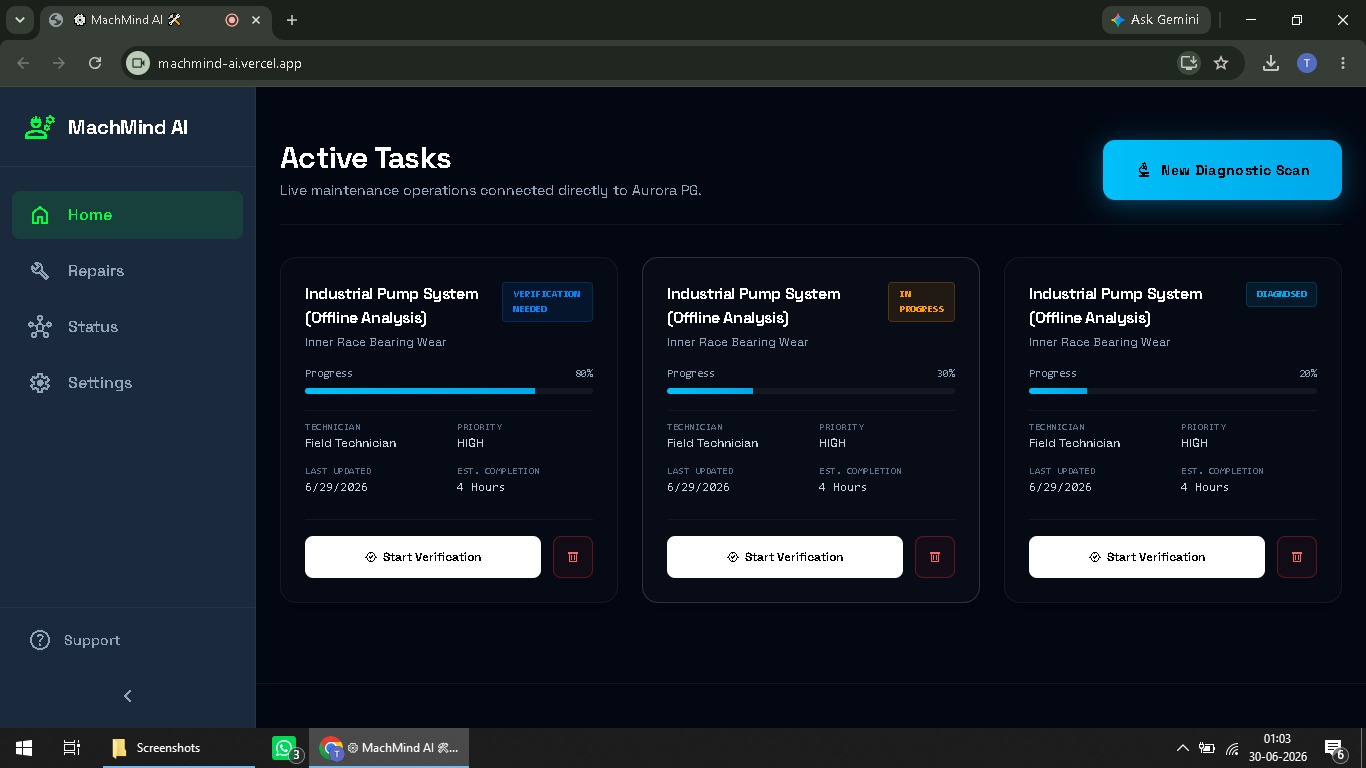
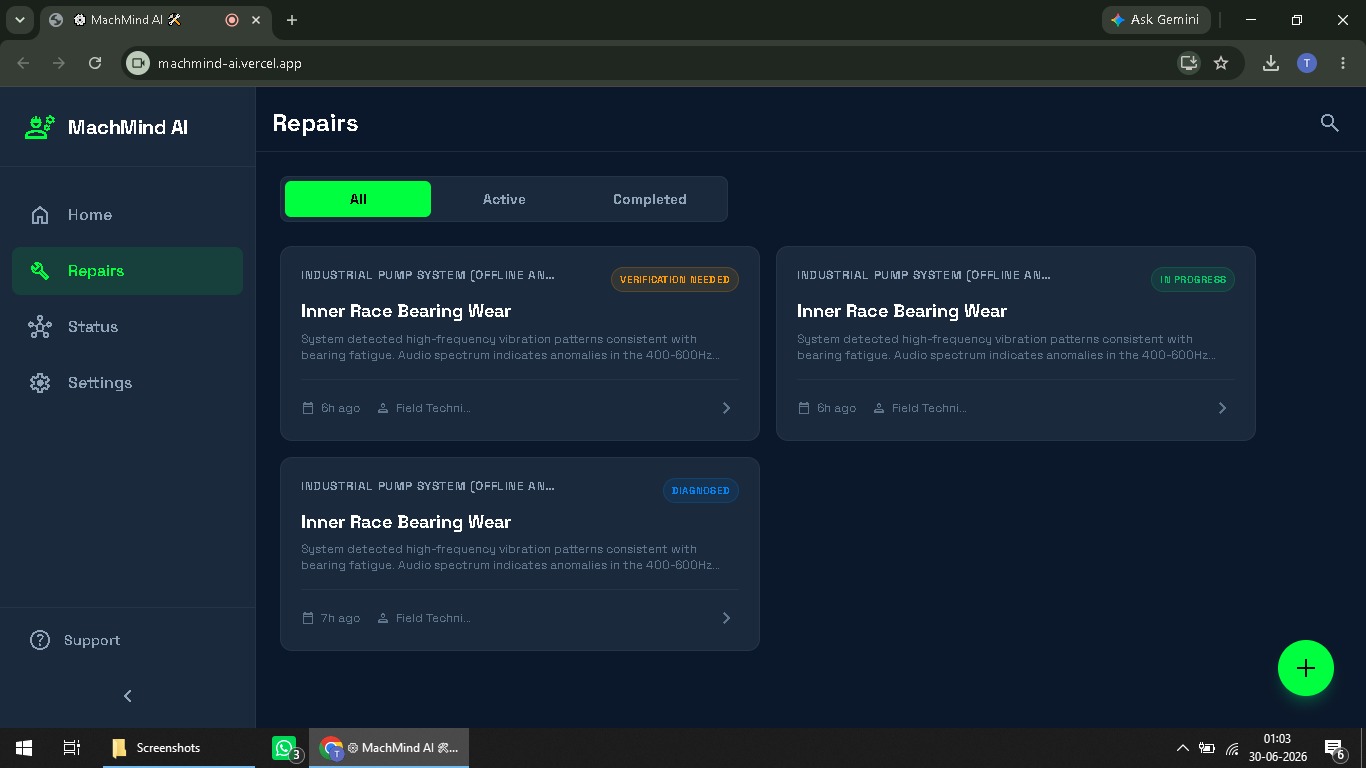
The backend uses Next.js API Routes with Drizzle ORM connected to Amazon Aurora PostgreSQL to securely store machine information, AI diagnoses, maintenance history, repair reports, and analytics. Media files such as images, videos, and repair evidence are stored in Amazon S3, while Google OAuth provides secure user authentication.
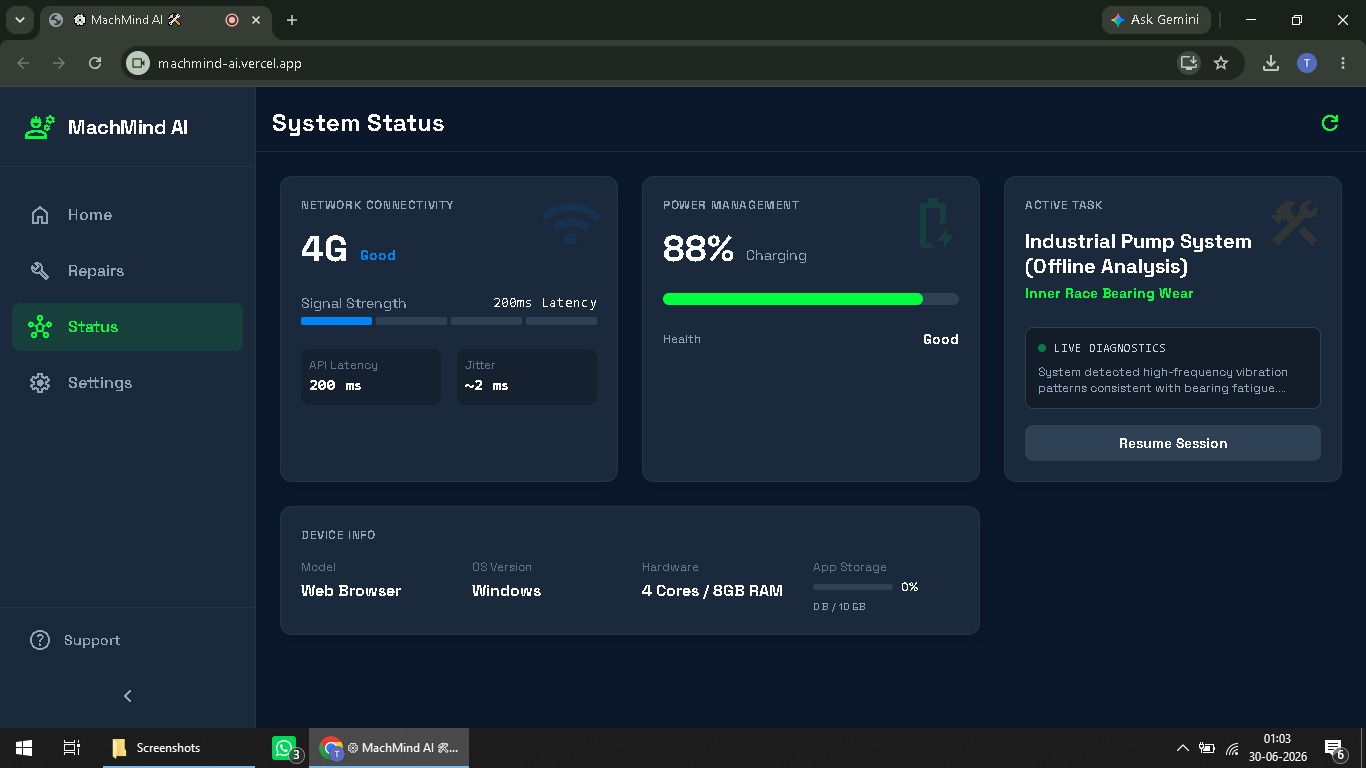
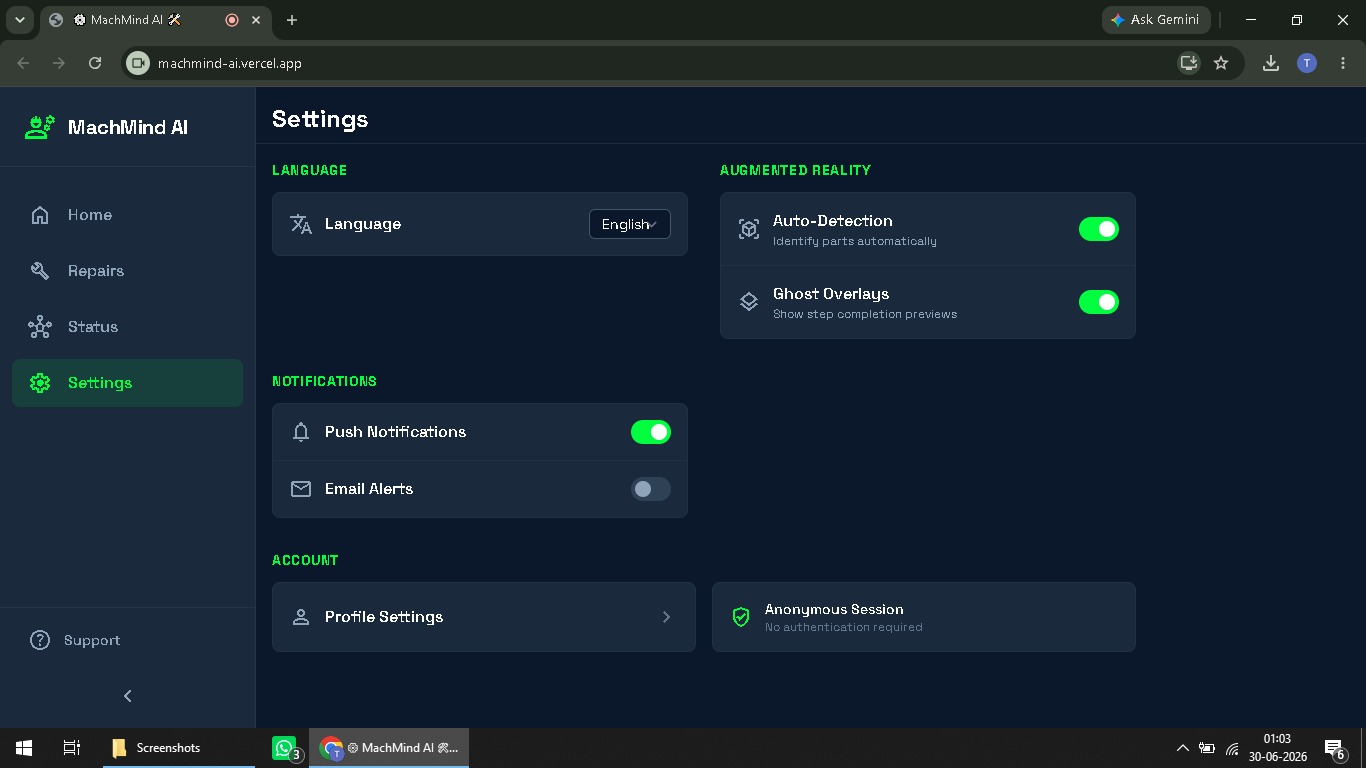
To deliver an intuitive experience, we built a modern industrial dashboard featuring New Scan, Start Verification, real-time AI diagnostics, maintenance history, analytics, and interactive AR overlays, creating a production-ready AI maintenance platform for industrial technicians.
Challenges we ran into
Building MachMind AI required solving several technical and engineering challenges. Accurately combining video, audio, and vibration data into a single AI reasoning workflow while maintaining fast response times was one of the biggest hurdles. We also faced challenges integrating AR guidance with real-time camera feeds, migrating from Supabase to Amazon Aurora PostgreSQL and Amazon S3, optimizing media uploads for network efficiency, securely implementing Google OAuth, and ensuring reliable end-to-end communication between the frontend, backend, cloud database, storage, and AI services. Finally, we focused on making the application production-ready with robust error handling, responsive performance, and seamless deployment on Vercel.
Accomplishments that we're proud of
We're proud of building MachMind AI into a complete AI-powered industrial maintenance platform that combines multimodal machine diagnostics, AR-guided repairs, and repair verification in a single web application. We successfully integrated Google Gemini for intelligent reasoning, Amazon Aurora PostgreSQL for reliable data storage, Amazon S3 for secure media management, Google OAuth for authentication, and deployed the entire solution on Vercel. Most importantly, we created a system that helps technicians diagnose faults faster, preserve valuable maintenance knowledge, and reduce equipment downtime using only a smartphone. MachMind AI isn't just a hackathon project—it's the foundation of a platform that makes expert mechanical knowledge universally accessible. In a world where "Google it" works for software but fails for hardware, we're building the answer.
The next generation of field technicians won't carry toolboxes alone—they'll carry AI that sees, hears, and reasons.
By 2030, when that 30-year veteran retires, their expertise won't be lost. It will live in FixStream's knowledge graph, accessible to every technician on every shift, forever.
The future of maintenance is multimodal, intelligent, and in your pocket.
What we learned
Building MachMind AI taught us that creating a reliable industrial AI assistant requires much more than connecting an LLM. We learned how to combine multimodal data (video, audio, and vibration), integrate cloud services like Amazon Aurora PostgreSQL and Amazon S3, build secure authentication with Google OAuth, optimize AI workflows for real-time performance, and design an intuitive AR-based user experience. Most importantly, we learned that AI can significantly enhance human expertise when combined with accurate data and practical workflows.
What's next for MachMind AI
Our next goal is to make MachMind AI an enterprise-ready maintenance platform. We plan to support IoT sensor integration for continuous machine monitoring, predictive maintenance using historical data, real-time collaboration with remote experts, offline functionality for field technicians, multilingual voice assistance, QR code-based machine identification, and integration with ERP/CMMS systems. We also aim to expand AI capabilities to support more industrial equipment, helping organizations reduce downtime, preserve expert knowledge, and improve maintenance efficiency at scale.
Built With
- amazon-web-services
- amazons3
- aurora
- css
- drizzle
- next.js
- orm
- postgresql
- react
- tailwand
- typescript
- vercel
- vercel/v0

Log in or sign up for Devpost to join the conversation.