
Inspiration
Reverse engineering applications compiled from Swift is difficult. Existing tools can expose assembly, symbols, and metadata, but understanding how these pieces relate back to Swift types, methods, control flow, and SwiftUI structures still requires substantial manual work.
MachLift grew out of my previous work on devirtualization and static binary analysis, including projects involving Agile.NET and ionCube. My experience using reverse-engineering tools such as IDA, Ghidra, Hopper, and Binary Ninja also helped shape my understanding of the workflows analysts need.
What it does
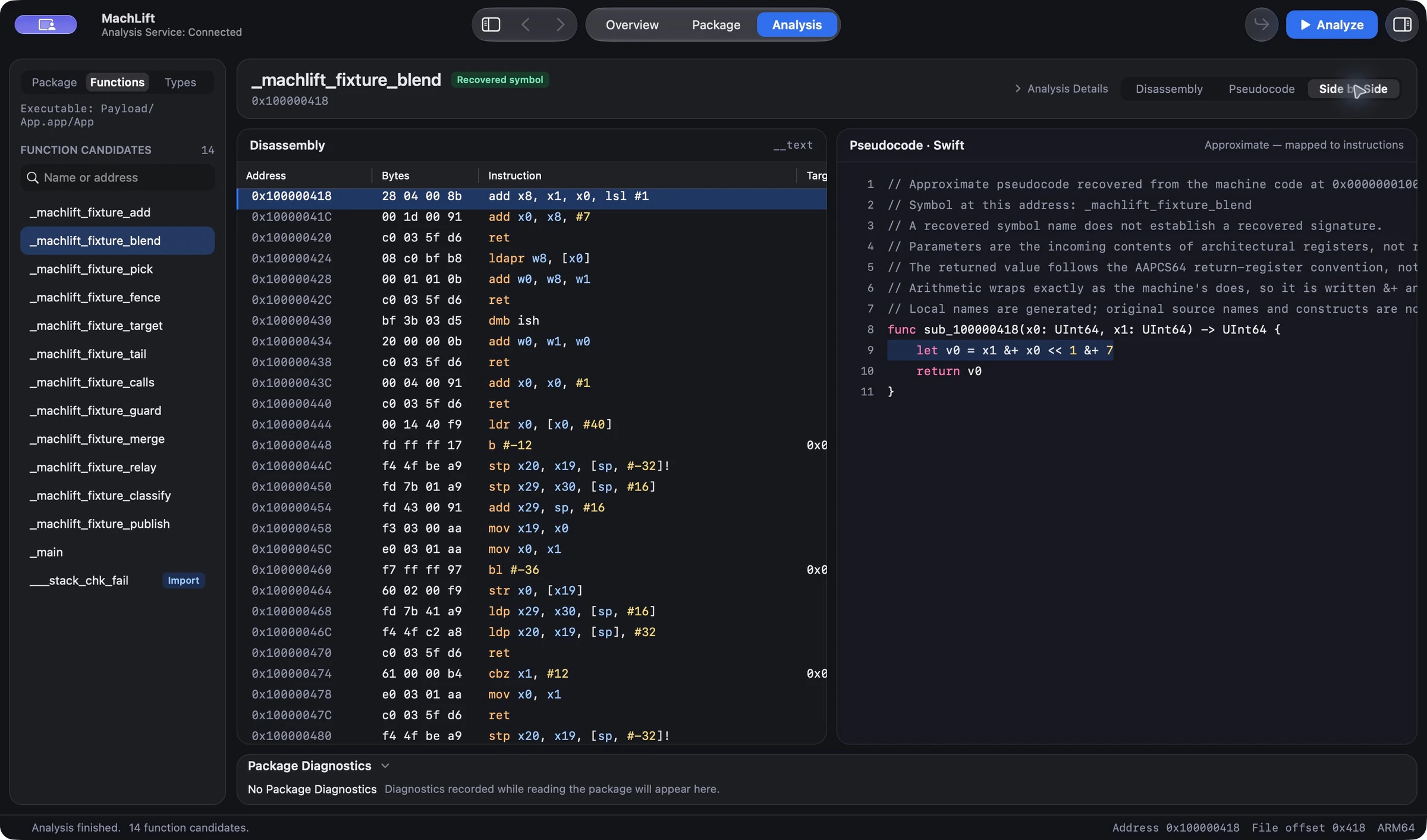
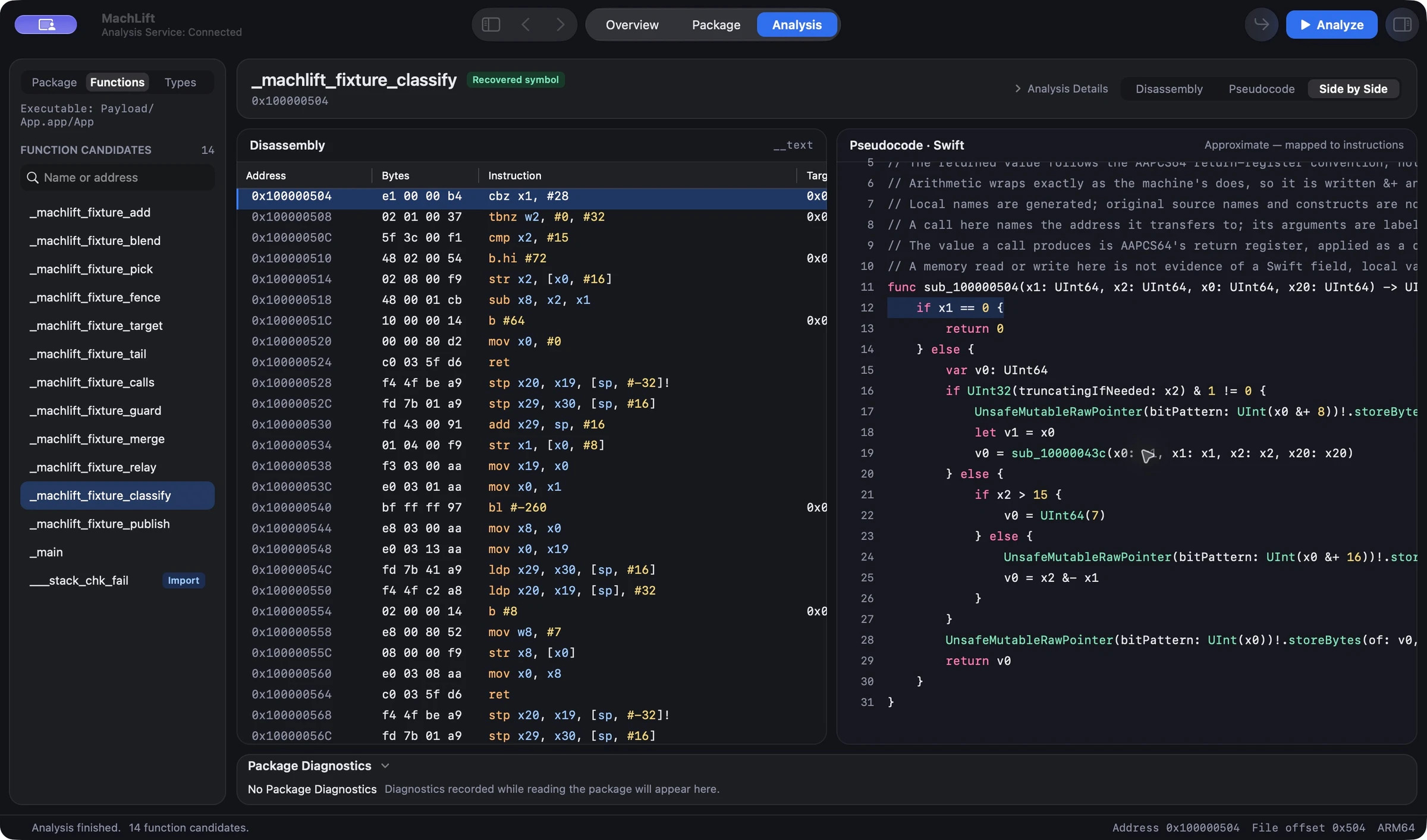
MachLift is a native macOS reverse-engineering application designed to analyze authorized .ipa, .app, and Mach-O binaries and reconstruct analysis-friendly approximate Swift.
The objective is not to recover the exact original source code. MachLift aims to recover useful structures such as classes, structs, protocols, functions, methods, calls, control flow, framework semantics, and eventually approximate SwiftUI view hierarchies.
Every inferred result is intended to retain its evidence, confidence level, and connection to the original binary. Unknown or ambiguous semantics remain visible instead of being invented to produce prettier output.
MachLift detects encrypted executable content but does not bypass FairPlay, DRM, or other access protections.
How we built it
MachLift uses a native AppKit-first interface written in Swift and a C++20 analysis engine. The application and analysis engine are designed to run in separate processes through XPC, preventing malformed inputs or engine failures from terminating the user interface.
The analysis pipeline is designed around several stages:
- Safe IPA and Mach-O container inspection.
- Swift symbols and ABI metadata recovery.
- ARM64 and ARM64e disassembly.
- Function, cross-reference, and control-flow graph discovery.
- Lifting native instructions into a custom low-level SSA representation called MachIR.
- Recovering Swift concepts through a semantic representation called SwiftIR.
- Producing evidence-backed pseudo-Swift and pseudo-SwiftUI.
The current implementation includes the reproducible C++20 build foundation, deterministic CLI output, structured error handling, strongly typed address spaces, sanitizer configurations, and automated tests. The native macOS application interface is currently being developed.
Challenges
Compiled Swift is highly optimized and loses much of the information found in the original project. Local variable names, comments, formatting, and some type information cannot be recovered exactly.
Other major challenges include understanding changing Swift ABI metadata, distinguishing different address spaces safely, reconstructing optimized ARM64 control flow, recognizing protocol and witness-table dispatch, and recovering SwiftUI result-builder patterns.
The project therefore prioritizes soundness over completeness: uncertain information must remain uncertain.
What we learned
A useful decompiler cannot be built as a single translation pass from assembly to source code. It requires several independently testable representations and a clear separation between proven binary facts and higher-level semantic inference.
We also learned that validation infrastructure must exist before introducing heuristics. MachLift uses deterministic outputs, controlled fixtures, sanitizer builds, and explicit regression tests as part of its foundation.
What's next
The next steps are to complete the native AppKit workspace, introduce the isolated XPC analysis service, create controlled Swift validation fixtures, and implement the first vertical slice from an authorized IPA to a safe binary inventory.
Later milestones will add Swift metadata exploration, ARM64 disassembly, control-flow graphs, MachIR, SwiftIR, pseudo-Swift, and SwiftUI semantic recovery.

Log in or sign up for Devpost to join the conversation.