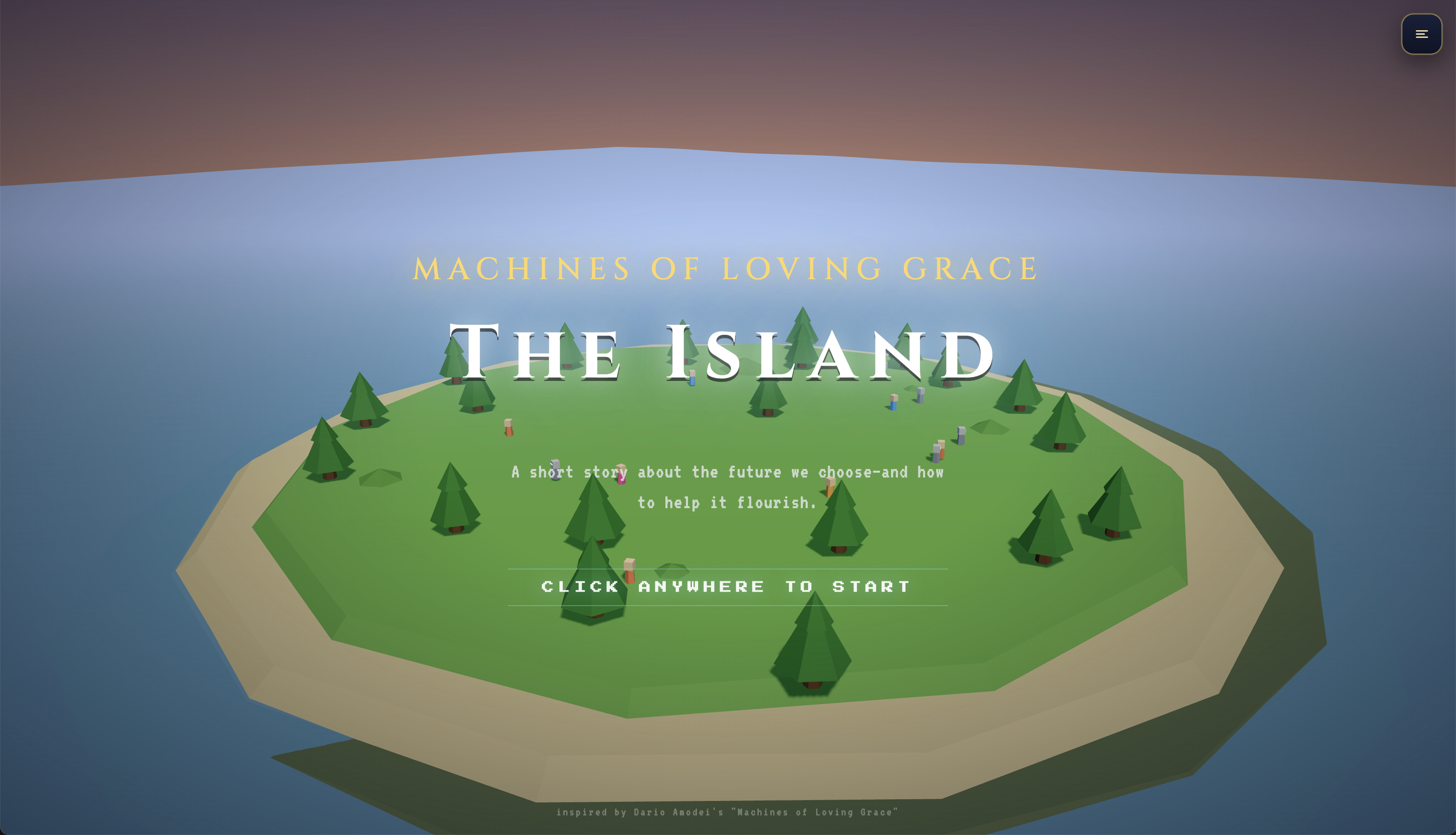
Machines of Loving Grace: The Island 🏝️
💡 Inspiration
"Storytelling is our superpower. Sapiens conquered the world because we can tell stories that inspire people to cooperate in very large numbers." — Yuval Noah Harari
Inspired by Dario Amodei’s vision of a future where technology expands human potential, we realized that "Social Impact" often fails because it's treated as an abstract statistic. We wanted to move from data to narrative.
We built The Island to turn the "alignment problem" into a felt experience. Our inspiration was the intersection of governance and collective futures: the idea that optimizing for one domain (like efficiency) often creates silent distortions in others (like creativity or trust).
🕹️ What it does
The Island is an interactive simulation that explores the emergent stories of our collective future.
- The Mechanic: Each round, players are given 2 "Credits of Intent" to allocate across five pillars: Learn, Heal, Govern, Create, and Connect.
- The System: Your choices accumulate in a persistent state-machine. The system evolves based on these tradeoffs—forcing players to decide what they are willing to sacrifice.
- The Story: There is no "win" condition. Instead, the game concludes with an emergent narrative ending based on your unique balance, ranging from flourishing coordination to fractured or over-optimized dystopias.
🛠️ How we built it
- The Engine: A browser-based simulation built with JavaScript utilizing a modular game-state architecture. Each societal zone is a complex system with parameters that respond dynamically to player inputs.
- Visual Layer: We implemented lightweight 3D/scene rendering where the environment physically transforms. Buildings and zones evolve in real-time, providing immediate visual feedback for investment levels.
- Logic Loop: A central game loop tracks rounds and state transitions, while a narrative layer interprets the mathematical system states into descriptive, story-driven scenarios.
⚖️ Ethical Alignment & Social Impact
The Island addresses Governance & Collaboration and Creative Flourishing by making the ethical "costs" of progress visible:
- Centering Human Dignity: The game enforces hard tradeoffs. By limiting credits, it mirrors real-world governance, forcing players to grapple with the ethics of neglecting "softer" domains like Connection and Creativity in favor of raw growth.
- Expanding Access: By simplifying complex societal systems into a playable story, we make high-level conversations about AI ethics and resource allocation accessible to anyone, not just policy experts.
- Impact Potential: Storytelling inspires cooperation. This project serves as a "moral mirror," helping players visualize the consequences of different value systems before they are implemented in reality.
🚀 Challenges we ran into
- Interpretability vs. Emergence: It was a challenge to make the system feel "alive" and unpredictable while ensuring the player could still trace their decisions to the outcomes.
- Tuning the Progression: We spent significant time calibrating the credit system. With only 2 credits per round, we had to ensure that the "weight" of what was not chosen felt as impactful as what was.
- Optimization: Keeping performance stable while dynamically updating visual elements and state-driven transitions required careful handling of the rendering loop.
🎉 Accomplishments that we're proud of
- Visualizing Priorities: We’re proud that the simulation produces visibly different worlds from simple inputs. You can see a society’s priorities reflected in its landscape.
- Mechanical Harmony: The alignment between the mechanics (limited credits) and the theme (societal tradeoffs) creates a cohesive experience where the game's difficulty is the message.
🧠 What we learned
We learned that carefully structured constraints create the richest stories. Multi-dimensional systems—like society itself—resist simplification. We discovered that "societal health" cannot be reduced to a single metric; it is the balance between the five domains that creates a world worth living in.
🗺️ What's next for The Island
- Memory Effects: Introducing long-term "legacy" variables where early-game decisions fundamentally reshape the rules of the late-game.
- Agent-Based Responses: Developing autonomous populations that respond to the player’s governance patterns with their own qualitative feedback.
- Narrative Branching: Expanding the final story generation to include even more granular outcomes based on the specific sequence of allocations.


Log in or sign up for Devpost to join the conversation.