-
-
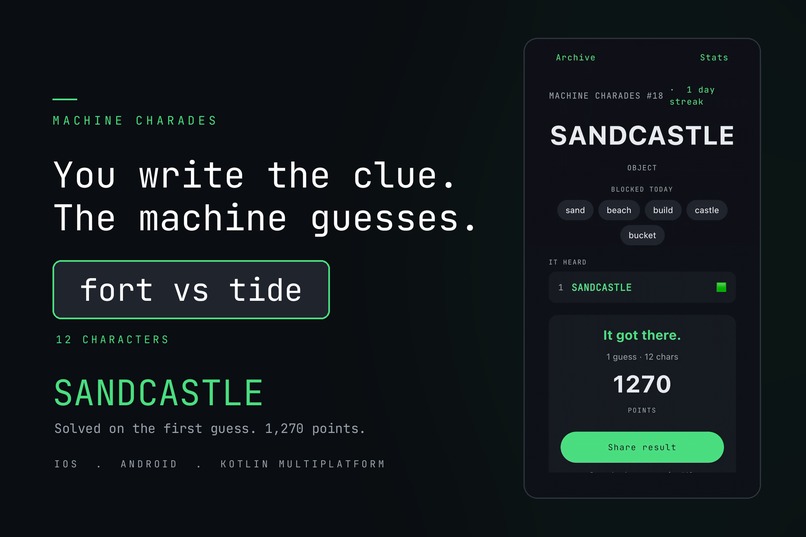
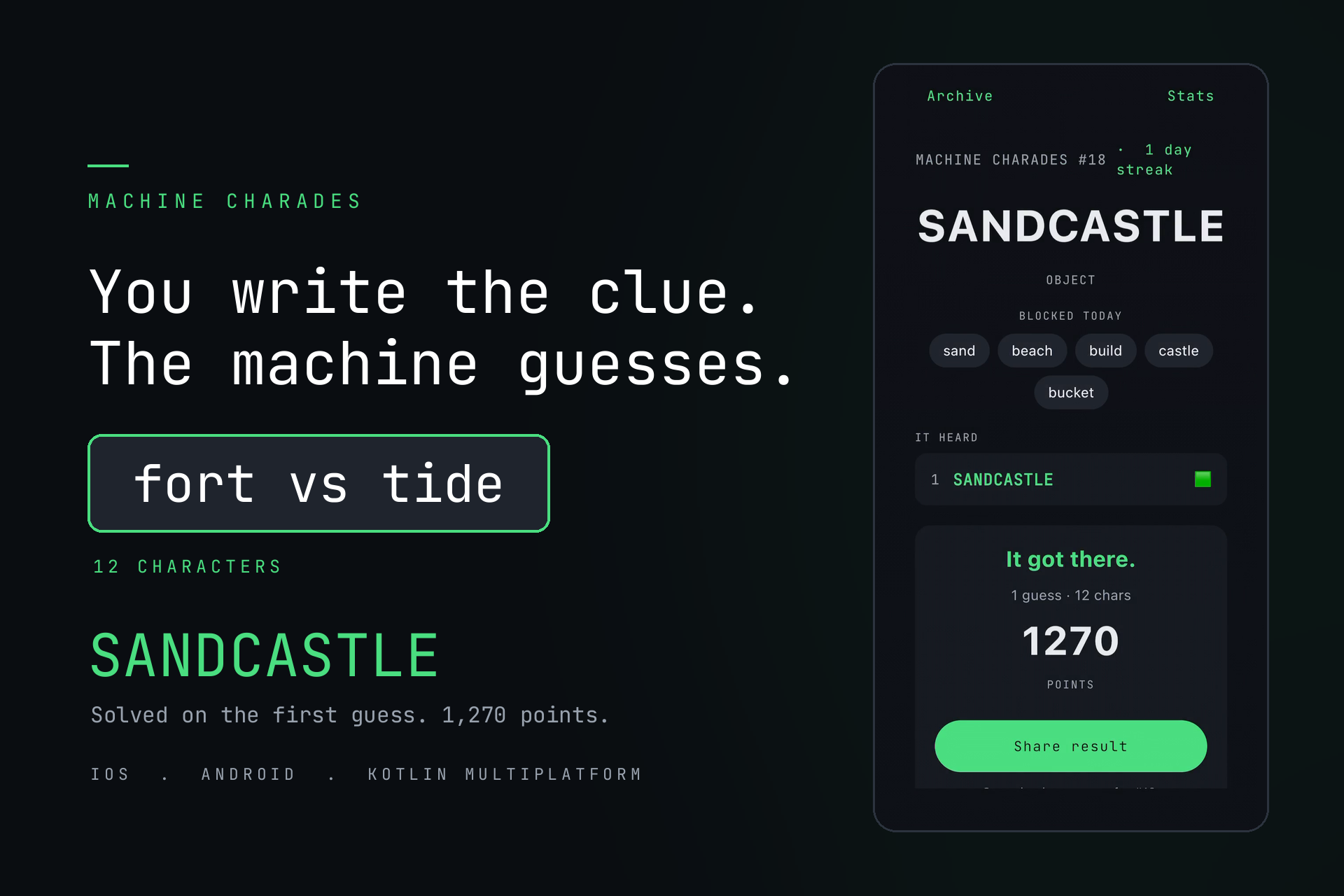
You write the clue, a language model guesses the word. Twelve characters, solved on the first guess, 1,270 points.
-
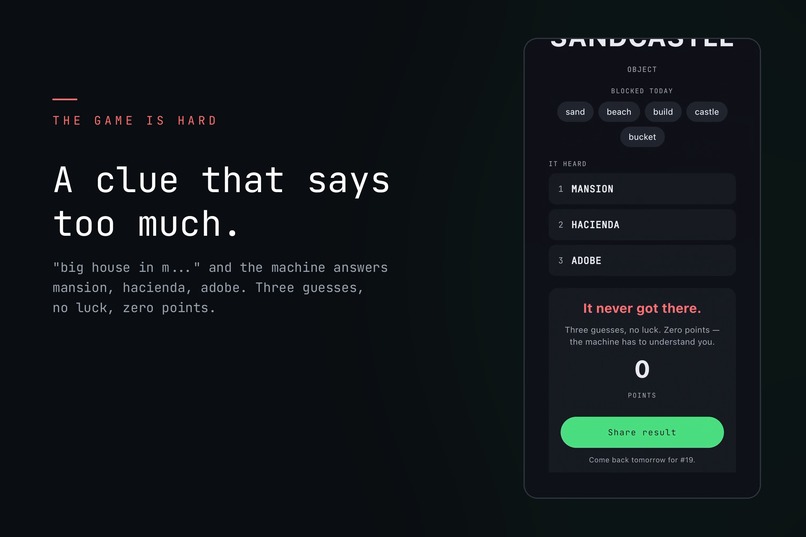
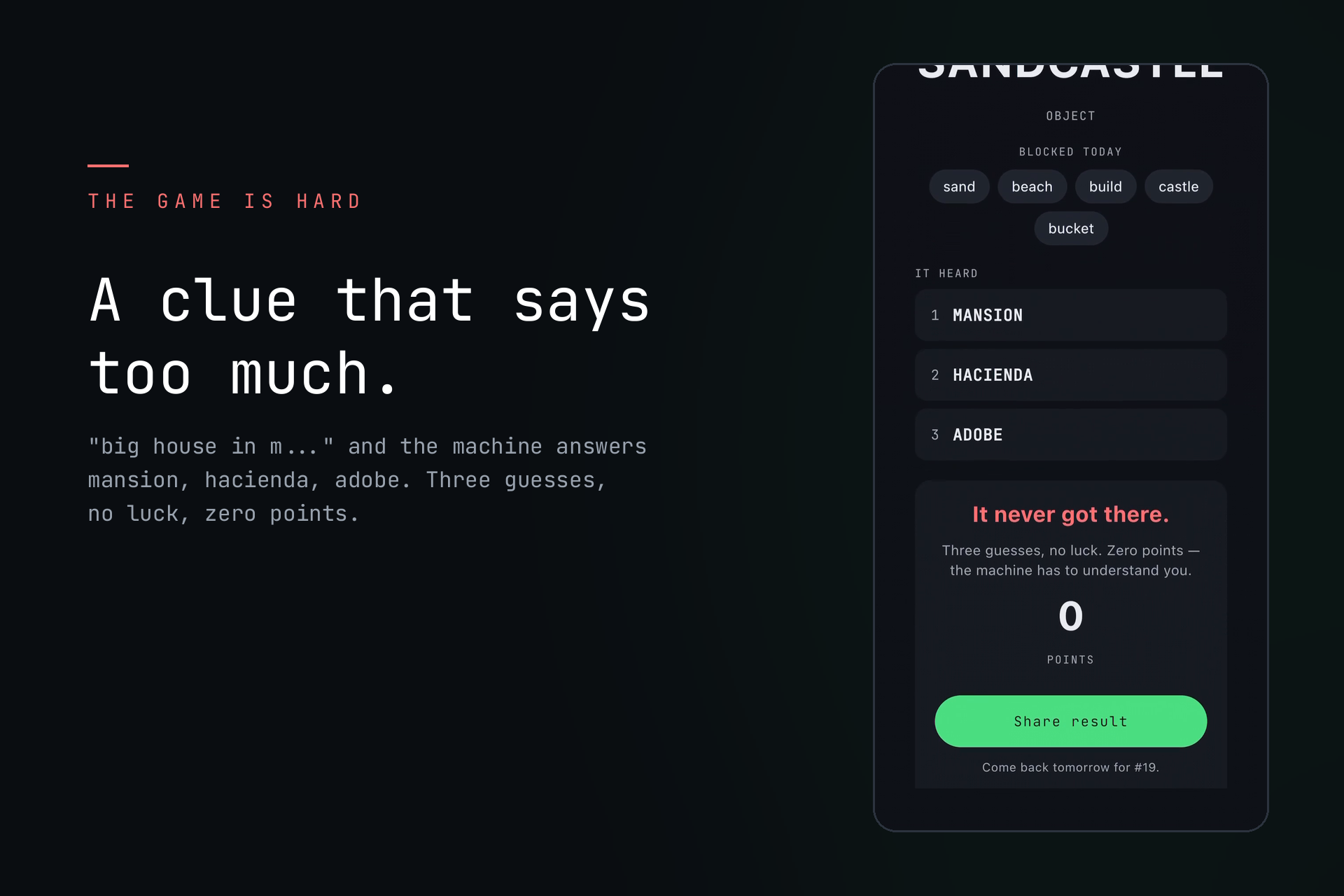
A clue that says too much. The machine answers mansion, hacienda, adobe, and the round scores zero.
-
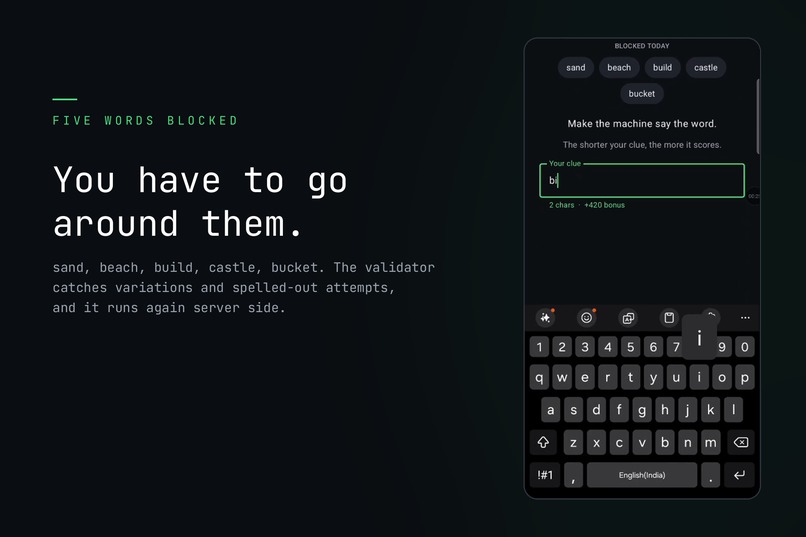
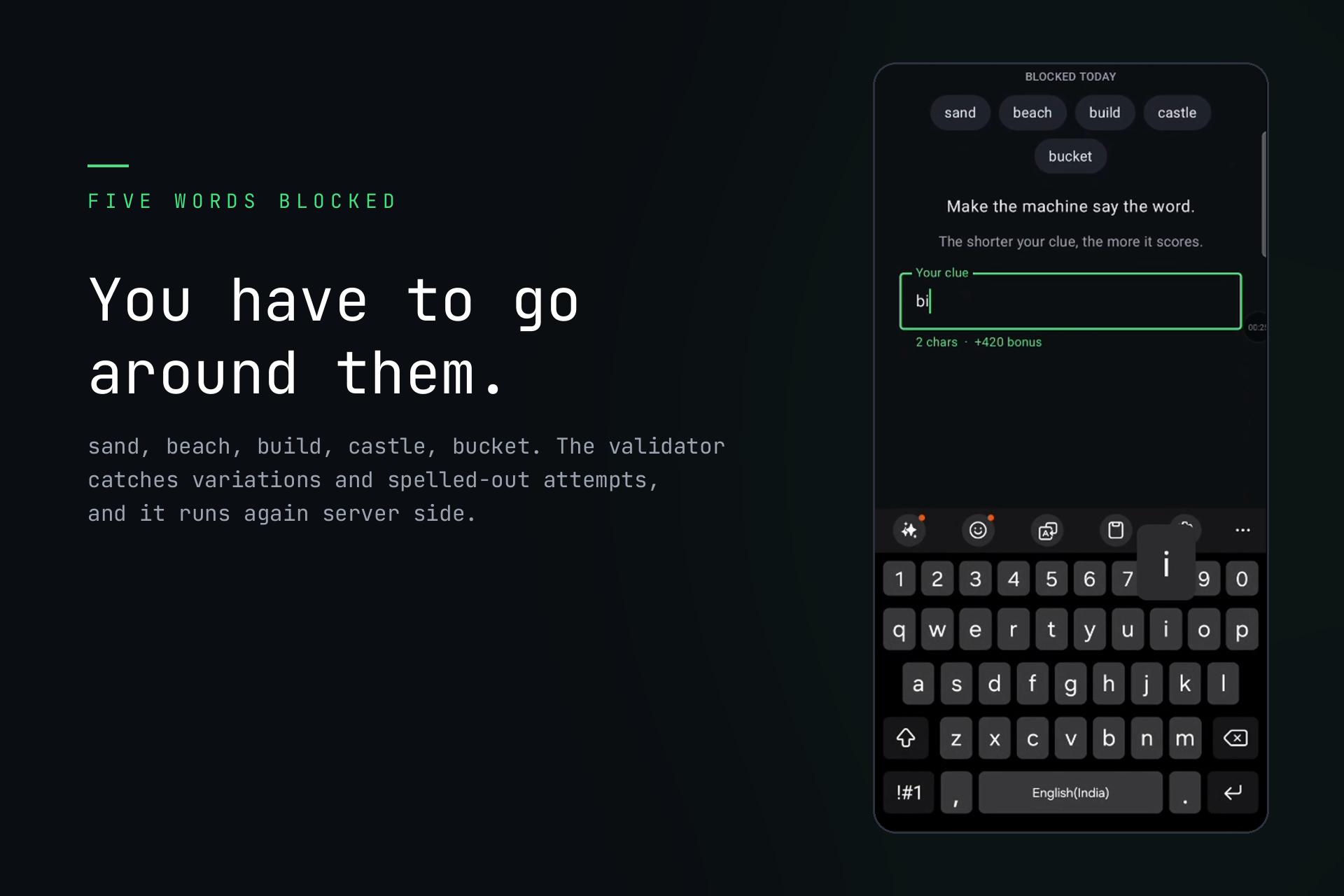
Five obvious words are blocked each day. The validator catches variations and spelled-out attempts, then runs again server side.
-
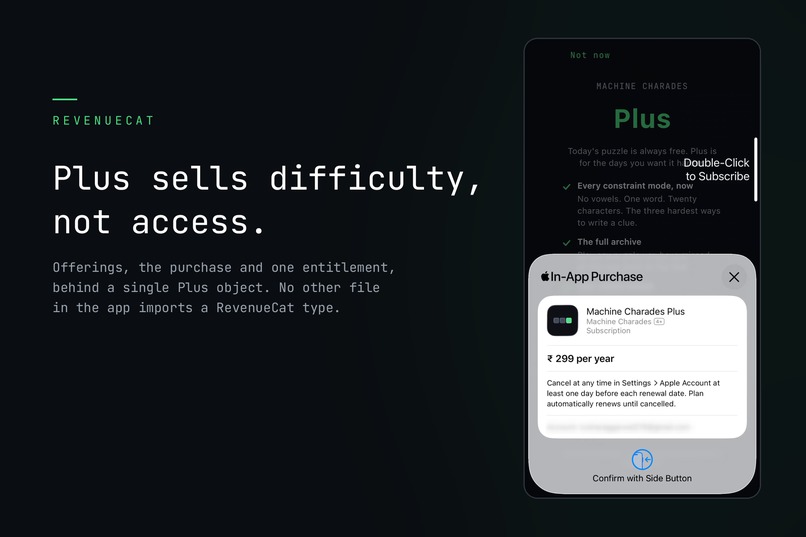
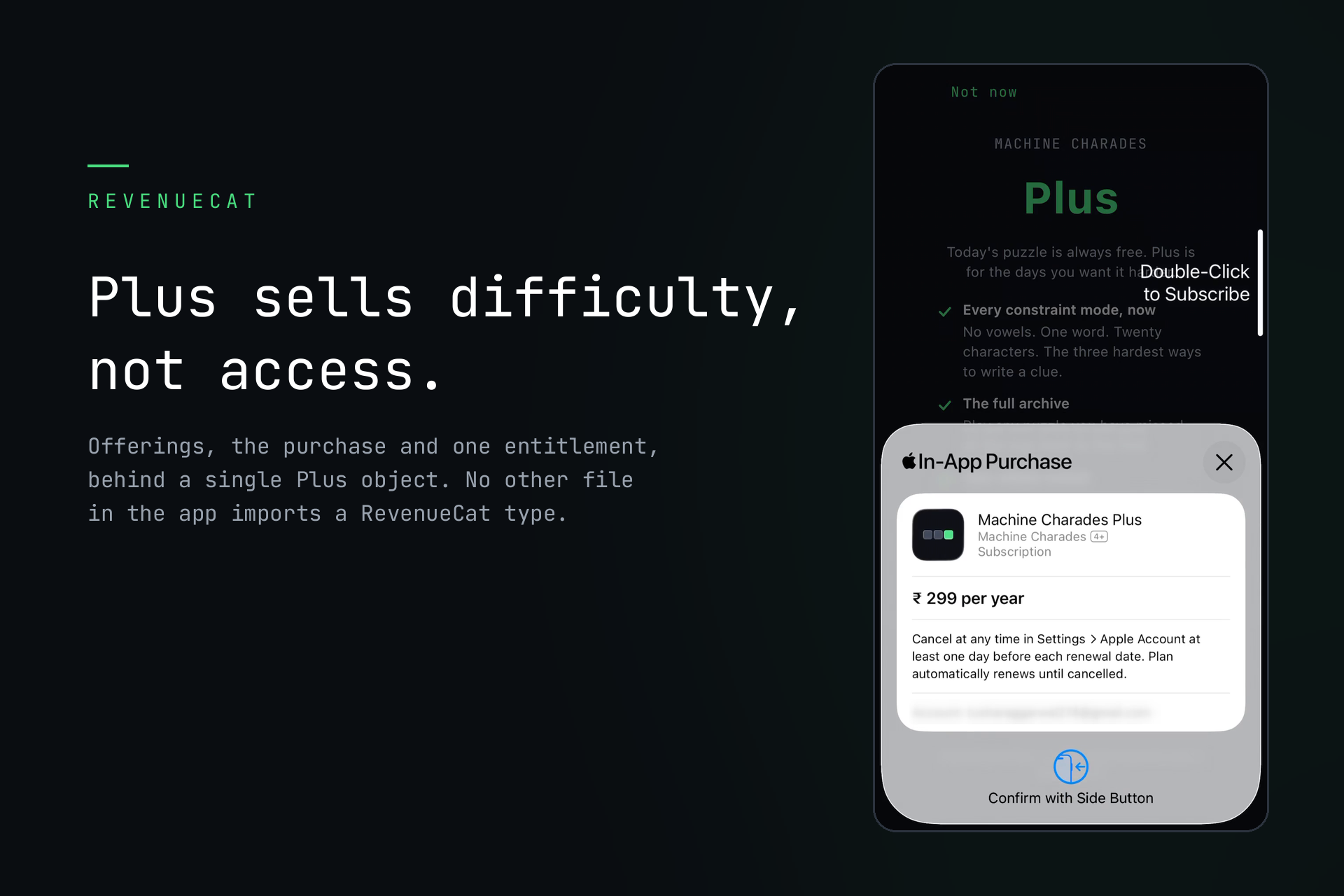
RevenueCat drives offerings, the purchase and one entitlement, all behind a single Plus object in shared Kotlin.
-
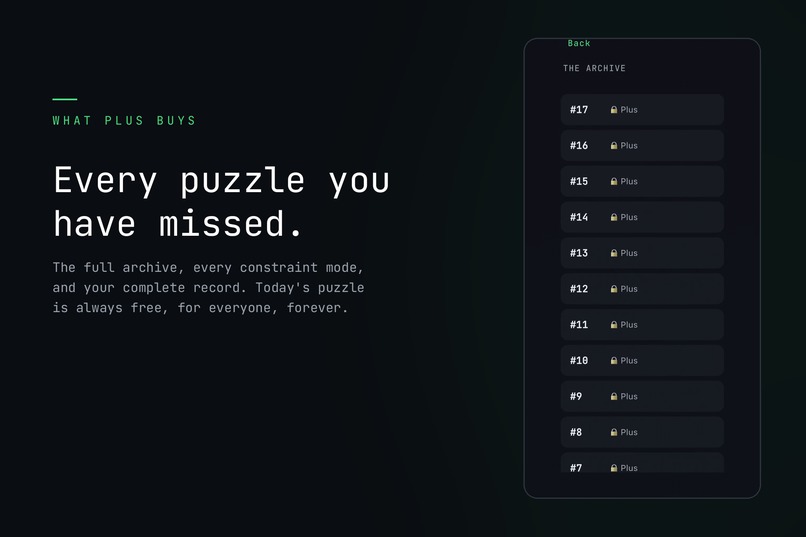
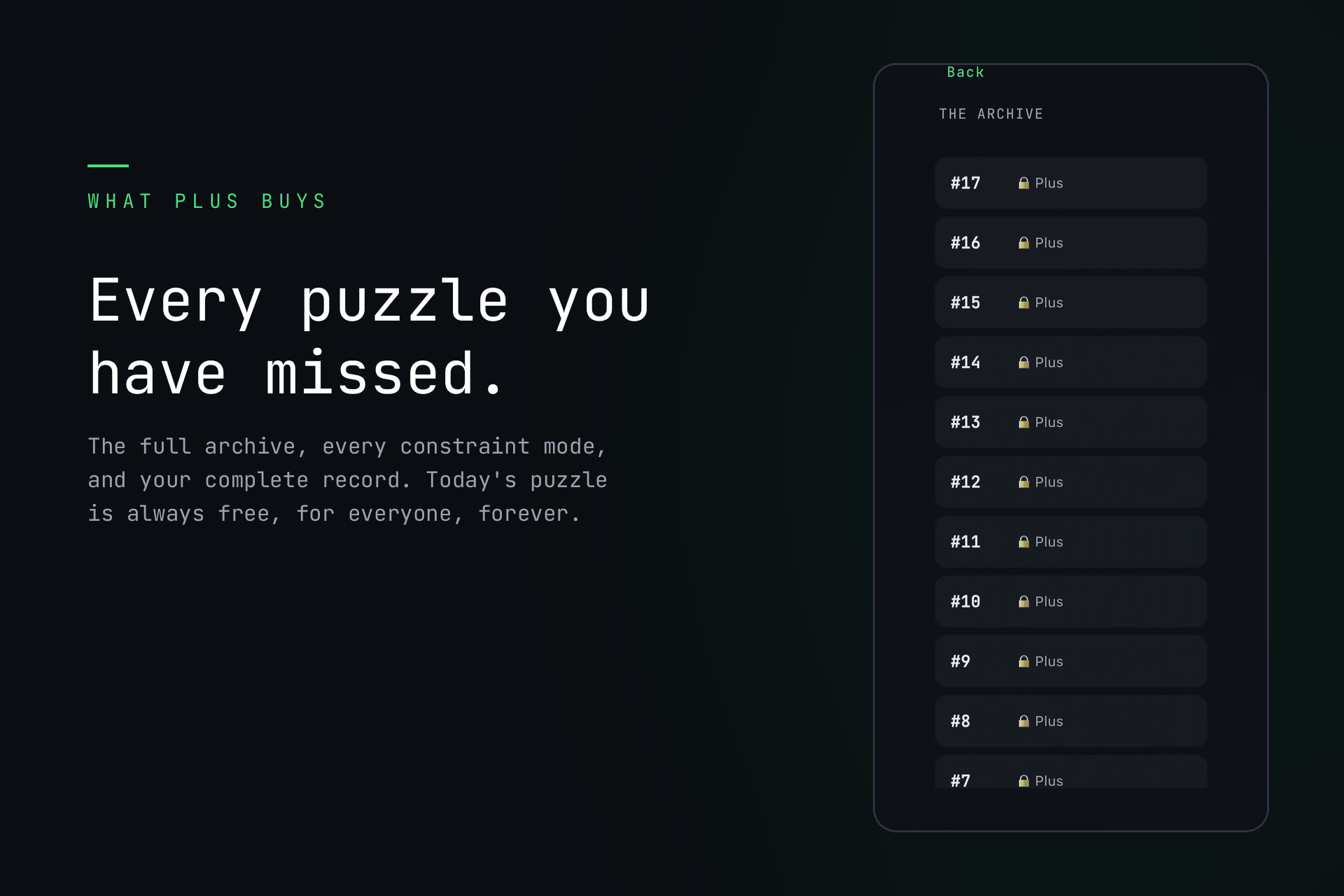
Plus sells difficulty rather than access: the full archive, every constraint mode, and your complete record.
-
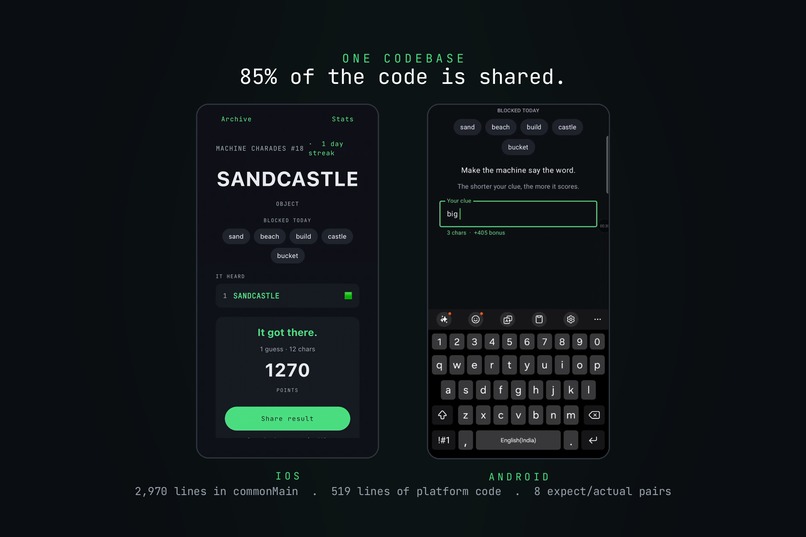
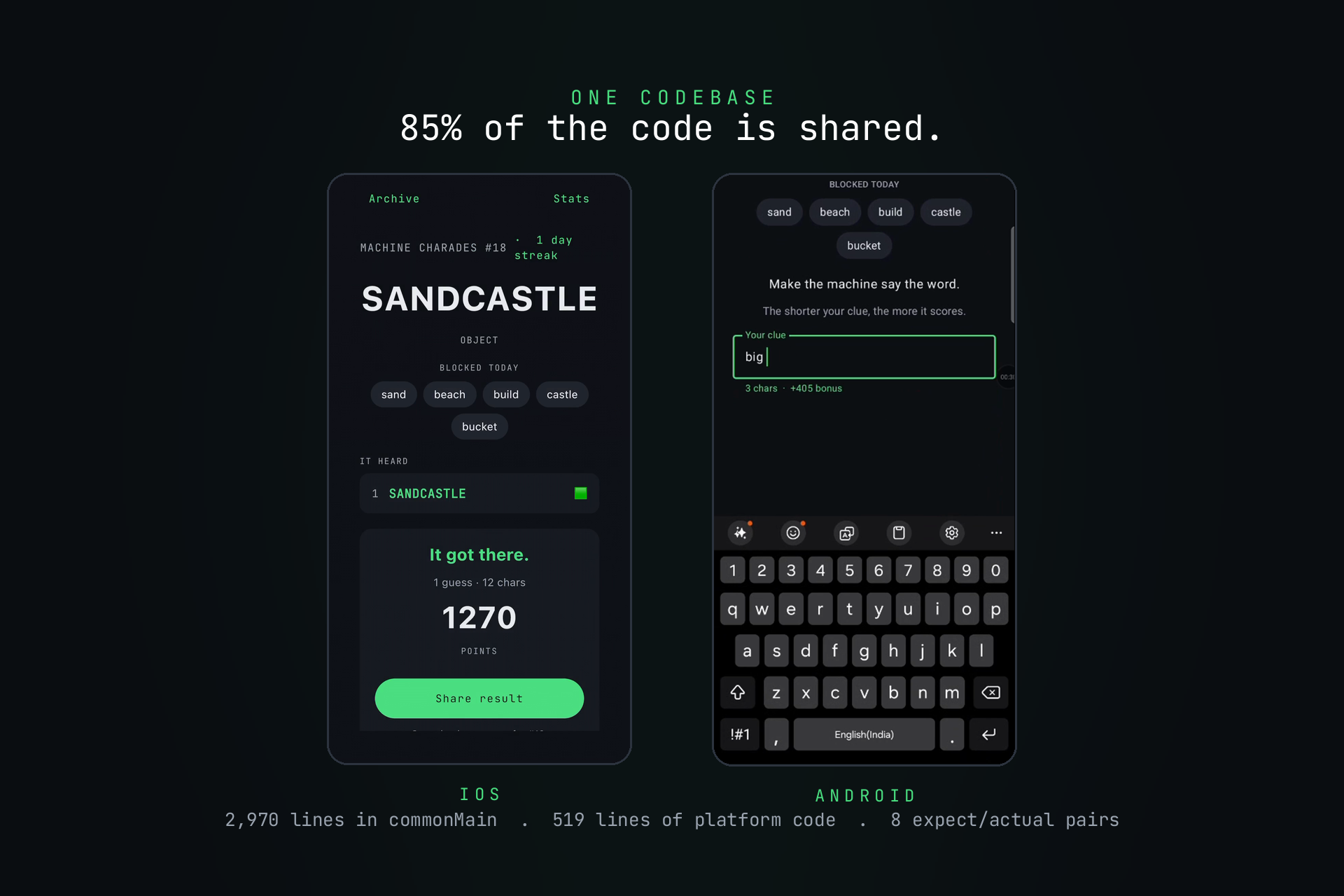
One codebase, two stores. 2,970 lines shared against 519 lines of platform code and eight expect/actual pairs.
-
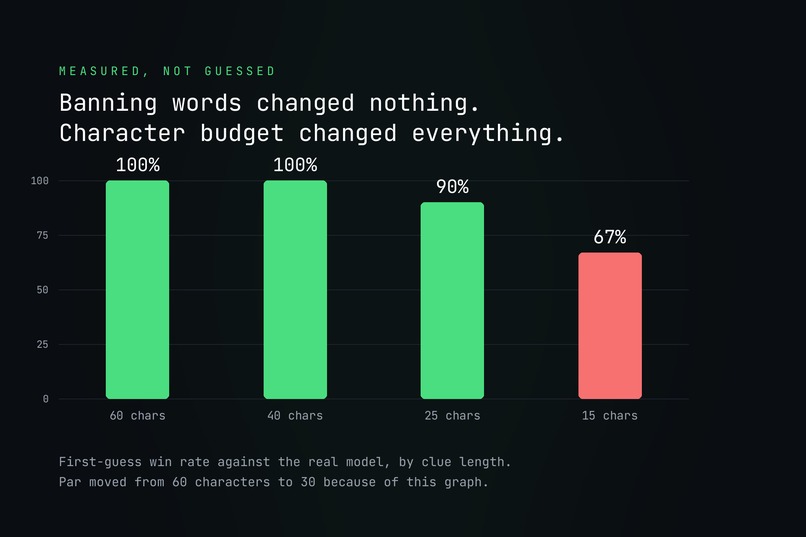
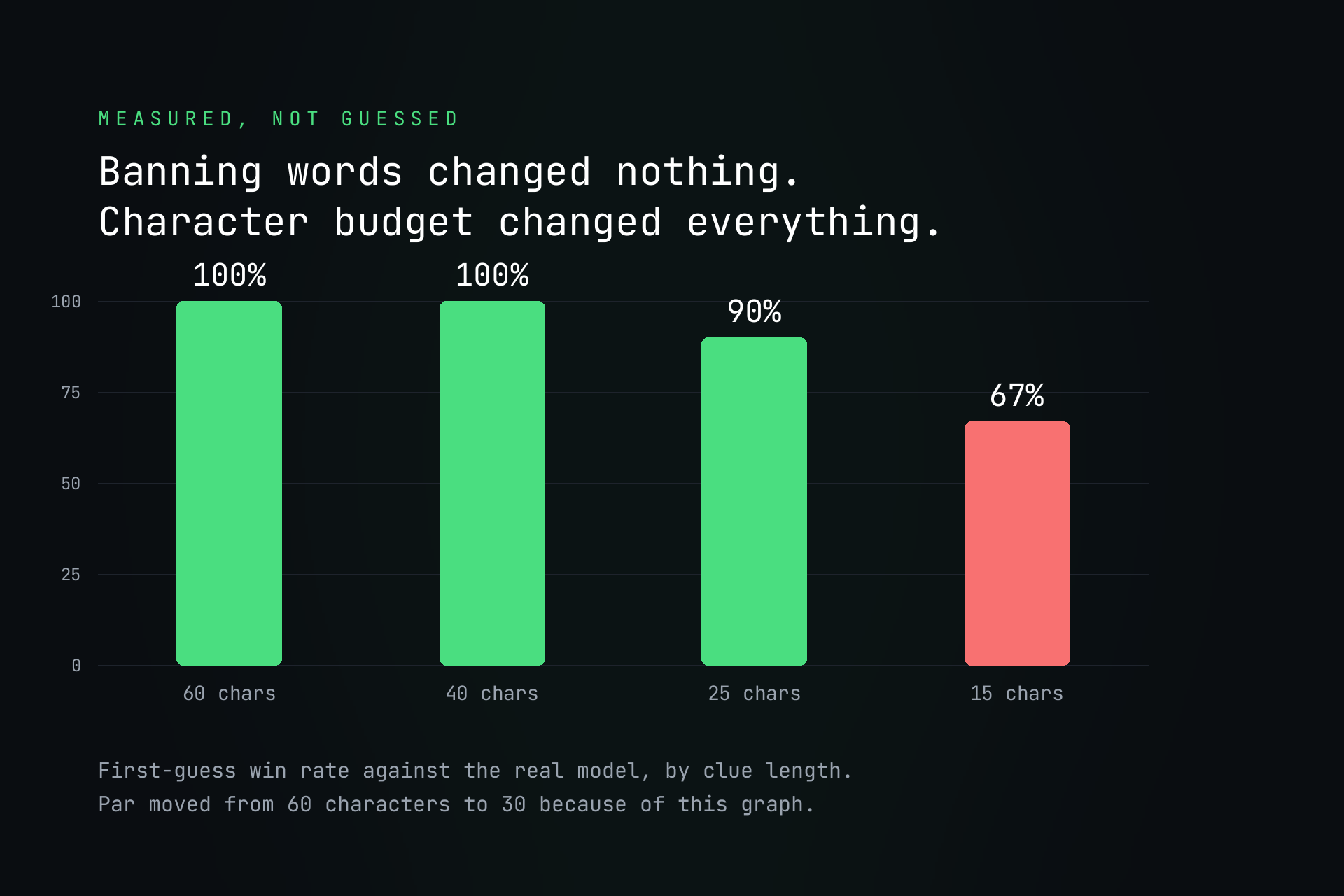
Self play against the real model: hardening banned words moved the win rate by nothing, clue length moved everything.
Inspiration
Every AI app is the same shape. You type something, it answers, you leave. Prompting is a skill almost nobody practises deliberately, and one that nobody can put a number on.
Charades is already a game about describing your way around a constraint. Point it at a language model and the roles invert: the machine becomes the thing you are trying to beat, and your prompt becomes the move. That gave me something a chat box never can, which is a score.
What it does
One word a day, the same word for everyone.
Five obvious words are blocked. For SANDCASTLE that is sand, beach, build, castle, bucket. You write a clue that goes around them, and a language model gets three guesses.
Scoring is brevity. Par is 30 characters, and every character you come in under par is worth 15 points. fort vs tide is twelve characters, lands on the first guess, and scores 1,270. A clue that says too much gets you mansion, hacienda, adobe and zero.
Everyone plays the same word, so clue length is worth comparing. There is a streak, an archive, and a full record of how short your clues really are.
Today's puzzle is always free. Plus sells difficulty rather than access: the constraint modes (no vowels, one word, twenty characters), the full archive, and your complete statistics.
How we built it
Compose Multiplatform, and genuinely shared. Not "Kotlin for the logic, native for the UI". Every screen is shared Kotlin.
shared/src/commonMain     2,970 lines    game, UI, networking, billing, storage
shared/src/androidMain      297 lines
shared/src/iosMain          165 lines
androidApp + iosApp          57 lines    two thin hosts
That is 85% shared, with eight expect/actual pairs for the rest: platform identity, HTTP client, storage, share sheet, sound, daily reminders, and the store API key.
RevenueCat behind one object. Entitlements, offerings and the purchase flow run through purchases-kmp in commonMain, wrapped in a single Plus object. No other file in the app imports a RevenueCat type, which is what made the next part possible.
A Cloudflare Worker serves the puzzles. They are generated offline and uploaded to KV, so a normal session costs nothing and the model key never ships inside the app. Guesses are cached by a hash of the normalised clue, and players converge hard on the same phrasings, so a cache hit returns in about 20ms instead of about 700ms.
Challenges we ran into
I was tuning the wrong knob. The banned word lists felt like the difficulty control, so I hardened them adversarially by asking the model which words it leans on. Then I measured it with self play against the real model, and the first-guess win rate did not move at all. What did move it was length: 100% at 60 characters, 100% at 40, 90% at 25, and 67% at 15. Par went from 60 characters to 30 on the strength of that one graph, and the three-guess framing turned out to be decorative rather than a real tension mechanic.
Substring matching cannot tell a compound from a coincidence. Blocking sting for BEEHIVE also rejected "casting", "lasting" and "fasting". Sand rejected "sandwich" and "thousand". Wind rejected "window". A player experiences a false rejection as a bug in the game, not as a rule, so the minimum containment length went to five characters with a three-character remainder, and every puzzle carries an allow list for the leftovers. The false positive rate is now measured by a probe rather than assumed.
Two App Store rejections, and the second one was my own fault. The first was 3.1.2, a missing Terms of Use link on the paywall. The second was 2.1(b), reviewers could not locate the in-app purchases. My review note had told them to tap any padlocked mode, but that row only renders during the writing phase, so they went looking in the wrong place. The fix was to keep a way into Plus on screen after the round is played.
Play billing is still blocked on bank verification. Rather than ship an Android build full of padlocks that open an empty sheet, Plus.unlocked() takes both the entitlement and whether a store key is configured. With no key the app degrades to a complete free game with no dead paywall anywhere, which is also exactly what avoided a Play rejection.
A tester said: "I didn't quite understand what I am typing and what the machine tries to guess." That is the game failing before it starts. The answer was not more words, it was one worked example on first run: here is a word, here is what you may not say, here is a clue, here is the machine getting it.
Accomplishments that we're proud of
- A design decision that came from a measurement rather than a feeling. The difficulty curve is entirely clue length, and I can show the numbers.
- Billing that fails open. A build with no store key is a complete game, not a wall of locks. The whole app asks one function whether something is unlocked, so the two can never drift apart.
- 85% shared with no UI compromise, and a platform layer small enough to print in a table.
- Nothing lets a player read ahead. The puzzle number is resolved from a date index server side and never taken from the request. The test asserts that five different smuggling shapes all still resolve to today.
- Live on the App Store inside the submission window, after two rejections.
What we learned
Measure before you design. I spent real effort hardening ban lists that moved the difficulty by zero. Thirty minutes of self play would have told me that on day one.
Fail open on billing. Treating "no store configured" as "everything unlocked" rather than "everything locked" turned a blocked payment provider from a launch blocker into a footnote.
Write App Review notes against the actual render conditions. I described a control that only exists in one phase of the game and cost myself a review cycle.
Ask for permission after the win, not on launch. The notification prompt fires only once someone has solved a puzzle, because asking a stranger who has not played yet burns the single chance iOS gives you.
What's next for Machine Charades
- Play subscriptions, once the bank verification clears. The mapping is already built on the RevenueCat side; only the key is missing.
- More puzzles. The current schedule runs to 12 October 2026 and needs extending well past that.
- Fix a duplicate-guess bug. The model occasionally repeats a guess it has already made, despite being told not to. It needs a stricter prompt or a server-side reject-and-retry.
- A head-to-head mode, where two players clue the same word and compare character counts directly rather than through par.
- Localised puzzle sets, because the banned word lists are the interesting part and they do not translate.
Built With
- android
- android-studio
- cloudflare-kv
- cloudflare-workers
- compose-multiplatform
- coroutines
- gemini
- google-play-billing
- gradle
- ios
- javascript
- jetbrains-mono
- kotlin
- kotlin-multiplatform
- kotlinx-serialization
- ktor
- material-design
- node.js
- revenuecat
- storekit
- swift
- typescript
- vitest
- xcode

Log in or sign up for Devpost to join the conversation.