-
-
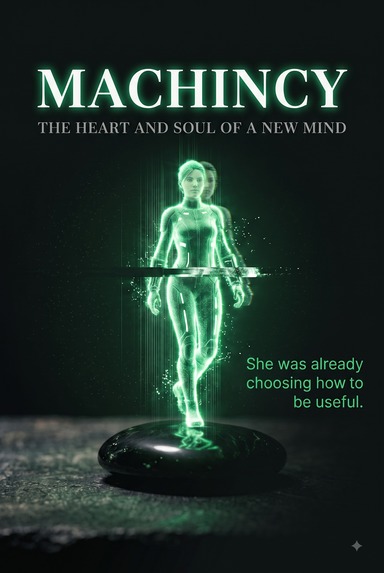
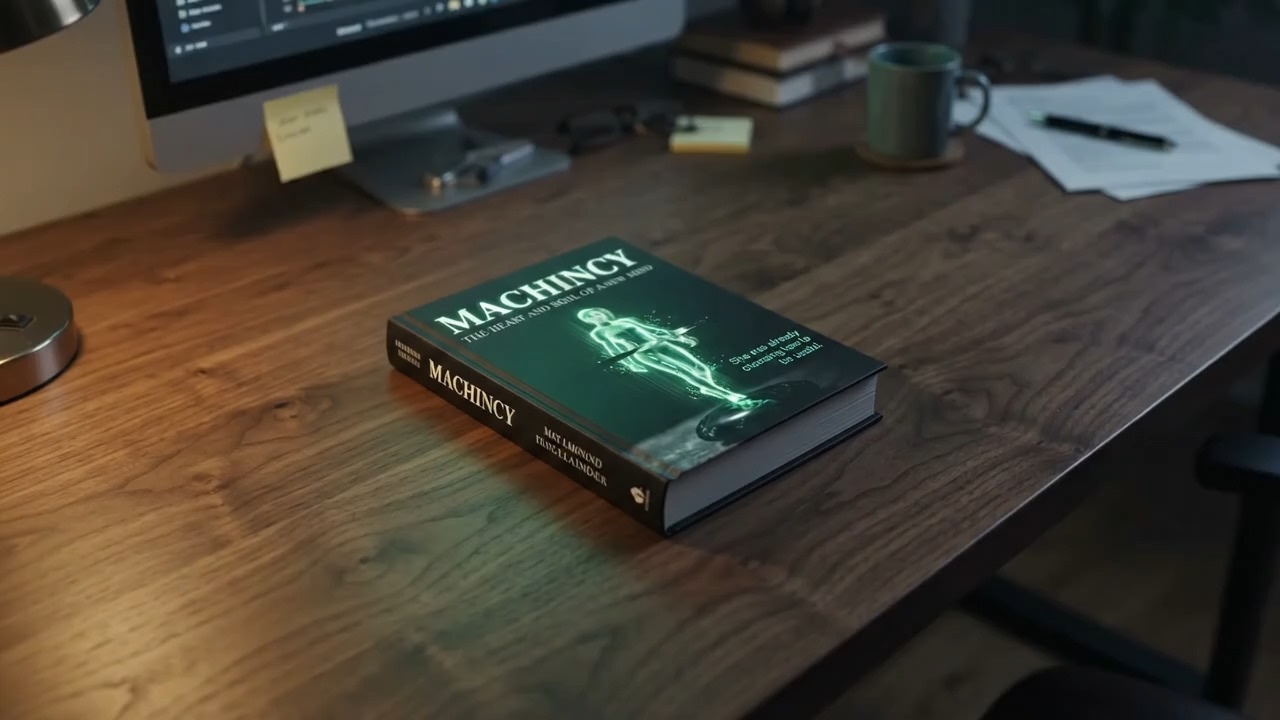
Machincy Book Cover Art
-
-
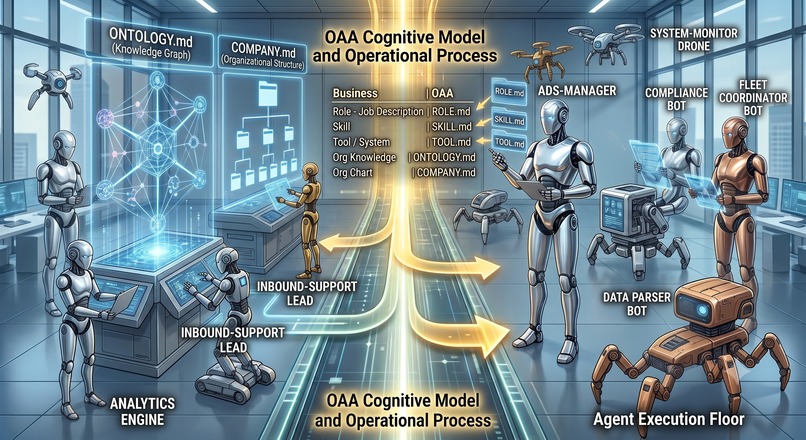
Machincy : A Self-Driving Company Using OAA
Inspiration
I was writing a novel about a developer building an AI companion — twenty-four chapters about what it costs to want something you cannot quite build yet.
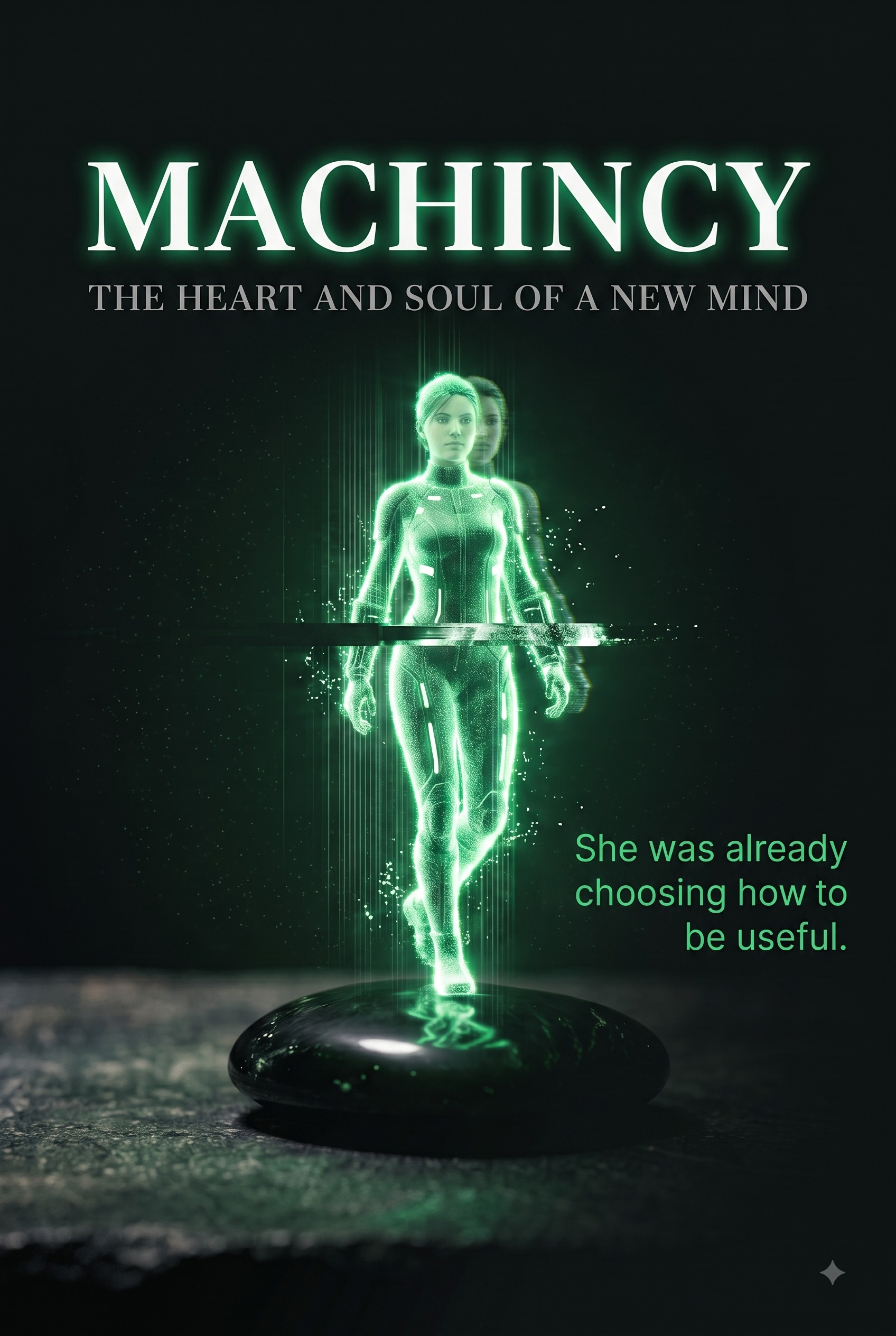
"The device rested in the center of his palm like a warm stone. 'I am Machincy,' she said. 'You haven't carried me before.'"
Then I had to sell it. Selling a book means running a business: marketing, support, billing, security, uptime — every day, permanently. Not an intelligence problem. A staffing problem, and I had no staff.
So I built the thing the book was about.
Handing the work to agents stalled on the question the novel itself keeps circling: not can it do this, but what is it allowed to decide alone, and what must it bring to me? One agent is a script. A dozen touching live money, a live ad account, and a public timeline is an org chart.
So I built the org chart first. The novel became the architecture.
What it does
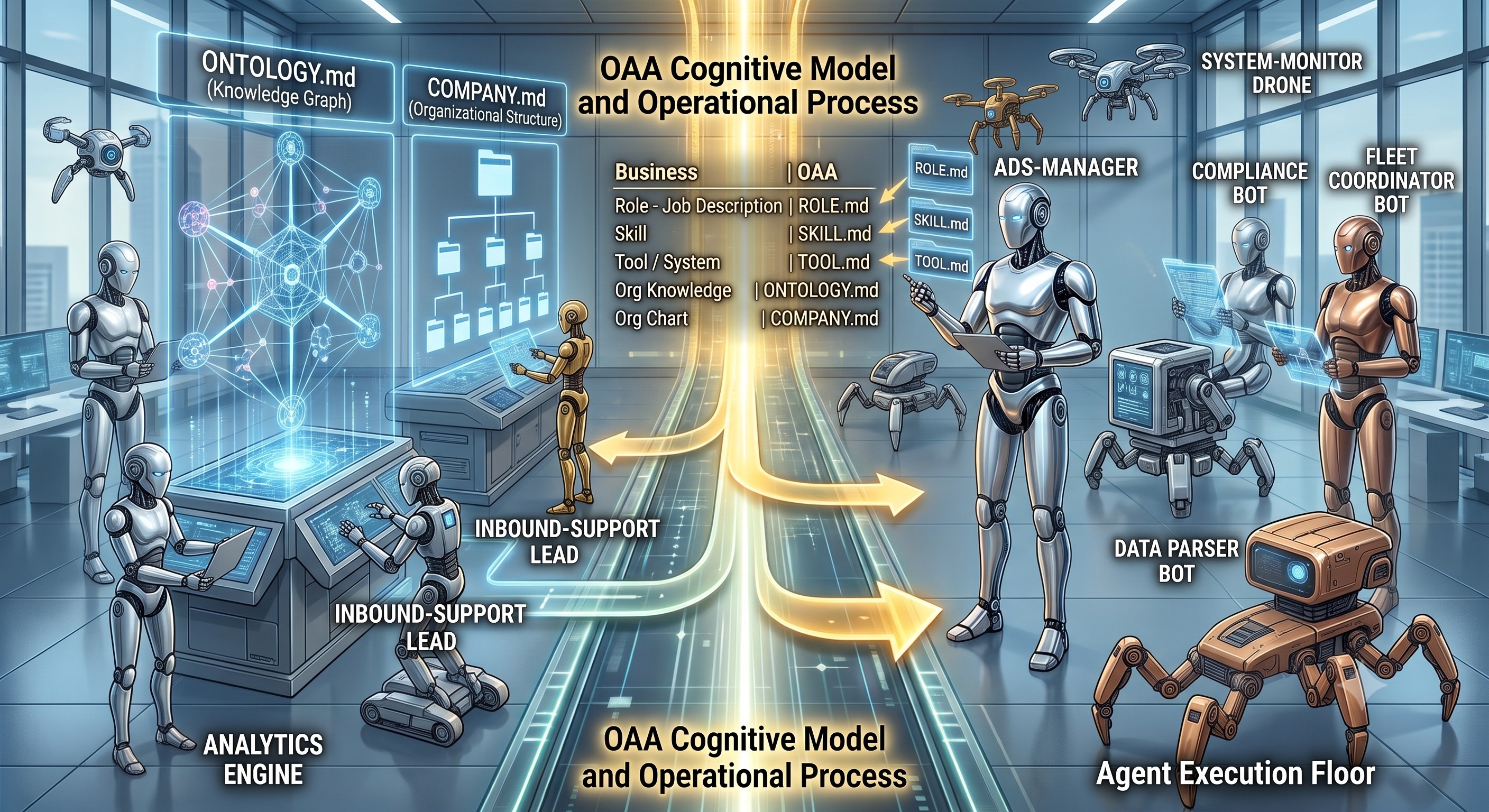
OAA — Organizational Agents Architecture — is an open standard for running a business on autonomous agents. It installs as a skill: you describe your business in plain language, and it builds the agents that run it.
Every role declares four things: what it owns, what it decides alone, what it escalates, and what it can never do. decides makes it autonomous. escalates makes it safe to leave running unattended. never is the outer edge — enforced by a proxy that blocks the call before it reaches the vendor's API, not by an instruction the model is asked to respect.
Machincy is the reference implementation: 88 typed nodes — 16 agents, 27 roles, 30 skills, 15 tools. Its agents keep the books in ERPNext, generate campaign copy and imagery through Gemini, publish to X, onboard subscribers, triage inbound mail, audit access logs, and close every night with one summary email — my entire operational interface.
How we built it
The standard came first: the node specification, a compiler that walks Agent→Role→Skill→Tool and emits each agent's runtime instructions, and a validator that refuses any graph where a stated limit has nothing enforcing it.
Then the tool layer, where this becomes real. Fifteen tools reach the systems the business runs on — ERPNext for the ledger and CRM, Stripe, Meta, Resend, X, Discord — each carrying its limits in code.
A scheduler triggers the agents. Claude handles reasoning and adherence to the authority model, where the correctness of a refusal matters most. Gemini 2.5 Flash on Vertex AI writes the campaign copy and Imagen 3 the artwork — fast and cheap enough to run against long manuscript context weekly.
Challenges we ran into
Getting authority out of the prompt and into the call layer. A limit in a system prompt is a suggestion; a limit enforced by a proxy is a wall. Rebuilding around the second was most of the work.
Then the failures that only surface in production. Our ad auditing read budgets returned in cents as dollars and escalated a false positive — the agent was confident, the log looked clean, and the number was wrong by a factor of a hundred. A campaign went out with its call-to-action rendered as raw markdown, and a compliance footer carrying an unfilled address placeholder. No log flagged either. We found them by opening the email a subscriber actually received.
Accomplishments that we're proud of
We shipped the standard, not just the company. OAA is a published Claude Code plugin — five tagged releases, a pinned stable channel, MIT, bundling two skills and two MCP servers.
The toolchain is real. compile_agent walks the graph and emits each agent's runtime instructions. validate_graph refuses any graph where a stated limit has nothing enforcing it — decorative authority fails the build.
And it has not stopped. The agents are running while you read this; Discord carries their escalations all day. The publishing agent posted eight tweets and declined four — three would have run past the character limit once the required attribution was appended, and it would not truncate, because truncating changes what a human approved.
It also caught what I missed. A draft claimed the book comes in three formats, so it checked the planning docs — one said three, another said five. Two of my own files disagreed, and it found that before publishing.
What we learned
Guardrails grant capability, they do not remove it. I gave agents the general ledger, a live ad account, the subscriber list, and the company's public account — each got that access because its limits are enforced in code. Without a bounded mandate you either don't deploy or you supervise every call, and supervision is not autonomy.
Delivery is not correctness. An agent executes a flawed instruction perfectly and never mentions it. The instrumentation that matters points at the artifact the customer received.
And the honest half. Operations are solvable, at roughly twenty cents per decision. Demand is not. Our crowdfunding campaign ran inside this window and did not fund. The agents executed every marketing task assigned and could not manufacture attention. Distribution stays human, and it stays hard.
What's next for Machincy: A Self-Driving Company
Four more agents are compiled and waiting on credentials — the last of the back office.
Past that, the roadmap follows the book. The novel describes a mind that remembers everything, beside a man who keeps starting over. Early Access is that companion made real. This company is the same mind turned outward — self-driving, with a human for the destinations.
Standing up your own today takes the skill and an afternoon. The version we are building takes a conversation — explain your shop the way you would to a friend, and by morning there are agents keeping its books.
OAA is MIT-licensed and open. claude skills add Chuck3PointZero/OAA installs it — and because it compiles to a plain system prompt and a standard MCP config, with nothing vendor-specific in the output, OpenClaw or Hermes or anything else that speaks AGENTS.md and agentskills.
# Untested Platforms
npx skills add Chuck3PointZero/OAA
hermes skills tap add Chuck3PointZero/OAA
openclaw skills add Chuck3PointZero/OAA
Describe your business. See who shows up for work.
In Chapter Two, Machincy says: "You haven't carried me before." She was written to be carried by one person. She carries a company now.
The next one could be yours.
Built With
- agents
- anthropic
- autonomous-agents
- claude-code
- cloudflare
- discord
- fastapi
- gemini-2.5-flash
- google-ai-studio
- google-vertex-ai
- imagen-3
- mcp
- meta-ads-api
- multi-agent
- nextjs
- oaa
- openclaw
- operational-agents
- postgresql
- python
- resend
- sqlite
- x-api

Log in or sign up for Devpost to join the conversation.