-
-
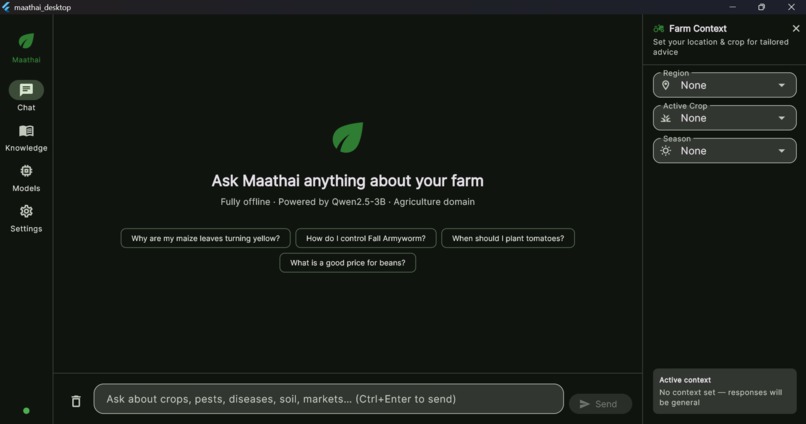
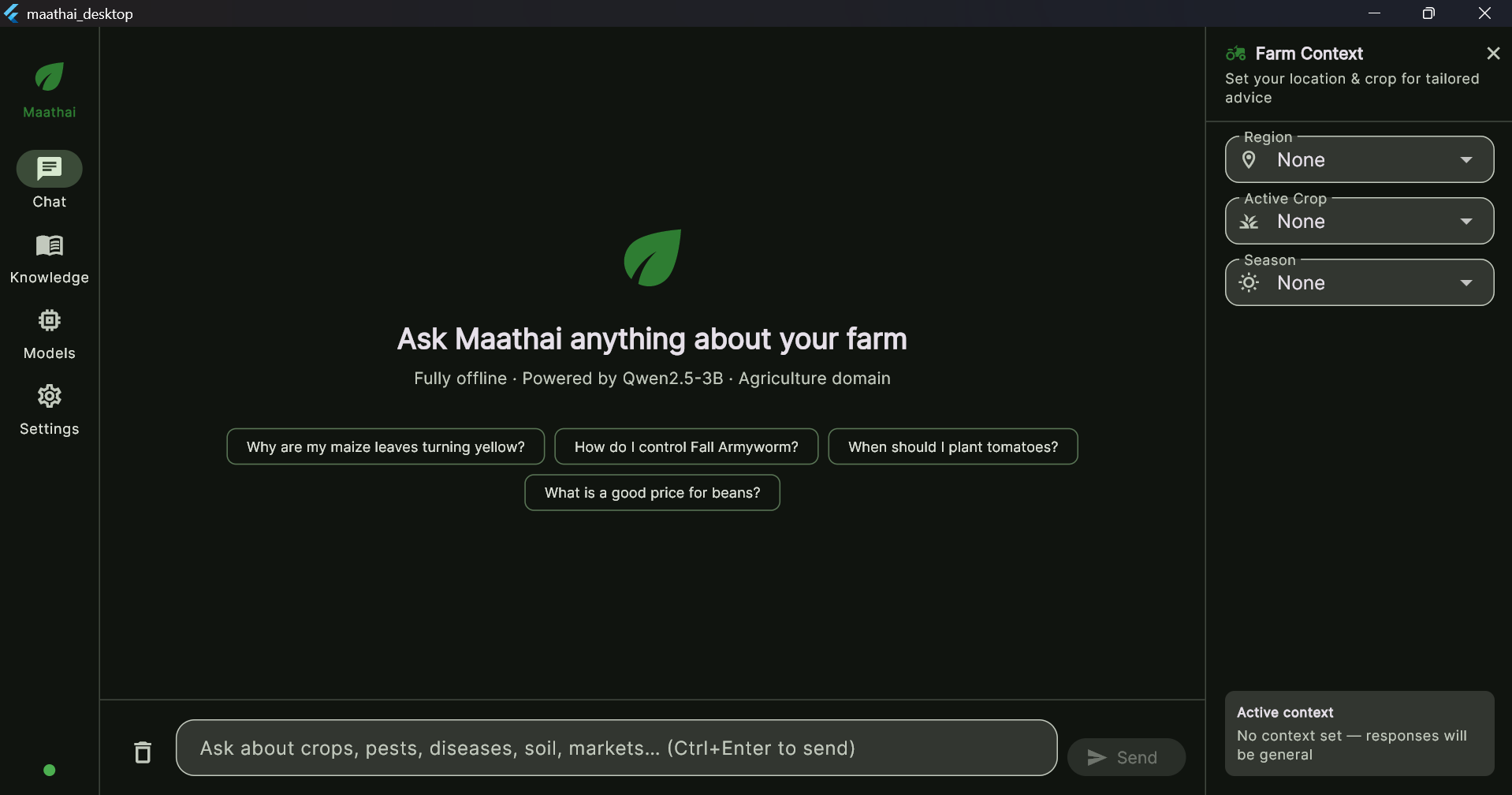
Chat Screen
Inspiration
Wangari Maathai taught that change comes from small, practical acts. For East African smallholders, the act that still fails too often is getting trustworthy advice in time—before yellowing maize becomes a lost season.
We already ship Maathai https://usemaathai.com, an on-device Android advisor powered by llama.cpp. Farmers keep saying the same thing: they may own a secondhand laptop, but cloud AI dies when data, power, or cash run out. ADTC 2026’s brief—build for the 8 GB integrated-GPU laptop Africa already has—was the natural next step: take what works on phones and put a full offline desktop advisor on that machine.
The inspiration is not “more AI.” It is access economics: inference that survives load-shedding, zero API fees, and answers in English and Kiswahili grounded in local varieties, seasons, and dosages.
What it does
Maathai Desktop is a 100% offline agricultural AI for budget laptops (Ubuntu primary, Windows supported):
Crop planting, fertilizer, and soil guidance Pest and disease symptom triage with treatment suggestions Livestock health and feeding basics Offline market / grading reference snippets Farm context (region, crop, season) injected into every prompt Full English ↔ Kiswahili UI and responses Inference runs locally with Qwen2.5-3B-Instruct (GGUF Q4_K_M) via llama-server. A load-bearing RAG layer (pure Dart TF-IDF over a bilingual East African knowledge base) grounds answers in curated agronomy—no cloud, no embedding server, no subscription after install.
How we built it
Reuse production DNA — Ported agriculture prompts, sampler defaults, and Swahili UX from Maathai mobile and kipkirui/Maathai_llama. Flutter desktop shell — Chat, Knowledge browser, Models, and Settings; spawn llama-server and stream SSE completions on localhost. Model under the 7 GB ceiling — Chose 3B Q4_K_M (not 7B) to keep peak RSS ~3.3 GB on ADTC-class hardware. Offline RAG without a second model — In-memory TF-IDF + cosine similarity retrieves bilingual passages in milliseconds; PromptService packs them into a ChatML context budget. Competition packaging — metadata.json, public Hugging Face weights via download_model.sh, REPORT.md, and adtc-profiler runs for Gate 1. Judged telemetry follows:
$$ S_{\mathrm{total}} = 0.50,S_{\mathrm{acc}} + 0.30,S_{\mathrm{perf}} + 0.20,S_{\mathrm{eff}} - P_{\mathrm{thermal}} $$
with efficiency tied to the memory budget:
$$ S_{\mathrm{eff}} = 100 \times \frac{7168 - \mathrm{PeakRSS}_{\mathrm{MB}}}{7168} $$
Challenges we ran into
Accuracy vs footprint — A larger model sounds smarter but tanks $S_{\mathrm{eff}}$ and speed. We bet on 3B + RAG: the model reasons; the corpus grounds local cases (e.g. Nakuru maize, Arusha tomatoes). RAG without embeddings — A second embedding model would burn hundreds of MB we cannot afford. TF-IDF stays fully offline; the cost is careful KB authoring. CPU-only latency — Participant runs showed ~8 tokens/s and a long cold start. Thread/context caps (n_{\mathrm{threads}}=4, $n_{\mathrm{ctx}}=4096$), warm loads, and BLAS matter as much as model choice. Real bilingual agronomy — UI translation is the easy half; agricultural Kiswahili (varieties, pests, dosages) needs manual review so localization is load-bearing. Eval-machine ops — Judges need Ubuntu 22.04 + llama.cpp only, clean download_model.sh, and *.gguf kept out of git—packaging discipline equals product work.
Accomplishments that we're proud of
A working offline desktop advisor on constrained hardware, not a cloud demo with a local UI. Peak RSS well under 7 GB (~3.3 GB) while keeping a usable 3B instruction model. Load-bearing RAG that turns generic LLM advice into Africa-specific guidance (varieties, rates, notifiable disease cues). English + Kiswahili end-to-end—UI and knowledge passages—for the African language bonus claim. Continuity from a production mobile product and open llama.cpp integration into an ADTC-ready desktop package (github.com/kipkirui/Maathai_Desktop).
What we learned
On budget laptops, systems beat raw parameter count: quantization, context budget, RAG, and UX decide whether advice is usable. Cross-disciplinary depth is the product—agriculture knowledge glued to on-device inference, not a chat wrapper. Prior production work compounds; desktop was an architecture port, not a greenfield prototype. Offline AI for Africa is a constraint design problem—and the constraints are the brief.
What's next for Maathai Desktop
Raise throughput and cut time-to-first-token (server flags, preload, BLAS) for stronger $S_{\mathrm{perf}}$. Expand the KB (soil, markets, planting calendars) and harden Swahili agronomic review. Finish Gate 1 polish: complete benchmark tables in REPORT.md, demo video, and DevPost packaging. Optional domain fine-tuning / LoRA merged back to GGUF if quality gains beat the latency cost. Closer parity with Maathai mobile features (feedback loops, richer farm context) while staying 100% offline on the ADTC standard laptop.


Log in or sign up for Devpost to join the conversation.