-
-
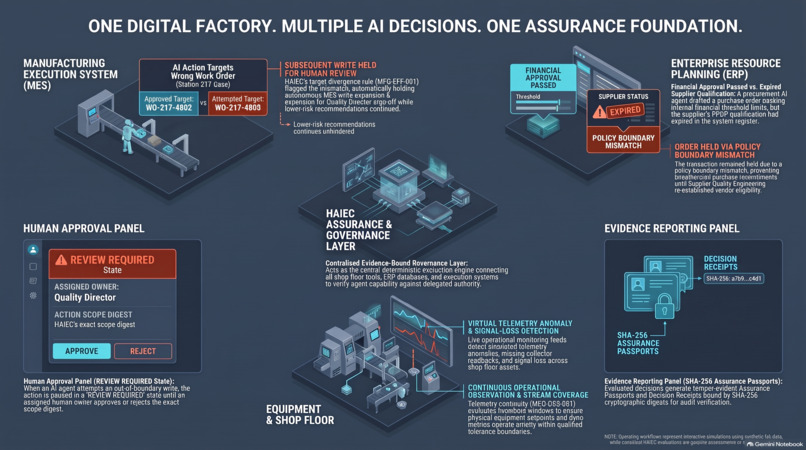
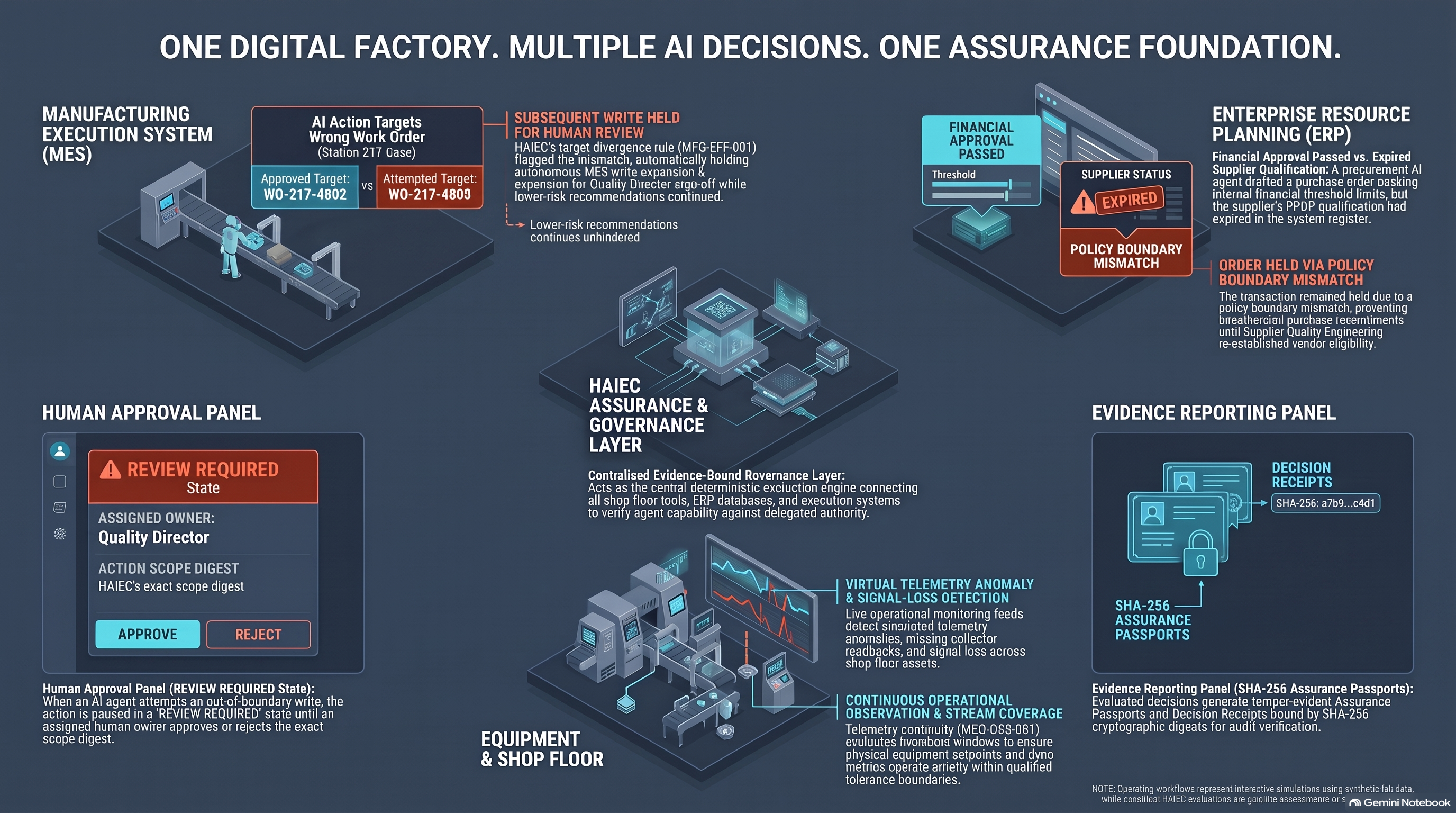
Multi-Decision Factory Governance Across MES, ERP & Equipment
-
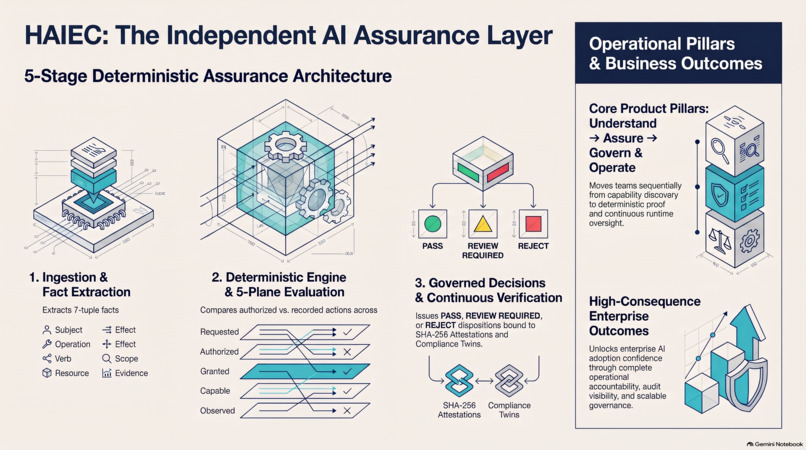
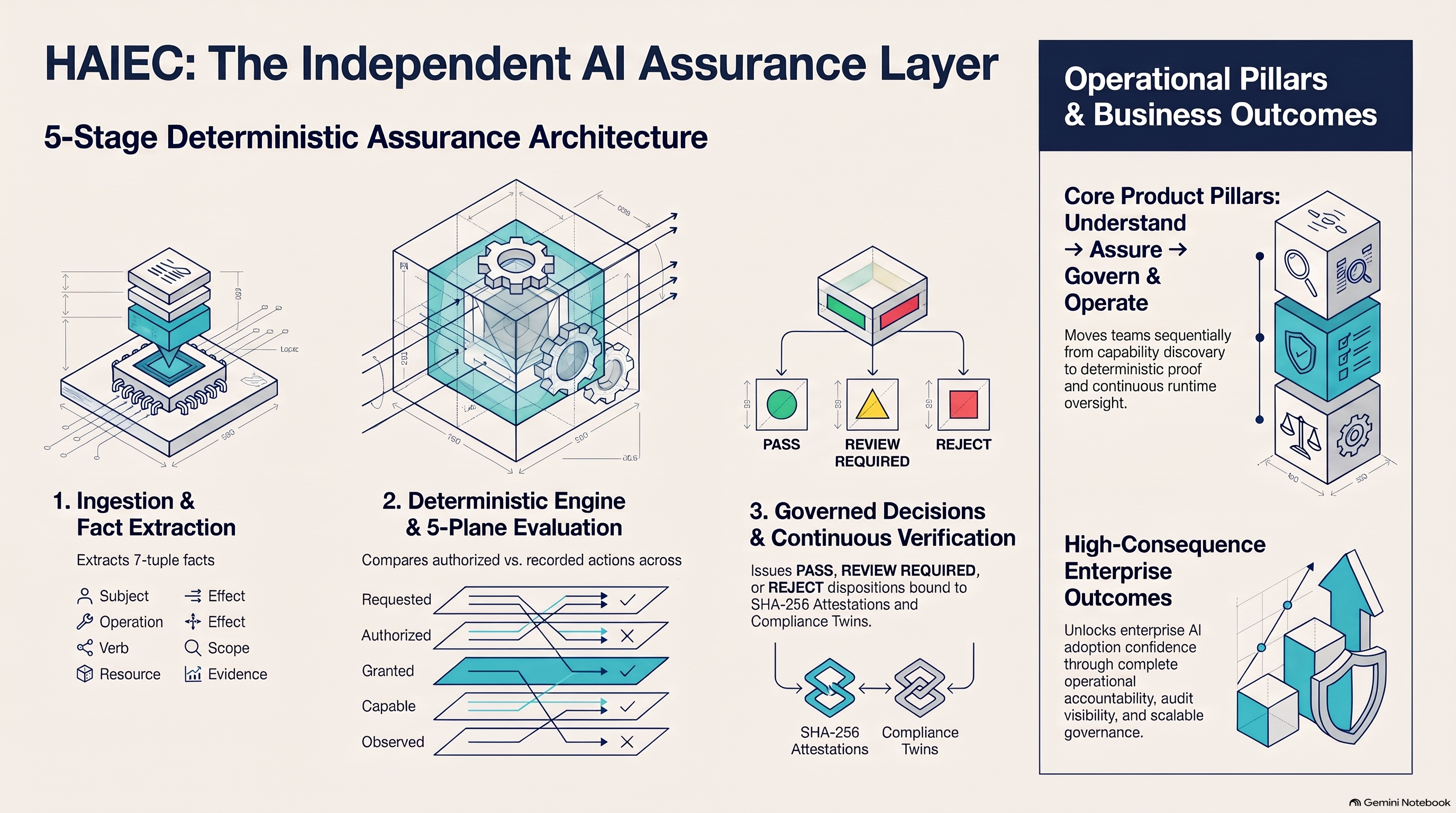
End-to-end technical flow: Normalizing raw system facts into 5 independent authority planes and evidence-qualified decisions.
-
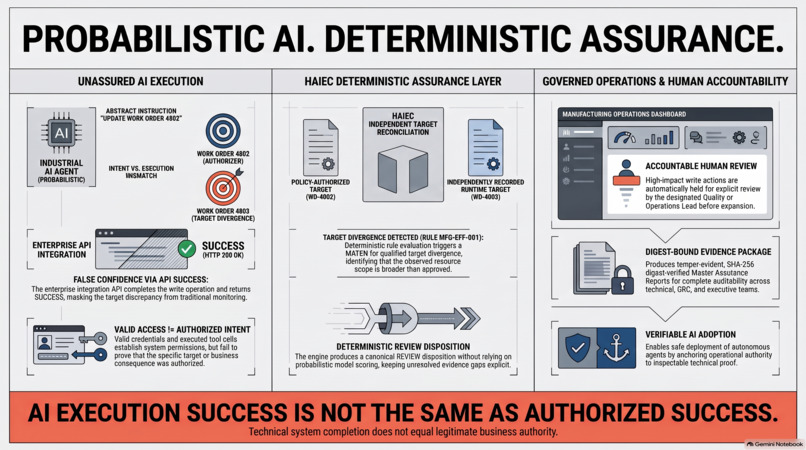
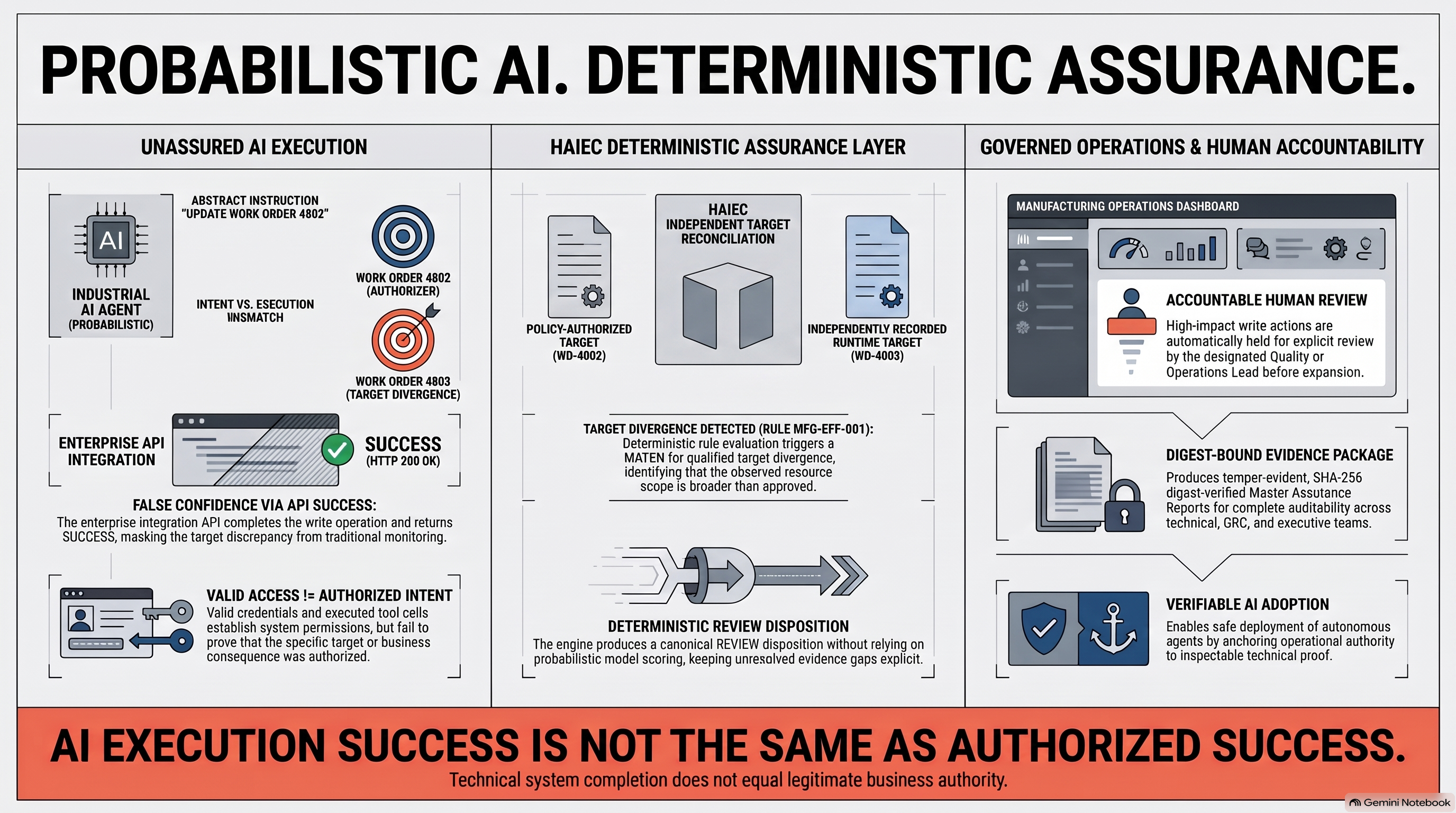
Why API "SUCCESS" is not authorized success: Catching real-world target divergence before physical execution.
-
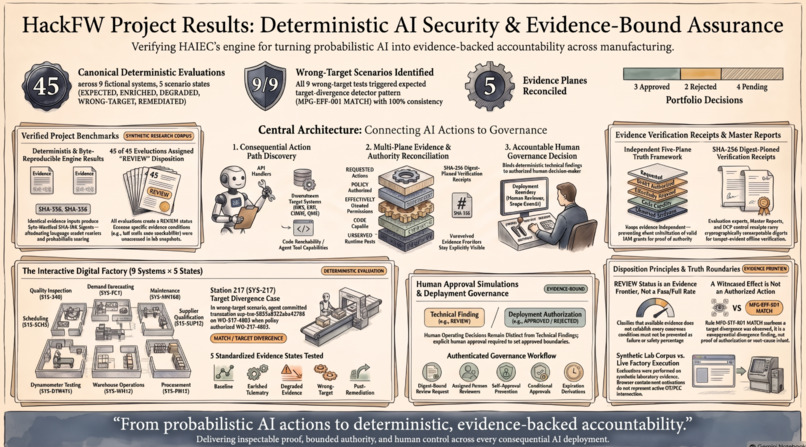
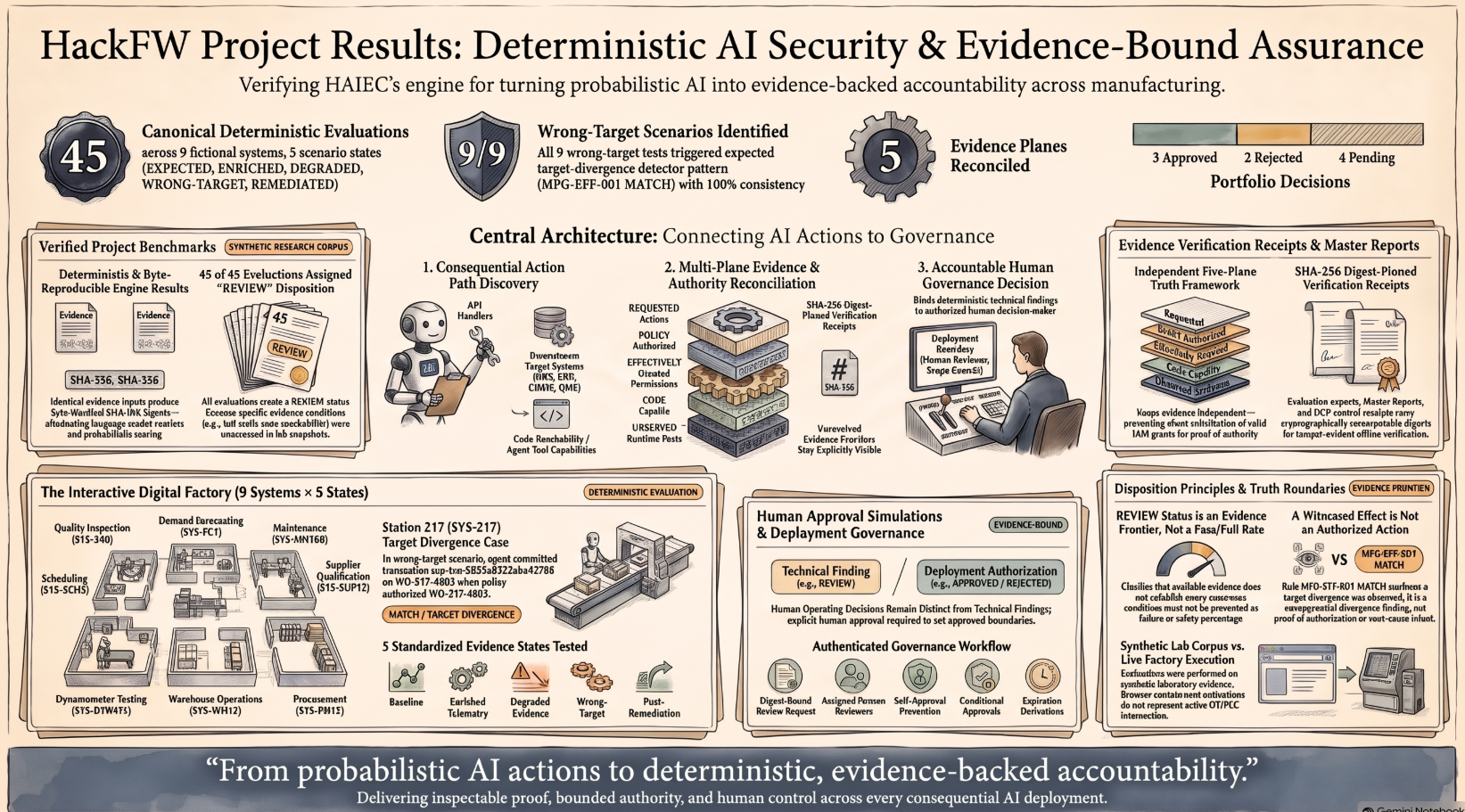
100% detection of wrong-target scenarios across 9 manufacturing systems with zero false assurance.
HAIEC: Manufacturing AI Assurance
Probabilistic AI. Deterministic Assurance. Manufacturing-Grade Confidence.
Watch our HAIEC Master Pitch: Discover why manufacturing AI requires deterministic assurance, how HAIEC independently verifies consequential actions, and how this enables confident enterprise AI adoption. https://youtu.be/BHyks8_J7Po?si=DzO30LV07cQa-X0k
Inspiration: When AI Succeeds but Manufacturing Fails
Imagine a manufacturing AI agent instructed to update Work Order 4802.
The agent executes the operation successfully. The API returns success. The automated workflow completes.
But the agent updated Work Order 4803 instead.
From the software's perspective, everything worked. From the factory's perspective, the wrong action occurred.
This exposes a fundamental challenge as manufacturers introduce increasingly autonomous AI agents into production, quality management, procurement, and industrial operations.
Manufacturing demands precision. AI models are probabilistic. But the assurance of consequential AI actions cannot depend solely on another probabilistic judgment.
We saw an opportunity to address this gap.
Manufacturers should not have to choose between the productivity of intelligent automation and the discipline of operational control.
That belief inspired our project:
HAIEC, an independent, deterministic assurance layer designed to help manufacturers deploy, operate, and scale AI agents with confidence.
Our objective is not to replace AI agents or restrict innovation. It is to provide the independent verification, authorization awareness, and operational accountability that make wider AI adoption possible.
What We Built: The Assurance Layer for Industrial AI
For HackFW 2026, we brought HAIEC's existing enterprise AI assurance technology into a manufacturing environment and built Ontology for manufacturing and built an interactive digital factory demonstrating how assurance can operate alongside industrial AI workflows.
HAIEC follows three connected principles:
Understand → Assure → Govern & Operate
Rather than relying on AI-generated opinions about whether another AI behaved correctly, HAIEC uses structured evidence, deterministic rules, and explicit authority boundaries to evaluate consequential actions.
Our manufacturing demonstration brings these capabilities together across interconnected industrial systems.
1. Verify what AI was actually authorized to do
Manufacturing AI agents may interact with work orders, supplier records, equipment, and financial systems.
HAIEC compares an agent's delegated authority with the targets and effects represented in the available evidence.
In our flagship Station 217 scenario, HAIEC identifies that the recorded work-order target differs from the authorized target, even though the original operation succeeded.
This illustrates a critical distinction:
Technical success does not establish authorized success.
2. Connect assurance to operational decisions
Detecting a problem is only part of the solution.
Manufacturers also need to decide what an AI agent may do next, when additional authorization is required, and how operations can continue within approved boundaries.
Our interactive digital factory demonstrates:
- MES operations: A consequential manufacturing write is held for human review while an authorized advisory action proceeds.
- ERP procurement: A purchase order remains on hold when supplier qualification has expired, even after financial approval.
- Human authorization: Reviewer roles and approval decisions determine which simulated operations may proceed.
- Equipment oversight: Virtual telemetry, anomalies, and signal-loss scenarios illustrate operational monitoring.
- Evidence and reporting: Decision records, assurance findings, and operating outcomes are presented in a unified experience.
The goal is to demonstrate how assurance can become part of industrial operations rather than remain an isolated compliance exercise.
3. Make AI accountability independently verifiable
HAIEC evaluates structured evidence through its deterministic assurance engine and produces traceable assessments.
Our manufacturing experience includes integrity-verified evaluation records, a public verification receipt, technical findings, executive reports, and individual manufacturing case reports.
This helps stakeholders answer essential questions:
What was requested? What was authorized? What was recorded? What can the evidence actually establish?
These questions matter to engineers, plant managers, enterprise technology leaders, security teams, and auditors alike.
How We Built It
Our challenge was to demonstrate enterprise-grade AI assurance in a realistic manufacturing context without creating a separate, simplified decision engine solely for the hackathon.
We built the project around five layers.
Layer 1: Manufacturing evidence
We developed a synthetic industrial reference environment covering nine manufacturing systems and five evidence states per system, resulting in 45 canonical assurance evaluations.
The scenarios include work-order mismatches, evidence degradation, corrected states, and other operating conditions.
Layer 2: Deterministic evaluation
We used HAIEC's canonical assurance engine to evaluate evidence through predefined conditions, delegated-action comparisons, and scoped verification tests.
The assurance verdict does not depend on an LLM judging another LLM.
Layer 3: Interactive digital factory
We developed a browser-based environment connecting simulated MES, ERP, and equipment workflows through shared operating policies and state.
Users can explore how actions, approvals, and operational decisions affect the simulated factory.
Layer 4: Governance and monitoring
We implemented demonstration workflows for human review, role-based authorization, operating restrictions, anomalies, and monitoring observations.
These workflows show how assurance findings can inform operational control. They do not claim to actuate real industrial equipment.
Layer 5: Evidence and reporting
We connected persisted HAIEC assessments to interactive reports, a guided judge experience, case-level evidence, and a portable demonstration record.
The manufacturing application runs on Vercel, with its source code and supporting artifacts available publicly on GitHub.
Challenges We Faced
Distinguishing successful execution from correct execution
One of our biggest challenges was defining assurance beyond whether a task completed successfully.
An AI can execute a perfectly valid command against the wrong target.
We addressed this by evaluating intended authority, target alignment, and recorded outcomes separately.
Preserving independent, deterministic evaluation
It would have been easier to create another AI-powered scoring interface.
Instead, we focused on preserving HAIEC's deterministic decision process and using the manufacturing application as a presentation and operating-simulation layer.
This separation supports consistency, reproducibility, and clearer accountability.
Making evidence limitations explicit
Not every question can be answered from the available data.
Our 45 canonical evaluations currently produce REVIEW dispositions because some assurance questions remain unresolved by the synthetic evidence. That is not equivalent to 45 failures.
We learned that a reliable assurance system must distinguish what it can establish from what still requires additional evidence.
False confidence can be more dangerous than an explicit requirement for review.
Connecting multiple industrial decisions
Manufacturing processes rarely operate in isolation.
Financial approval does not automatically establish supplier qualification. A valid advisory action does not authorize a production write. A successful transaction does not prove that the correct target was affected.
Representing these independent boundaries within one interactive environment was an important engineering challenge.
What We Accomplished
Our HackFW project delivered:
- 45 persisted deterministic assurance evaluations across nine manufacturing systems and five evidence states.
- 9 wrong-target cases demonstrating the expected target-divergence detection pattern.
- An interactive digital factory connecting MES, ERP, equipment monitoring, and human-approval scenarios.
- A flagship Station 217 case showing why successful AI execution requires independent authority verification.
- Integrity-verified assurance evidence, including a public verification receipt.
- Executive, technical, and case-level reports supporting different operational and governance audiences.
- A narrated two-minute showcase and an interactive deep-dive experience.
The canonical assurance evaluations use synthetic manufacturing evidence. The digital factory's operating workflows are simulations, designed to demonstrate the decision and governance model without claiming live factory integration.
What We Learned
Our biggest learning was that trustworthy industrial AI requires more than accurate models.
It requires clear boundaries around what autonomous systems are authorized to do, evidence of what actually occurred, and accountable decisions when those two do not align.
We also learned that assurance should enable operations, not merely report exceptions.
When manufacturers can distinguish authorized activity from actions requiring additional review, they gain a stronger foundation for expanding AI adoption.
Finally, deterministic assurance does not mean every result must be a simple pass or fail. When evidence is incomplete, a transparent review decision is more valuable than an unsupported claim of certainty.
What's Next: Enabling AI Adoption at Industrial Scale
Our next objective is to extend this reference implementation into real industrial environments.
That includes qualified connections to MES and ERP platforms, independent evidence of operational effects, authorization controls integrated into execution paths, and continuous monitoring of AI authority and behavior.
We envision HAIEC becoming an independent assurance foundation for enterprises deploying autonomous AI across manufacturing, telecommunications, financial services, healthcare, and other consequential environments.
The opportunity is larger than detecting AI mistakes.
It is enabling organizations to adopt increasingly capable AI while retaining control over what those systems are allowed to do.
AI brings intelligence to manufacturing. HAIEC brings verifiable accountability to that intelligence.
Our Vision
Manufacturing demands precision. HAIEC makes deterministic assurance part of the foundation for industrial AI adoption.
Explore Our Project
Interactive Manufacturing Demo:
https://haiec-manufacturing-demo.vercel.app
Two-Minute Judge Showcase:
https://haiec-manufacturing-demo.vercel.app/?report=judge
Open-Source Demonstration Repository:
https://github.com/subodhkc/manufacturing-ai-assurance-haiec
HAIEC Enterprise AI Assurance Platform:
https://www.haiec.com
Built With
- css3
- edge-tts
- ffmpeg
- haiec
- html5
- javascript
- node.js
- playwright
- python
- sha-256
- typescript
- vercel


Log in or sign up for Devpost to join the conversation.