-
-
ALTERING THE WATER
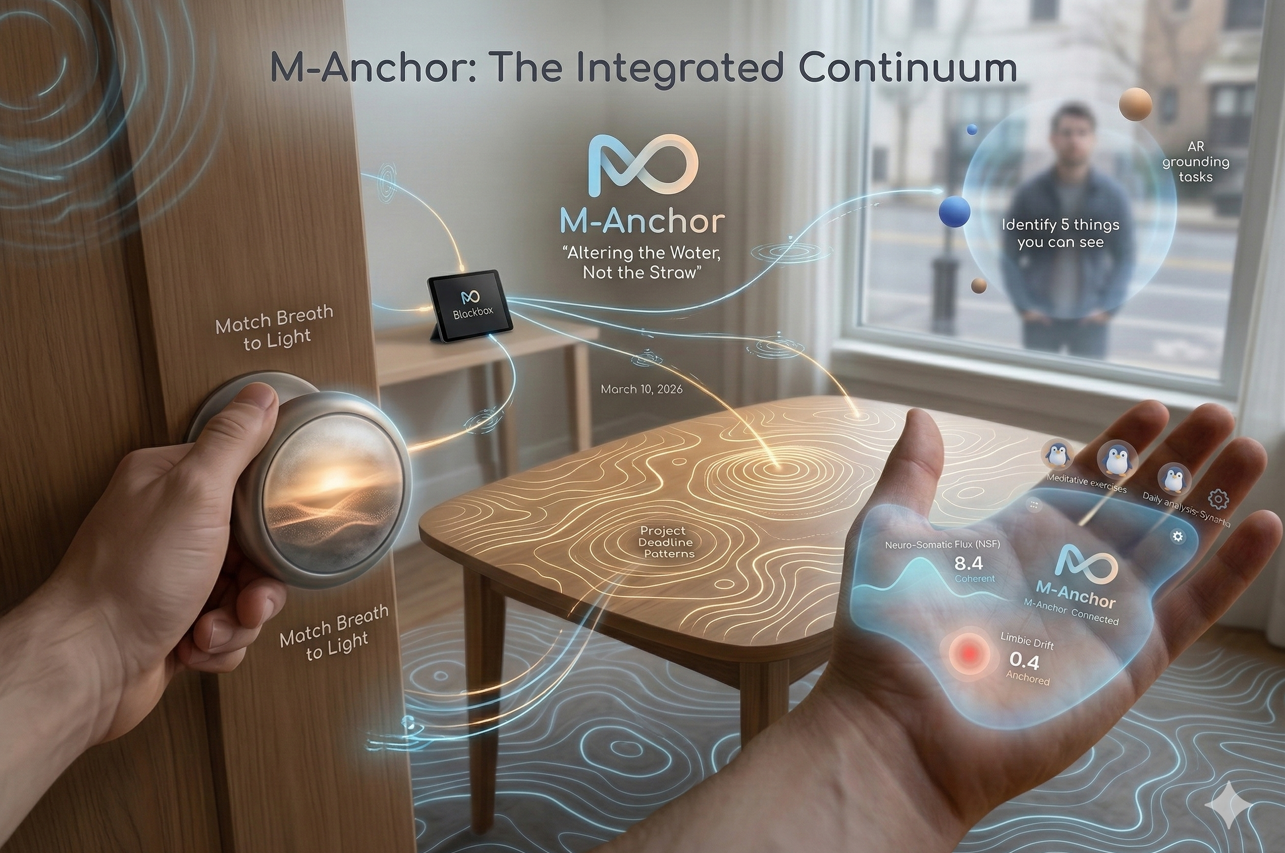
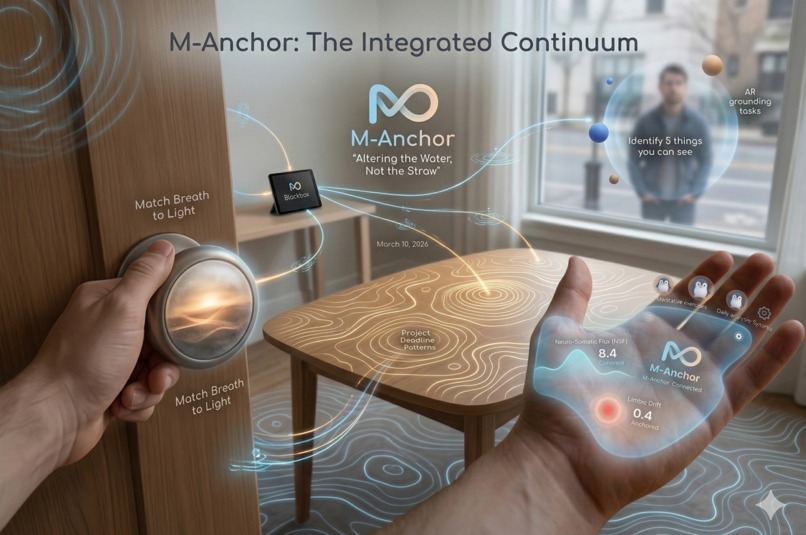
Inspiration: They say a drowning man will clutch at a straw. When someone experiences a severe panic attack, a somatic freeze, or suicidal ideation, they aren't just overwhelmed they are neurologically drowning. Yet, modern mental health technology throws them a straw: a mindfulness app, a notification, a pie chart. But a straw requires cognitive effort they no longer possess. We realized we needed to stop throwing straws and start altering the water. We wanted to design a system that acts as an invisible, ambient anchor, using spatial computing to physically regulate the nervous system when the user cannot do it themselves.
What it does : M-Anchor is a spatial computing and ambient health ecosystem that acts as a sensory prosthetic. It quantifies an invisible biological sense we call Chronosense—the human perception of time and the biological ability to perceive tomorrow. When a user's Chronosense flatlines, they suffer from Temporal Myopia, becoming trapped in an agonizing present. M-Anchor passively tracks the nervous system using zero-friction touchpoints like a biometric steering wheel, a smart door, or a holographic Palm Touch OS. When it detects a critical breakdown, the physical environment transforms. A door emits a pulsing biological pacemaker of light. A mirror acts like fog coming from a mouth on glass to initiate a grounding task. We bypass the overwhelmed cognitive brain entirely, using ambient light and haptics to physically pull the user out of the deep end.
How we built it : We built the M-Anchor ecosystem using Figma's advanced spatial design features, primarily Make, We moved entirely away from traditional mobile frames, designing fluid, screenless touchpoints embedded in physical environments. To quantify Chronosense, we developed speculative biometric algorithms. The ecosystem calculates Neuro-Somatic Flux (NSF) Coherence by cross-referencing parasympathetic stability against physical panic markers. When NSF drops below 3.0, the system registers high Limbic Drift (dissociation) and triggers the environmental UI.
Challenges we ran into : Our greatest challenge was participating in a UI/UX design-a-thon while actively trying to eliminate traditional UI. We had to figure out how to visualize complex, life-or-death medical data without using a single bar chart, graph, or rigid grid, as those trigger anxiety and increase cognitive load. Prototyping the Palm Touch OS was particularly difficult. We had to iterate extensively to create an interface that felt organic to the human body. We achieved this by utilizing heavy glassmorphism, fluid topographical ripples , and empathetic companions (like the penguin avatars) to guide meditative exercises rather than relying on clinical menus. Accomplishments that we're proud of. We are incredibly proud of the Chronosense framework. Translating a philosophical concept like "hope" or "the perception of time" into a quantifiable biometric algorithm fundamentally shifts how we design for mental health. Visually, we are most proud of the state transitions we prototyped in Figma—specifically the Smart Door sequence, where the heavy, dark fog of a panic attack dissolves into an open, expansive horizon gradient. It perfectly captures the feeling of the blockage clearing.
What we learned : We learned that in life-or-death scenarios, design isn't about pixels; it is about spatial empathy. The most profound realization was that the best interface is sometimes no interface at all. By shifting the burden of emotional regulation from the user's active mind to their passive environment, we can treat mental health crises as mechanical sensory failures that spatial architecture can actually fix.
What's next for M-Anchor? : The immediate next step for M-Anchor is hardware feasibility testing. We want to explore the integration of piezo-electric threads, thermochromic smart-glass, and sub-dermal sensors to bring the Palm Touch OS to life. Additionally, we plan to expand the "Blackbox" feature. By providing clinical psychiatrists with an objective, ambient data log of a patient's nervous system, we can help doctors identify exact physiological failure points without relying on the patient's flawed memory of a traumatic event. M-Anchor will become not just a lifeline for the user but a lighthouse for the medical field.


Log in or sign up for Devpost to join the conversation.