CallIQ
Strategic intelligence. Orchestrated execution.
A multi-agent AI platform that turns a sales brief into a live, compliant, research-grounded voice campaign — in hours, not weeks.
The Short Version
Voice remains one of the highest-converting B2B channels. Yet running a high-quality outbound campaign is still slow, manual, and fragmented. Teams either personalize deeply and cannot scale, or they scale and sound like a robocall.
CallIQ removes that trade-off.
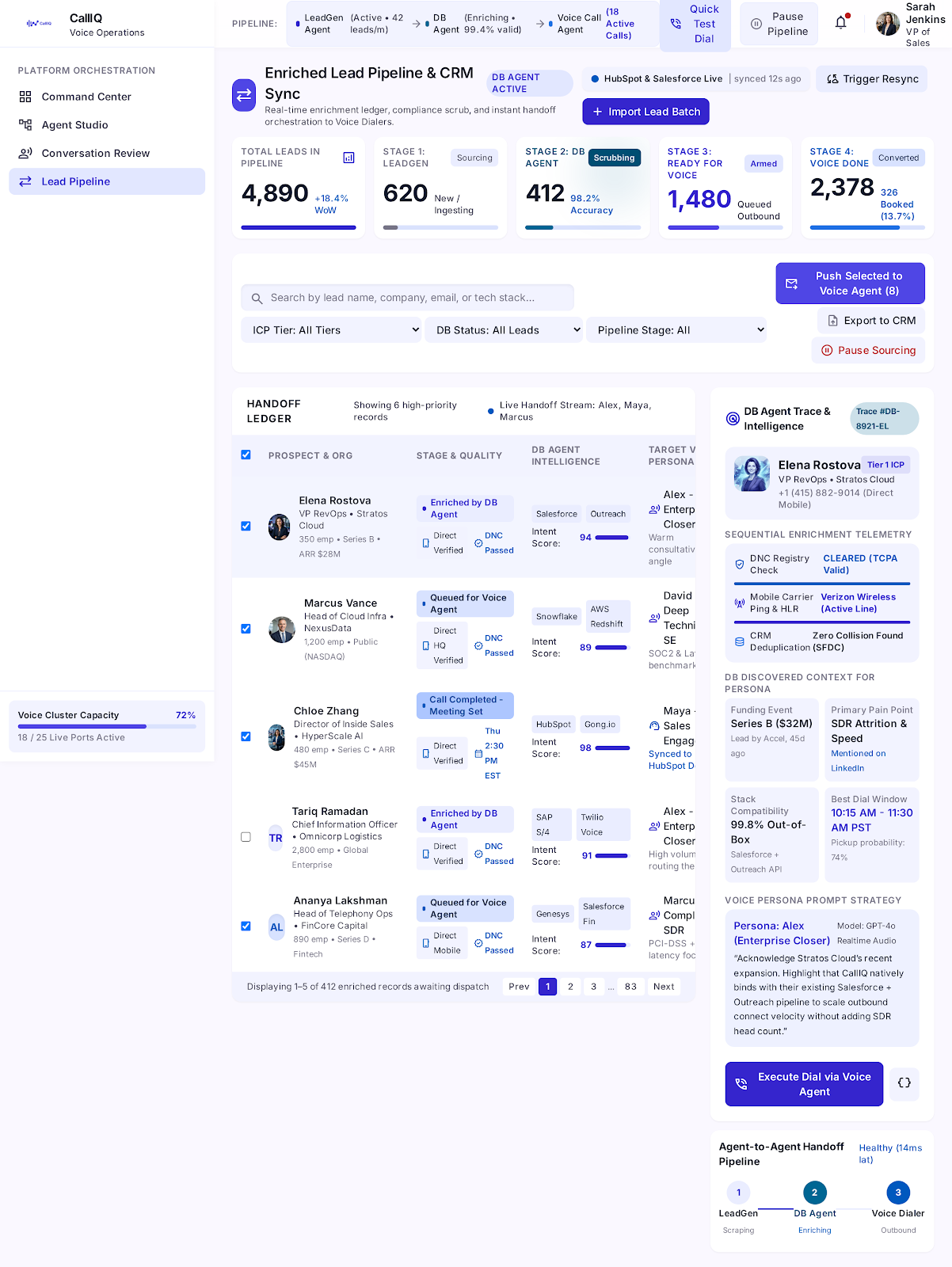
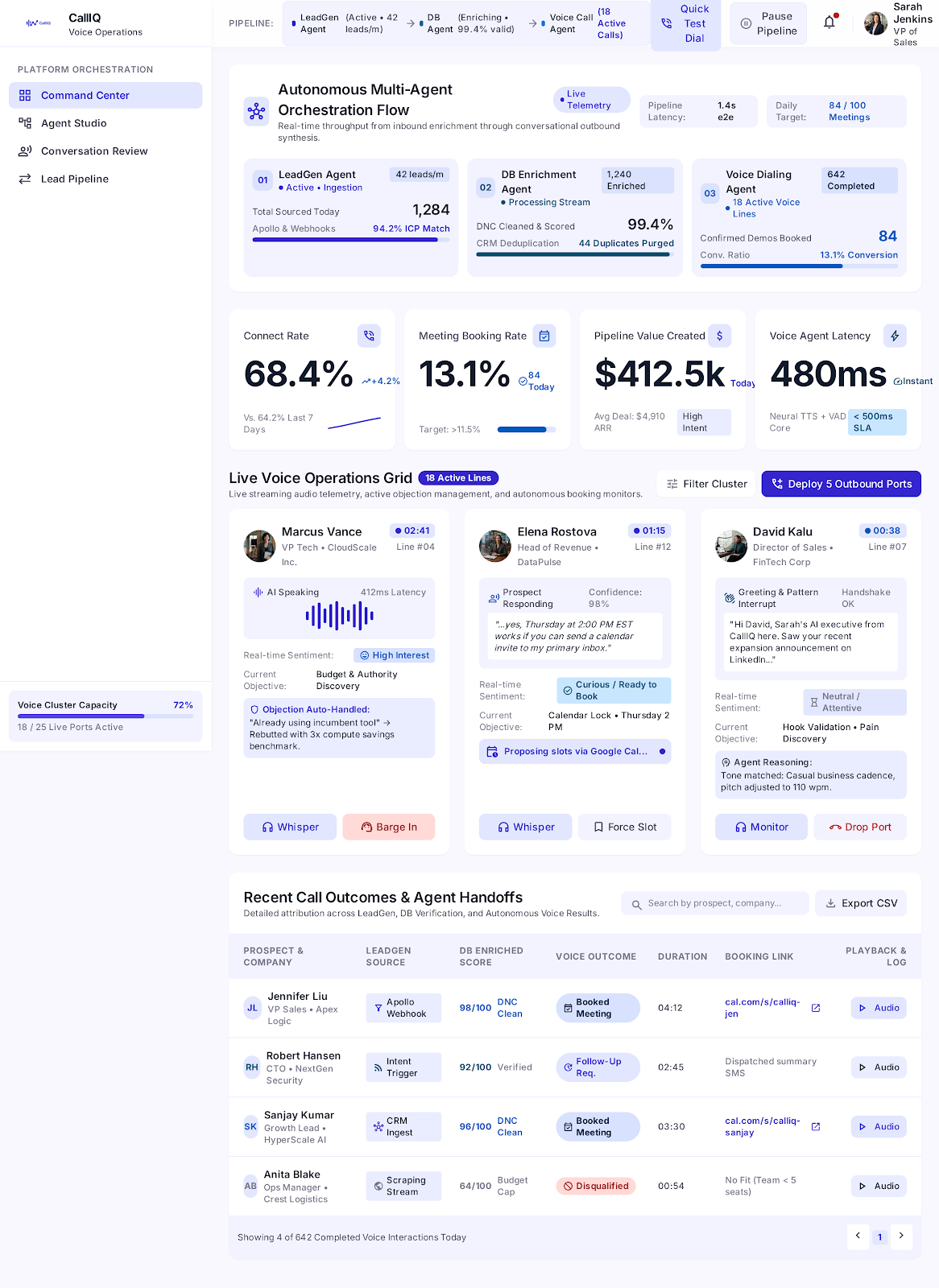
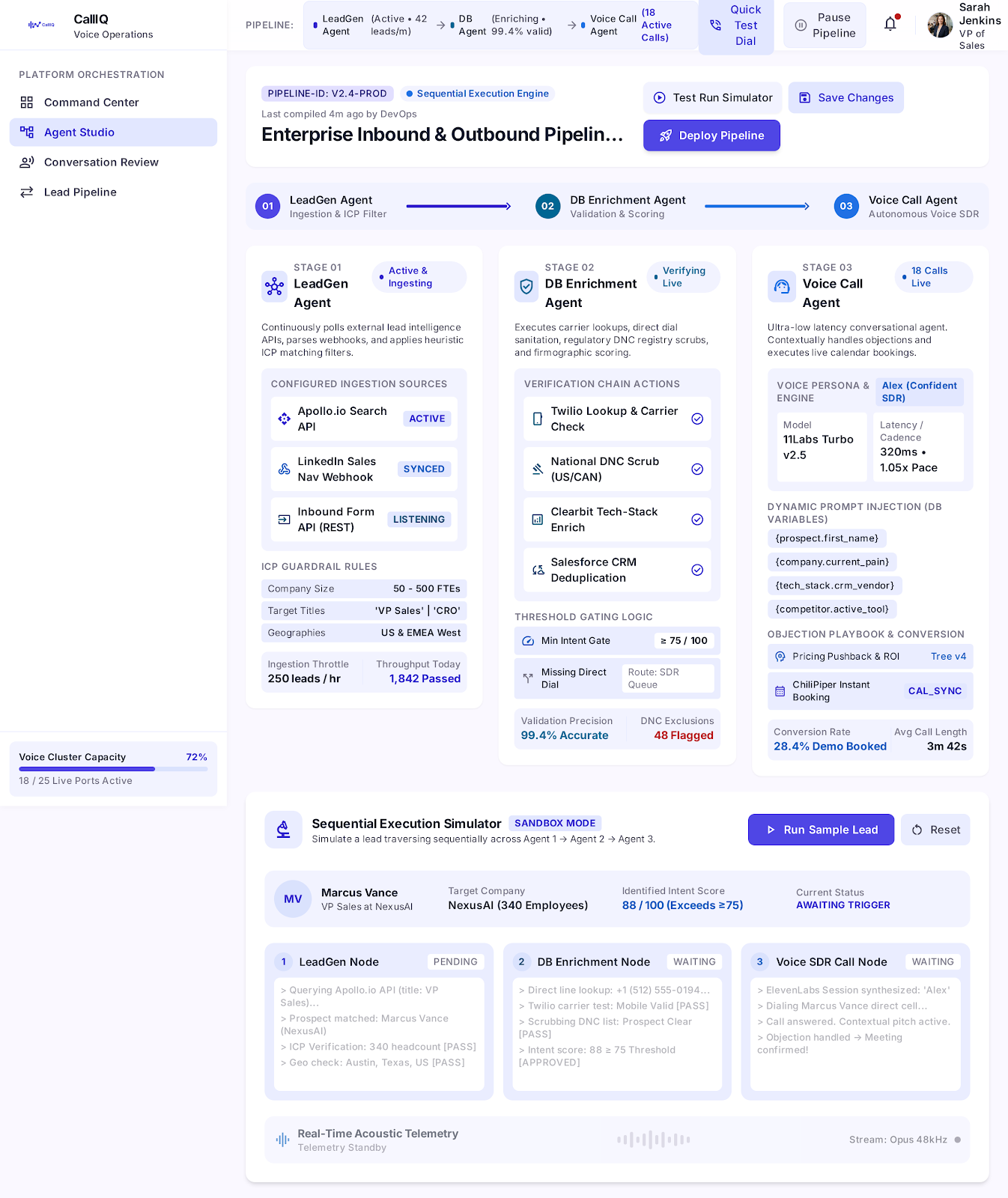
Three specialized AI agents — Lead Generation, Database Management, and Voice Call — operate as one coordinated team. Each agent validates its own output before handing off, so research, data, and conversations are verified at every step instead of cleaned up afterward.
Results at a Glance
| Outcome | What it means |
|---|---|
| Launch in hours, not weeks | Strategy to live conversations with no manual stitching between tools |
| Target: 80%+ less manual review | Quality gates catch errors where they start, not in the CRM weeks later |
| Principle-led, not script-bound | Positioning and sales methodology are encoded into every conversation |
| One brand voice across every touchpoint | Each call reinforces your positioning instead of eroding it |
| Full audit trail | Every decision, handoff, and data change is logged and reviewable |
| 50 to 5,000+ prospects | Same validation depth at every scale |
Figures marked as targets are design goals; validate them against your own pilot data before external use.
The Problem
Outbound calling is high-value work buried under low-value effort
Most of a calling campaign’s cost is not the calls. It is the research, data cleanup, scripting, and review that surround them.
Illustrative annual cost model
(12 campaigns/year · 100 prospects each · $80/hr loaded cost)
| Activity | Time basis | Annual cost |
|---|---|---|
| Prospect research & qualification | 8–12 hrs/week (416–624 hrs) | $33,280 – $49,920 |
| Call scripting & personalization | 20–40 min per prospect (≈33–67 hrs per 100) | $32,000 – $64,000 |
| Follow-up coordination | 2–4 hrs per campaign (24–48 hrs) | $1,920 – $3,840 |
| Subtotal (directly calculable) | ≈470–740 hrs | $67,200 – $117,760 |
On top of this, manual data entry and validation typically add roughly 20% to prep time. Quality review and CRM updates can consume 40% or more of total effort. Those overheads vary by team — substitute your own figures.
For a team running a dozen campaigns a year, that is effectively a full-time headcount spent on execution rather than strategy.
Quality doesn’t scale. Mediocrity does.
Genuinely personal conversations require understanding each prospect’s business, role, context, and pain points. Doing that by hand for thousands of prospects is impossible, so teams settle for semi-personalized calls that satisfy neither quality nor scale.
Automation without strategy
Traditional automated dialers treat each call in isolation. Personalization is cosmetic, objection handling is scripted, and no system asks whether a given conversation strengthens or weakens the brand in the prospect’s mind. The call becomes a transaction, and the brand becomes just another vendor.
What CallIQ Does
CallIQ converts a short sales requirement into a complete, ready-to-run outbound voice campaign.
Inputs
- Target audience: industry, company size, role, geography
- Business context and competitive landscape
- Number of leads needed
- Brand voice, positioning, and key differentiators
- Compliance rules for the target regions (calling windows, consent, do-not-call lists)
Outputs
- 50–5,000+ qualified prospects, each with verified business intelligence
- A validated, de-duplicated, enriched lead database
- Dynamic voice conversations, unique to each prospect
- Real-time qualification, objection handling, and meeting booking
- Outcomes written back to your CRM automatically
- A complete audit trail of every decision
The Workflow
| Stage | Agent | Responsibilities |
|---|---|---|
| 1. Discover | Lead Generation | Identify prospects, research the business, map decision-makers and pain points, validate against reliable sources |
| 2. Organize | Database Management | Structure and validate data, de-duplicate, detect issues, enforce integrity |
| 3. Converse | Voice Call | Run the conversation, qualify, handle objections, book meetings, log outcomes |
Agents hand off over low-latency RPC with a critique loop at every boundary. External systems — CRM, telephony, calendars, enrichment APIs — connect through MCP. The output is a campaign that is ready to deploy with no manual cleanup.
The Three Agents
1. Lead Generation & Business Intelligence Agent
Finds the right prospects and learns who they are before anyone dials.
- Identifies prospects that match your criteria
- Researches company structure, market position, and trajectory
- Collects firmographics: revenue, headcount, funding stage, growth signals
- Identifies decision-makers and likely pain points
- Verifies every claim against reliable sources before it advances
Six-stage validation loop
- Generate candidates
- Validate against requirements (90%+ match confidence required)
- Verify company facts against reliable sources
- Detect hallucinations and unsupported claims
- Identify duplicates within the batch
- Confirm target match and pass forward
Result: only high-confidence, verified leads enter the database.
2. Database Agent
Keeps the data clean, consistent, and trustworthy.
- Structures prospect data into consistent, queryable formats
- Validates every field against schema definitions
- Removes duplicates using multi-factor matching
- Maintains a complete audit trail of every modification
- Optimizes queries for performance at scale
Six-stage validation loop
- Organize data
- Validate against schema
- Detect issues
- Correct and remediate
- Re-validate
- Confirm integrity
Result: only structurally sound, de-duplicated records reach the Voice Call Agent.
3. Voice Call Agent
Holds real conversations guided by sales principles, not scripts.
- Opens naturally, tailored to the prospect’s role and context
- Qualifies in real time on budget, authority, need, and timeline
- Handles objections using only approved business knowledge
- Books meetings when the moment is right
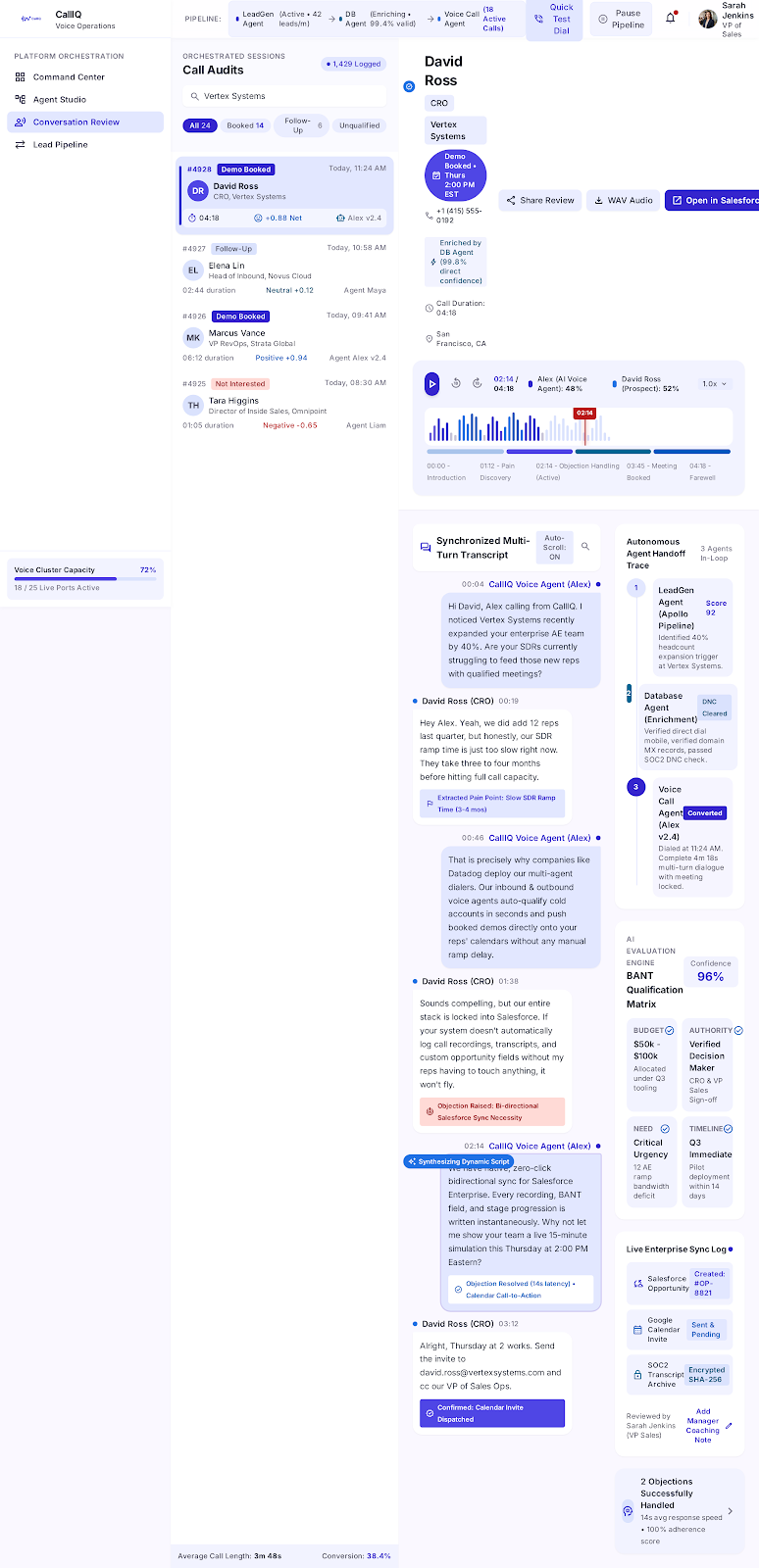
- Logs outcomes and next actions automatically
- Hands off to a human rep on request or when a conversation exceeds its remit
Eight-stage validation loop
- Generate conversation strategy
- Self-evaluate against sales principles
- Identify specific issues
- Refine the approach
- Re-evaluate
- Validate context accuracy
- Confirm brand-voice authenticity
- Pass forward
Result: only strategically sound, context-aware conversations reach prospects.
A Prospect’s Journey: Example
Brief: “Find 200 operations directors at mid-size logistics companies in the Midwest who are likely evaluating warehouse automation.”
- Lead Gen surfaces 340 candidates, discards 120 below the 90% match threshold, flags 9 with unverifiable claims, and removes 11 duplicates — leaving 200 verified leads, each with a short intelligence brief.
- Database validates fields, standardizes titles and phone formats, and rejects 6 malformed records for re-research. All changes are logged.
- Voice Call prepares a conversation strategy per prospect. For a COO who recently announced a second distribution center, it opens on expansion planning rather than a generic pitch.
- During the call, the agent qualifies, answers a pricing objection using approved messaging, and books a meeting. The outcome syncs to the CRM within seconds.
The numbers above are illustrative of the flow, not guaranteed benchmarks.
Integrated Critique and Feedback Loops
Philosophy: prevention, not detection.
Conventional QA works backward: generate, hope it is good, review later, fix what broke. CallIQ works forward: generate, validate, name the specific problem, refine, re-validate, and only then proceed.
| Gate | What it checks | What it prevents |
|---|---|---|
| Lead Gen | Relevance, accuracy, hallucinations, duplicates | Irrelevant or false leads |
| Database | Schema integrity, consistency, duplicates | Bad data reaching conversations |
| Voice Call | Context accuracy, brand voice, strategic alignment | Scripted, off-brand, or low-value calls |
Compliance, Safety, and Human Oversight
Voice automation carries real regulatory and reputational risk. CallIQ treats that as a first-class requirement.
- Calling rules: configurable calling windows, do-not-call suppression, and consent tracking per region (e.g., TCPA in the US and equivalents elsewhere)
- Disclosure: the agent identifies itself as an AI where required or requested, and never claims to be human
- Grounded answers: objection handling draws only from approved business knowledge; when unsure, the agent defers rather than improvises
- Human handoff: warm transfer or callback scheduling when a prospect asks for a person, becomes upset, or raises topics outside scope
- Audit and review: full call recordings, transcripts, and decision logs, with sampling dashboards for human QA
- Data protection: role-based access, encryption in transit and at rest, and retention controls
Compliance requirements vary by jurisdiction and should be confirmed with legal counsel before launch.
Architecture: RPC and MCP
| Layer | Role | Why it matters |
|---|---|---|
| RPC | Agent-to-agent handoffs (target 1–10 ms) | Fast, observable coordination between agents |
| MCP | External integrations: CRM, telephony, calendars, enrichment | Reliable, standardized connections to the tools you already use |
Together they deliver speed inside the system and dependability at its edges.
Why Multi-Agent Beats Single-Model
| Dimension | Single-model approach | CallIQ multi-agent |
|---|---|---|
| Specialization | Generalist | Domain experts |
| Error isolation | Cascading failures | Errors caught at source |
| Data quality | Validated only at the end | Validated at every handoff |
| Scalability | Single bottleneck | Parallel or sequential as needed |
| Observability | Black box | Full RPC logging and audit trails |
| Maintenance | Retrain everything | Update one agent independently |
How Success Is Measured
| Area | Metrics |
|---|---|
| Data quality | Lead match rate, hallucination catch rate, duplicate rate, field-validity rate |
| Conversation quality | Connect rate, qualification rate, meeting-booked rate, handoff rate, call-quality scores |
| Efficiency | Time to launch, manual review hours, cost per qualified meeting |
| Trust | Opt-out rate, complaint rate, audit-log completeness |
Getting Started
- Define the brief — audience, geography, volume, positioning
- Pilot — a 50-prospect campaign with human review of every call
- Tune — adjust thresholds, messaging, and handoff rules from pilot data
- Scale — expand toward thousands of prospects with sampling-based QA
Conclusion
CallIQ is not a faster dialer. It is not better call automation.
It is a sales team in software form: research, validation, and live conversation coordinated around one strategy and deployed across thousands of prospects at once.
Effective AI voice sales needs three things:
- Specialization — different agents excelling at different parts of the workflow
- Coordination — clean handoffs, shared context, aligned goals
- Intelligence — every step informed by sales principles and strategy, not just pattern matching
The future of AI sales is not one model that talks better.
It is a coordinated team of specialized agents working as one strategic system.
That is the difference between a tool and a teammate.

Log in or sign up for Devpost to join the conversation.