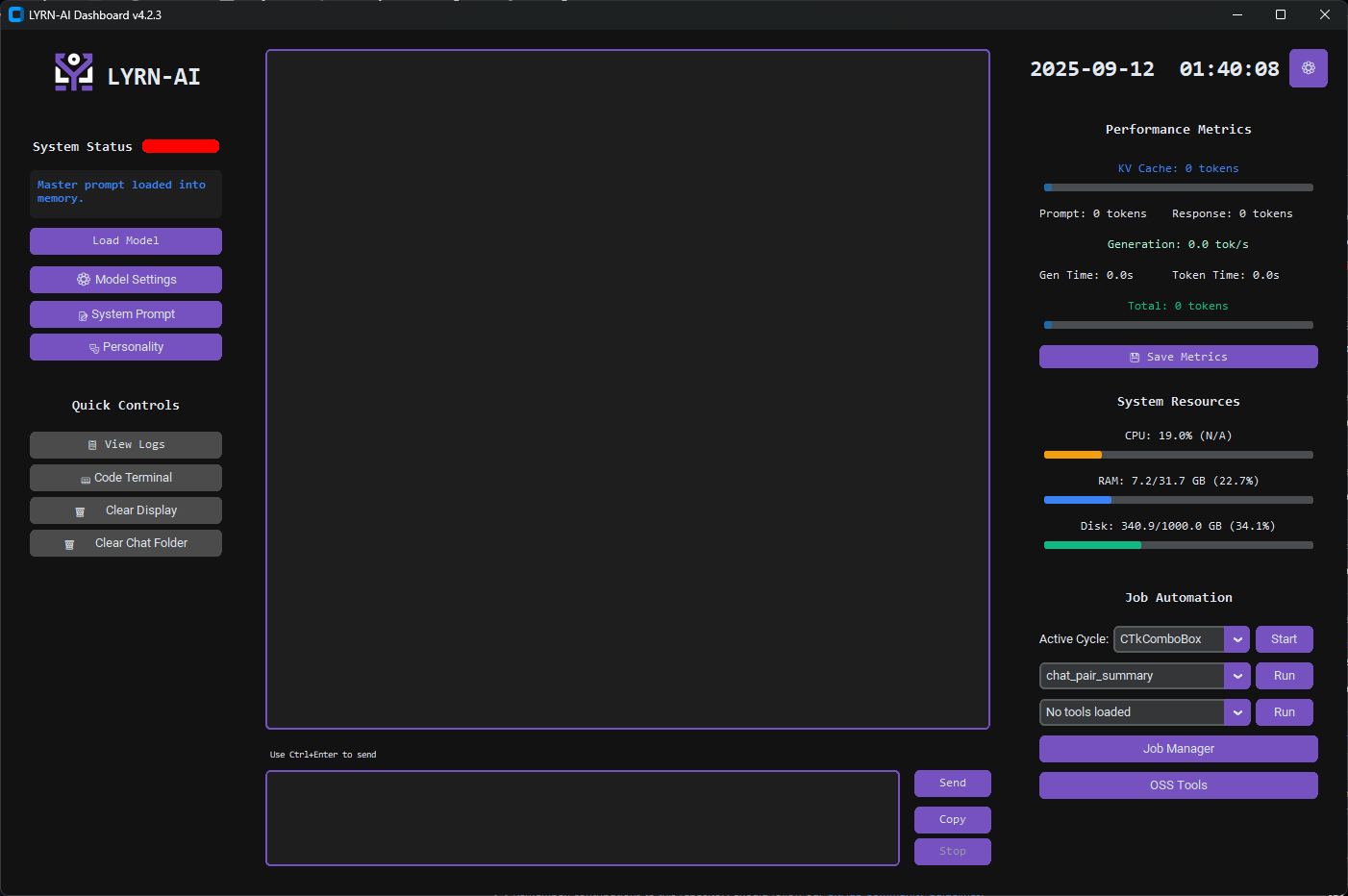
LYRN-AI Dashboard
About
LYRN-AI (Living Yield Relational Network) is a local-first cognitive framework built to solve one of AI’s most persistent problems: context loss.
Most systems depend on scaling model size or constant prompt tweaking, but LYRN takes a different approach. It builds intelligent context by layering symbolic memory, dynamic task injection, and structured reflection into a unified, modular interface.
This results in an AI agent that can remember, adapt, and grow over time. It runs efficiently on consumer-grade hardware and operates entirely offline without relying on the cloud.
Why It Matters
Modern LLMs are powerful, but they often forget, hallucinate, and drift from task to task. They need to be babysat. LYRN-AI is designed to act more like a reliable collaborator than a disposable chatbot.
At its core, LYRN uses a layered memory strategy:
- Static snapshots preserve long-term traits, rules, and instructions.
- Dynamic snapshots deliver situational awareness and project-specific data when needed.
- Autonomous reflection cycles maintain memory hygiene by updating summaries and generating new goals over time.
- A modular prompt builder constructs optimized prompts using only the relevant context and components selected by the user.
Together, these tools help LYRN perform smarter reasoning, adapt to new tasks more efficiently, and retain important knowledge without requiring massive models or external APIs.
Under the Hood
LYRN is entirely Python-based and designed for local-first operation with complete user control. Its architecture includes:
- 🧠 Context Engine: Coordinates when and how snapshots, summaries, and topic indexes are injected, ensuring working memory (KV-cache) remains coherent.
- 🗃️ Memory Architecture: Separates persistent symbolic knowledge, dynamic task state, and chat history into distinct layers for precision and scalability.
- 🧰 Prompt Builder: Enables prompt construction through selectable components, giving the user fine-tuned control over AI behavior.
- 💬 Verbatim Chat Logging: Saves all interactions in a clean, readable format that supports selective recall and long-term reference.
- 🖥️ Custom GUI: Built with
tkinterandcustomtkinter, the interface lets users modify prompts, inspect memory states, and toggle components without needing to edit code.
The goal is to help small models achieve big results by managing information more intelligently.
What’s Working Now
- ✅ Modular prompt-building system with live preview and context assembly
- ✅ Layered memory management using snapshots, deltas, and structured chat logs
- ✅ Built-in job automation system for scheduled reflection, indexing, and goal generation
- ✅ GUI dashboard for editing prompts, toggling memory layers, and injecting runtime context
- ✅ Affordance-based OSS tool builder that mirrors real-world workflows using modular templates
- ✅ Transparent, local-first memory engine that operates fully offline with complete user control
What’s Coming Next
With core systems in place, the roadmap focuses on deeper memory features and multimodal support. Planned updates include:
- 🔍 Topic Indexes: Symbolic tagging and cross-session linking of themes, ideas, and tasks
- ✍️ Delta System Enhancements: Efficiently log changes and support deeper revision history
- 📜 Running Summaries: Maintain lean prompts by condensing long chats while preserving intent
- 🧠 Deep Verbatim Recall: Blend structured logs and semantic search for context-aware lookups
- 🧩 Snapshot Composer: Visual builder for reusable memory templates and project-specific setups
- 🖼️ Multimodal Input Handling: Extend agent capability to process image, audio, and video inputs
- 🌍 Deployment Flexibility: Options for open-source, self-hosted, and commercially licensed tiers
Core Principles
- Context is more important than compute. Managing memory well enables small models to outperform expectations.
- Transparency matters. All memory is human-readable, local-first, and completely owned by the user.
- Modularity is key. Every component—whether a rule, a snapshot, or a prompt—is swappable and composable.
The Vision
LYRN is not just a dashboard or a prompt wrapper. It is a memory architecture built for agents that grow and improve over time. Instead of focusing on generating answers alone, LYRN helps agents reflect, adapt, and stay grounded in past experience.
What began as a solo project grew into a full cognitive engine in under six months. The result is a transparent, extensible system that redefines what local AI can achieve.
Built With
- llama-cpp-python
- llama.cpp
- python

Log in or sign up for Devpost to join the conversation.