-
-
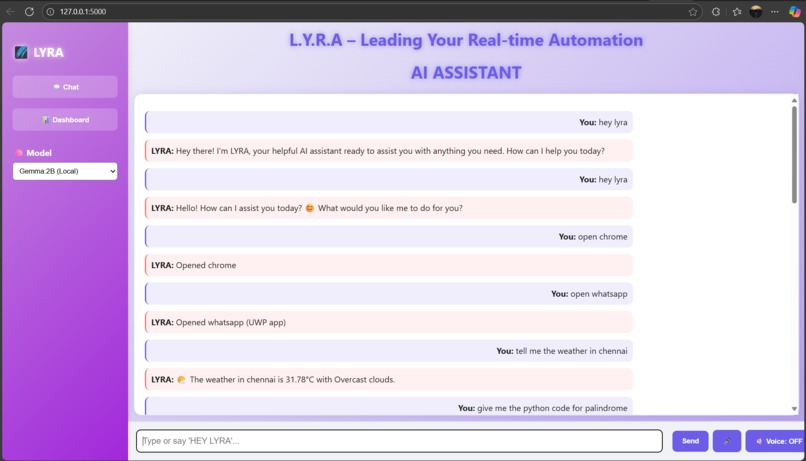
Showing how LYRA can respond
-
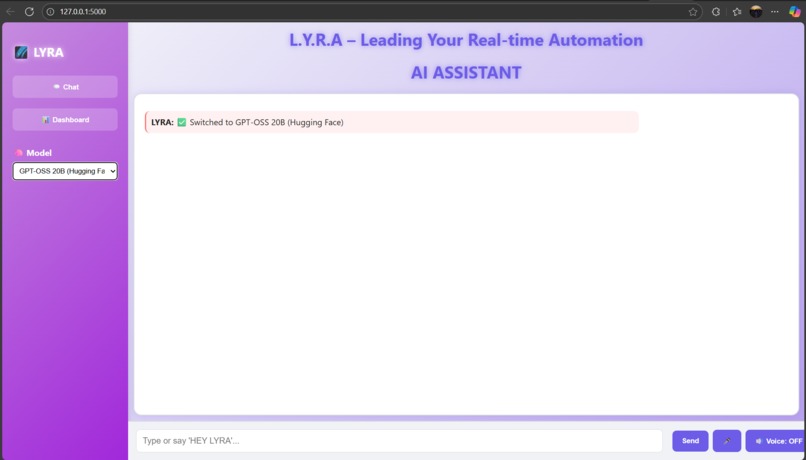
Showing how we can switch Model


Inspiration
ur inspiration came from the gap between smart assistants and true intelligent agents. LYRA bridges that gap — open-source, customizable, and built to run anywhere.
What it does
Conversational AI (Text + Voice): Natural chat with TTS (female voice) and browser-based STT for seamless voice control.
Persistent Memory: Remembers user interactions, last question, and custom facts (e.g., name, preferences).
Plugin Ecosystem: Modular plugins for reminders, app launching, math solving, weather lookup, WhatsApp messaging, system commands, and Wikipedia/news knowledge.
Reminders & Notifications: Schedule reminders (“remind me to drink water in 1 minute”) that appear inside chat and can be spoken aloud.
Automation: Launch apps (Chrome, VS Code, Camera), open URLs, send WhatsApp messages, and run system commands.
Math & Reasoning: Symbolic math (SymPy) and numeric solving (NumPy/Scipy) for tasks from basic arithmetic to calculus.
Dashboard: Visual panel with CPU/RAM usage, weather, news feed, and stock charts (auto-refresh with Chart.js).
Model Switching: UI dropdown lets users select between Gemma:2B (fast, offline) and GPT-OSS 20B (powerful, remote). If Hugging Face is unavailable (paused/bad request), LYRA automatically falls back to Gemma:2B.
Response Formatting: Outputs cleanly structured text, bullet points, and code blocks for developer-friendly interaction.
How we built it
Built a Flask backend with modular endpoints for chat, dashboard, reminders, and model switching.
Designed a plugin manager to orchestrate automation (apps, system commands, WhatsApp, math, weather).
Implemented a persistent memory module for facts & interactions.
Integrated local LLM (Gemma:2B via Ollama) and remote LLM (GPT-OSS 20B via Hugging Face) with auto-failover.
Built a responsive web frontend (HTML/CSS/JS + Chart.js) with chat, voice input/output, and real-time dashboard.
Challenges we ran into
Users want powerful assistants but worry about privacy & latency.
Local models are fast & private but limited in reasoning.
Large models are strong but costly/unreliable for demos or offline use.
Opportunity: deliver a hybrid agent that is useful offline and scales up when needed.
Accomplishments that we're proud of
Built a fully working hybrid AI assistant in limited hackathon time.
Achieved local-first privacy with seamless remote model fallback.
Designed an extensible plugin system (reminders, app launcher, WhatsApp, math, weather).
Implemented persistent memory for context and personalization.
Delivered a real-time dashboard with system stats, news, weather, and stocks.
Smooth voice + text UX with STT/TTS integration.
What we learned
Balancing speed vs. intelligence by switching between local and remote models.
Importance of modularity — plugins made adding new features quick.
How to implement persistent memory for personalization.
Challenges of voice UX (STT/TTS differences across browsers).
Designing for failover & reliability under real-world constraints.
What's next for LYRA-Leading Your RealTime Automation
Polish dashboard with richer visuals, animations, and live API data (news, stocks).
Add new plugins (calendar sync, email, PPT generator, plagiarism checker).
Improve voice UX with hotword detection & server-side TTS.
Enhance memory with semantic search & multi-user profiles.
Explore fine-tuning smaller local models for personalization.
Package LYRA as a desktop app for easier adoption.

Log in or sign up for Devpost to join the conversation.