Inspiration
Students struggle with personalized, offline study help. Generic AI chatbots lack context about their courses, don't adapt to their learning style, and require internet. We built LynxMind – a complete offline AI study coach that works anywhere, even without Wi-Fi.
What it does
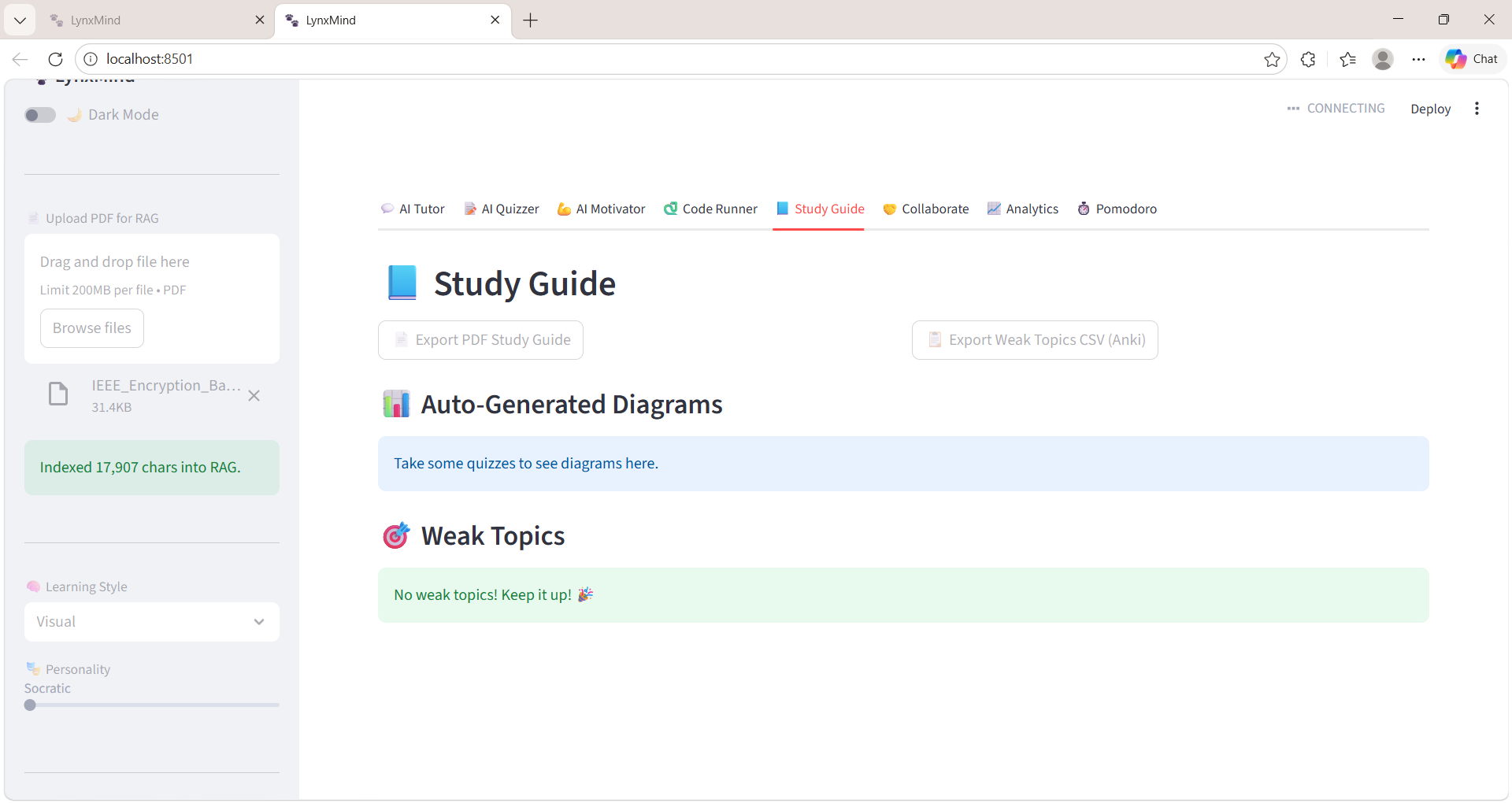
LynxMind uses three specialized AI agents:
- Tutor – answers questions using RAG from uploaded PDFs
- Quizzer – generates adaptive quizzes (easy/medium/hard) and tracks weak topics
- Motivator – gives personalized encouragement based on your performance
Plus 17 more features: gamification (XP/levels), code runner, voice input/output, dark mode, Pomodoro timer, PDF study guide export, collaboration, analytics dashboard, spaced repetition, LaTeX math rendering, personality slider, and more.
How we built it
- Local LLM: Ollama + llama3.2:3b (runs entirely offline)
- RAG: FAISS vector database + sentence-transformers embeddings
- Frontend: Streamlit with 8 custom tabs
- Persistence: JSON files for user progress, XP, and review schedules
- Libraries: PyPDF2, reportlab, matplotlib, plotly, pyttsx3, langchain
Challenges we faced
- Making all 20 features work together without breaking the local LLM context
- Ensuring the Pomodoro timer didn't block Streamlit's event loop
- Generating diagrams from natural language descriptions
- Implementing voice input within Streamlit's component architecture
What we learned
- Offline AI is feasible and powerful for education
- Multi-agent systems can create richer user experiences than single chatbots
- Gamification dramatically increases engagement
Impact
LynxMind democratizes AI tutoring – no internet, no API costs, no data privacy concerns. Perfect for rural schools, low-bandwidth areas, and students who prefer local tools.

Log in or sign up for Devpost to join the conversation.