-
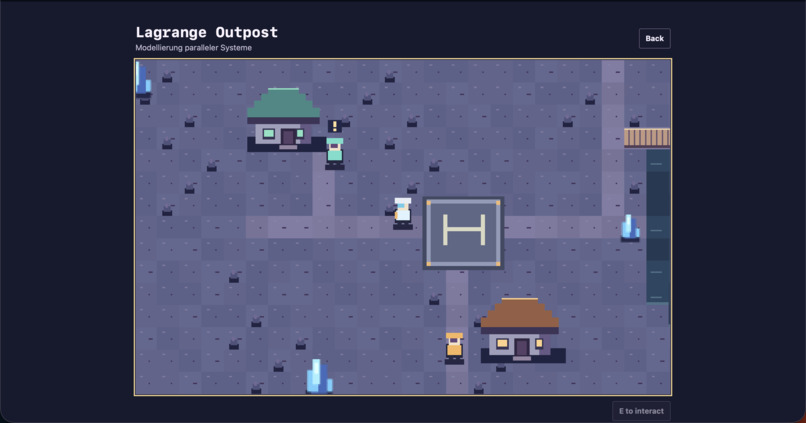
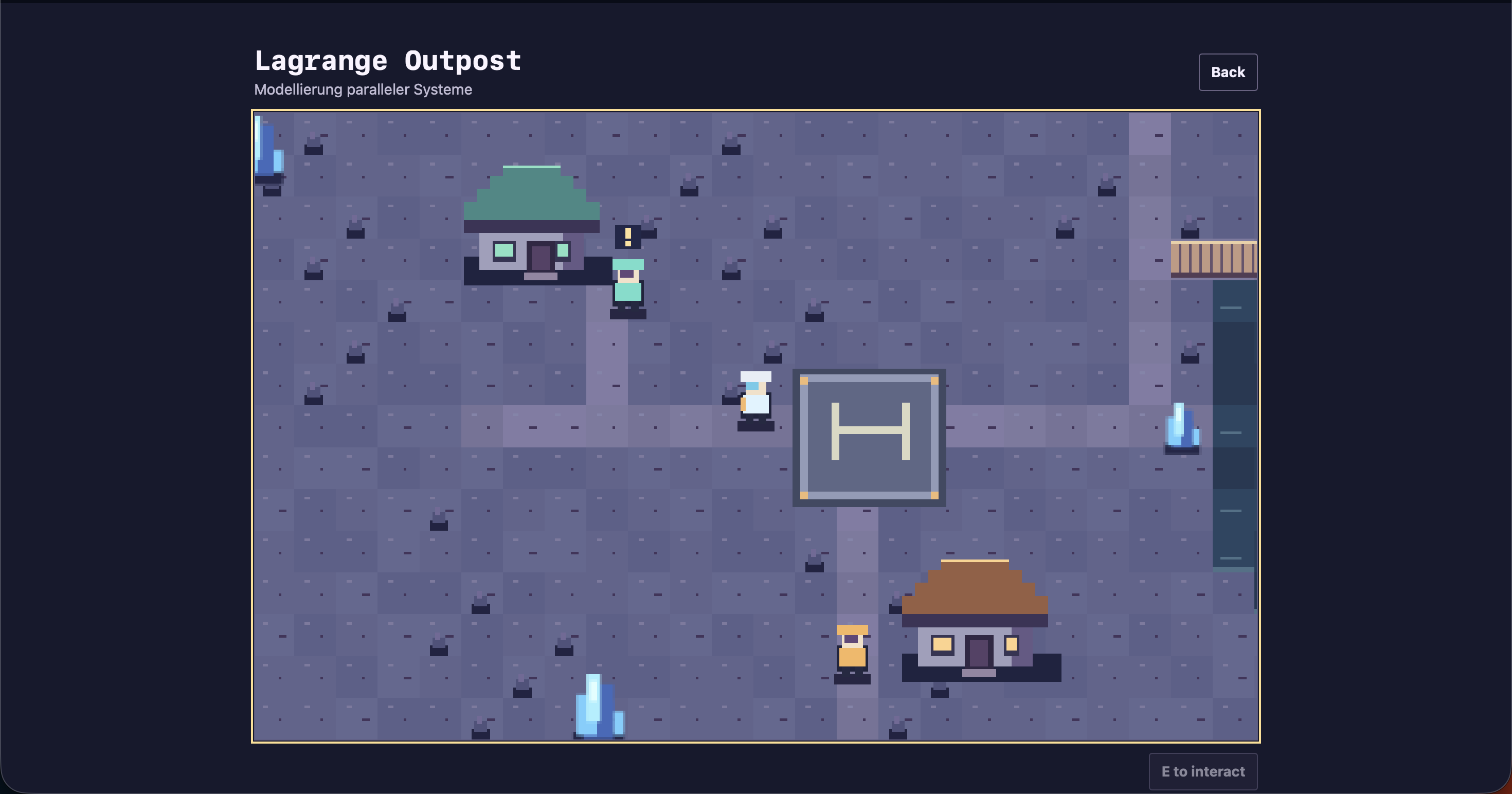
Minigame with curriculum questions
-
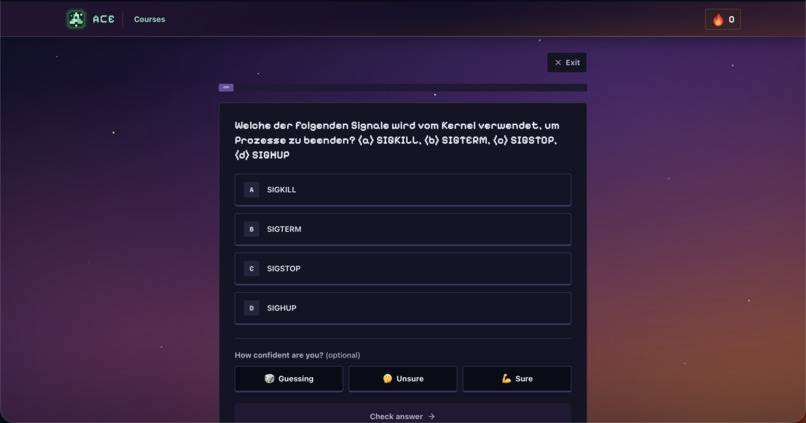
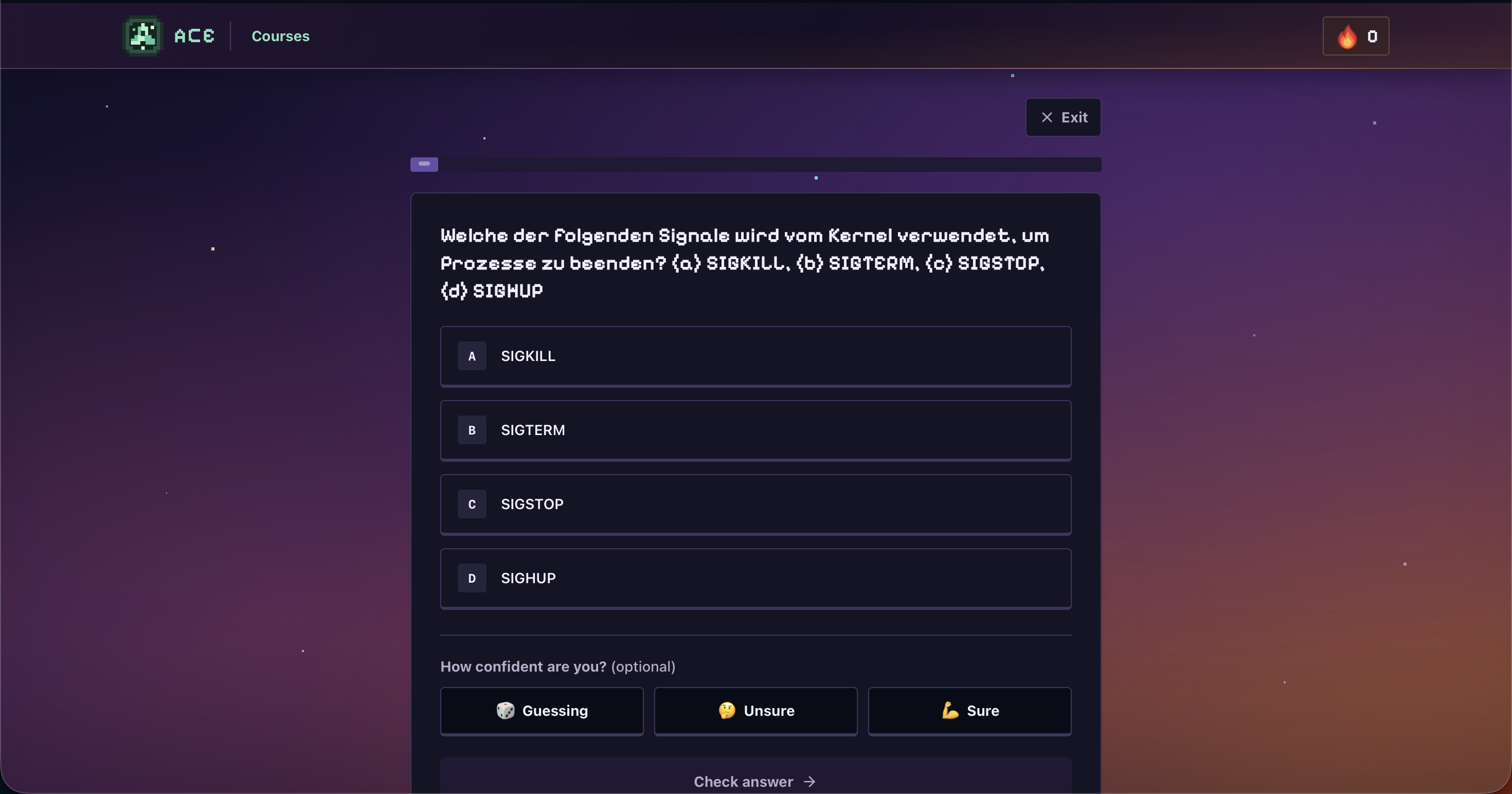
Practice lesson
-
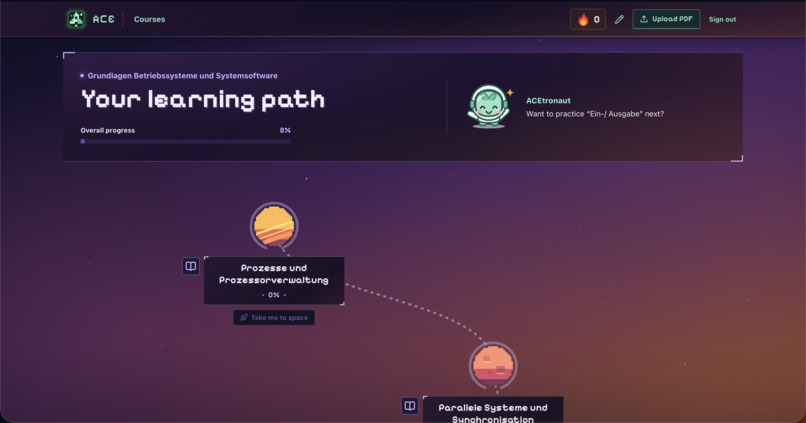
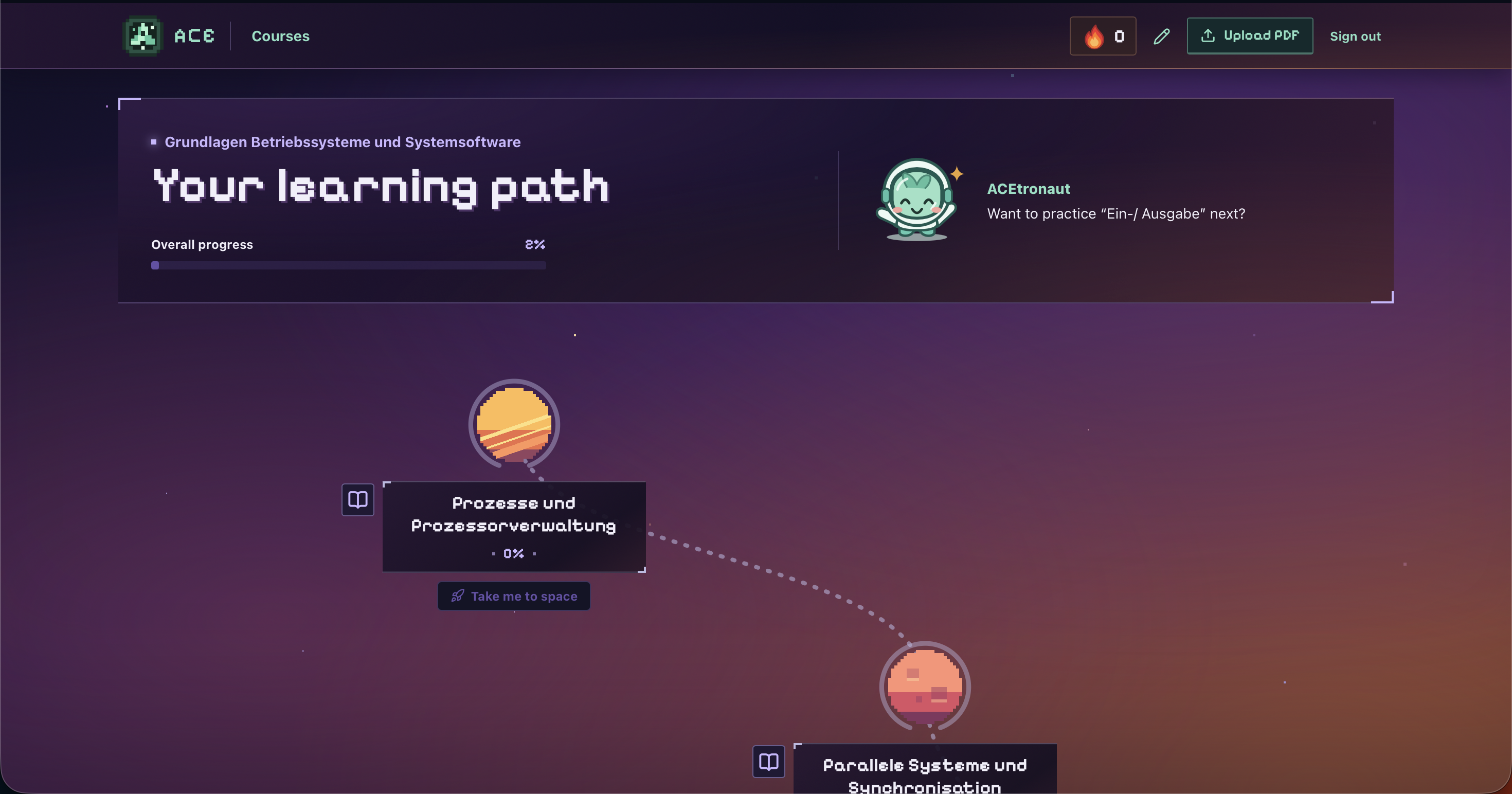
Planet learning path
-
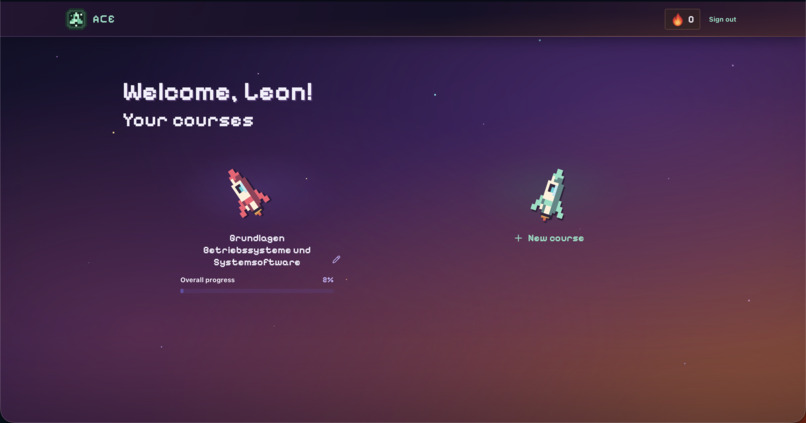
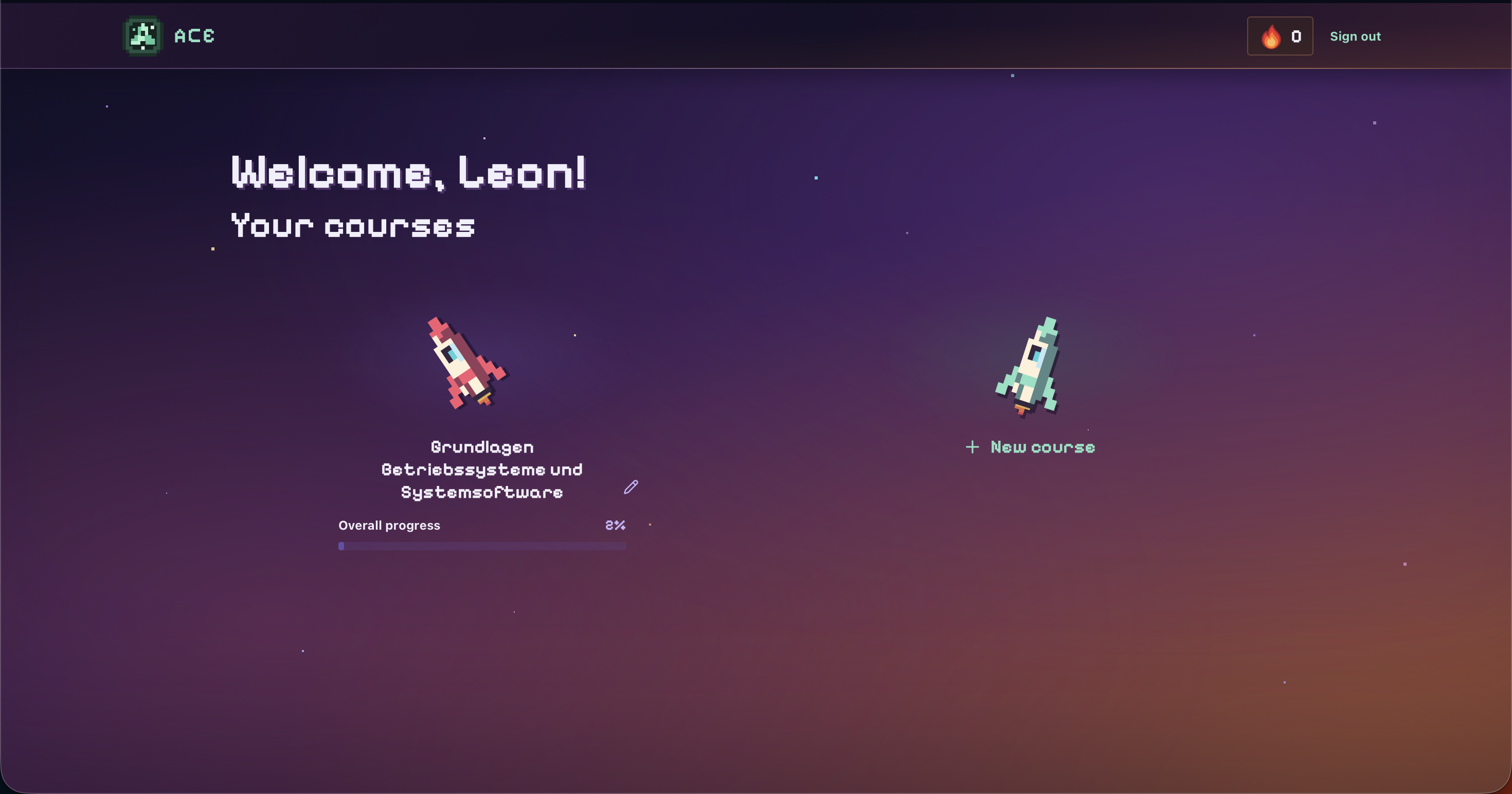
Course selection landing page after login
Inspiration
Many multiple choice and one liner questions in university exams require detailed and in depth knowledge of the course content, while only a limited amount of actual practice materials focusing on this directive are available. Being able to solve the standard tasks and having a broad overview is good, but often not enough.
However, learning these type of questions by repeating the entire slide deck becomes exhausting, boring and inefficient, so a lot of students tend to skip this part.
What it does
To make this annoying but also important learning goal more fun, we implemented a fully automatic interactive tutoring system that adapts to your performance of different topics and provides playful interaction to motivate learners.
The user story begins with a login, after that, the student can upload the course material and the curriculum is automatically generated. This is done in a two stage AI parse which first splits the lecture into roughly 8-12 chapters, including the correct order, title and relevant pdf pages. After that, it uses multiple agents to generate a list of the chapters subtopics and 48 questions containing their corresponding subtopic, the question text, type, difficulty, correct answer and and if not obvious, an explanation of the solution.
For a welcoming and warm design, our setting is in space, where our cute little mascot ACE, dressed up as an ACEtronaut, is there to help. After picking the course, the student sees a roadmap of the chapters in form of planets. They contain a circular progress bar, showing the current learning progress of the chapter, the title and a pop up for a short markdown summary. By clicking on a chapter, a lesson is startet. The user answers about ten multiple choice or free text answers, initially uniformly distributed about all subtopics. After submitting, one get's immediate feedback, including LLM grading of your free text answer. For active recall, each subtopic get's an approximated half-life time, inspired by Settles' and Meeder's A Trainable Spaced Repetition Model for Language Learning.
The idea is that the forgetting curve is modeled by exponential decay \(p = 2^{-\frac{\Delta}{h}}\). p is the probability a student can answer a question of the subtopic after the passed time (\Delta\). Right after the practice, p equals almost 1.0 and after the half-life time h, it is 0.5. After a very long time, it reaches almost zero. Each pool intentionally consists of way more questions than asked in a lesson to prevent to discourage memorization.
By using this method, easy subtopics will be asked again only after a long time, while hard ones are repeated earlier, leading to less time wasted with practicing already mastered areas. To make things even more enjoyable, our prototype also includes minigames in which the user has to find a treasure. In order to do this, several npcs provide hints if you can answer their question, which is of course on of the curriculum questions.
How we built it
We use Amazon nova-lite and nova-pro to generate the curriculum and free text answer grading. To prevent parsing errors, we use the bedrock tool mode for generating curriculum json files.
The front end is build with React, Vite and Tailwind and is hosted on an EC2 aws instance. For storing curriculums and user scores, we integrated Amazons DynamoDB.
Challenges we ran into
All of us had no experience with aws before. We also were familiar with classic LLMs, but automatic structured content generation was also new for us. Setting up the EC2 instance also turned out more complicated than expected, as the aws DNS names are not eligible for external SSL certificates, which is why we used duckdns.org as a solution. We decided against a server less deployment in order to have the separate running nova API on the same server.
Accomplishments that we're proud of
We harmonized well as a team and were able to deploy a working prototype, bringing our algorithm and game idea to life in a very limited time, while having limited experience with some of the used technologies.
What we learned
We learned using LLMs beyond chats, managing aws resources and also gained a lot of new frontend experiences.
What's next for ACE
Our original idea also included the automatic digitalization of practice exams to allow for automatic grading and provided guidance. But during the coding phase, we decided to focus more on the minigame path. But including this feature might be a neat addition to our project.
Built With
- aws-ec2
- dynamodb
- nova-lite
- nova-pro
- python
- react
- tailwind
- typescript


