Inspiration
We were inspired to make LUX to solve the difficulty of trying to examine something while also having to redirect your light source. For instance, if you wanted to see up the charging port in your phone, you might have to hold a flashlight in your mouth or with a hand to really get a good look. LUX aims to change all of that. It is a movable work light that can track both you and a paperweight to help you see. Although LUX is currently designed for a work bench, it can be easily extrapolated to look up to help you seen under a car or elsewhere.
What it does
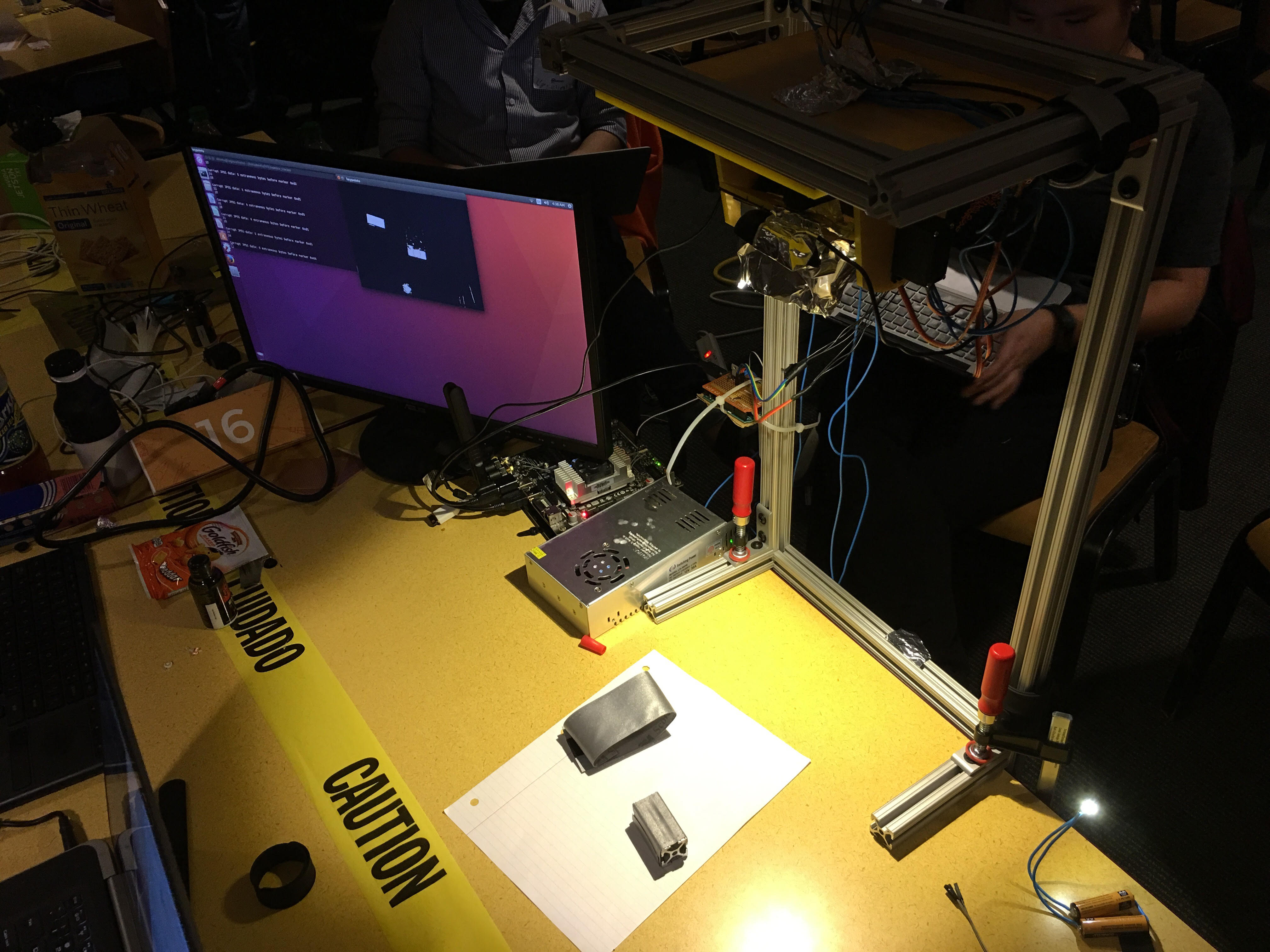
LUX stands for "Light Used for Examination." It is a motion-tracking work light which illuminates your work space. It tracks retroreflective bracelets and paperweights to move a 10W LED. It also has capacitive touch sense buttons to turn on and off, to dim and to brighten.
How we built it
The main mechanical bits (that hold the light and move it) were designed to be primarily laser cut with a few 3D printed parts. We used Jetson for machine vision and tracking, a webcam to see, implemented in C++ with OpenCV.
Challenges we ran into
First, we ran into a lot of odd bugs with learning how to setup our system and libraries. We then also had to learn C++. We also ran into unexpected mechanical challenges like overcoming friction (which we did with graphite based lubrication and a lot of sanding).
Accomplishments that we're proud of
We're proud of a lot of different aspects of this project. For starters, it's the first project we've ever done where we've met all of the specs that we set out to meet initially. We created a system that was able to track the light, differentiate between objects and not set itself on fire (overheat).
What we learned
For this iteration of LUX, we made only one setup to prove that tracking retroreflective objects was feasible with a light. We figured out how to work with the Jetson, design a robust mechanical gimbal from simple to manufacture parts, and track objects. We've created a version of LUX that can be easily expanded to multiple setups and multiple tracking objects.
What's next for LUX
There's a lot we want to do for LUX the second time around. Here's quick list
- Make multiple light setups
- Pattern Recognition for different bracelets and objects
- Battery-powered wireless version to bring outdoors.
- Miniaturize gimbal
- Generate a more user-friendly interface for the capacitive sense buttons
- Add a lens to the light to focus it better so we can mount it further up (like on a ceiling)
- Adjust the system for reflective surfaces or tables
Built With
- 80/20
- arduino
- jetson-tx1
- lasercutting
- retroreflective-tape
- webcam

Log in or sign up for Devpost to join the conversation.