\documentclass[11pt]{article}
\usepackage[margin=1in]{geometry} \usepackage[T1]{fontenc} \usepackage[utf8]{inputenc} \usepackage{lmodern} \usepackage{hyperref} \usepackage{enumitem} \usepackage{xcolor} \usepackage{parskip}
\hypersetup{ colorlinks=true, urlcolor=blue, linkcolor=black }
\title{\textbf{VitalSync: Unified Health Intelligence}} \author{} \date{}
\begin{document}
\maketitle
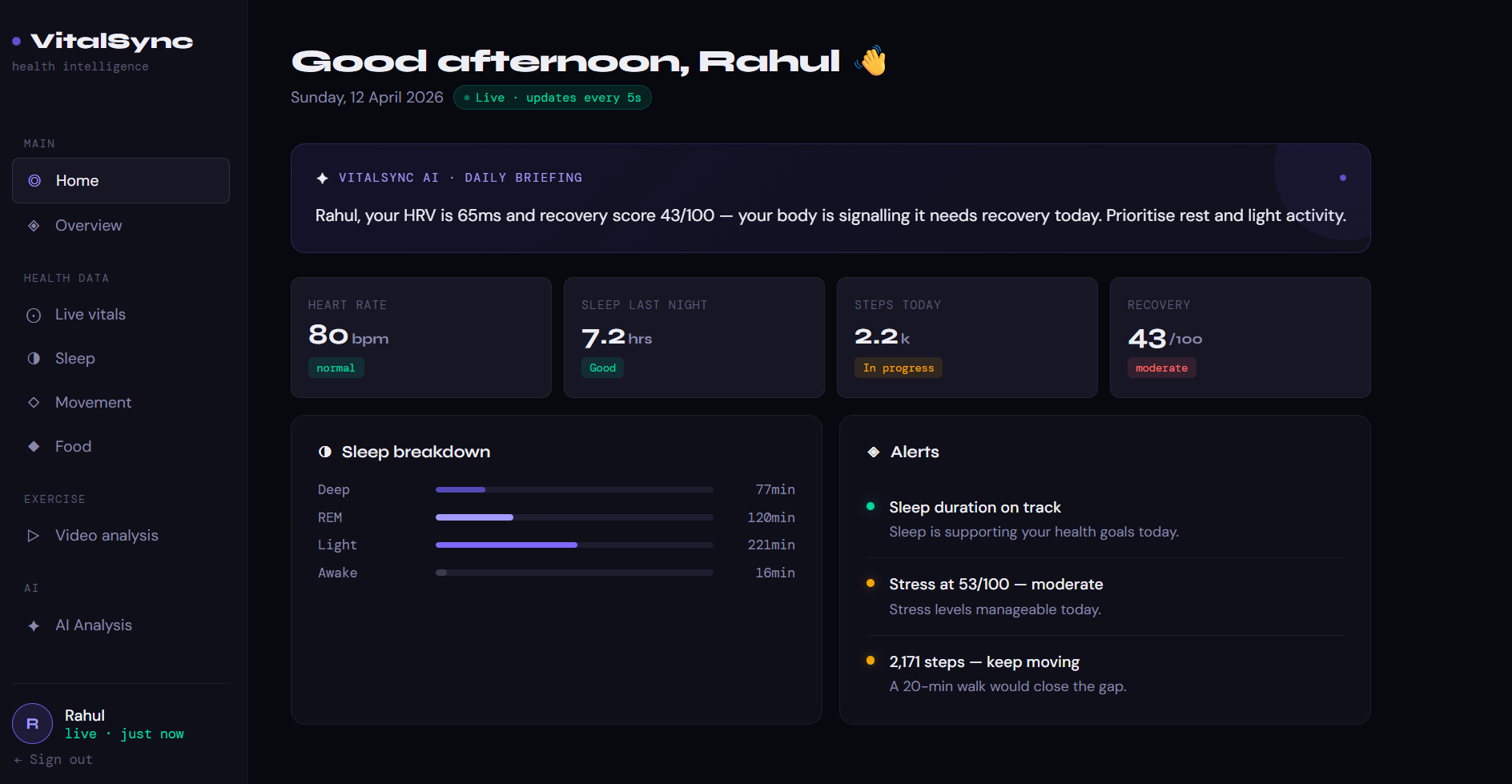
\noindent \textbf{VitalSync} is a privacy-first health dashboard that turns fragmented biometrics, workout analysis, and daily life context into one unified layer of health intelligence. Instead of showing users isolated charts and scores, VitalSync connects multiple health signals and translates them into personalized, actionable guidance.
\section*{Inspiration} Modern health data is everywhere, but it is rarely connected.
A smartwatch can measure sleep, heart rate, stress, and oxygen saturation. A fitness app can record workouts and movement. A person, meanwhile, experiences the context behind those numbers: a late-night flight, a stressful day, soreness after training, poor sleep, skipped meals, or an unusual change in routine. Traditional health platforms usually treat these as separate streams.
We built VitalSync to solve that fragmentation problem.
The inspiration came from the broader idea that AI should not just store or display information, but reason across it. In health, this matters even more. A single metric often means very little on its own. Elevated heart rate could be normal after exercise, but more concerning if it appears alongside poor sleep, high stress, and rising temperature. VitalSync is designed to bring those signals together and interpret them as one coherent picture.
\section*{What it does} VitalSync acts as a centralized health intelligence system that combines multiple data sources into a single dashboard and reasoning pipeline.
It currently supports three major input types: \begin{itemize}[leftmargin=1.5em] \item \textbf{Live wearable telemetry} from a backend API \item \textbf{Workout video analysis} using computer vision \item \textbf{Manual context logging} for real-life events and overrides \end{itemize}
\subsection*{Live wearable telemetry} VitalSync continuously polls a backend API for near-real-time biometric data, including: \begin{itemize}[leftmargin=1.5em] \item Heart rate \item Blood pressure \item SpO2 \item Skin temperature \item Stress levels \end{itemize}
These signals are refreshed regularly and displayed in the dashboard so users can monitor changing physiological conditions over time.
\subsection*{Workout video analysis} Users can upload workout videos in formats such as MP4, MOV, and AVI. A computer vision processing pipeline analyzes the footage and returns structured insights such as: \begin{itemize}[leftmargin=1.5em] \item Exercise form quality \item Repetition counts \item Estimated calorie burn \item Injury-risk indicators \end{itemize}
This allows VitalSync to go beyond passive vital tracking and include movement intelligence as part of the user’s daily health state.
\subsection*{Manual context logging} Health data becomes much more meaningful when paired with human context. VitalSync allows users to manually log events such as: \begin{itemize}[leftmargin=1.5em] \item Slept poorly due to travel \item Had a stressful workday \item Feeling sore after training \item Missed meals or hydration \item Unusual fatigue \end{itemize}
These manual inputs help explain why biometric values may shift and allow the reasoning engine to generate more realistic and personalized recommendations.
\section*{Why it is different} Most health and recovery apps rely on simple weighted formulas to generate readiness or recovery scores. These systems are easy to compute, but they usually assume that each variable contributes independently and predictably.
In reality, human health is not linear.
A slightly elevated stress score, mildly reduced sleep, poor movement mechanics, and increased skin temperature may each seem minor in isolation. Together, however, they may signal overtraining, illness, or the need for recovery. Static formulas often miss these kinds of compounding effects.
VitalSync is designed to move beyond that model. Instead of depending only on preset weights, it sends the combined biometric, movement, and contextual data into \textbf{Claude}, which acts as a reasoning engine. The model interprets relationships between signals and generates a personalized daily health briefing.
This means the platform can help answer questions like: \begin{itemize}[leftmargin=1.5em] \item Why does recovery look lower today? \item Should the user reduce workout intensity? \item Are current patterns pointing to fatigue or injury risk? \item Which lifestyle changes would most likely improve the next day’s state? \end{itemize}
The result is a system focused on \textbf{interpretation}, not just measurement.
\section*{Example use case} Imagine a user wakes up after a short night of sleep following a late flight. Their wearable shows elevated stress and slightly higher heart rate. Later, they upload a workout video that reveals reduced form quality and possible compensation patterns.
A traditional tracker might display these as separate metrics.
VitalSync connects them and produces a more useful conclusion, such as:
\begin{quote} Your recovery may be reduced today due to poor sleep, travel fatigue, and elevated physiological stress. Training intensity should be lowered, with more emphasis on hydration, mobility, and rest. \end{quote}
That kind of cross-signal reasoning is the core value of the product.
\section*{Tech stack} VitalSync was built for speed, reliability, and demo readiness during a hackathon. The technical design intentionally favored simplicity and resilience.
\begin{itemize}[leftmargin=1.5em] \item \textbf{Frontend:} Vanilla HTML, CSS, and JavaScript \item \textbf{Architecture:} Single-page application contained in one \texttt{vitalsync.html} file \item \textbf{Persistence:} \texttt{localStorage} for lightweight session continuity \item \textbf{Realtime updates:} \texttt{setInterval} polling for telemetry refresh and asynchronous job tracking \item \textbf{AI reasoning:} Claude 3.5 Sonnet via the Anthropic API \item \textbf{Computer vision:} External video analysis API \item \textbf{Reliability:} Fallback mock responses to prevent UI failure when APIs are unavailable \end{itemize}
\section*{Architecture decisions} Because the project was built under tight time constraints, we made a few deliberate engineering tradeoffs.
\subsection*{Single-file frontend} The entire application lives inside one HTML file. This made the project easier to ship, demo, and troubleshoot quickly. It also removed the overhead of framework setup, build tooling, and dependency management during the hackathon.
\subsection*{Local session persistence} We used \texttt{localStorage} to preserve the user session across refreshes. This made the demo more stable and ensured that a browser refresh would not break the flow during testing or pitching.
\subsection*{Asynchronous polling} The app uses interval-based polling to continuously fetch new wearable data and track the state of video processing jobs. This creates a responsive experience without requiring a more complex real-time backend architecture.
\subsection*{Graceful fallback design} One of the most important parts of the implementation was resilience. External APIs can fail due to CORS restrictions, rate limits, cold starts, or connectivity issues. To avoid broken UI states, VitalSync uses \texttt{try/catch} safeguards and falls back to context-aware mock outputs when needed.
This ensures that the product experience remains smooth even when live integrations are unstable.
\section*{External integrations} VitalSync relies on three main external services: \begin{itemize}[leftmargin=1.5em] \item \textbf{Wearable Data API:} \url{https://hackathon-cxt3.onrender.com} \item \textbf{Video Processing API:} \url{https://video-api-mr3x.onrender.com} \item \textbf{LLM Reasoning API:} \url{https://api.anthropic.com/v1/messages} \end{itemize}
These services work together to provide live health telemetry, movement analysis, and AI-generated interpretation.
\section*{Getting started} \begin{enumerate}[leftmargin=1.5em] \item Download the \texttt{vitalsync.html} file \item Open it directly in any modern browser \item Enter your name on the entry screen to initialize the session \item Use the sidebar to navigate between telemetry, food logging, and video upload \item Upload a workout video or log contextual events to explore the reasoning workflow \end{enumerate}
\section*{Demo goals} VitalSync was designed as a working prototype that demonstrates a broader idea: \begin{itemize}[leftmargin=1.5em] \item Health data should be unified, not siloed \item AI should interpret relationships, not just summarize values \item Users benefit more from explanations and actions than raw numbers \item Consumer health tools can become more clinically meaningful when context is included \end{itemize}
\section*{Why it matters} Most consumer health products are good at collecting data but weaker at helping users understand it. They provide dashboards, graphs, and scores, but often leave the real interpretation to the user.
VitalSync aims to bridge that gap.
By combining wearable signals, workout analysis, and life events into one reasoning system, it helps users understand not only \textbf{what changed}, but also \textbf{why it changed} and \textbf{what they should do next}. That makes the platform feel less like a tracker and more like a daily health intelligence assistant.
\section*{Future potential} Although this version was built as a hackathon prototype, the concept can be extended much further. Future versions could support: \begin{itemize}[leftmargin=1.5em] \item More wearable ecosystems and health platforms \item Long-term trend analysis \item Smarter anomaly detection \item Personalized recovery baselines \item Richer clinician-facing summaries \item Nutrition and medication context \item Stronger privacy controls and data governance \end{itemize}
The long-term vision is to build a system that helps translate daily health signals into more proactive and informed decisions.
\section*{Note on AI functionality} Browsers restrict some direct client-side API calls to external services such as Anthropic because of CORS and related security policies. As a result, live Claude responses may not always work locally without a proxy or backend wrapper.
To keep the demo reliable, VitalSync includes built-in fallback responses that simulate the AI reasoning flow whenever live API access is unavailable. This ensures the interface remains functional and the core product experience can still be demonstrated.
\end{document}
Built With
- html
- javascript
- python
- render

Log in or sign up for Devpost to join the conversation.