Inspiration
I've been a big chocolate lover my whole life, and this past summer I had the opportunity to learn how to work with chocolate as part of an upcoming Netflix show. At the same time, I've been taking traditional Chinese herbal supplements for my PMS symptoms since I was a teenager. Like most people, I noticed my desire for chocolate would increase around the time of my period. So I was interested in combining these two elements into a product that would not only occupy a unique area in the food space, but also allow me leverage my background in product design and social media marketing.
What it does
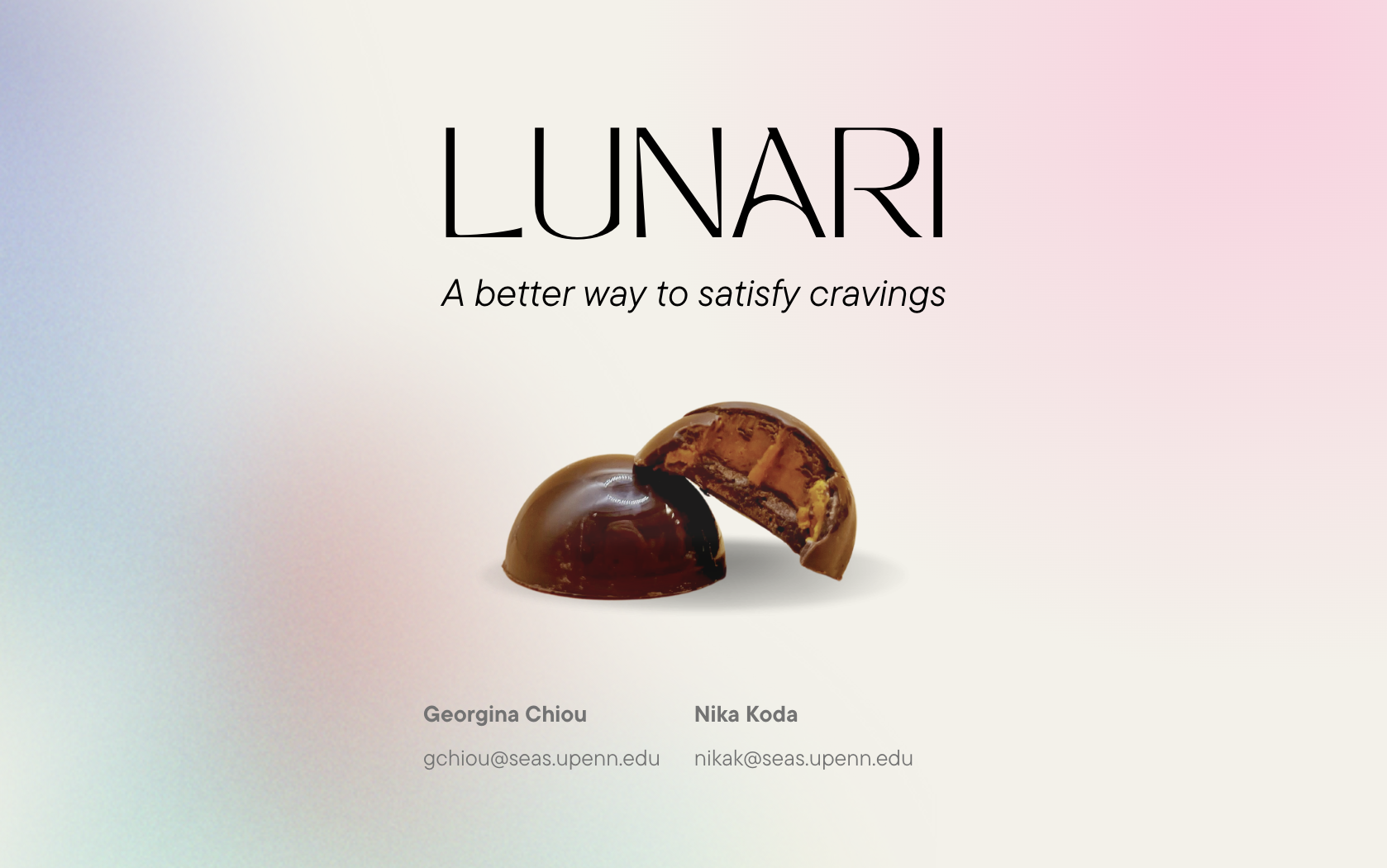
Lunari satisfies hormonal cravings while also easing physical and emotional PMS symptoms. Our delicious herbal chocolates contain a blend of traditional Chinese herbs that decrease bloating, cramping, and inflammation while still getting your chocolate fix. And, the inclusion cards in each box contain evidence-based prompts and exercises that help ease the emotional symptoms of PMS by regulating your nervous system.
How we built it
Since last fall, we've been working with the Food Innovation Lab (FIL) at Penn to develop our recipes. For each iteration, we would host a tasting session to evaluate flavor, and test the chocolates with 2-3 menstruating women to evaluate efficacy. This was done on a weekly basis, and we continued to iterate until we found a recipe that met our criteria. We also surveyed over 500 people in our target segment to gain a sense of what the current PMS and chocolate landscape looked like. For the inclusion cards, I interviewed licensed counselors and therapists who worked with people in my target market, and asked them about the tools they recommended to their clients for emotional regulation and grounding the nervous system. Cards, packaging, and visual identity were designed by me. Packaging was prototyped using Venture Lab Studio facilities.
Challenges we ran into
Recipe development and testing was where we saw the bulk of our challenges. Accounting for shelf stability, taste, and efficacy was difficult to accomplish, as taste and efficacy are very subjective between each person. Also, finding people to test the product got tricky, as I had to track the menstrual cycles of everyone in my test pool and find people who had differently timed cycles so that we would have menstruating people to test each iteration.
Accomplishments that we're proud of
The recipe we've developed. Quite frankly, our chocolates taste really good, to the point that even people who don't menstruate have told me they would buy it just to eat. They also have a very unique flavor, as we weren't trying to mask the taste of the herbs, but highlight them with complementary flavors. We've truly concocted a uniquely good recipe with a flavor that cannot be found in the current confectionary landscape. I'm also really proud of how we started with a recipe and ended with a full product and business plan.
What we learned
This venture was initially driven by my own personal interests, so I learned a lot about hammering down on things from an entrepreneurial perspective. Getting a hands-on understanding of the entire process, from validation to distribution, was huge for me, as my previous work only gave me glimpses into parts of the process (digital marketing and product design). It's hard for me to summarize what I learned without rehashing the entire syllabus, but I learned a lot about the need for specificity, validating a concept, and what it means to develop a viable business.
What's next for LUNARI
I'm currently in the process of obtaining the regulatory licenses needed to sell a product made in a commercial kitchen. I'll also be finalizing contracts with a kitchen and packaging manufacturer later this summer, and seeking some funding ($8,000) so that we can begin producing and shipping out orders for our Q4 launch.
Built With
- 64%darkchocolate
- adobecc
- callebautgoldenchocolate
- canva
- chasteberry
- dongquai
- heavycream
- turmeric

Log in or sign up for Devpost to join the conversation.