-
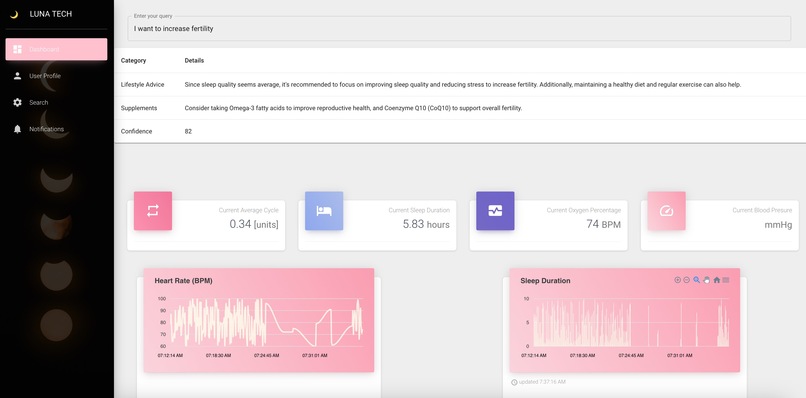
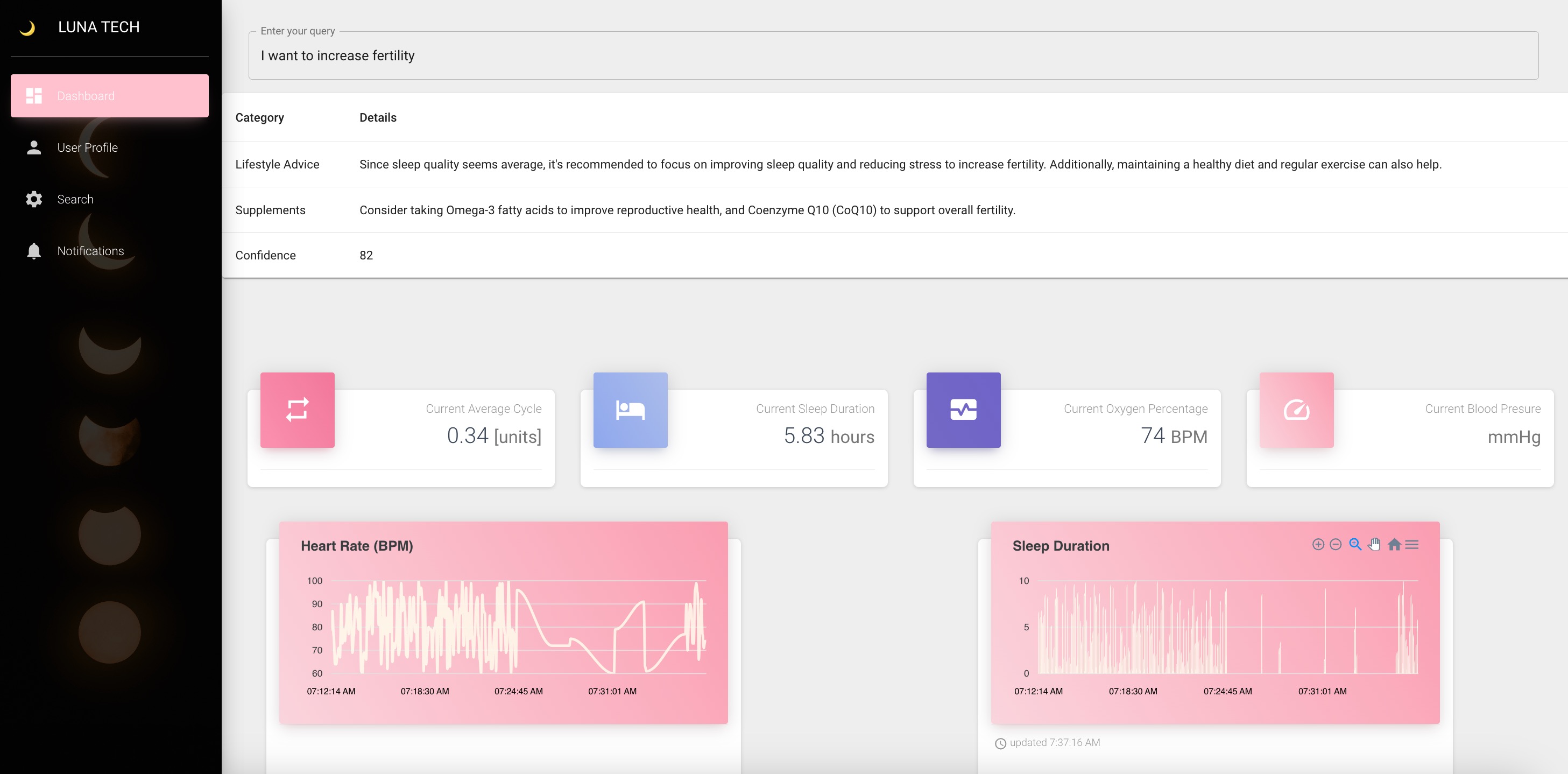
Website Display
Inspiration
Before 1993, women were rarely included in clinical trials. Even today, women still remain underrepresented in medical research, vastly limiting our understanding of how women, particularly women of color, react to and experience drugs and other medical procedures. Existing research published in medical journals typically remains unseen from the general public, and nuances of the research are easily lost when relayed through news articles or social media. We aim to consolidate all existing medical research about women's health and make findings more accessible to the general public.
What it does
Our website allows users to search questions ("How can I increase my fertility?", "How can I feel less bloated during my period?") and receive well-informed, research-based advice about lifestyle changes and dietary supplements to take. Our model takes into account personal demographics (age, race, previous medical history) and live-time data (BPM, menstrual cycle duration, oxygen levels, sleep duration) and consolidates it with published research papers to make a well-informed decision. Live-time information, such as BPM, menstrual cycle duration, and sleep duration, is also displayed on the dashboard.
How we built it
For frontend, we used Node.js. The model itself utilized an algorithm similar to mixture of experts. Many small LLMs, each an expert on a specific topic (sleep, menstrual cycle, drug interactions) generate advice with a corresponding confidence score. A larger LLM takes these responses and produces a distilled piece of advice that is well-informed, accurate, and comprehensive.
Challenges we ran into
After training the smaller LLM models, we discovered the advice was too generic and sometimes even included other genders. This was due to one of our decisions early on, where we realized our original idea of finding the 50 most relevant research papers to train our small LLMs was infeasible for the scope of the project in terms of time, resources, and compute. We decided to stick with our original decision to create smaller, less knowledgable LLMs, and take the tradeoff for accuracy with functionality. In the end, we prompted the model with the target gender and shelved the task to make more accurate LLMs for the future.
Accomplishments that we're proud of
One accomplishment we're proud of was our task delegation. All four team members were experienced in different parts of the tech stack, and our distribution of expectations and features to ship were evenly distributed. Everyone collaborated, communicated, and worked together, and learned about the other parts of the tech stack as well. Being collaborative came naturally to us, and as a team we worked very efficiently. Additionally, we are proud of the realistic pacing of the scope of the project. We finished just on time, and the features that we deemed infeasible had alternatives that worked almost just as well. Overall, we worked well as a team, and decided on a challenging yet doable project to complete.
What we learned
We learned a lot of technical skills while working on this project. None of us had worked with LLMs before, so learning how to train such a big model and learning to tailor our queries successfully took a lot of research. We also became familiar with different parts of the tech stack that we weren't familiar with before- for some of us, it was our first time learning how to write APIs and how front-end and back-end were connected!
What's next for Luna Tech
For Luna Tech, one of our first priorities is to improve the smaller LLMs by training them on larger, more curated datasets tailored to women's health. With more time and compute, we can train our LLMs to become true experts that are up-to-date with the latest publications. With this, we can also include more topics for our smaller LLMs, including ones knowledgable about microbiomes, exercise, and diet. In the future, we can use unsupervised learning to select the topics that are most relevant to the search criteria.
Furthermore, we hope to expand wearable device data integration. By integrating wearable devices like FitBit or Apple Watch, we can track additional biomarkers like glucose levels and heart rate variability to give the model a better picture of the user and their needs. In the far future, we hope to create a device that can track hormones, which would be extremely useful in assessing health during menstruation, pregnancy, and postpartum.

Log in or sign up for Devpost to join the conversation.