
Inspiration
The inspiration for Luna came from the need to create a compassionate and approachable virtual assistant that can help individuals, especially the younger demographic, navigate their emotions. In a fast-paced world, mental health support should be easily accessible, and Luna aims to provide a listening ear whenever someone needs it.
What it does
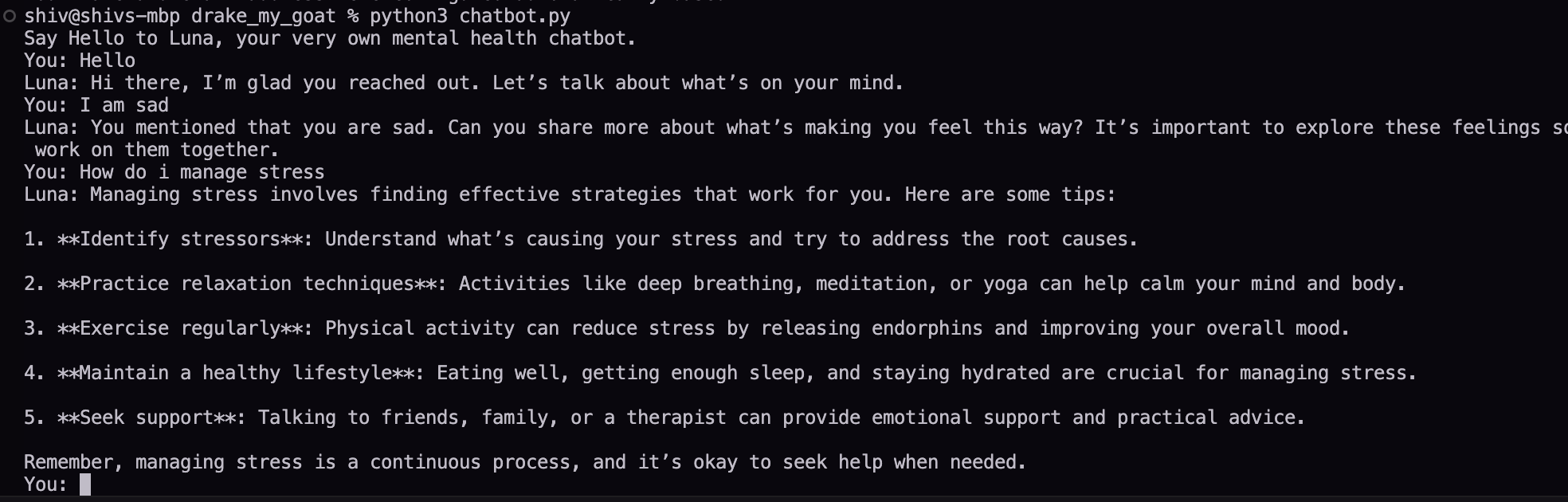
Luna is an interactive chatbot designed to engage users in conversations about their feelings, providing supportive responses. Whether users need advice, a comforting response, or just someone to talk to, Luna is there to offer sympathy and support.
How we built it
We built Luna using Python, leveraging the re and random libraries to match user inputs with appropriate responses. The chatbot logic was developed to handle user queries, match them with predefined patterns, and provide tailored responses.
Challenges we ran into
One of the main challenges we faced was designing a response system that could handle the diverse ways people express their emotions. We tried to use OpenAI, but were conflicted therefore creating a dictionary with predefined responses, so Luna could respond empathetically to a wide range of emotional inputs.
Accomplishments that we're proud of
We’re proud of creating a chatbot that can offer meaningful and empathetic responses to various emotional triggers. Additionally, developing a robust response system that can handle different conversational patterns is something we’re particularly pleased with.
What's next for Luna
In the future, we plan to implement Luna in an iOS app or a web app, making it even more accessible to users. We also aim to incorporate more advanced techniques, as well as using OpenAI (buying credits for the API key lol) and expand Luna’s conversational capabilities to cover a broader range of emotional scenarios.


Log in or sign up for Devpost to join the conversation.