-
-
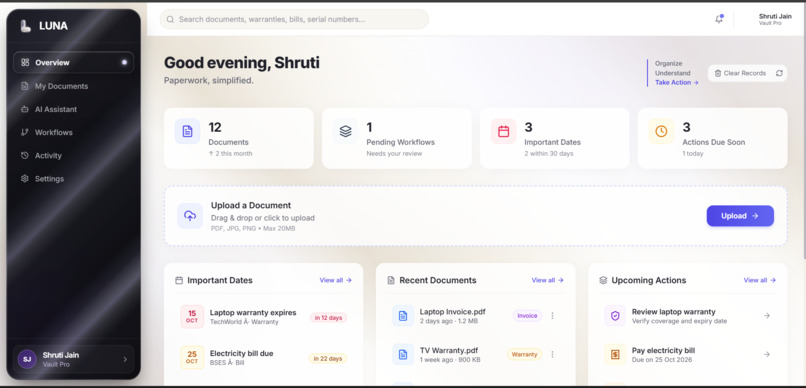
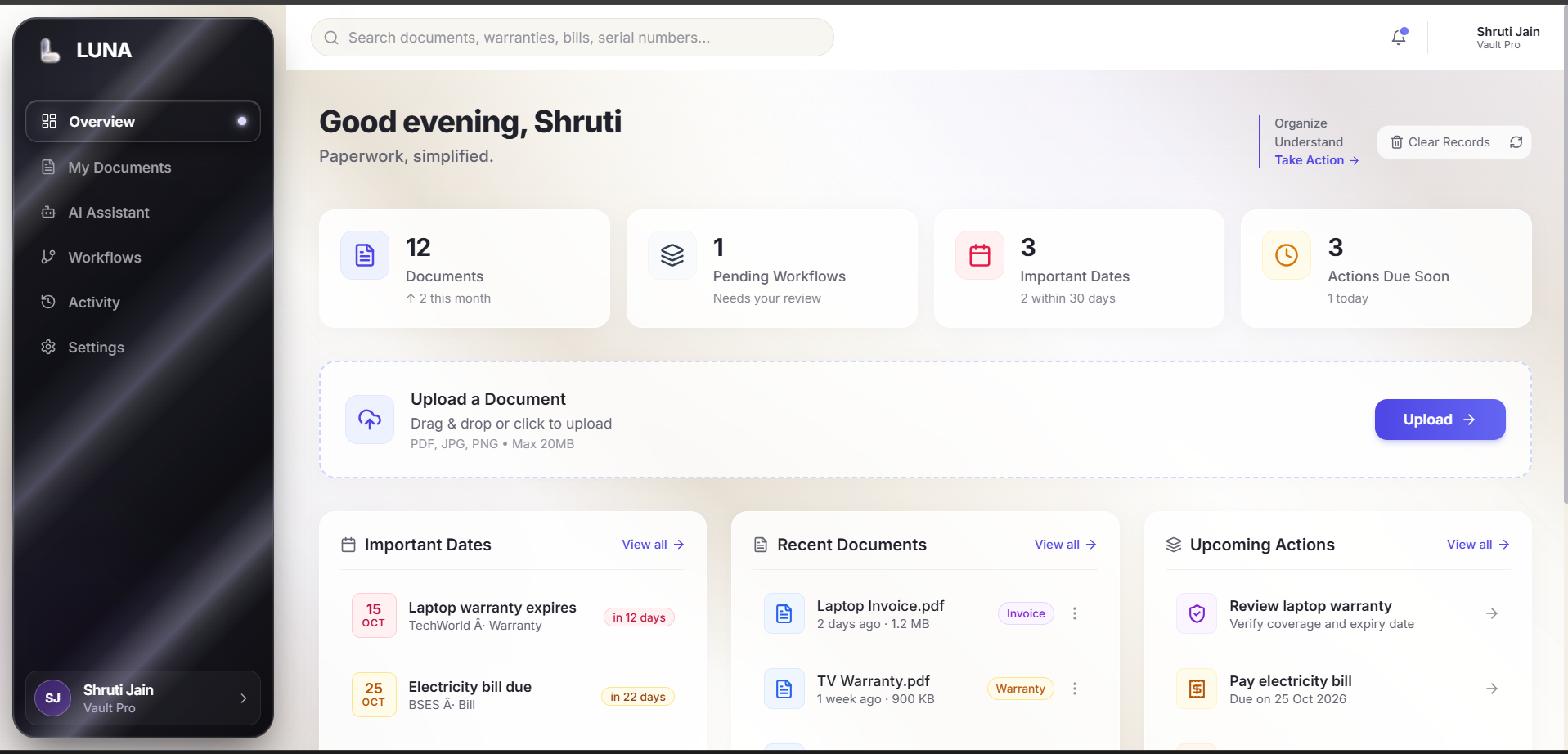
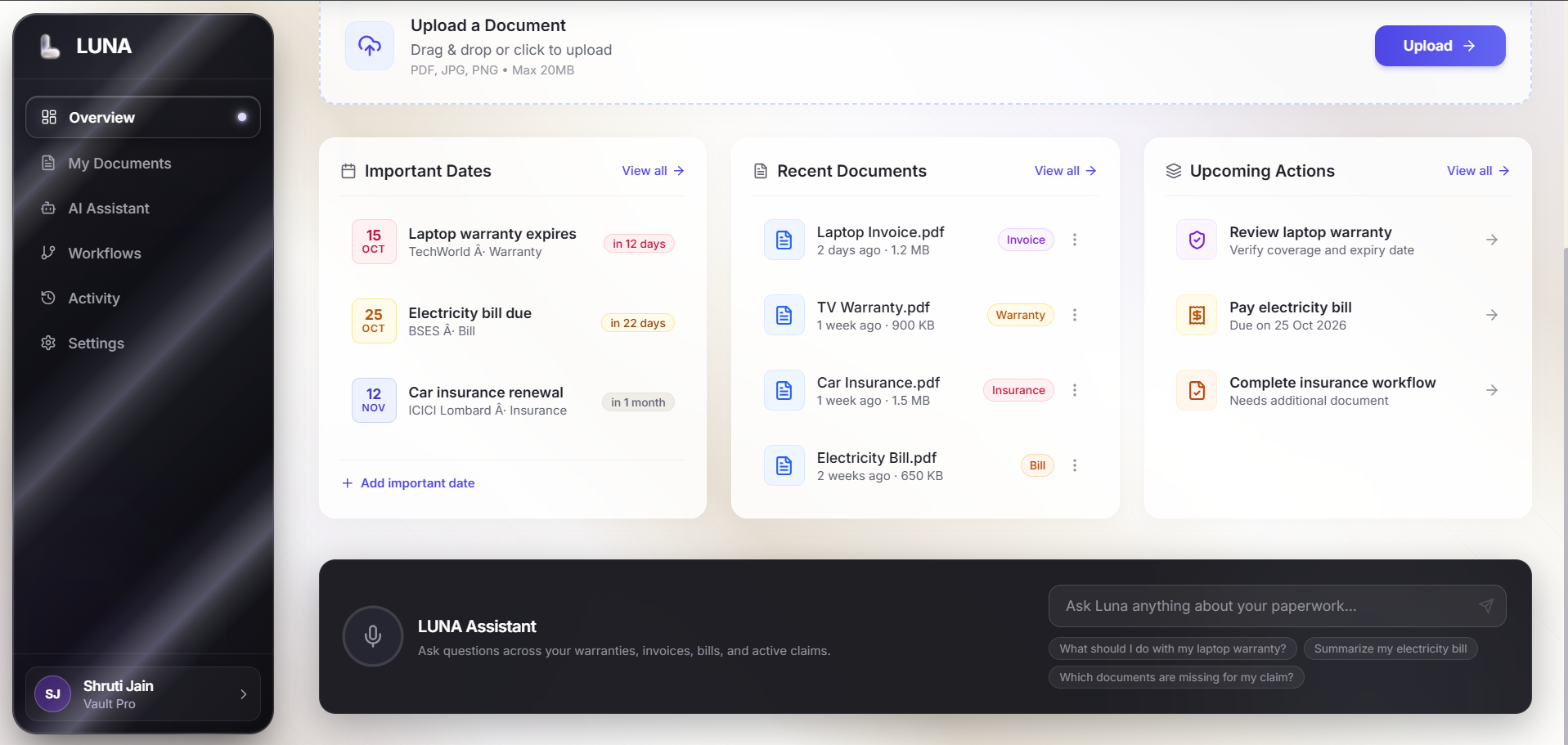
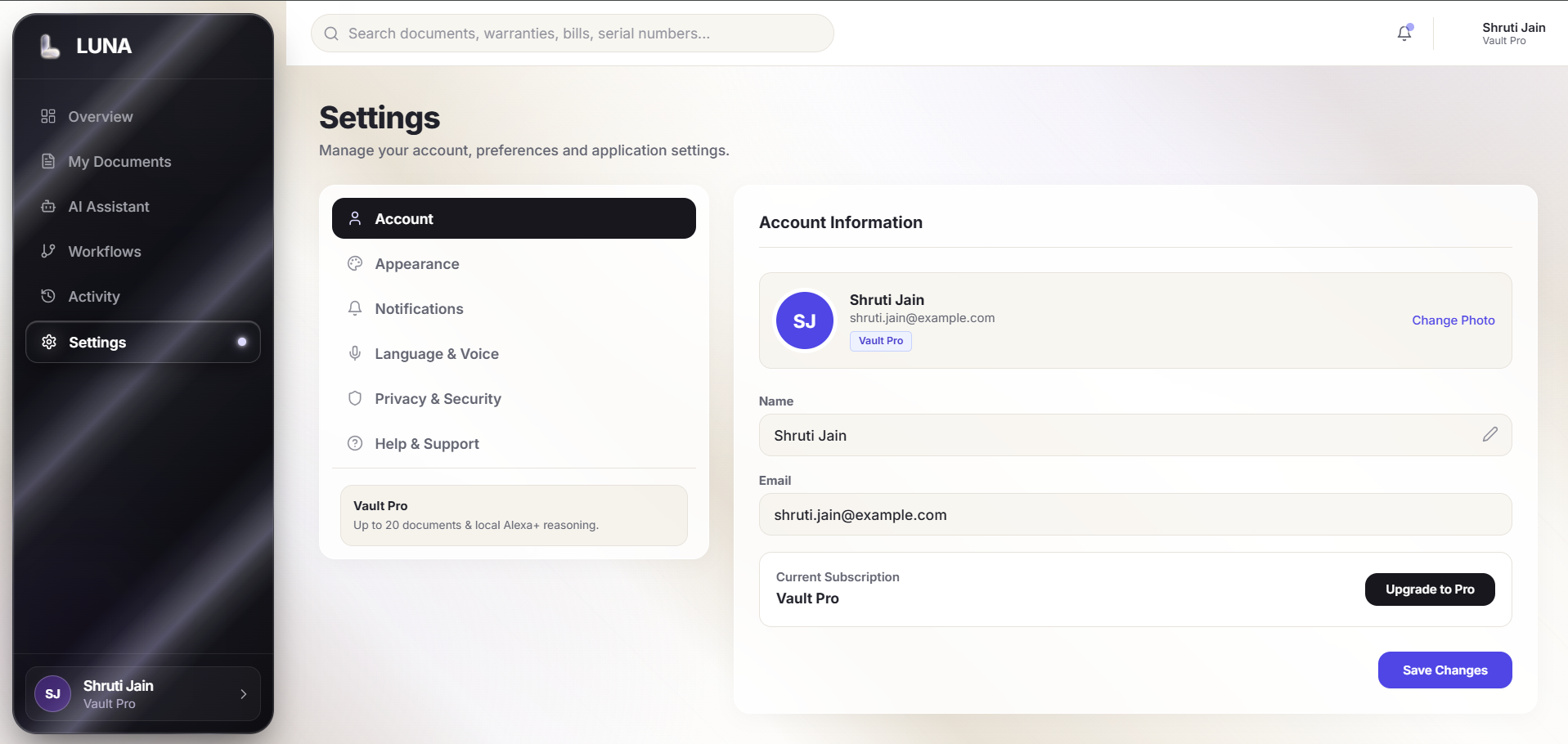
Luna's personalized dashboard brings documents, important deadlines, pending workflows, and upcoming actions into one intelligent workspace.
-
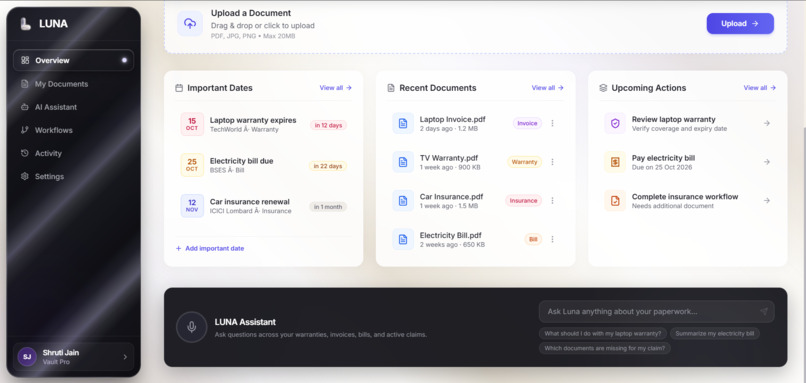
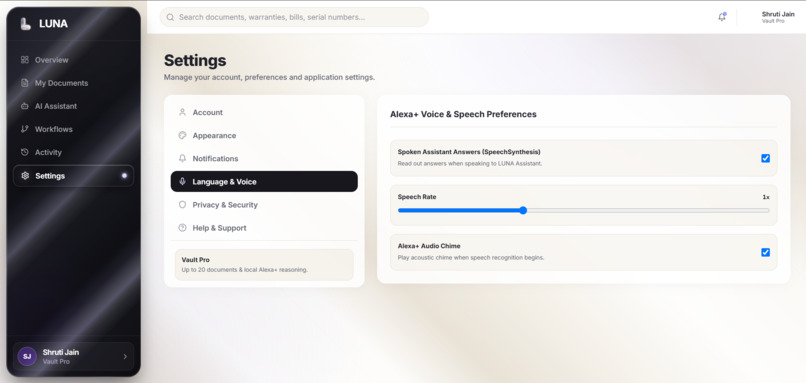
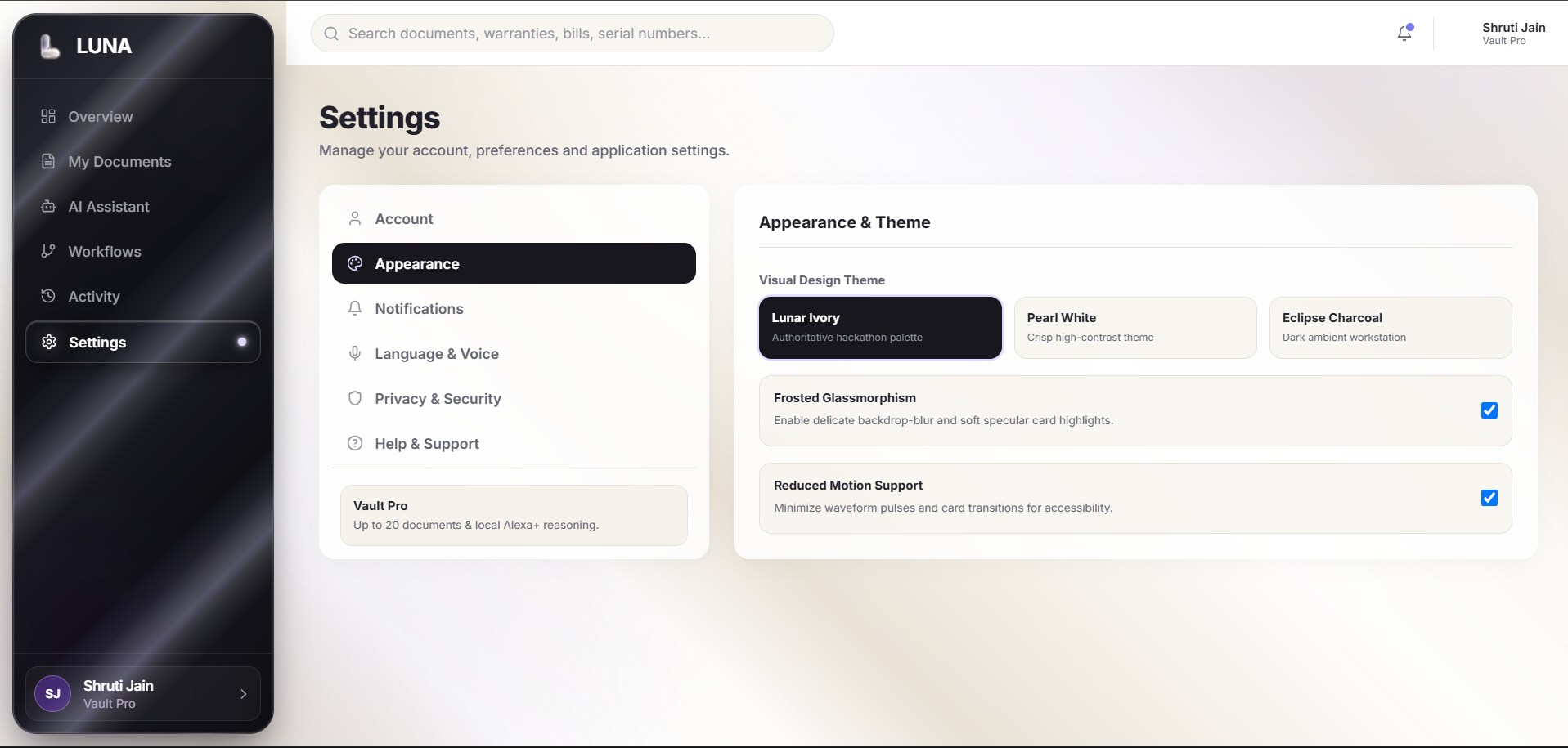
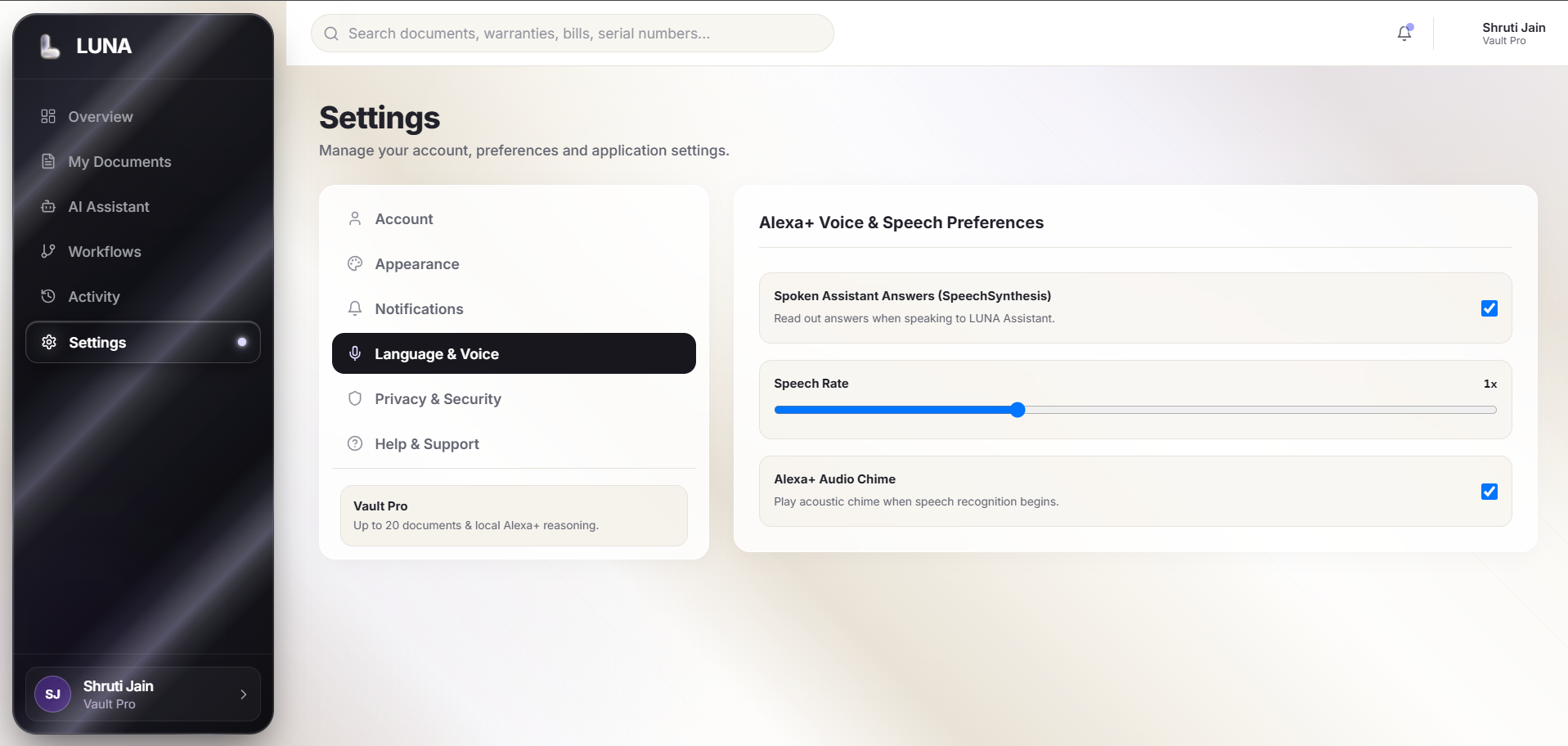
Customizable voice settings make Luna's conversational document assistant more accessible and natural to interact with.
-
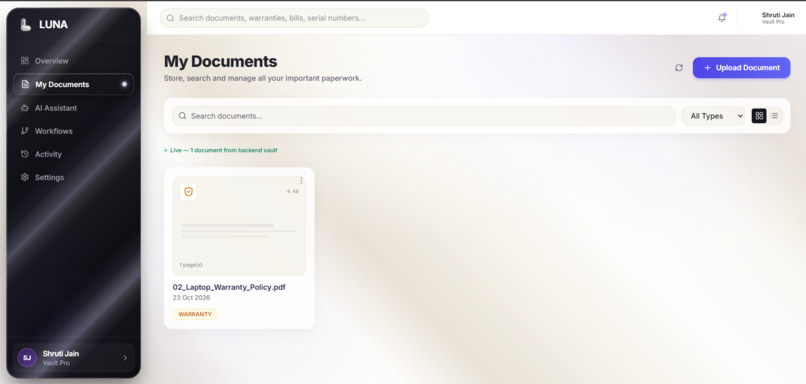
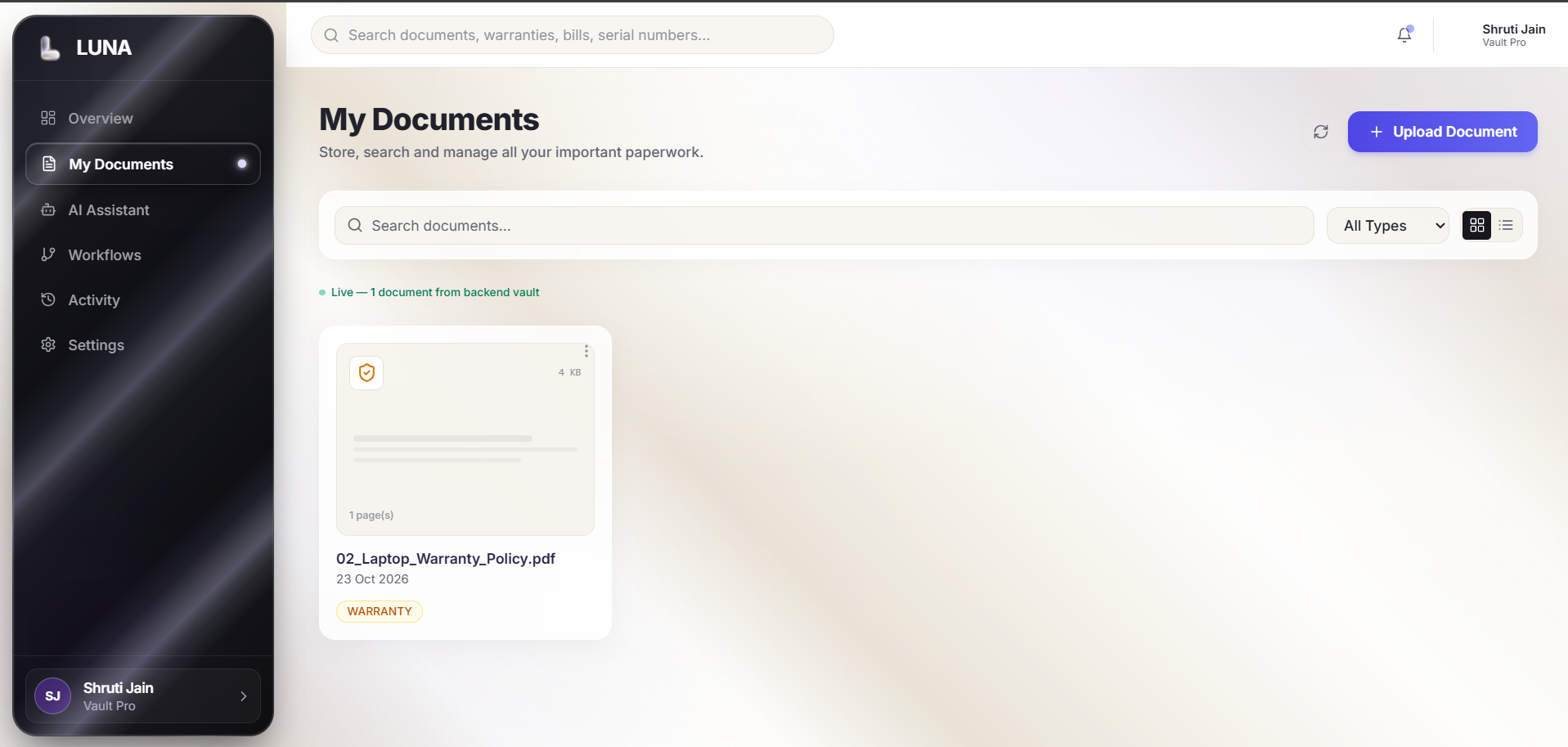
A centralized document vault where users can upload, organize, search, and access important paperwork.
-
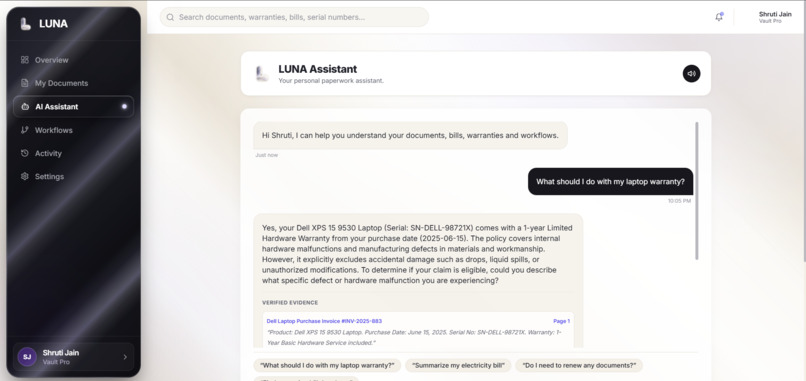
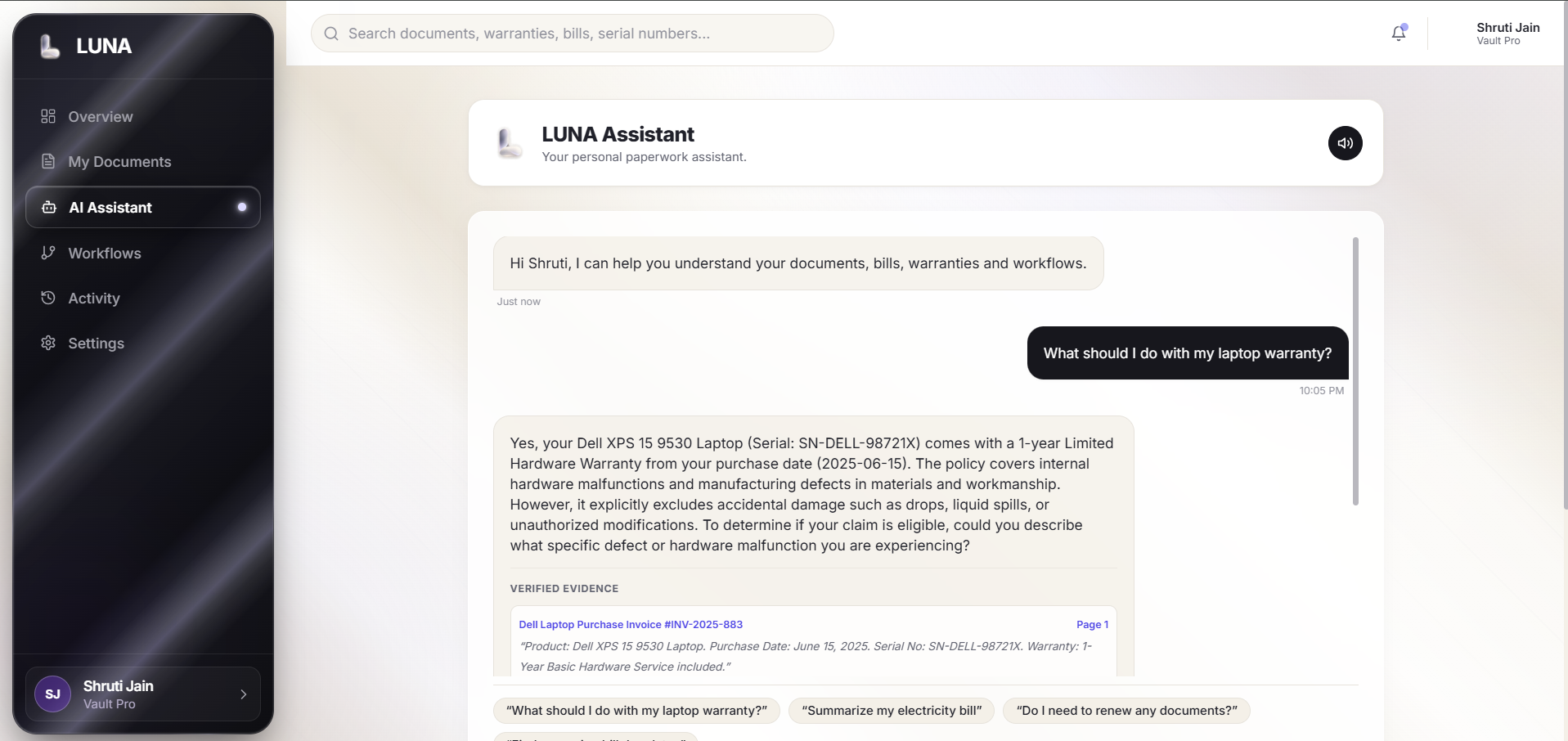
Luna's conversational AI assistant helps users understand complex documents with contextual answers and supporting source evidence.
-
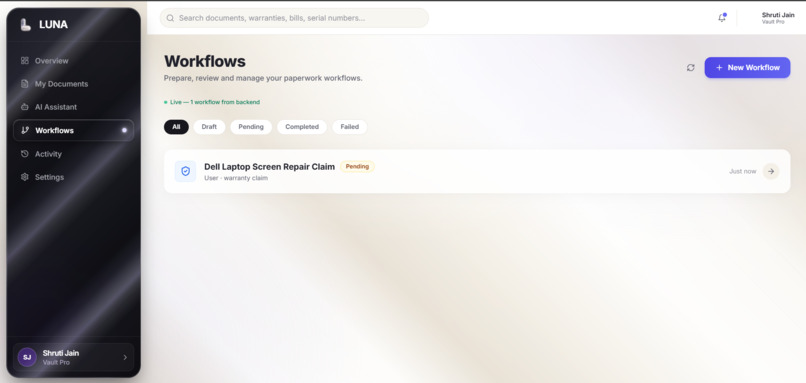
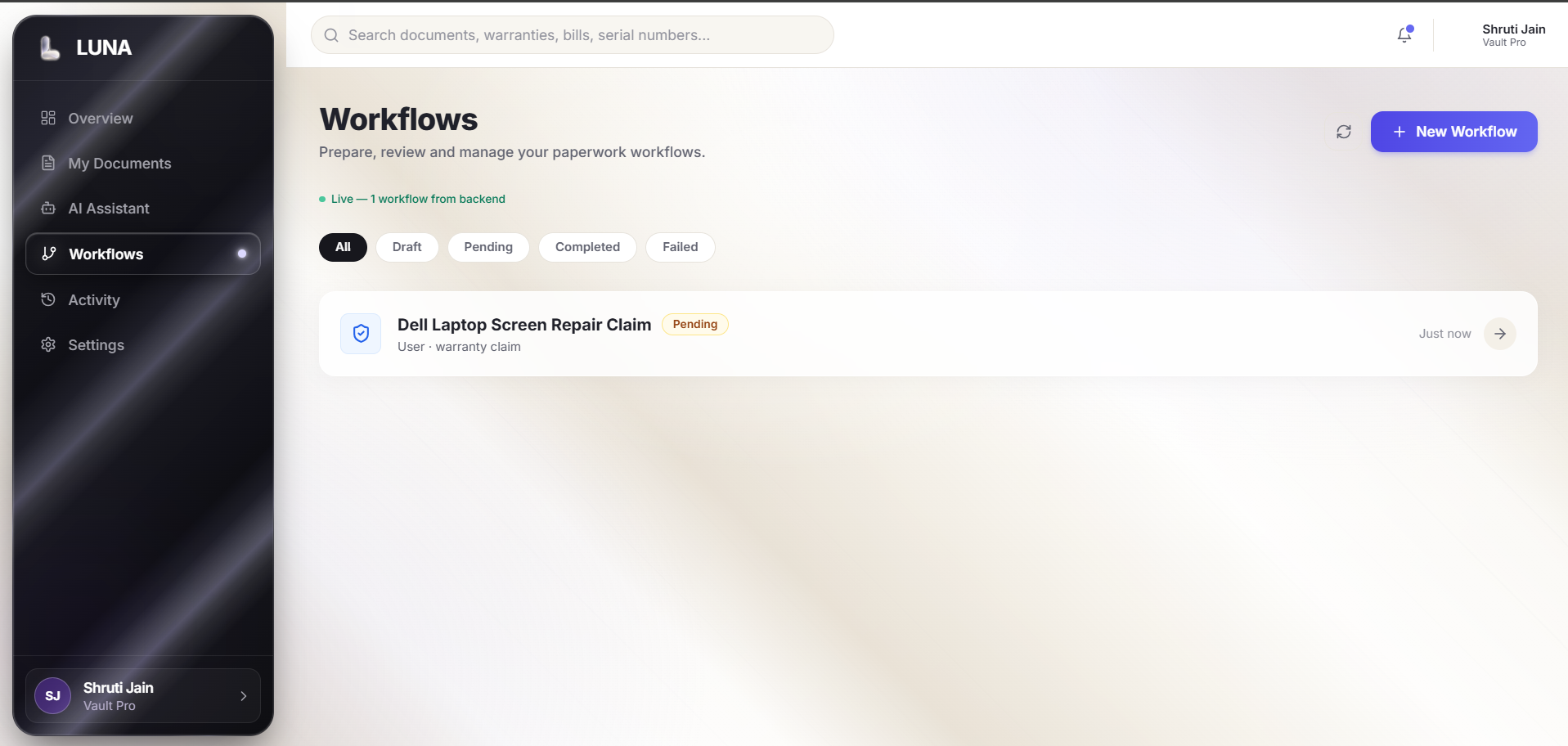
Transform document information into actionable workflows, track claim progress, and review requests before taking action.
-
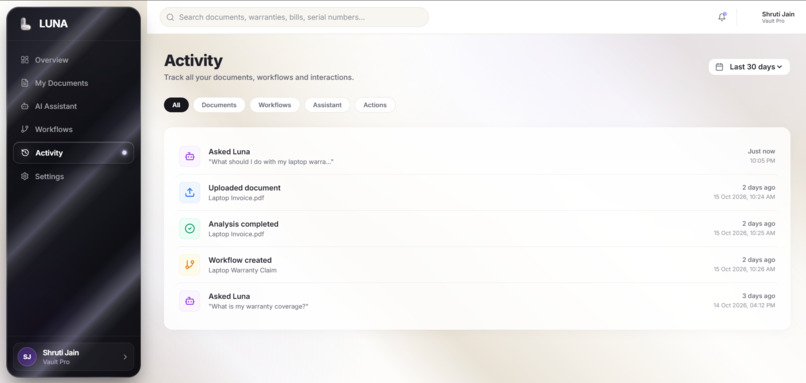
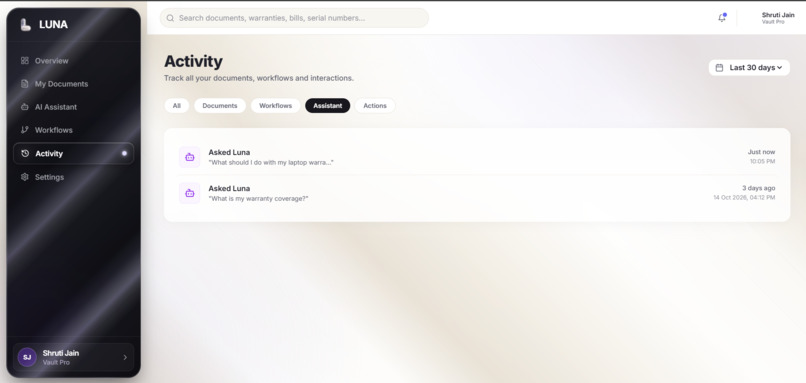
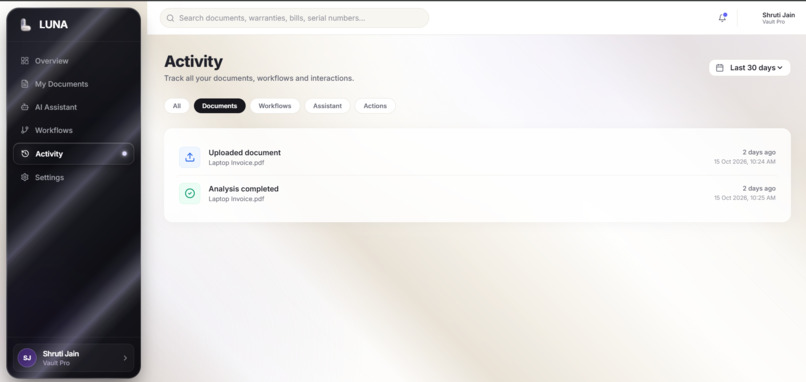
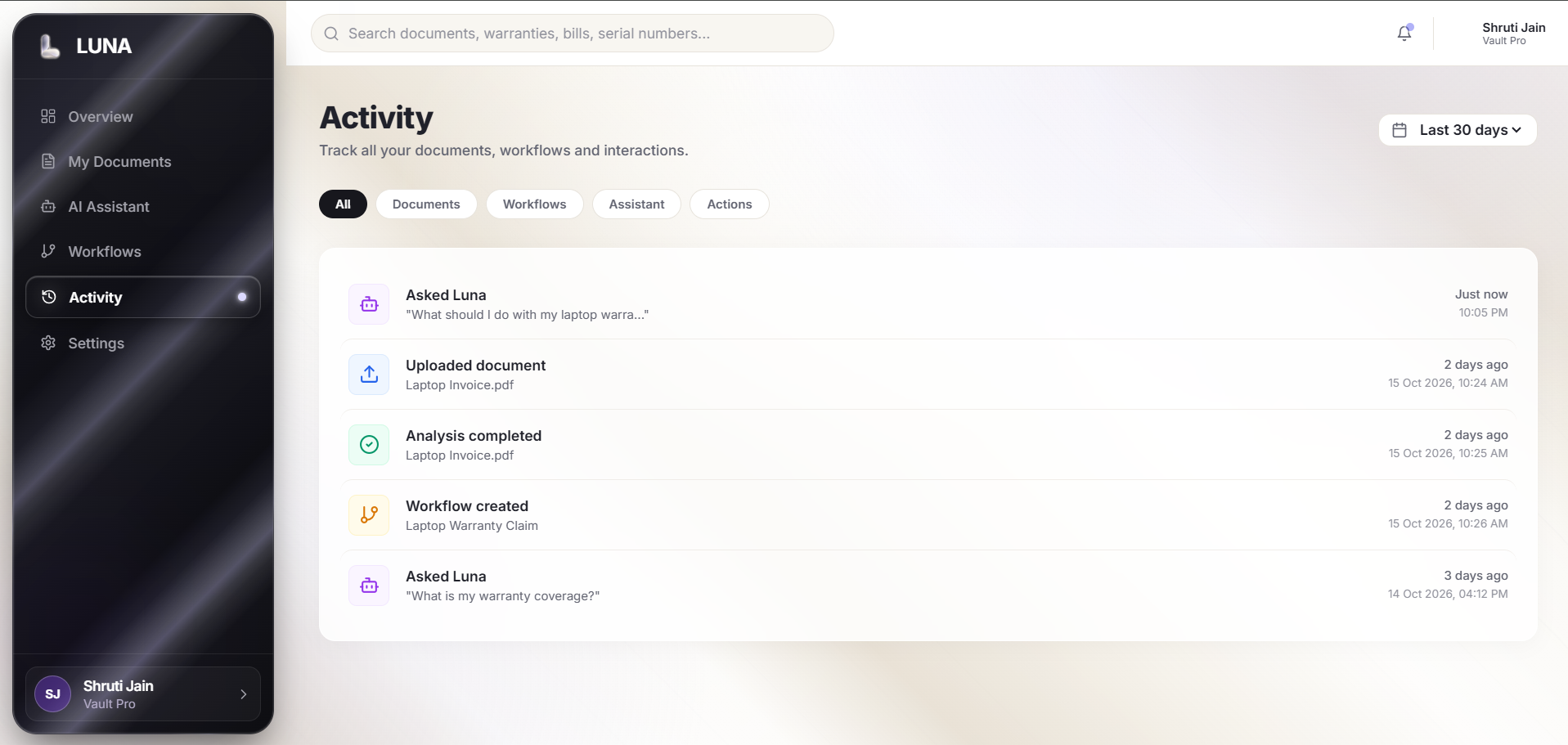
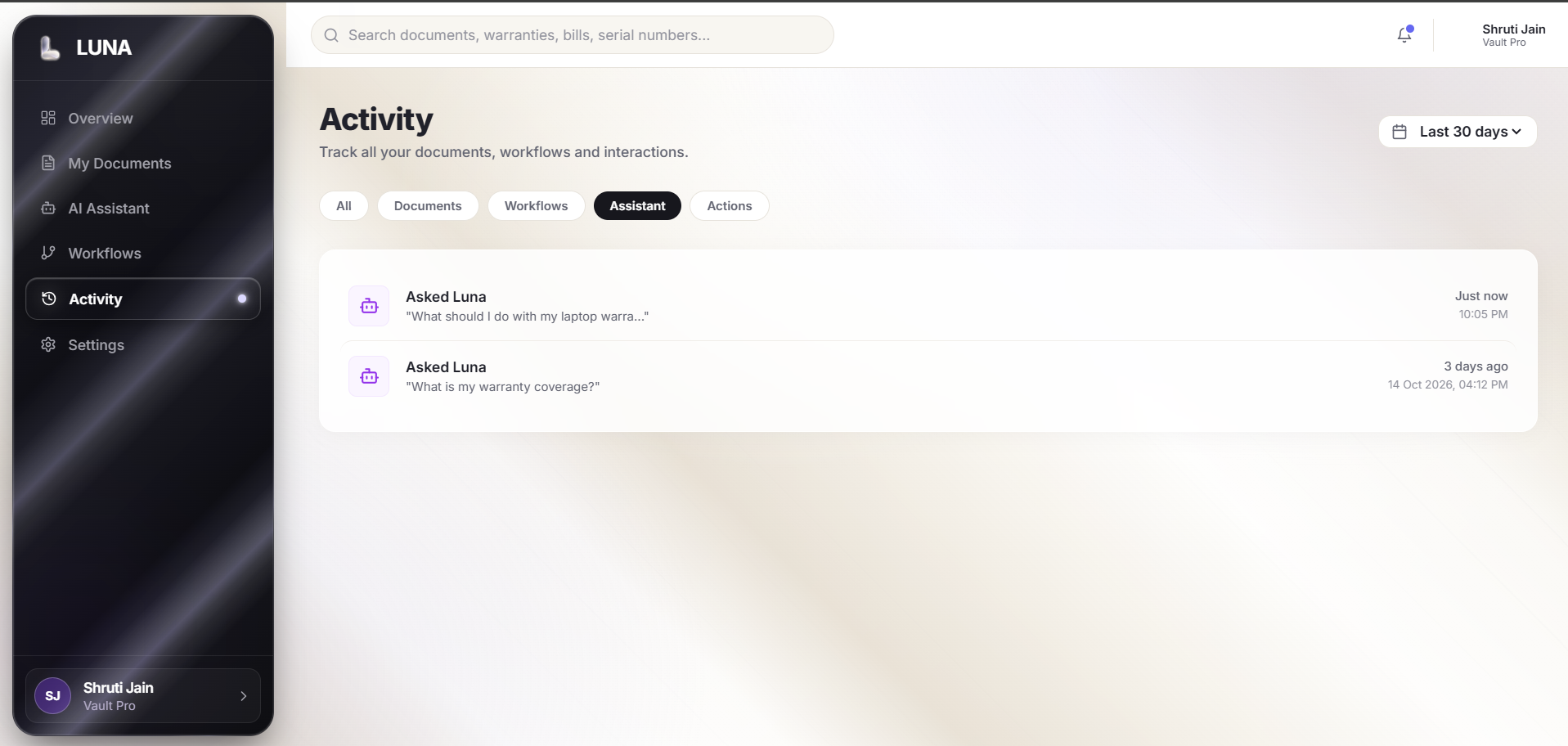
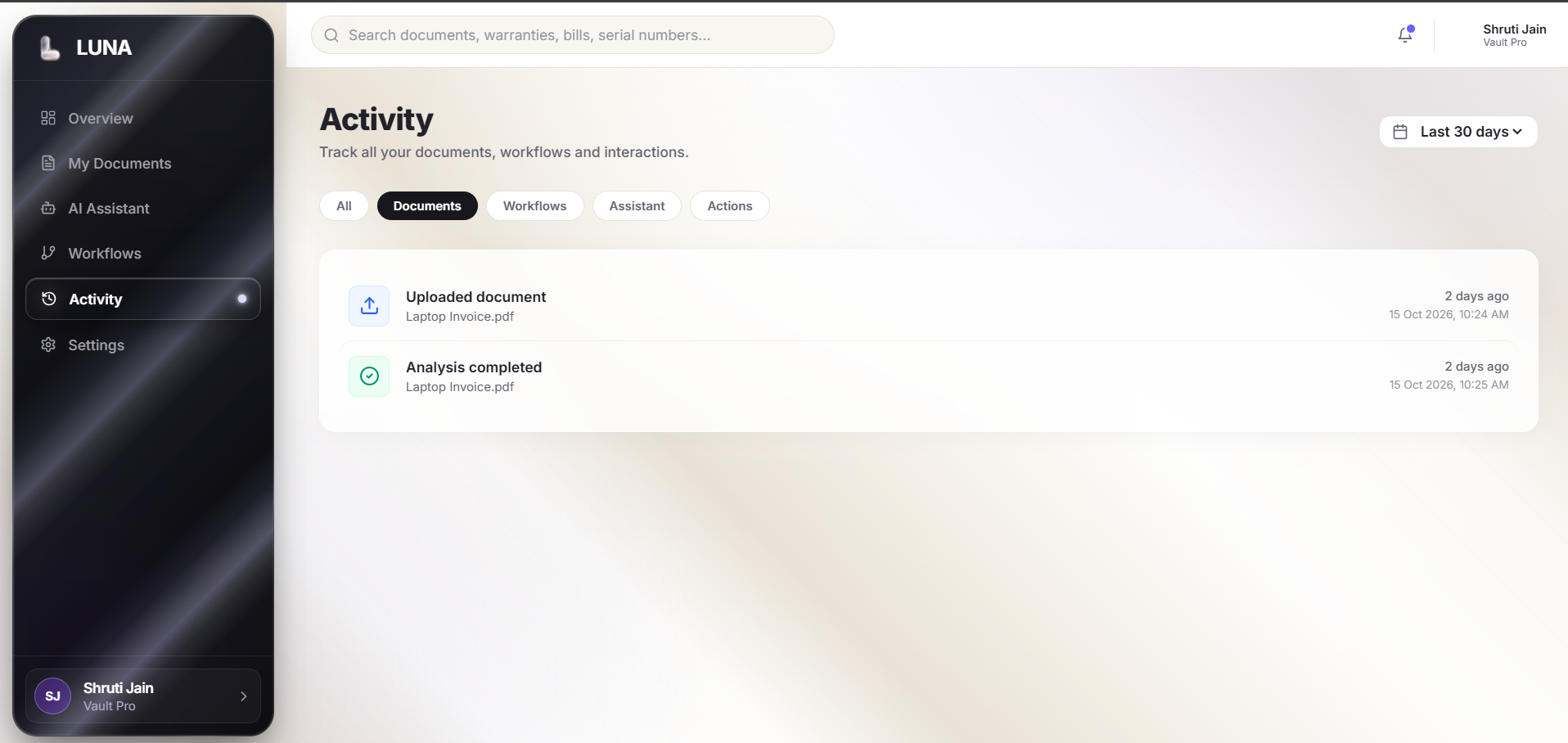
A unified activity timeline provides transparency into document processing, AI conversations, and workflow progress.
-
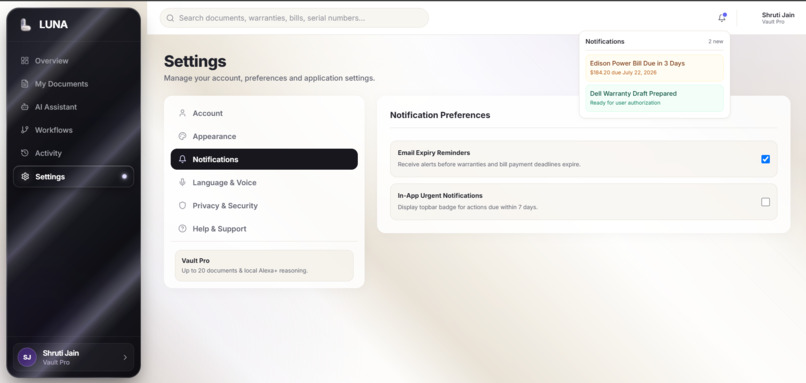
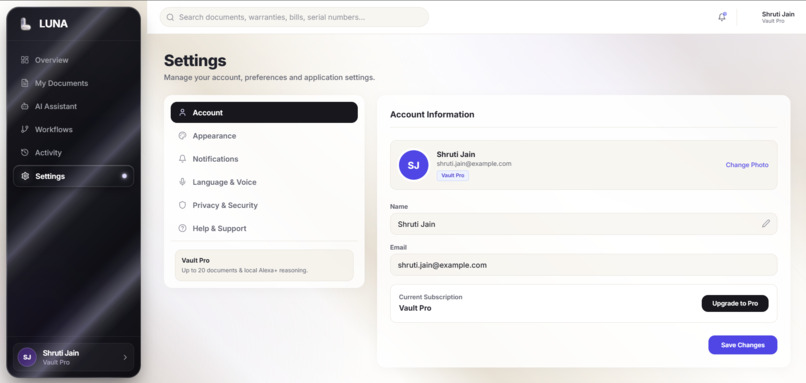
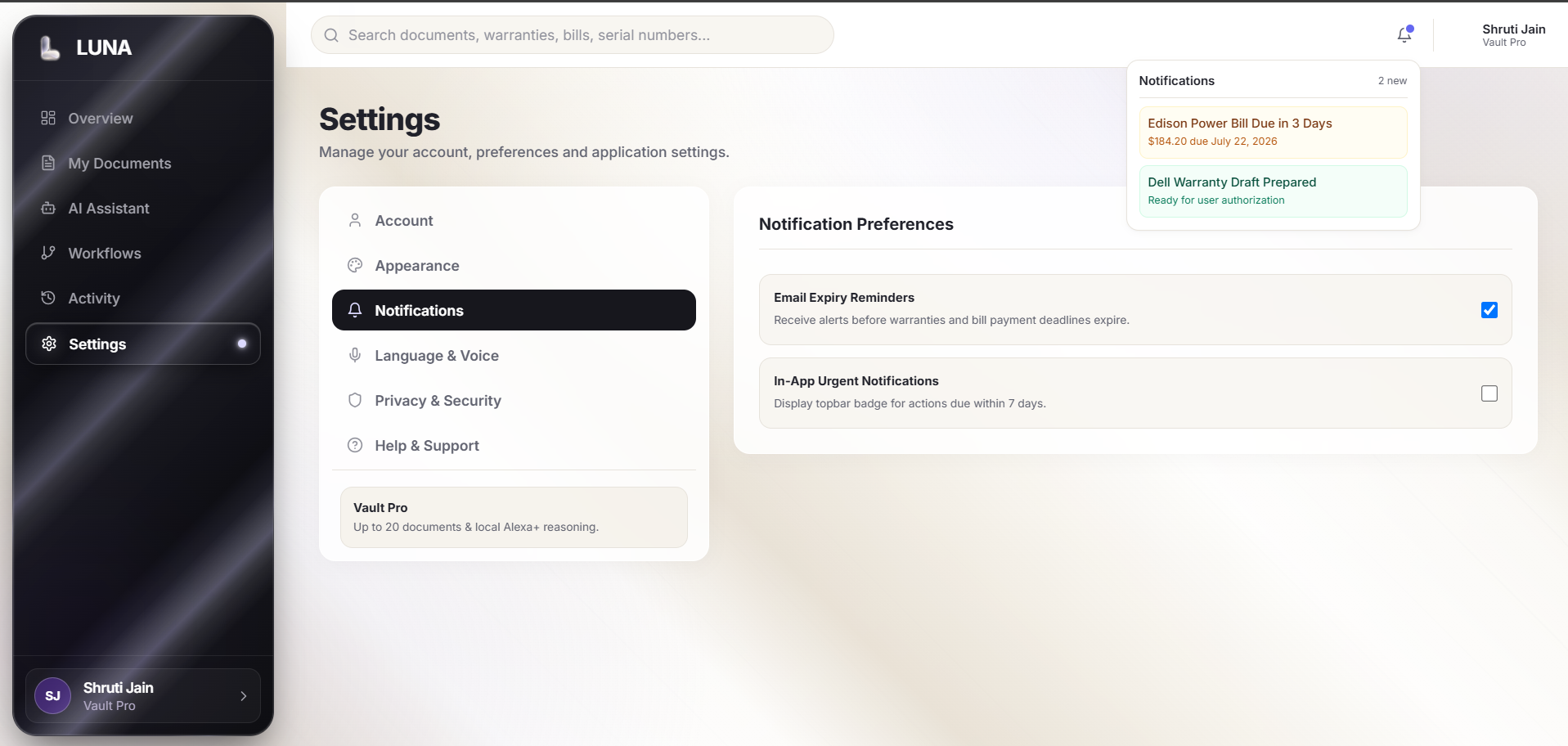
Keep track of approaching bill deadlines warranty related updates and workflows requiring user attention through configurable notifications.
-
-
-
-
-
Inspiration
Every day, people deal with countless documents—purchase invoices, warranty policies, electricity bills, insurance documents, and application forms. But the real problem isn't storing these documents. It's understanding what they mean and figuring out what to do next. Imagine purchasing a laptop and discovering a hardware issue a few months later. You have the invoice and warranty policy, but now you need to search through several pages of conditions, determine whether the issue might be covered, gather the required information, and prepare a service request. Something that should be simple becomes a time-consuming process. We asked ourselves: What if an AI assistant could do more than just read documents? What if it could understand the requirements and help people take the next step? That question inspired Luna, an AI-powered personal paperwork assistant built around the vision of Alexa+. Our goal was to make document handling as natural as having a conversation.
What it does
Luna transforms everyday paperwork into understandable information and actionable workflows. Instead of manually searching through documents, users can upload their files and interact with Luna using natural language. Luna is designed around five capabilities:
Intelligent Document Understanding Users can upload documents such as purchase invoices, warranty policies, and utility bills. Luna processes the documents and extracts relevant information, including dates, amounts, product details, conditions, and requirements.
Conversational Document Assistance Through an Alexa+-style conversational interface, users can ask questions such as: "When does my laptop warranty expire?" "Is my damaged laptop screen potentially covered?" "Why is my electricity bill higher this month?" "What documents do I need for a warranty claim?" Luna uses available document information to produce understandable answers rather than relying on generic responses.
Evidence-Based Explanations One of our priorities was making document analysis trustworthy. Luna is designed to connect important findings with supporting document evidence, helping users understand where information comes from. When information is incomplete or uncertain, Luna should identify the missing details rather than invent an answer.
Document-to-Action Workflows
This is the feature that makes Luna more than a document chatbot. For example, when a user requests help with a warranty claim, Luna can guide them through the requirements, identify missing information, and help prepare a structured service-request draft. The user remains in control, reviewing the information before approving the final action.
- Personal Document Workspace Luna brings uploaded documents, extracted information, conversations, and prepared workflows into one interface. Instead of moving between multiple applications, users have a single workspace for understanding and handling paperwork.
How we built it
We designed Luna as a modular application with three major components, allowing our three-member team to work independently while maintaining clear integration boundaries.
Frontend — Next.js and TypeScript The frontend provides Luna's user experience, including: Document dashboard and file uploads Document viewer and extracted information Alexa+-style conversational interface Workflow review and approval screens Responsive layouts for different screen sizes Our focus was to create a clean, accessible interface that feels like a real consumer product rather than a technical prototype.
Backend — Python and FastAPI The backend handles document management and workflow operations. It is responsible for validating uploads, processing documents, extracting information, maintaining records, and preparing downloadable outputs. We used Python document-processing tools, including PyMuPDF, to work with PDF content.
Agentic AI — Gemini and Model Context Protocol Luna's conversational intelligence is designed around an AI agent powered by Google's Gemini API. We initially explored Amazon Bedrock, but because promotional AWS credits were no longer available, we adapted the architecture to support an alternative model provider. We designed an MCP-based tool layer to expose capabilities such as retrieving document information, checking requirements, and preparing workflows. This separation is important: the language model handles conversational reasoning, while backend tools perform structured operations.
Alexa+ Relevance We built Luna around the simulated Alexa+ experience pathway. Our idea is to demonstrate how a conversational assistant can gain a valuable new capability: helping users understand and act on everyday paperwork. Rather than asking users to navigate several forms and menus, Luna allows them to express their needs naturally and guides them toward an actionable result.
Challenges we ran into
Integrating Three Independently Developed Modules With three people developing different parts of the application, maintaining consistent APIs and data structures was a major engineering challenge. We addressed this through a modular architecture, shared interface contracts, and integration testing. Moving Beyond a Basic AI Chatbot A conventional AI chatbot can summarize a warranty document, but that doesn't necessarily help someone complete a warranty claim. We focused on connecting document understanding with structured workflows, so the assistant could help users move from information to action. Handling Unstructured Documents Different documents present information in different formats. Invoices, warranties, and bills contain varying layouts, terminology, and conditions. Extracting useful information while maintaining source accuracy required careful document-processing design. Maintaining Trust in AI Responses Document-related mistakes can cause real inconvenience. We therefore prioritized evidence-based reasoning, explicit uncertainty, missing-information detection, and user approval before finalizing actions. AI Provider and Integration Constraints Our original architecture considered Amazon Bedrock. When hackathon promotional credits became unavailable, we adjusted our approach to use Gemini while keeping the application modular. This reinforced the importance of designing AI applications that are not unnecessarily dependent on one model provider.
Accomplishments that we're proud of
One of our biggest accomplishments is transforming Luna from a simple document-reading concept into an agentic AI system designed to turn everyday paperwork into actionable workflows. We're particularly proud of: Building a modular full-stack architecture: Dividing Luna into three independently developed components—frontend, backend, and AI agent—while coordinating their integration through shared API contracts. Moving beyond traditional AI chatbots: Designing Luna to do more than answer questions by connecting document understanding with requirement checking, missing-information detection, and workflow preparation. Developing an Alexa+-style conversational experience: Making it possible for users to interact naturally with a document assistant instead of navigating complicated paperwork manually. Integrating AI with real tools: Building around Gemini and Model Context Protocol (MCP) to connect conversational reasoning with document retrieval and backend operations. Prioritizing trustworthy AI: Designing the system to provide evidence-based explanations, acknowledge missing information, and keep users in control of important actions. Adapting to technical constraints: When AWS promotional credits became unavailable, we adjusted our AI architecture to support Gemini without abandoning our original product vision. Most importantly, we're proud that three developers came together to tackle a problem almost everyone faces—making complicated paperwork easier to understand and act upon. Luna represents our attempt to make AI not just intelligent, but genuinely useful in everyday life
What we learned
Building Luna taught us several important lessons. Agentic AI is about completing useful workflows, not simply generating answers. The most meaningful part of our project was designing how an assistant could move from understanding a request to using tools and preparing an actionable result. We also learned the importance of modular architecture, reliable API contracts, structured data extraction, and clear boundaries between AI reasoning and deterministic backend operations. Most importantly, we realized that making AI useful for everyday problems requires just as much attention to trust, accessibility, and user experience as it does to the underlying technology.
What's next for Luna - From Documents to Action
Our long-term vision is to make Luna a universal personal paperwork companion. Future improvements could include: Support for more document categories, including insurance and government applications Multilingual document understanding and voice interactions Secure integrations with authorized service providers Automated renewal and expiry reminders Better support for scanned and handwritten documents More advanced multi-document reasoning Secure personal document synchronization Personalized workflow recommendations We also want to explore how Luna's capabilities could become accessible through real Alexa+ integrations as developer access and supported integration opportunities evolve.
Built With
- agenticai
- amazon-alexa
- fastapi
- geminiapi
- genai
- google-gemini
- javascript
- natural-language-processing
- next.js
- pdf-processing
- pymupdf
- python
- restapi
- sqlite
- strand-agents-sdk
- typescript
- voice-recognization


Log in or sign up for Devpost to join the conversation.