Description
_"Miss one deadline and you can lose your status for years, Lumos exists so that doesn't happen to a brain that struggles with deadlines." _
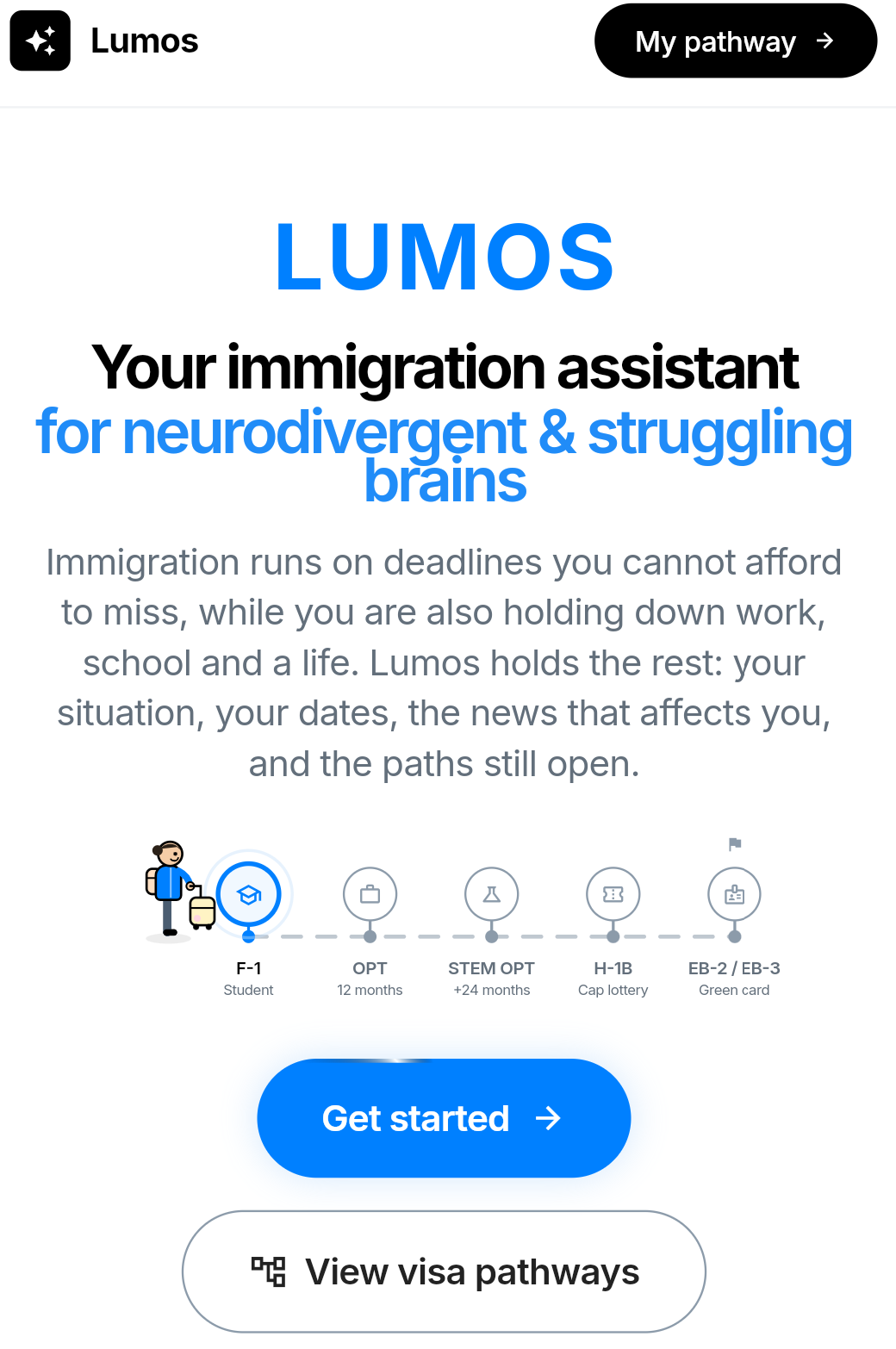
Lumos is your AI immigration assistant for neurodivergent and struggling brains. It resolves your visa situation in plain English, tracks your deadlines, and filters immigration news down to what actually applies to you and keeps the clutter away.
Slide deck: https://claude.ai/code/artifact/957e8d24-5a78-4a76-a260-b72ef2f1bd96
Inspiration
Being a neurodivergent myself and having gone through enough mental struggle, I have experienced the pain point of tackling immigration deadlines and paperwork and know that it is hard along with schoolwork and managing a full-time job. Most of the younger/neurodivergent population struggle with executive dysfunction. Dealing with multiple deadlines and planning ahead is not as easy as a neurotypical brain. The problem holds for ADHD, autism, people with depression, anxiety, etc. I built Lumos (an AI immigration assistant) to make the journey easier for them.
What it does
Lumos keeps the clutter and chaos minimal for those struggling with executive dysfunction.
- It understands your situation: Describe where you stand in plain words plain words no forms, no legal vocabulary. Lumos works out your actual status and shows you what it found before anything is saved.
- Keeps you ahead of deadlines: Every date your status implies, in order, each with the plain reason it exists. What is urgent comes first; what is months away stays out of your way.
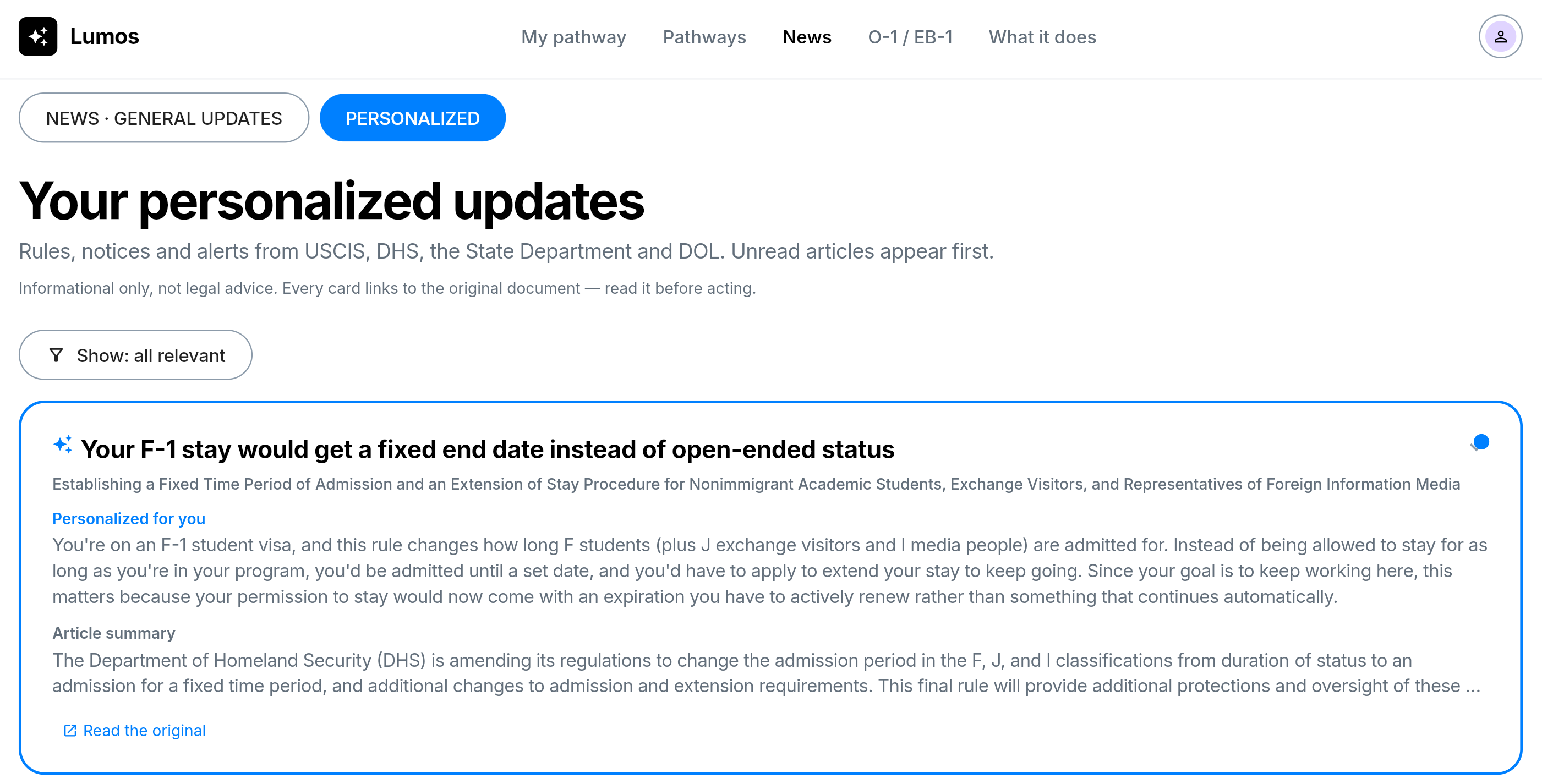
- Personalizes & Filters the news for you: Not every immigration update needs your attention. Lumos scrapes all of it, then surfaces only the news that actually applies to your situation nothing unnecessary.
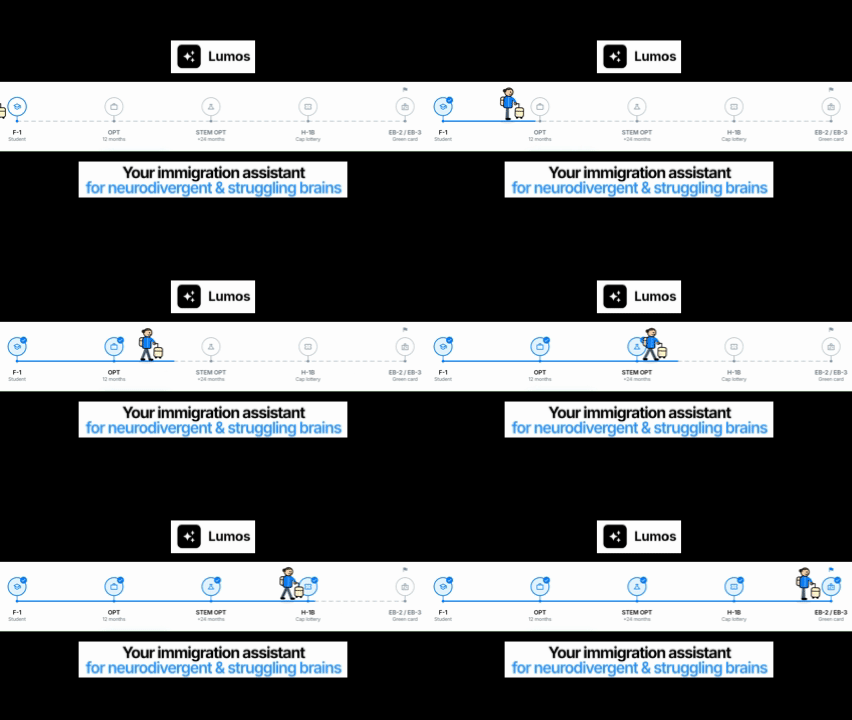
- Maps the paths ahead: Explore where each visa can lead, what switching types actually involves, and what to start building now including the evidence an O-1 or EB-1 profile takes years to build.
Workflow: Tell your situation in your own words. Eg: "I'm on OPT, my employer is sponsoring an H-1B", and Lumos resolves it to a status on a pathway graph of 43 visa statuses and 79 transitions, without ever guessing past what you told it. From there it:
- surfaces every deadline that status implies, in order, each with the plain reason it exists and a link to the official source
- watches a curated feed of official policy sources (led by the Federal Register API) and only shows you the updates that touch your status, explained in plain language instead of legal text
- lets you explore where your status can lead, what switching visa types actually involves, and what evidence an O-1 or EB-1 case needs years before you'd file, so you can start building it now
What we do store is deliberately minimal: an anonymous sign-in id, your situation and goal in your own words, and the deadlines derived from them. No documents, no name, no address, no payment information.
How I built it
Frontend is built with Flutter (web) using Dart language. Backend is built with Python FastAPI with a twice a weekday news scraper over an allow-list of official sources, and a case intake endpoint that asks Claude to summarize the news personalized for the user. Federal Register API is used for news scraping primary, authoritative feed of USCIS/DHS/State/DOL policy changes. Database is built with Postgres on render. All three resources are deployed with render. The main Lumos AI assistant is built with Claude which also performs the intake of the user status and constraints the answers to real graph node via JSON schema and also drives summarization of news updates personalized to user's situation. When the model isn't available or declines, intake falls back to keyword matching and says so plainly rather than presenting a guess as a reasoned answer. User authentication and sign in was built with Google Identity Services for sign-in with no password/email stored. Voice to Text for intake as well as for Lumos AI assistant was built with Web Speech API which uses browsers' default transcription that works for Chrome/Edge.
The pathway graph including statuses, transitions, and the O-1/EB-1 evidence criteria are modeled from scraped data of visa paths. So, the map, the questionnaire, and the intake reasoner all read from the same source of truth.
Everything in the project including the pathway graph data, the Flutter frontend, the FastAPI backend, the news scraper, and the Claude-powered intake reasoner and assistant was built during this hackathon and I was the only person in the team. No pre-existing codebase was used.
Challenges I ran into
- Government sites don't want to be scraped. uscis.gov, studyinthestates.dhs.gov, and travel.state.gov all sit behind bot protection that 403s non-browser clients, inconsistently across networks. I leaned on the Federal Register API as the primary, authoritative source instead of fighting selectors, and report HTML-source failures in the UI rather than hiding them.
- Panning over an interactive canvas. Working with Flutter for animations and pathways took more back and forth with Claude than expected. The pathway map's node cards each have their own tap and hover handlers, which meant Flutter's built-in pan gesture couldn't tell a drag from a tap. I ended up owning the gesture recognition directly so pan works from anywhere on the canvas, it's still not the best.
- Path verification The biggest problem was in verifying manually the different visa paths possible which is right now coded with scraped data. But I could only manually verify a few cases and also observed that the paths aren't perfect in the edge connections.
- Getting the to dos for each visas updated is still an ongoing problem that I'm resolving.
What I learnt
I started out with a different focus and ended up on this, so the biggest personal pain points win over what you plan out was my biggest lesson from this project. Learning to iterate and make the project better and easy to use and understand was a good experience for me. I also learnt to think from pain point and then formulate the problem and user flow for the project. Keeping the design minimal and clutter free was where my focus went on.
What's next for the project
I'm currently verifying all the pathways and plans and would also like to edit the to dos tasks and notifications to help users better. Also, the O1/EB1 evidence tracker can be improved to be more specific and sub tasks based and to be relevant to compliance deadlines.
Built With
- fastapi
- flutter
- postgresql
- python
- render
- sqlite


Log in or sign up for Devpost to join the conversation.