-
-
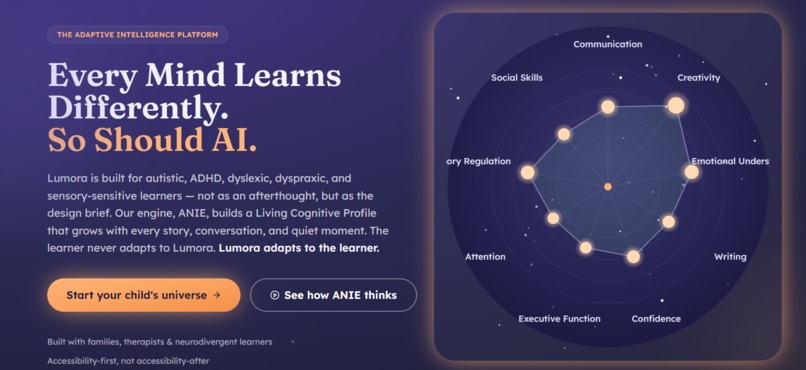
No two learners ever get the same sky
-
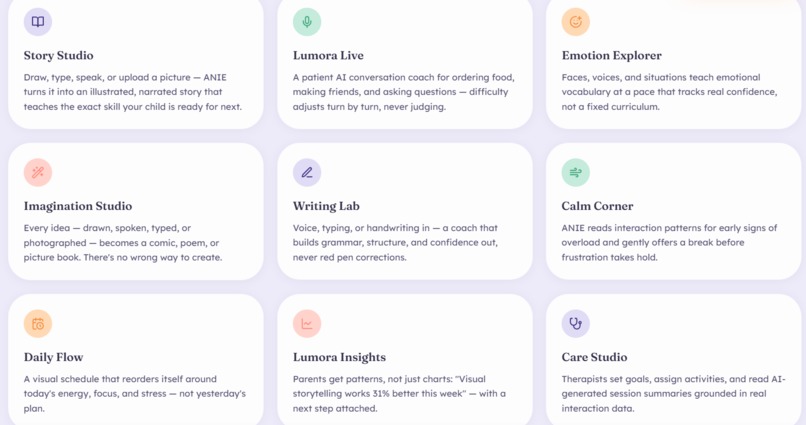
Every feature reads from — and writes back to — the same Living Cognitive Profile. Nothing here is a standalone tool bolted onto a dashboard
Inspiration
Every neurodivergent child experiences the world differently, yet most educational tools are built around a single definition of how learning should work. Instead of adapting to the child, the child is expected to adapt to the software.
We wanted to challenge that idea.
Inspired by conversations with autistic learners, parents, and existing accessibility projects, we asked ourselves a simple question: What if AI learned the child before trying to teach them?
That question became Lumora. Rather than being another AI tutor or educational platform, Lumora is designed to understand each learner's unique strengths, interests, communication style, and sensory preferences, then reshape the entire learning experience around them.
Our goal was never just to make learning easier—it was to make every child feel understood.
Disclaimer: None of the emotions were hurt while making or testing the applications as blind testing was done as an activity.
What it does
Lumora is an adaptive AI learning platform designed specifically for neurodivergent learners, including children with autism, ADHD, dyslexia, and other learning differences.
At the heart of Lumora is the Adaptive Neurodivergent Intelligence Engine (ANIE), which builds a Living Cognitive Profile for every learner. As children interact with the platform, the AI continuously learns how they think, communicate, create, and learn, making every future experience more personalized.
Lumora includes:
- Story Studio – Children can draw, speak, type, or upload an image, and AI transforms it into personalized illustrated stories with narration and interactive quizzes.
- Lumora Live – A safe AI conversation partner where children can practice real-life social situations like making friends or talking to teachers.
- Emotion Explorer – Interactive activities that help children recognize emotions through images, stories, voices, and everyday scenarios.
- Imagination Studio – Lets children express ideas through drawing, speech, or writing, which AI turns into comics, stories, poems, and picture books.
- Writing Lab – Supports handwriting, typing, and voice input while gently coaching creativity, structure, and communication instead of simply correcting mistakes.
- Calm Corner – Detects signs of cognitive fatigue or sensory overload and recommends calming activities, breaks, or breathing exercises.
- Daily Flow – An adaptive visual schedule that reorganizes activities based on the learner's focus, mood, and energy.
- Lumora Insights – AI-generated insights for parents and therapists that explain progress, strengths, and areas where additional support may help.
Every interaction helps Lumora understand the learner better, making the platform more personalized over time.
How we built it
We built Lumora using a modern AI-powered technology stack focused on scalability and accessibility.
The frontend was developed with Next.js, React, TypeScript, Tailwind CSS, Shadcn UI, and Framer Motion to create a responsive and calming user experience.
The backend was built using FastAPI and Python, while Firebase Authentication, Firestore, and Firebase Storage handled authentication, real-time data, and secure storage.
For AI capabilities, we integrated Google Gemini for personalized conversations, adaptive learning, reasoning, and content generation. Imagen was used to generate illustrations for stories, while Google Text-to-Speech and Speech-to-Text enabled natural voice interactions. MediaPipe and OpenCV were incorporated for real-time interaction and future support for gesture and emotion-based experiences.
The biggest technical challenge was designing the Living Cognitive Profile, which connects every feature so that the platform continuously adapts instead of treating each activity as an isolated experience.
Challenges we ran into
One of our biggest challenges was making the AI feel genuinely supportive instead of overwhelming. Every learner has different needs, so finding the right balance between personalization and simplicity required constant iteration.
Another challenge was designing a system where every feature contributed to the same evolving cognitive profile. We wanted stories, conversations, creative activities, and emotion exercises to work together rather than behave like separate AI tools.
Accessibility was also a major focus. We spent considerable effort making the interface clean, predictable, and easy to navigate while minimizing unnecessary distractions and cognitive load.
Accomplishments that we're proud of
Our biggest achievement is creating a platform where every feature works together around one central idea instead of feeling like separate AI demos.
We're especially proud of the Living Cognitive Profile, which allows Lumora to continuously understand each learner and personalize future experiences automatically.
We also believe we've built something that supports not only children, but also parents and therapists by providing meaningful AI insights instead of just charts and raw data.
Most importantly, Lumora shifts the focus from fixing learners to understanding them.
What we learned
Building Lumora taught us that accessibility is much more than adding features like larger fonts or voice support.
True accessibility starts with designing for different ways of thinking from the very beginning.
We also learned that AI becomes far more valuable when it remembers, adapts, and grows with the learner instead of simply generating responses.
Finally, we realized that some of the best innovations come from asking a different question. Instead of asking how AI can teach better, we asked how AI can understand better.
What's next for Lumora
Our vision is to make Lumora a lifelong learning companion for neurodivergent individuals.
We plan to expand support for more neurodivergent profiles, improve adaptive recommendations using long-term learning patterns, and introduce collaborative spaces where teachers, therapists, and parents can work together while respecting learner privacy.
We're also exploring multimodal interactions, wearable integrations for better sensory support, multilingual experiences, and offline capabilities so Lumora can reach learners regardless of their environment.
Ultimately, we want Lumora to become more than an educational platform—we want it to become a trusted companion that helps every learner discover their own path to confidence, creativity, and independence.
Built With
- fastapi
- firebase-authentication
- firebase-firestore
- firebase-storage
- framer-motion
- gemini-live-api
- google-cloud-text-to-speech
- google-gemini-2.5-flash
- google-imagen
- google-speech-to-text
- mediapipe
- next.js
- opencv
- python
- react
- recharts
- shadcn-ui
- tailwind-css
- typescript

Log in or sign up for Devpost to join the conversation.