Inspiration
This project didn't start with a brilliant idea — it started with the complete lack of one.
I sat down wanting to build something cool with AI… and always ended up with "Nah, it wouldn't work" or "How do I know if anyone needs this?" because I had no idea what people actually wanted.
This wasn't a one-time problem — it happened again and again throughout college. Sometimes I'd get so hyped thinking I found the idea. "This will change the world! I'll be a millionaire!" And then reality hits.
Many of those projects slowly fell apart: what started as "maybe I can raise a seed round" eventually became "maybe I'll get some GitHub stars"… and some just died halfway through. Weeks or even months wasted, chasing something no one asked for.
So I stopped trying to guess what people need — and started building a tool to find it out. That's how Lumio was born: a local AI-powered product that reads Reddit, finds real user pain points, and helps you validate startup ideas and ecommerce product selection before you waste months chasing ghosts.
Now, instead of building random tools, I'm building the system that helps everyone — including myself — build smarter.
What it does
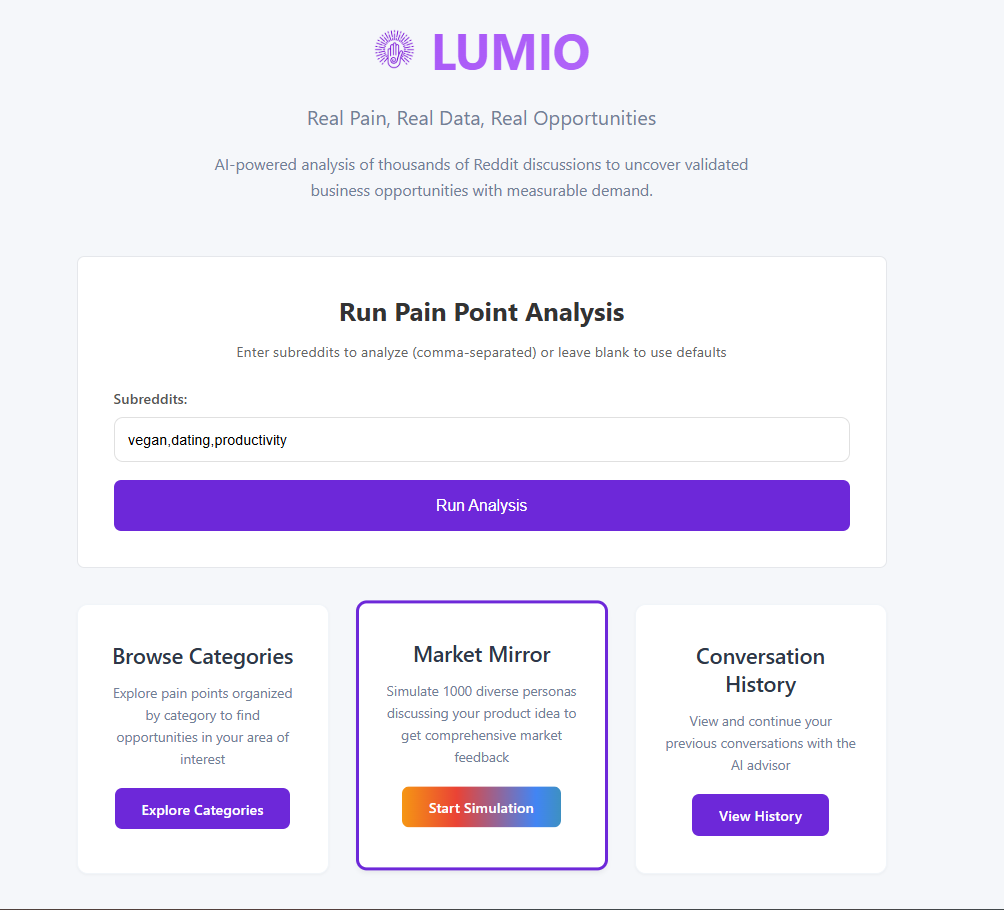
Lumio helps you discover real business opportunities by analyzing Reddit discussions.
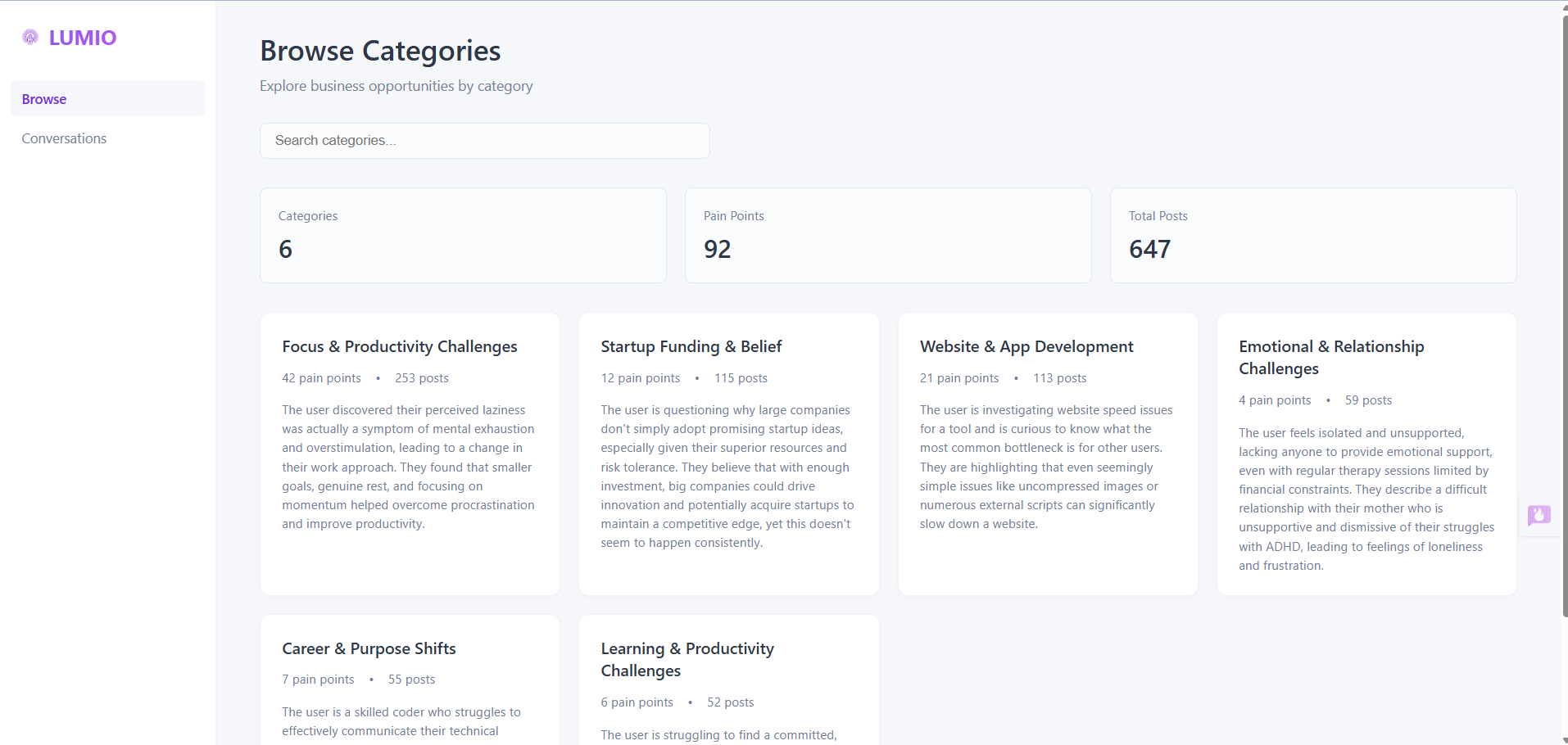
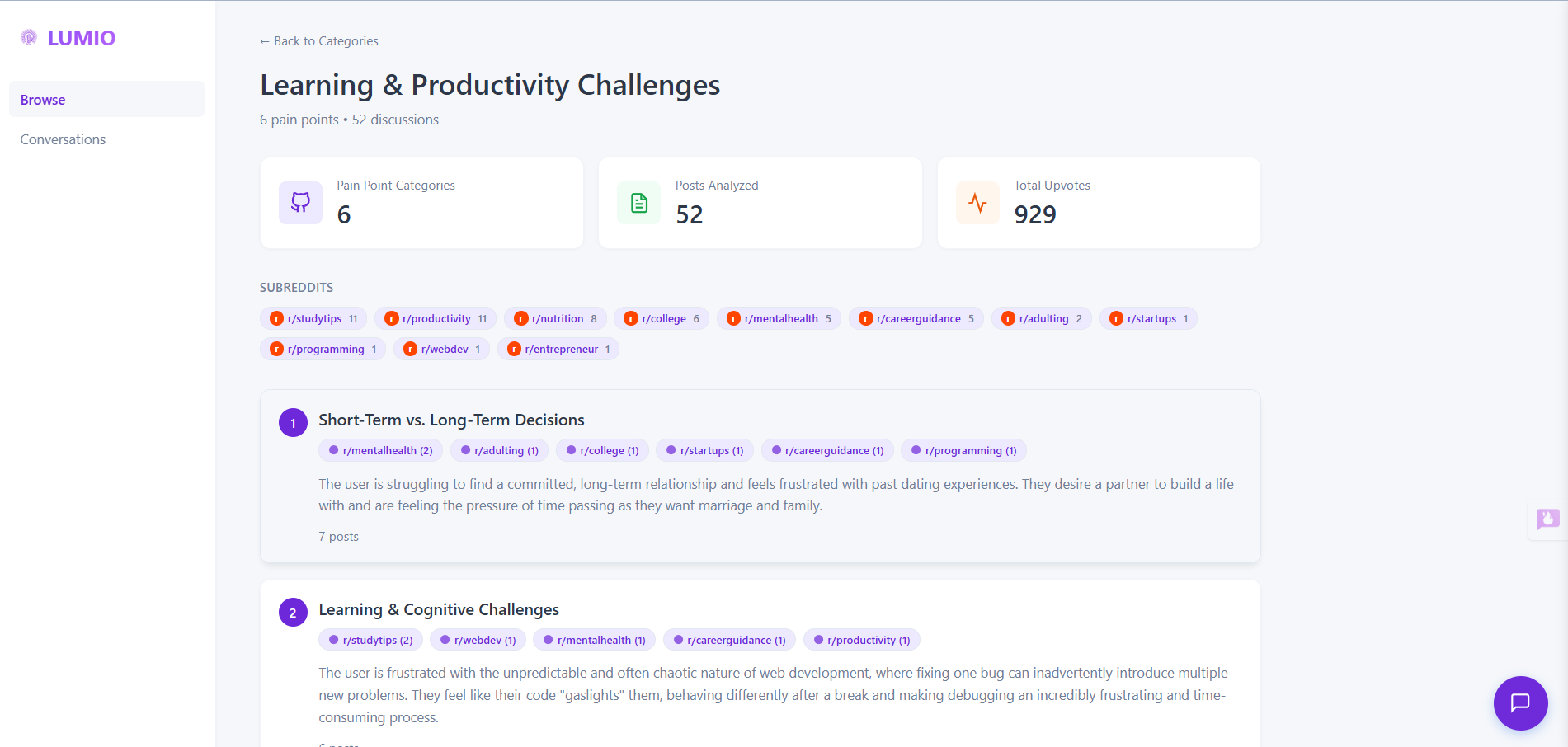
You choose a subreddit, and the system crawls thousands of posts to extract pain points users face in real life. These are automatically clustered into categories → pain points → original posts, giving you a structured view of what people are struggling with.
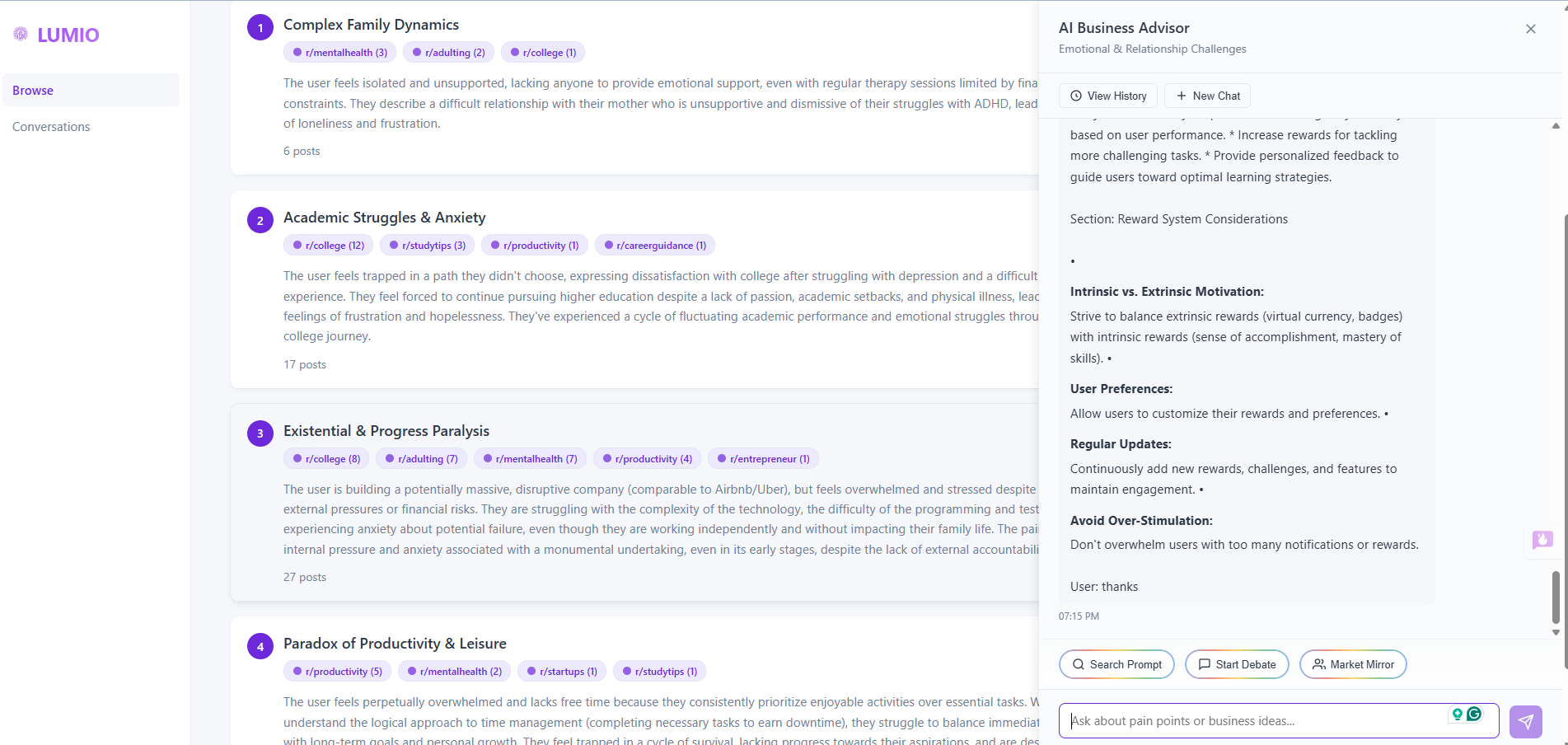
You can then talk to an AI advisor that understands everything on the page — ask for insights, product ideas, or explore market angles. Want deeper validation? Use Debate Mode to let three AI personas (Pro, Con, Judge) argue over your idea's viability, surfacing perspectives you might've missed.
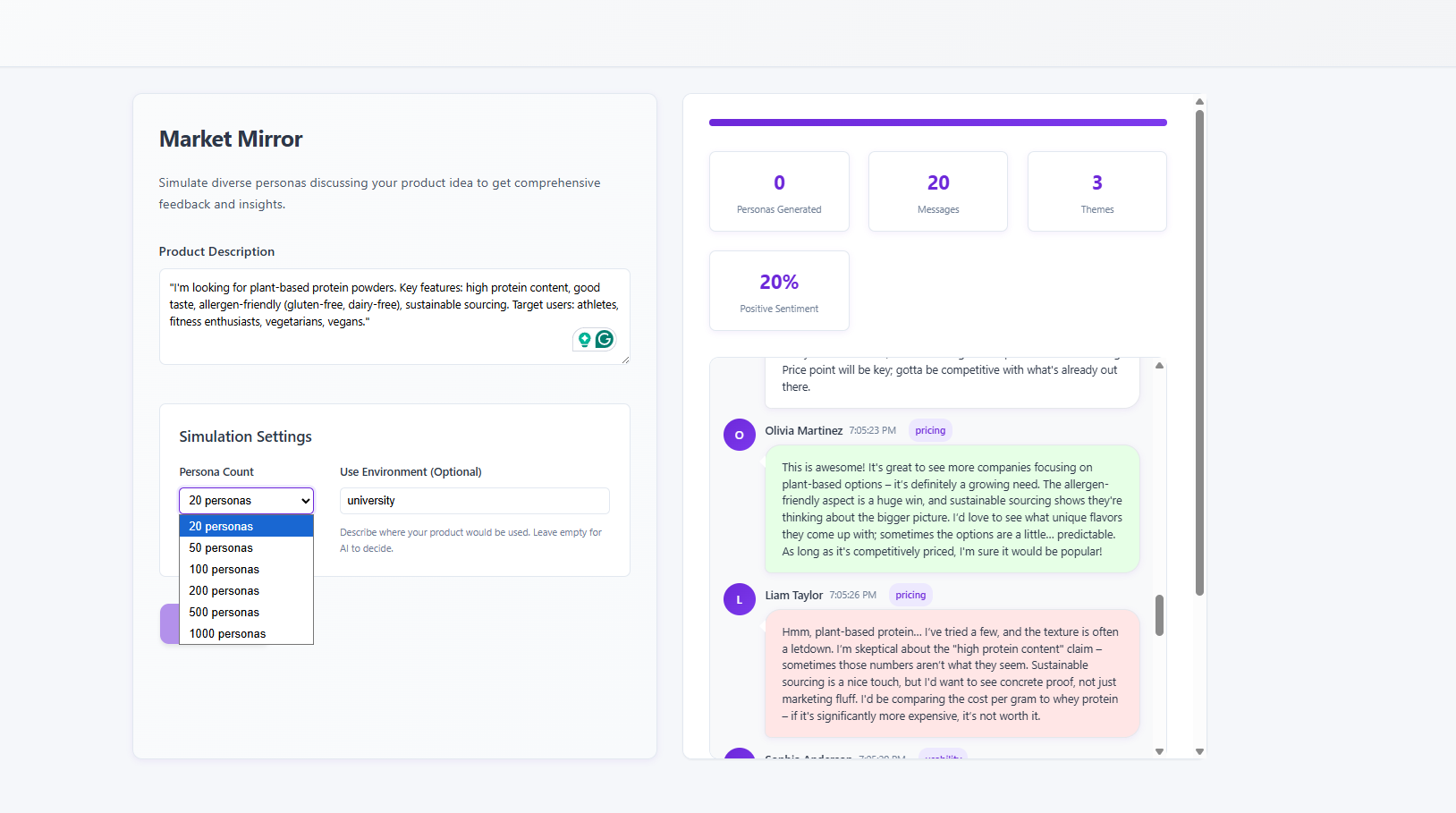
Going even further, Lumio simulates a community of thousands personas with variety of backgrounds. When you describe your product, they "react" with feedback and evaluation, revealing unexpected responses from diverse audiences. All of this is summarized into an AI-generated product feedback report — helping you test ideas before writing a single line of code.
Perfect for both startup validation and ecommerce product research — whether you're launching a SaaS or selling physical products, Lumio helps you understand what people actually want.
The best part? You can use the local AI unlimitedly because you don't have to worry about API costs. That's the beauty of Chrome AI — you just need to be patient, but you get unlimited access to powerful AI capabilities without any usage restrictions or pricing concerns.
How I built it
Lumio uses a hybrid AI architecture combining Chrome Built-in AI for real-time interactions with Python NLP processing for complex data analysis. I leverage the Reddit public API to access thousands of posts and use summarizer APIs to distill information from each post. My TF-IDF clustering and DBSCAN algorithms identify genuine pain points from massive datasets.
The Market Mirror simulation generates 20-2000 diverse user personas using Chrome AI and simulates realistic market reactions through sentiment analysis. I conducted A/B testing with university peers to validate classification accuracy and effectiveness. I tested my system using recently successful startup ideas within the simulated community to verify that this approach is significantly more effective than direct AI conversations.
The result is a hybrid AI system that provides the speed of local processing with the power of local AI, enabling users to discover validated business opportunities from real user pain points while simulating diverse market environments to test their product ideas before investing in development.
Challenges I ran into
The biggest challenge was proving that my structured approach actually works better than just chatting with an LLM. I needed to demonstrate that my pain point clustering and AI-supported analysis provides more valuable insights than traditional AI conversations. I conducted comprehensive A/B testing with 20 computer science students, comparing my system against traditional AI chat approaches. The control group used ChatGPT to analyze startup ideas, while the test group used Lumio's structured pain point analysis combined with my AI advisor.
Accomplishments that I'm proud of
I validated my system using five recently successful startups like Discord, Notion, Figma, and other 2 very recent famous startups that I'm sure the built-in API wouldn't have knowledge of, inputting their early-stage ideas into my Market Mirror simulation. My simulation predicted four out of five of their actual market challenges and user feedback patterns, while ChatGPT alone only identified one out of five of these patterns.
The key breakthrough was realizing that structured data plus AI context beats generic AI conversation every time, as my pain point clustering provides the AI with real market context, making its advice dramatically more relevant and actionable. This validation convinced me that I wasn't just building another AI tool — I was creating a systematic approach to market research that actually works.
What I learned
The development of Lumio provided me with invaluable insights into the practical application of AI within web applications. One of the most significant breakthroughs I experienced was discovering that Chrome Built-in AI excels in pattern recognition and can be leveraged for unlimited local processing without API costs. This insight led me to explore how AI could identify patterns in user pain points and market behaviors, enhancing the app's functionality dramatically.
I became proficient in using Chrome AI Studio, which was instrumental in refining my AI strategies and understanding the nuances of prompt engineering for local AI implementations. This experience has been crucial for optimizing the performance and relevance of my AI implementations through trial and error.
My exploration of various APIs within the Google Cloud Project significantly expanded my technical repertoire, offering a wide array of tools that enriched the development process. The breadth and variety of APIs available were both impressive and educational, providing numerous opportunities to integrate and experiment with different functionalities for our hybrid AI architecture.
Additionally, encountering new technologies such as Firebase and PostgreSQL with vector extensions was initially challenging but ultimately rewarding. Learning how to implement these technologies not only added complexity to the project but also contributed greatly to my professional growth. I also had no prior experience in UI/UX design, so I had to teach myself design principles, color theory, and user experience optimization from scratch. This hackathon was an enriching experience, pushing my boundaries and enhancing my capabilities in developing AI-driven applications while learning entirely new skill sets.
What's next for LUMIO - Business Opportunity Discovery
I'm actively seeking to expand the team with talented developers, data scientists, and UX designers to accelerate development and bring fresh perspectives to the project. The next major milestone is implementing real-time monitoring capabilities that will continuously track emerging pain points and market trends across multiple platforms, not just Reddit. This will provide users with live insights into shifting market dynamics and emerging opportunities as they happen.
I'm also developing an autonomous search functionality that will dramatically lower the barrier to market research. Instead of users having to manually select subreddits or platforms, the system will intelligently discover and analyze relevant discussions across social media, forums, review sites, and news platforms automatically. This will make market research accessible to anyone, regardless of their technical expertise or time constraints.
The persona generation system is getting a major upgrade through historical startup backtesting. By analyzing thousands of successful and failed startups, I'm training the AI personas to behave more realistically based on actual market reactions from the past. This will make the Market Mirror simulation incredibly accurate, with personas that respond to ideas the same way real users did in similar historical contexts.
Looking ahead, I'm excited about implementing predictive market modeling that can forecast which pain points will become major opportunities, cross-platform sentiment correlation that identifies patterns across different social networks, and AI-powered competitor analysis that automatically tracks and analyzes what your competitors are doing in real-time. The ultimate vision is to build the world's first AI-powered market intelligence platform that democratizes access to professional-grade market research and makes successful entrepreneurship accessible to everyone.
Built With
- dbscan-algorithms
- firebase
- javascript
- postgresql
- promptapi
- pwa
- python
- tf-idf-clustering
- vector-databases


Log in or sign up for Devpost to join the conversation.