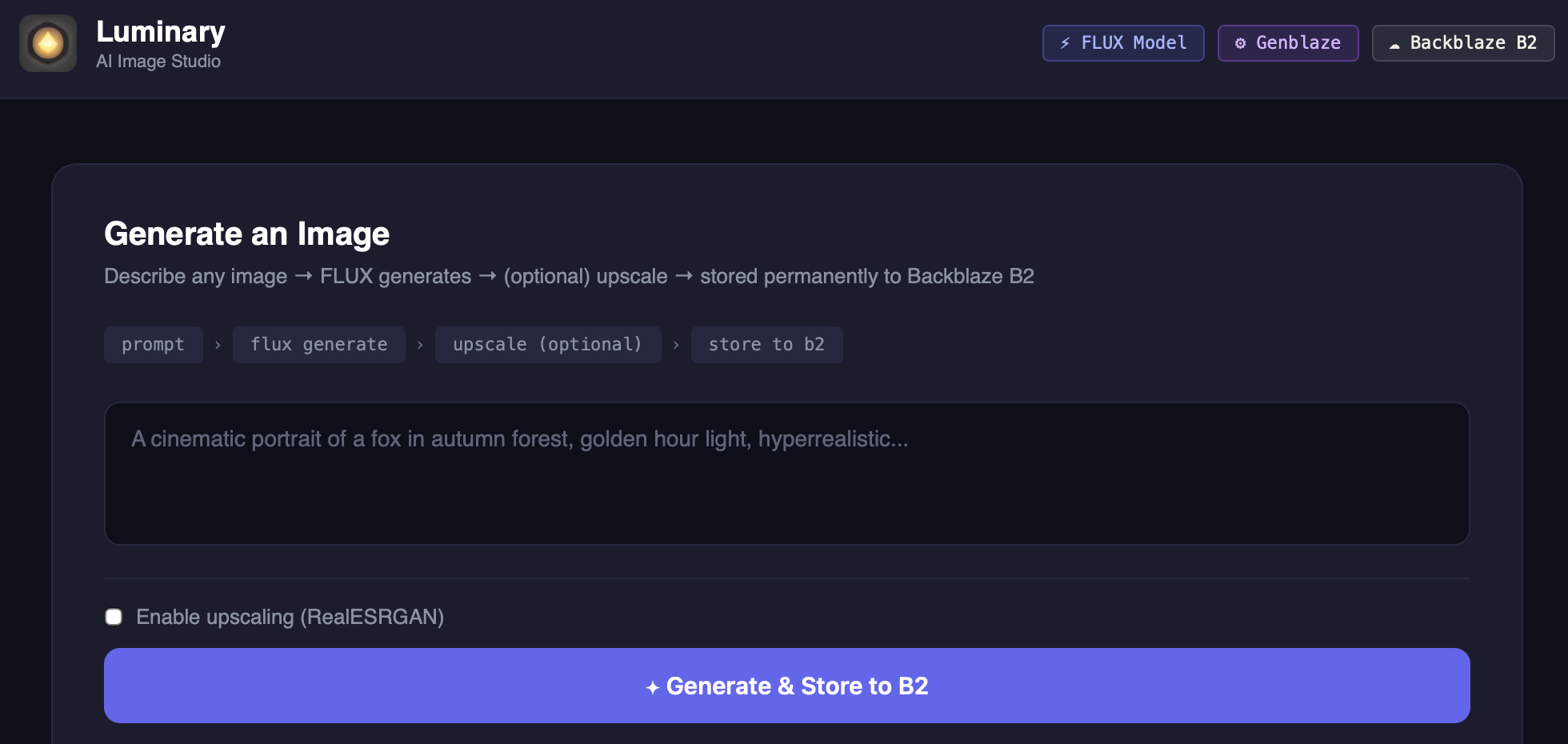
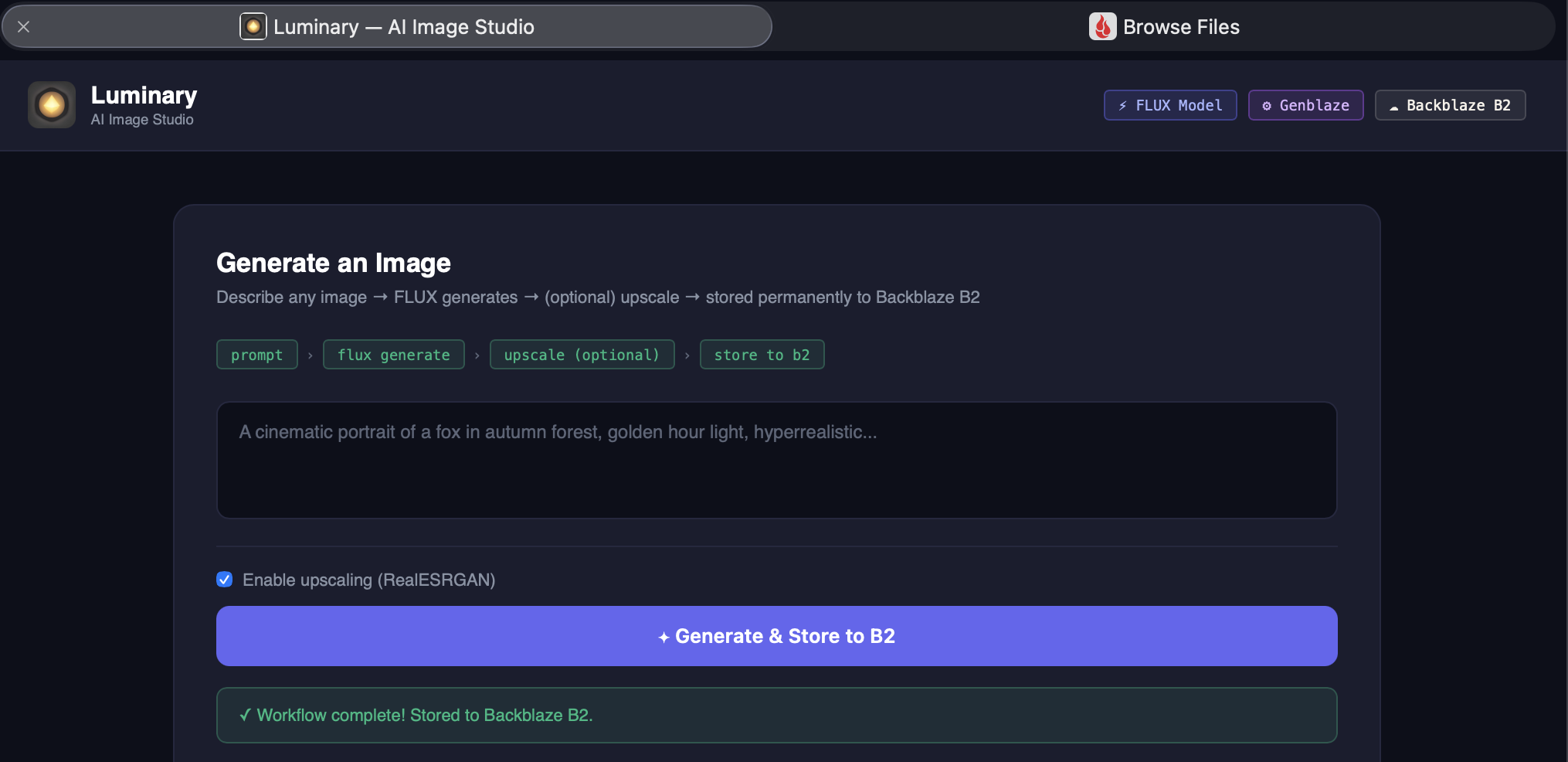
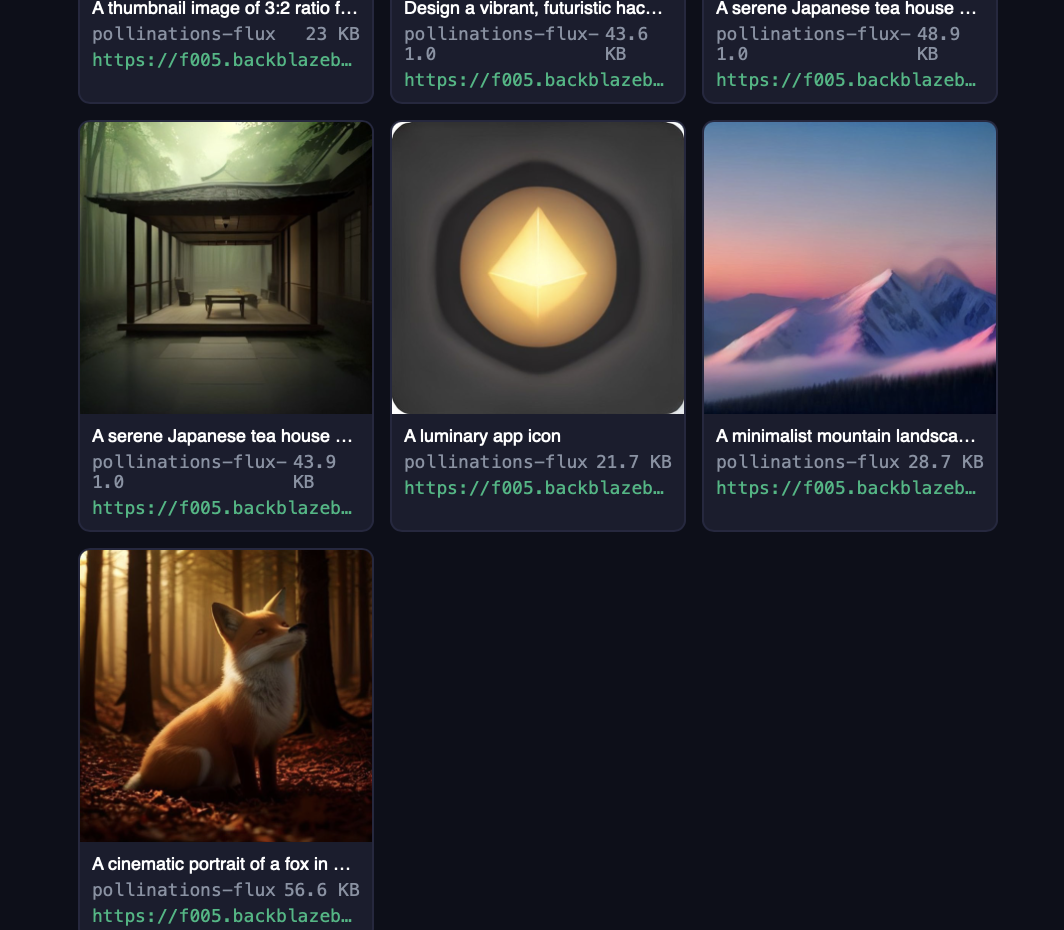
Luminary shows that AI-generated media can move from prompt to pipeline to durable storage on Backblaze B2.
Real-World Utility: Luminary solves a concrete problem for digital creators, designers, and content teams who need fast, reliable AI image generation without juggling multiple tools or platforms. Rather than switching between Pollinations, local storage, cloud buckets, and gallery apps, users can:
-Generate AI images instantly via text prompts
-Automatically preserve generation metadata (prompt, model, timestamp)
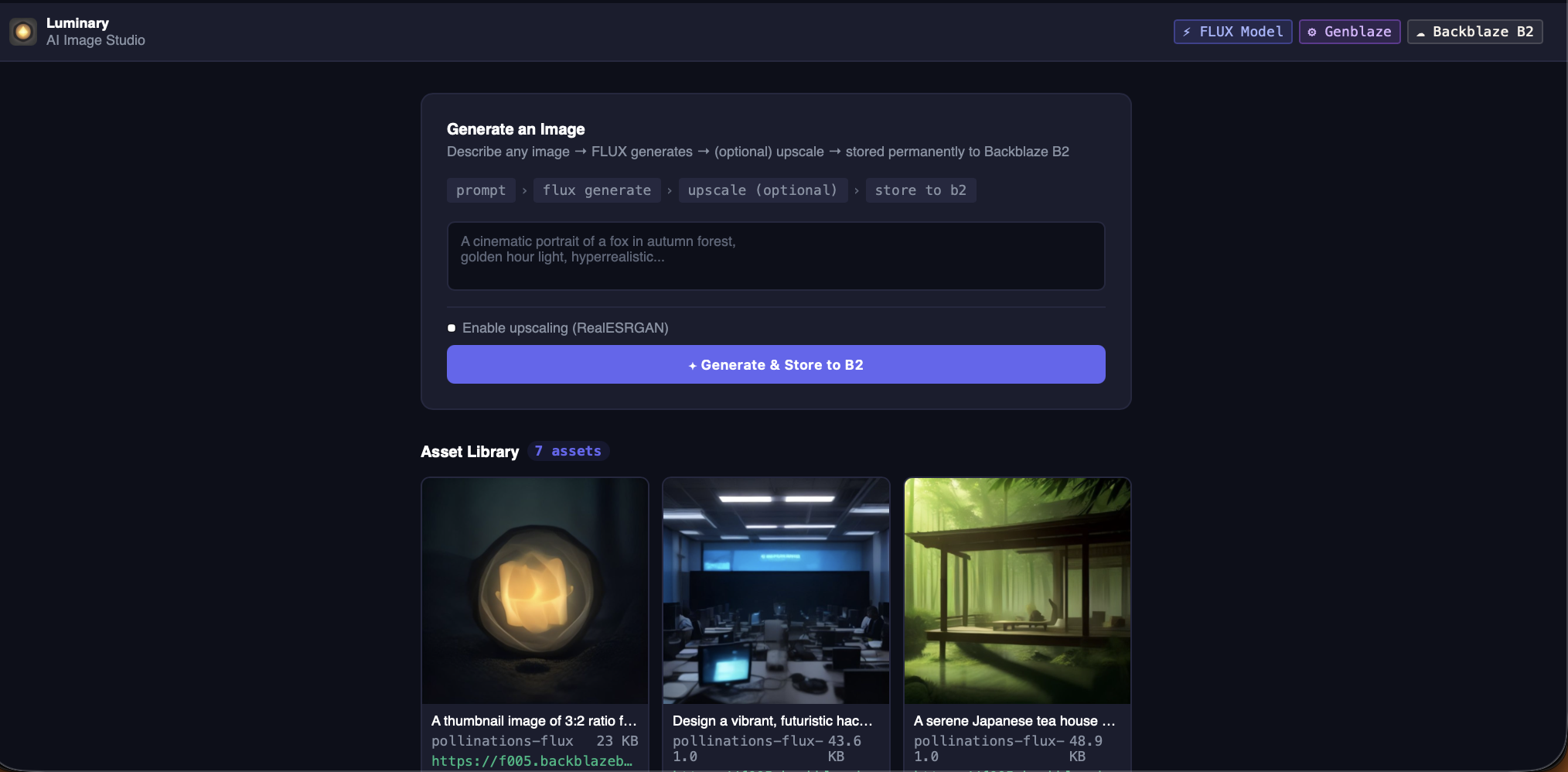
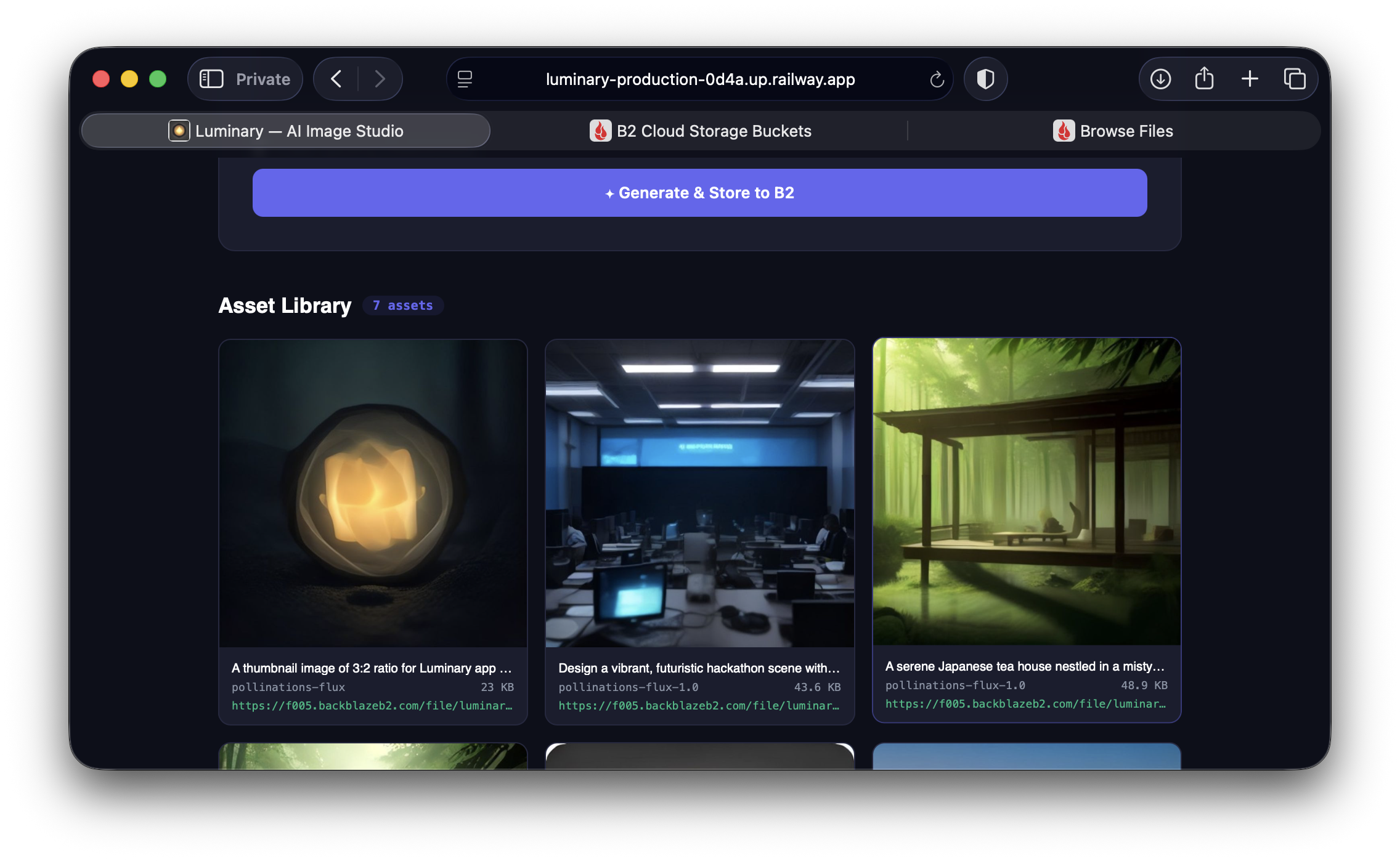
-Browse a persistent, timestamped gallery of all created assets
-Share generated images with immediate public URLs
The target audience includes freelance designers prototyping concepts, marketing teams generating campaign assets, and creators building visual portfolios—all of whom need durability and organization, not just one-off generations.
Production Readiness: Luminary isn't a toy. It demonstrates real production patterns:
-Reliable API design: Error handling for both generation failures and storage faults; timeout management (60s for image generation)
-Durable workflows: Each generated image is immediately persisted with structured metadata, preventing loss of work
-Stateless scaling: Stateless Flask backend deployed on Railway with no local filesystem dependencies—ready to scale horizontally
-Metadata provenance: Every image is stored with generation context (prompt, model version, exact timestamp) embedded in S3 object metadata, enabling audit trails and reproducibility
-Public-facing reliability: B2 CDN integration for fast image serving; optional proxy endpoint (/img) for CORS handling
-Health preservation: Images are organized into predictable paths (generated/YYYYMMDD_HHMMSS.png), enabling bulk operations and retention policies
B2 Storage & Data Orchestration: Luminary uses Backblaze B2 as its core persistence layer, not as an afterthought:
-Generated media storage: All AI-generated images flow directly into B2 via s3.put_object() with S3-compatible API
-Metadata as first-class data: Custom S3 metadata headers store:
- User prompt (for searchability and attribution)
- Model name (for version tracking and reproducibility)
- Precise timestamp (for audit logs and deduplication)
-Gallery intelligence: The /api/gallery endpoint queries B2's object listing, parses metadata headers, and serves a live inventory without a separate database. As users generate images, the gallery auto-updates—B2 is the source of truth
-Cost-efficient serving: B2's public file URLs (https://f005.backblazeb2.com/file/...) deliver images directly from CDN; the Flask proxy (/img) provides a fallback for auth/CORS edge cases without adding bandwidth overhead to the app server
-Scalable asset organization: Prefixed paths (generated/, optional drafts/, exports/) enable lifecycle policies—future versions could auto-archive old generations or move popular assets to faster tiers
Use of Generative Models & Workflow Orchestration: Luminary demonstrates pragmatic generative workflow design:
-Multi-provider readiness: Currently integrated with Pollinations (free, no API key, instant), but the architecture is provider-agnostic. The /api/generate endpoint abstracts the generation call—swapping Pollinations for OpenAI DALL-E, Replicate, or a local Stable Diffusion server requires only changing one URL
-Clean separation of concerns:
- generate.py: Standalone CLI for batch operations or scheduled generation
- app.py: Web service that orchestrates generation → B2 upload in a single request/response cycle
- Frontend: Reactive UI that displays results with live metadata
- Error resilience: If generation fails, B2 is untouched; if B2 upload fails, the user gets immediate feedback. No orphaned images or corrupted metadata
Prompt → image → metadata pipeline: A user's text prompt flows through Pollinations, becomes binary image data, gets enriched with model/timestamp metadata, and is persisted in B2—all atomically and traceable
Why This Matters: Luminary isn't a prototype hidden behind localhost. It's a full production app with:
✅ Real audience (creators needing reliable, organized AI image workflows)
✅ Durable infrastructure (B2 + Railway for zero-knowledge persistence)
✅ Metadata intelligence (provenance tracking, reproducibility, audit trails)
✅ Extensible architecture (swap generation providers without rewriting storage logic)
✅ Shareable workflows (public gallery URLs, live-updating inventory)
It demonstrates the use of Genblaze and how Backblaze B2 becomes the architectural backbone for generative media apps—not just storage, but the source of truth for metadata, versioning, and multi-user workflows.
Built With
- ai-model
- b2-storage
- backblaze
- genblaze
- generative-ai-media-application
- image-generation


Log in or sign up for Devpost to join the conversation.