-
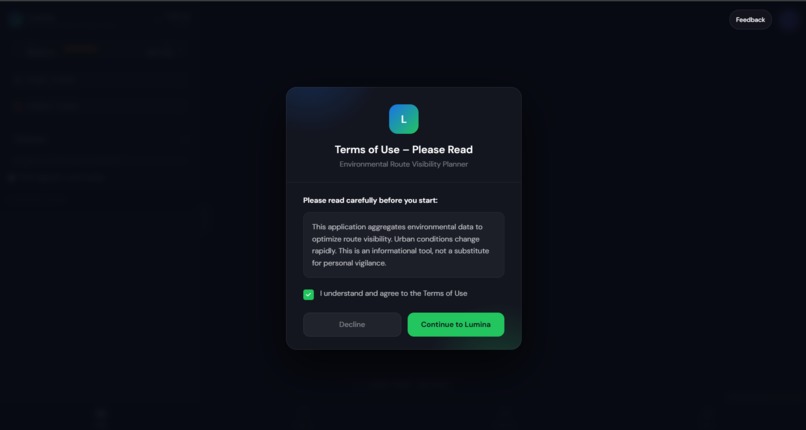
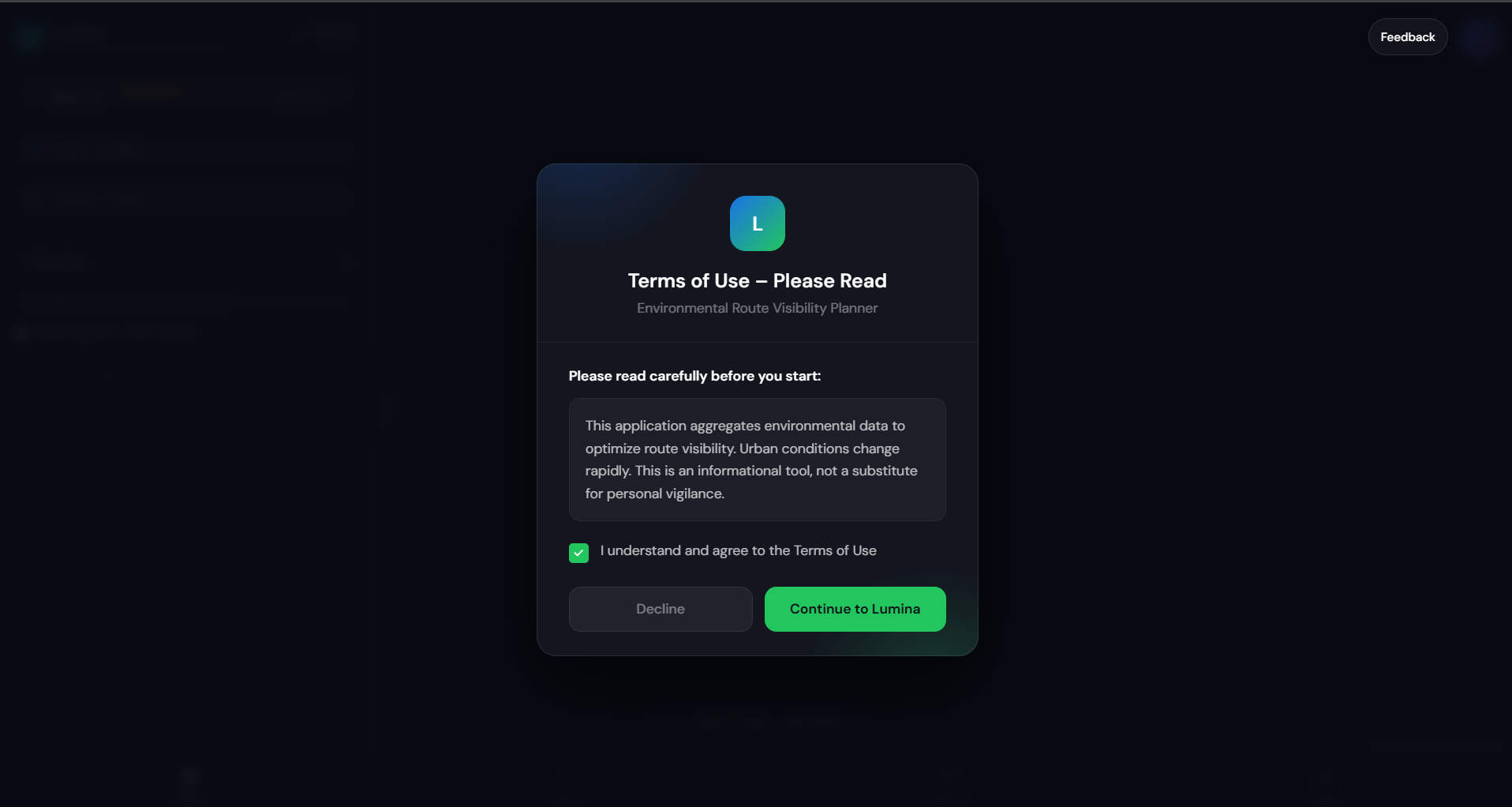
T&C page
-
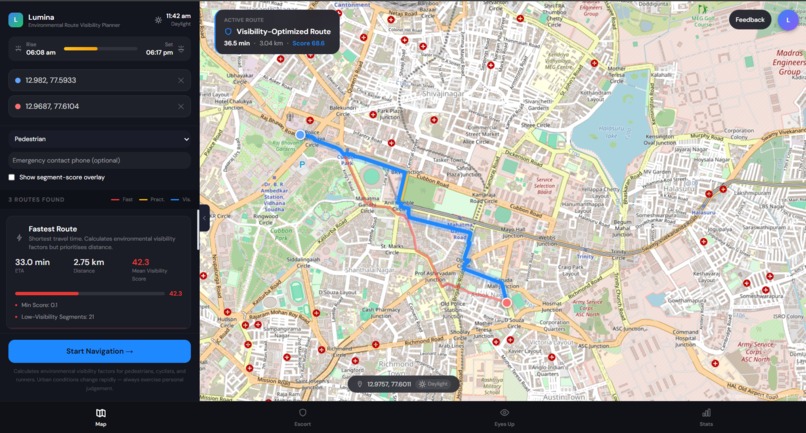
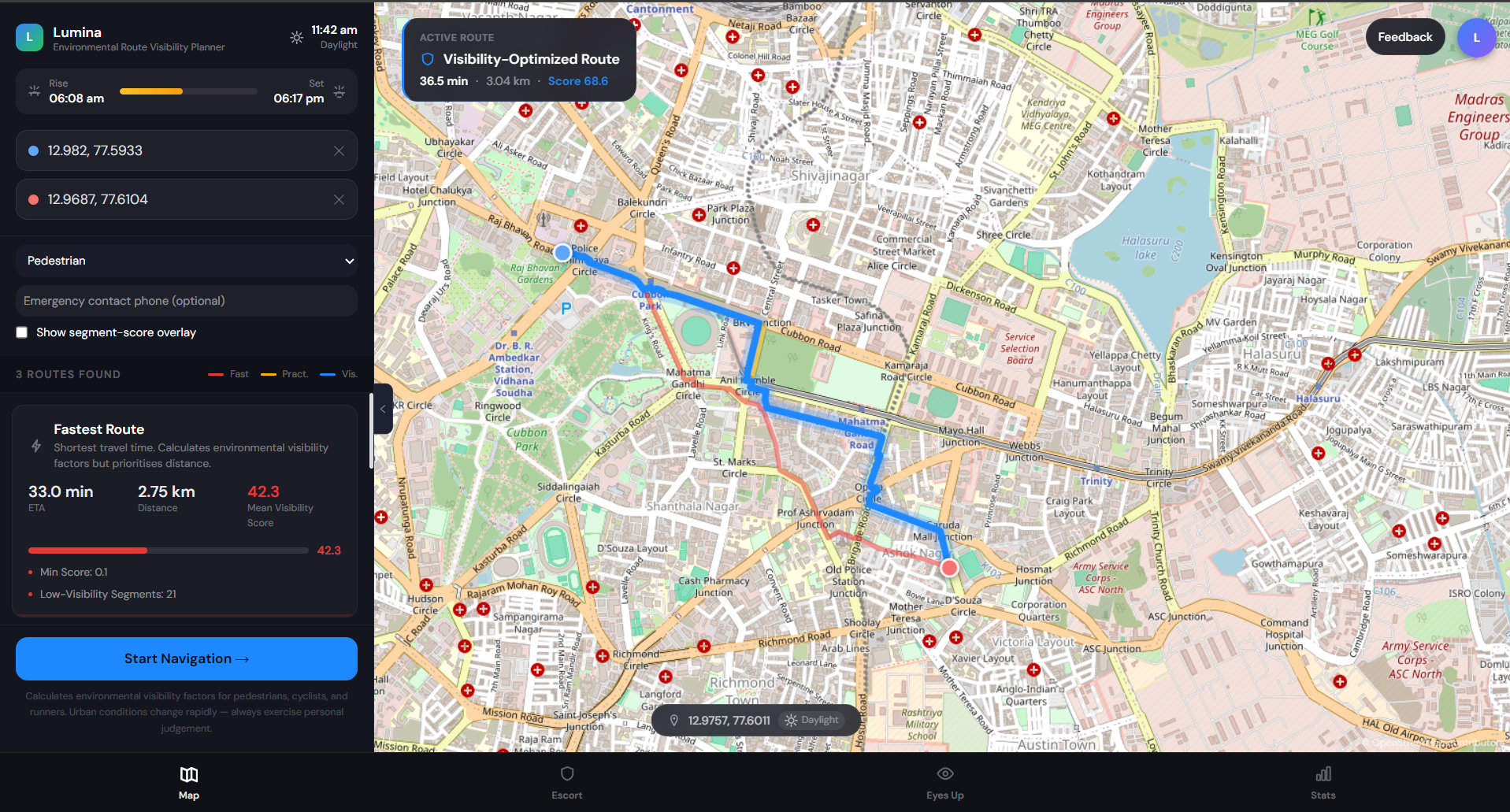
Homepage
Inspiration
The idea for Lumina came straight from our own lived experiences. We’ve all felt that familiar spike of anxiety walking home late at night, staring at Google Maps as it tries to send us down a pitch black, empty shortcut just to save 45 seconds. Traditional navigation apps were built for cars, efficiency, and speed. They treat a dark, deserted alley and a brightly lit avenue as identical choices if the physical distance is the same. We wanted to build something that prioritizes visibility over raw speed and takes the lonely shortcut out of walking alone.
What it does
Lumina AI helps users compare three routes: visibility-first, fastest, and balanced. It considers available information about lighting, nearby establishments, and surrounding activity to help people make more informed choices. We also envisioned Escort Mode, with optional journey sharing and arrival confirmation.
How we built it
Spatial Graph & Pathfinding: Used OSMnx to download OpenStreetMap street networks and NetworkX to run a custom-weighted pathfinding algorithm. The AI Cost Formula: To make the algorithm avoid dark streets without completely breaking pathfinding logic, we dynamically inflated the mathematical "cost" of each 50-meter edge using a formula. We Leveraged LLM API pipelines to parse mock community text streams and police logs, converting qualitative hazard reports into numerical spatial penalties.
Challenges we ran into
Downloading the real map into our backend code and the subsequent act of connecting our frontend and backend codes was time consuming and challenging.
Accomplishments that we're proud of
We’re proud that we turned a problem we personally cared about into a tangible product. Seeing our idea evolve from a conversation into a working prototype was incredibly rewarding. Integrating the actual map into our application, and then seeing the frontend connect to the backend workings was really great.
What we learned
Hackathons are hard but really fun as well.
What's next for Lumina
The Dynamic Buddy System: Introducing a peer-to-peer pairing feature that safely connects verified users walking through unavoidable low-visibility bottlenecks at the same time. Enterprise & B2B Licensing: Partnering with universities for campus security integration and licensing our routing API to delivery platforms (like Swiggy or Zepto) to protect late-night gig workers. Wearable Integration: Syncing with smartwatches to detect sudden biometric spikes (like a sudden heart rate jump) to automatically launch Escort Mode without unlocking a phone.
