-
Smart Lighting That Thinks — Saving Energy, One Night at a Time
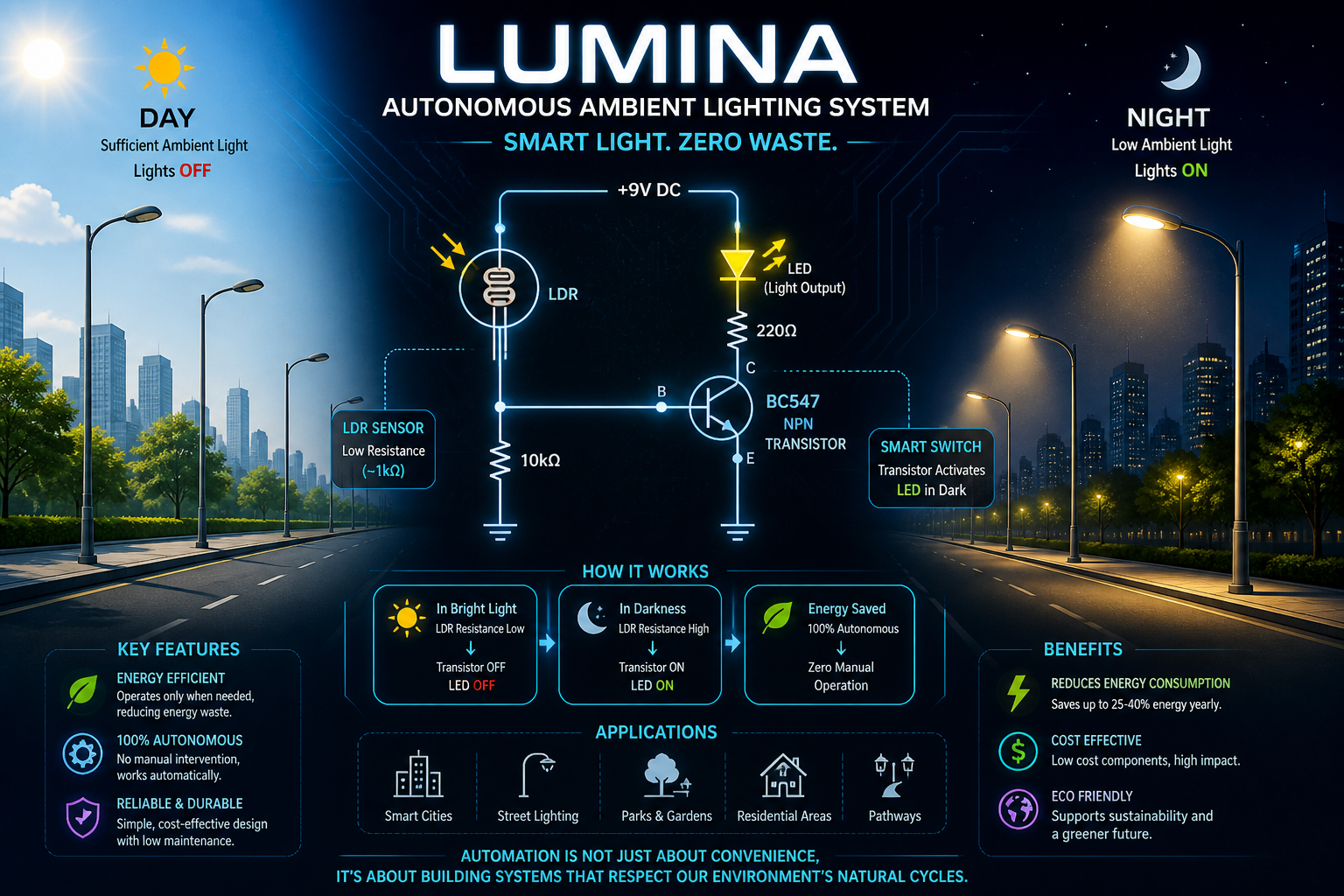
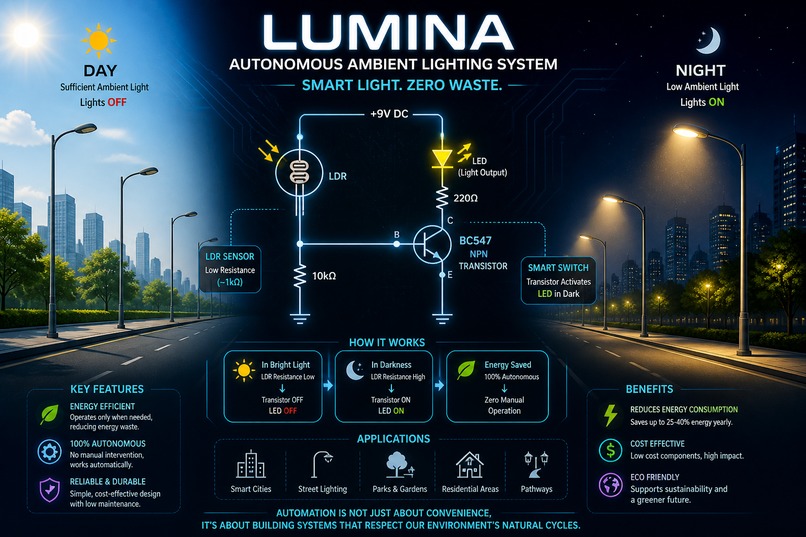
LUMINA was inspired by a common real-world problem—street lights staying ON during the daytime, wasting energy and increasing costs. To solve this, we designed an autonomous lighting system that automatically controls lights based on ambient conditions. The system uses a Light Dependent Resistor (LDR) to detect light intensity and a transistor-based switching mechanism to turn lights ON at night and OFF during the day.
We built the circuit using simple analog electronics, including a voltage divider, BC547 transistor, resistors, and an LED, all assembled on a breadboard with a DC power supply. Along the way, we faced challenges such as selecting the right resistor values, managing sensitivity under varying light conditions, and ensuring stable connections.
Despite these challenges, we successfully developed a low-cost, reliable, and fully automated system. This project helped us understand practical circuit design, sensor behavior, and real-world problem solving. In the future, we plan to enhance LUMINA by integrating microcontrollers, motion sensors, and solar power, making it more efficient and suitable for smart city applications.
Built With
- analog-electronics
- basic
- breadboard-prototyping
- electrical
- including
- light-dependent-resistor-ldr
- ohm?s
- principles
- transistor-switching-bc547
- voltage-divider-circuit

Log in or sign up for Devpost to join the conversation.