Inspiration
Walking across campus at night can feel uncomfortable or unsafe, especially when students are moving alone between dorms, libraries, dining halls, and parking areas. While Virginia Tech has safety resources like Blue Light stations, those tools are spread across different platforms and aren’t always easy to access in the moment. We wanted to bring everything into one place and design around how students actually move at night—quickly, on foot, and often under stress.
What it does
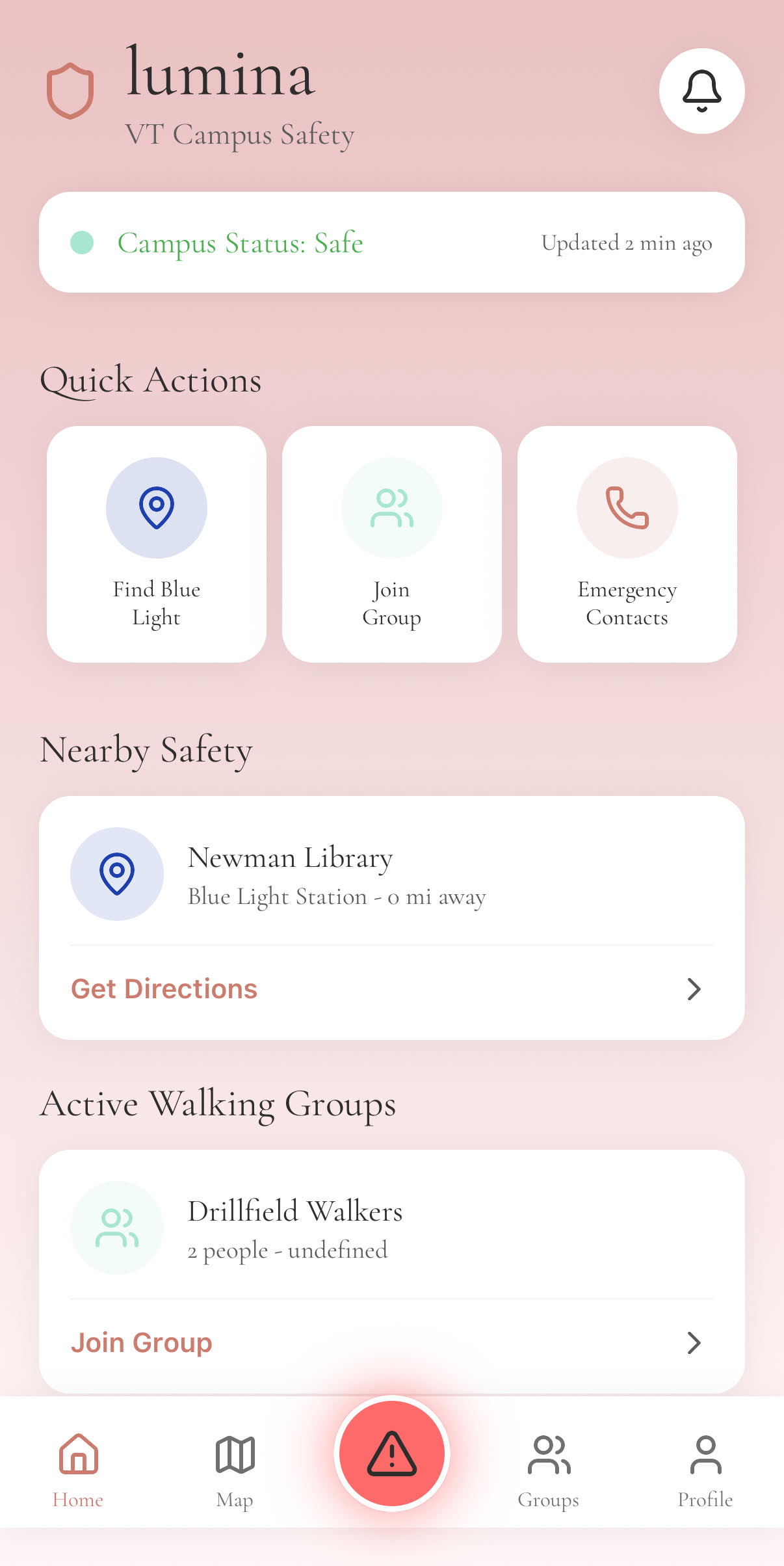
Lumina is a campus safety app for Virginia Tech that helps students walk more safely by combining prevention, community, and emergency tools. It provides safe route planning with turn-by-turn navigation, shows nearby Blue Light stations and activity/risk zones on a dark-mode campus map, lets students join or view walking groups, and includes a long-press SOS system that’s accessible from any screen for fast emergency response.
How we built it
We built Lumina using React Native with Expo for fast cross-platform development. Geoapify APIs power address autocomplete, campus-verified locations, and turn-by-turn walking routes. Expo Location handles live GPS tracking during navigation. We layered in AI (Google Gemini) to support route safety optimization and explanations, with a local fallback to ensure reliability. The UI was designed mobile-first with dark mode, quick actions, and minimal friction for emergency use.
Challenges we ran into
One major challenge was balancing feature depth with speed and simplicity—especially for emergency scenarios where every second matters. Integrating real-time navigation, GPS updates, and map rendering while keeping the app responsive was also tricky. Designing realistic safety features without access to live campus police data required careful use of simulated data while keeping the system extensible for real integrations later.
Accomplishments that we're proud of
We shipped a fully functional MVP that feels realistic and usable, not just a concept. Lumina includes live navigation, campus-specific locations, interactive maps, walking groups, and an always-accessible SOS system—all integrated into a cohesive experience. We’re especially proud of how seamlessly the prevention, community, and emergency layers work together in one app.
What we learned
We learned how important it is to design safety tools around real user behavior, not just features. We gained experience integrating mapping, GPS, and external APIs into a mobile app, and learned how to build resilient systems with fallbacks when advanced features like AI aren’t available. We also learned the value of scoping an MVP tightly while still making it impactful.
What's next for Lumina
Next, we want to add real-time safety alerts and push notifications, integrate live campus police and incident data to generate smarter risk zones, and support real-time walking group tracking. Future enhancements include lit-path overlays, incident reporting, offline mode, accessibility features like voice navigation, and full user authentication to make Lumina production-ready for campus-wide use.


Log in or sign up for Devpost to join the conversation.