-
-
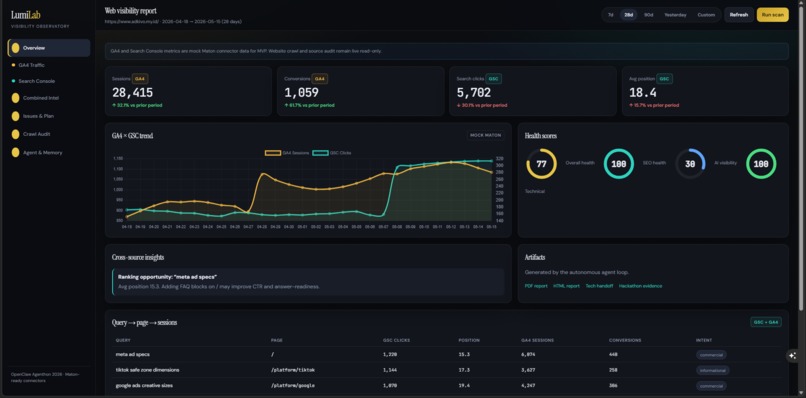
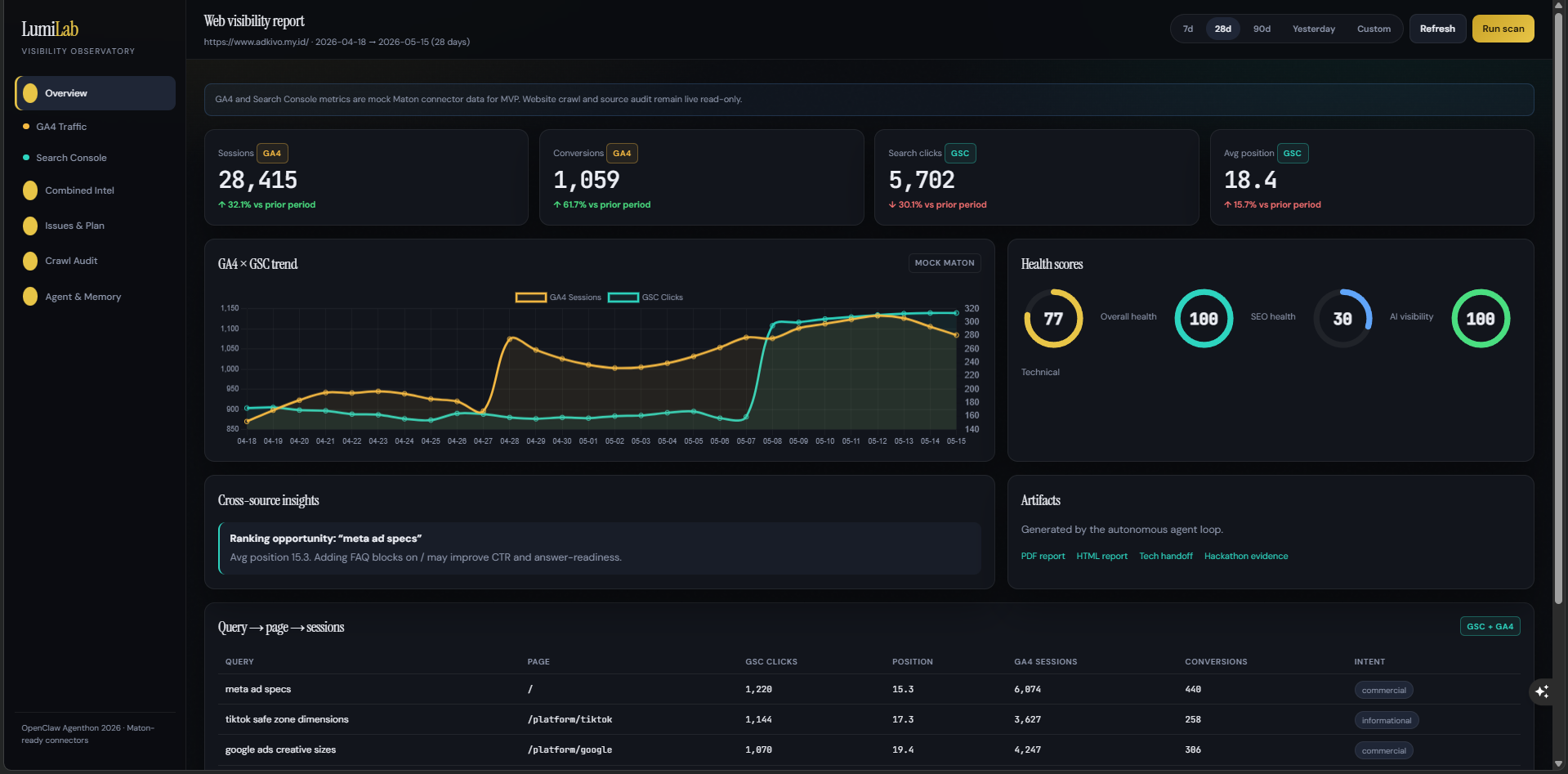
Web UI Interactive Dashboard
LumiLab — Devpost Project Description
Inspiration
Businesses today can launch websites faster than ever, but many still struggle to understand whether their website is actually discoverable, readable, and growth-ready. This is especially true for founders, SMEs, creators, and developers who can build a website but do not always have the SEO, analytics, and digital marketing expertise to continuously monitor and improve it.
At the same time, website visibility is no longer limited to traditional search rankings. Websites now need to be understandable not only by search engines, but also by AI-powered discovery systems and generative search experiences. A company profile, blog, media site, landing page, or web-commerce store can lose growth opportunities simply because its content structure, metadata, schema, page clarity, or search signals are not properly optimized.
LumiLab was inspired by this gap between website creation and website growth.
We wanted to build an autonomous website visibility agent that helps non-marketers, business owners, and developers understand:
- What is wrong with their website
- Why it matters for visibility and growth
- What should be fixed first
- How to translate marketing problems into technical actions
What it does
LumiLab is an Autonomous Website Visibility Agent that scans a website, analyzes SEO and AI visibility signals, combines them with performance and business context, remembers historical issues, prioritizes improvements, and generates executive-ready reports plus developer-ready action plans.
The core workflow is:
Scan → Analyze → Remember → Prioritize → Report → Dashboard
In the MVP, LumiLab can:
- Crawl a target website in read-only mode
- Extract website signals such as title tags, meta descriptions, headings, canonical tags, image alt text, internal links, schema presence, FAQ presence, and content structure
- Analyze SEO health and AI visibility readiness
- Load mock connector-ready data for GA4, Google Search Console, and commerce/business signals
- Compare the latest scan with previous memory
- Detect new, repeated, and unresolved issues
- Calculate a priority score based on severity, business page value, traffic opportunity, and recurrence
- Generate report outputs in JSON, HTML, and PDF
- Show the results in a simple dashboard
- Provide an AI-assisted explanation layer so users can understand why an issue matters and what to do next
LumiLab is website-agnostic. It can support company profiles, blogs, media sites, landing pages, and web-commerce sites.
For this hackathon demo, we used a web-commerce-like scenario because it has more complex signals and clearer business impact.
How we built it
We built LumiLab as an agent-ready Node.js application with a modular connector architecture. The repository is structured around clear functional layers, including agent logic, connectors, dashboard, documentation, memory scans, mock data, output files, and scripts.
The system has several main parts:
1. Website crawler
The crawler reads website pages in read-only mode and extracts SEO and content signals.
2. Mock/live connector layer
LumiLab uses mock GA4, Search Console, and commerce data for the hackathon demo, but the data is normalized through adapter files so the same agent logic can later use live API data without changing the reasoning layer.
3. Agent reasoning layer
The agent evaluates:
- SEO health
- AI visibility readiness
- Business relevance
- Traffic opportunity
- Issue recurrence
4. Memory layer
LumiLab keeps historical scan context so it can identify whether an issue is new, repeated, or resolved.
5. Priority scoring engine
Each issue is ranked using a business-oriented scoring formula:
Priority Score = Severity × Business Page Value × Traffic Opportunity × Recurrence Factor
6. Report generator
The agent creates structured outputs such as:
latest_report.jsonlatest_report.htmllatest_report.pdf- technical handoff documentation
7. Dashboard
The dashboard displays connector status, website health, SEO score, AI visibility score, priority issues, executive summary, and developer action plan.
We also made LumiLab OpenClaw-compatible through an autonomous daily run command. The project includes commands such as:
npm run scan
npm run openclaw:daily
npm run dashboard
These commands help judges reproduce the core workflow.
Challenges we ran into
The biggest challenge was balancing ambition with the 12-hour build sprint. LumiLab has a large long-term vision: real GA4 integration, Search Console integration, web-commerce data, dashboard intelligence, memory, AI assistant, and automated reporting. However, building all real API integrations during a hackathon would create too much risk, especially around OAuth, credentials, and API setup.
To solve this, we designed a connector-ready architecture. The MVP uses stable mock data for GA4, Google Search Console, and commerce signals, while the website crawler and report generation logic still run as real functional components. This lets us prove the agent workflow end-to-end without depending on external credential setup.
Another challenge was making sure LumiLab did not become just another chatbot or static dashboard. The system needed to show real agent behavior:
- Tool usage
- Autonomous execution
- Memory comparison
- Reasoning
- Prioritization
- Workflow completion
We focused on making the agent run a complete task from scan to report.
We also had to translate marketing logic into technical rules. As a digital marketer, I understand what matters for website growth, but I am not a full-time software engineer. Vibecoding tools helped convert the product logic into working modules, while the product strategy stayed focused on real business value.
Accomplishments that we're proud of
We are proud that LumiLab successfully turns a complex marketing and website optimization problem into an autonomous agent workflow.
The MVP demonstrates:
- A clear autonomous loop: scan, analyze, remember, prioritize, report, and update dashboard
- Read-only website analysis, making the concept safer for real-world use
- Connector-ready architecture for GA4, Search Console, and commerce data
- A scoring system that translates technical issues into business priorities
- Memory-based issue tracking, so the agent can identify recurring problems instead of only running one-time audits
- Multiple report outputs, including JSON, HTML, PDF, and technical handoff files
- A dashboard that makes the report understandable for both business users and developers
- A reproducible GitHub repository with quick-start commands and project documentation
Most importantly, LumiLab was built from the perspective of a marketer who understands product growth but relies on AI-assisted development to create a functional agent system. That made the project itself a proof of the problem we are trying to solve: bridging the gap between technical execution and marketing intelligence.
What we learned
We learned that building an AI agent is not just about connecting an LLM to a chat interface. The real value comes from designing a workflow where the agent can use tools, read data, make decisions, remember context, and complete a useful task end-to-end.
We also learned that mock data can be useful when it is not used as fake output, but as a simulation layer for connector-ready architecture. By standardizing the data shape, LumiLab can work with mock data today and live API data later.
Another key learning was that website optimization needs to be framed in a way that both business users and developers can understand. A founder may need to know which issue affects business growth, while a developer needs a clear technical action. LumiLab tries to serve both audiences in one workflow.
Finally, we learned that autonomy is the core differentiator. A normal SEO checker shows a list of issues. LumiLab goes further by remembering previous scans, escalating recurring issues, prioritizing by business impact, and generating a structured report automatically.
What's next for LumiLab — Autonomous Website Visibility Agent
The next step is to move LumiLab from MVP to a production-ready website visibility agent.
Planned developments include:
1. Live GA4 and Google Search Console integration
Replace mock adapters with real API connectors so LumiLab can analyze actual sessions, clicks, impressions, CTR, rankings, and conversion signals.
2. CMS and web-commerce integrations
Add read-only integrations for WordPress, WooCommerce, Shopify-like stores, and other website platforms.
3. Scheduled monitoring
Run daily and weekly scans automatically using cron or OpenClaw workflows.
4. Smarter memory
Expand memory from simple scan comparison into long-term website intelligence that tracks recurring issues, resolved issues, trend changes, and improvement history.
5. AI visibility monitoring
Add deeper checks for structured data, FAQ readiness, entity clarity, content answerability, and AI-generated search readiness.
6. Approval-based autofix mode
In the future, LumiLab could suggest fixes and apply low-risk changes only after user approval, such as meta description drafts, schema suggestions, FAQ blocks, or developer tickets.
7. Multi-website dashboard
Allow agencies, founders, and SMEs to monitor several websites from one LumiLab workspace.
8. Alert system
Add Telegram, Discord, or email alerts for critical issues, traffic drops, missing metadata, or recurring unresolved problems.
Long term, LumiLab aims to become the autonomous visibility layer for any website.
The goal is to help businesses stop guessing and start improving their websites through continuous, data-informed, AI-assisted action.
Built With
- cursor
- openclaw

Log in or sign up for Devpost to join the conversation.