Inspiration
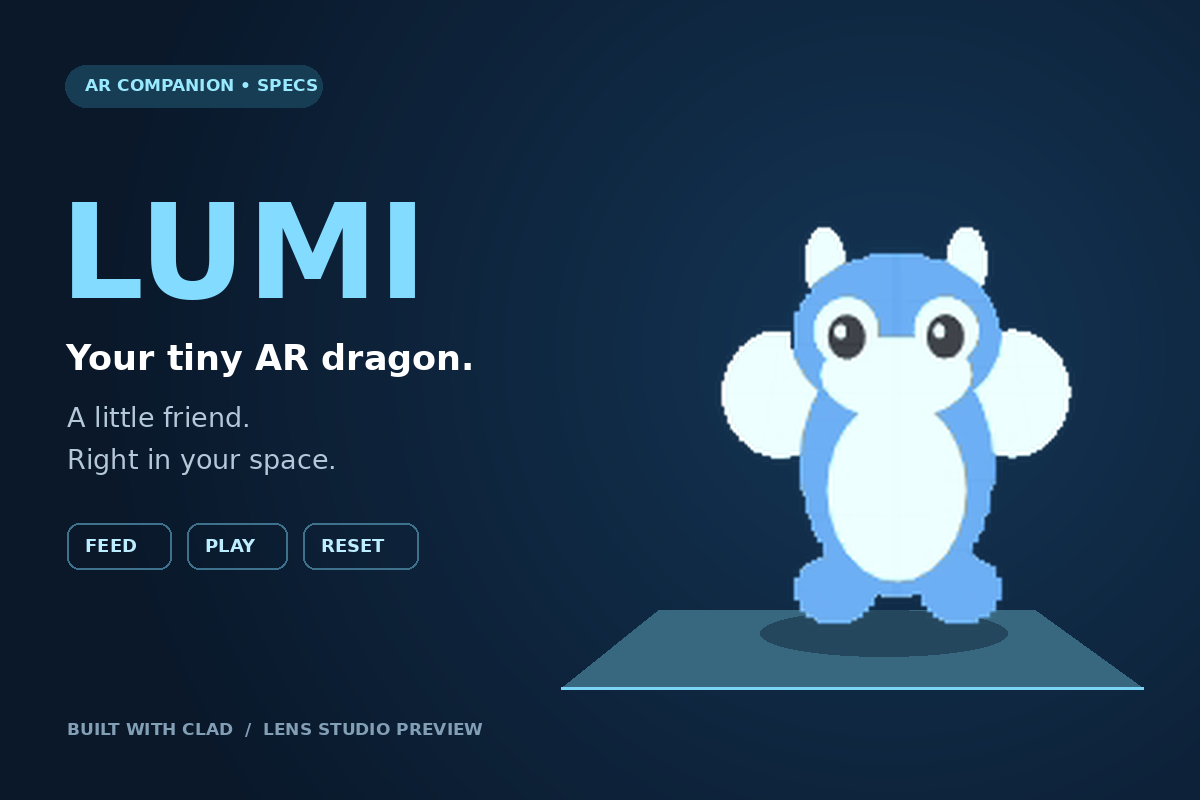
Lumi explores a simple question: what would it feel like to have a tiny dragon sharing your space? I wanted to create a playful companion that occupies a place in the world and responds to small moments of attention.
What it does
Lumi is a blue-and-white baby dragon for SPECS. Place him on a tabletop, feed him a treat, or invite him to chase a ball. He responds through short movements and animations. Reset returns the experience to the placement stage.
The demo runs in Lens Studio preview with a simulated table. No physical glasses or webcam are required.
How I built it
I planned the experience using the Devpost Learn plan-lens skill, which produced the approved design brief included in the devpost folder. I then used Codex with CLAD and the Lens Studio MCP to build the scene, TypeScript behavior, dragon geometry, animations, and interaction controls.
The working project uses Lens Studio 5.23.2.
Challenges
Developer-platform login problems required switching from Lens Studio 5.24.1 to 5.23.2 and creating a fresh compatible project while preserving the design brief.
LEAF 4.0.0 had an interaction-package dependency mismatch in this setup. I removed the incompatible package to restore compilation and verified the main interactions manually in preview. The five planned LEAF tests remain blocked, not passed.
What I learned
I learned to define observable success criteria before building, keep the first version small, and distinguish a working interaction from a visual mockup. Designing for AR also meant thinking about spatial placement: Lumi stays at his location rather than following the camera.
What's next
I would improve animation expressiveness, strengthen visual feedback, resolve automated-test compatibility, and test the experience on physical SPECS hardware.
Built With
- clad
- codex
- lens
- specs
- studio
- typescript
