-
-
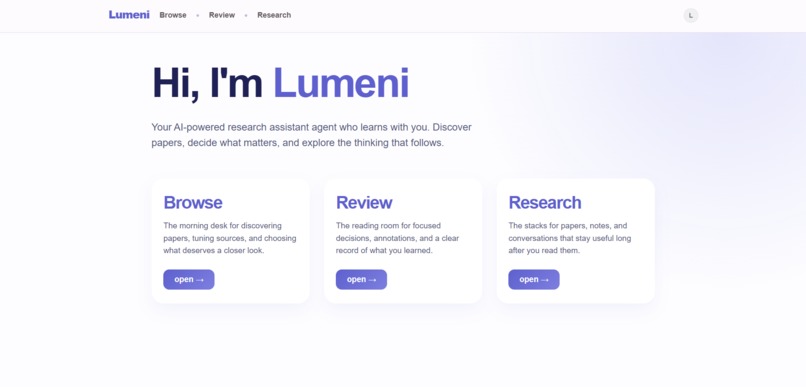
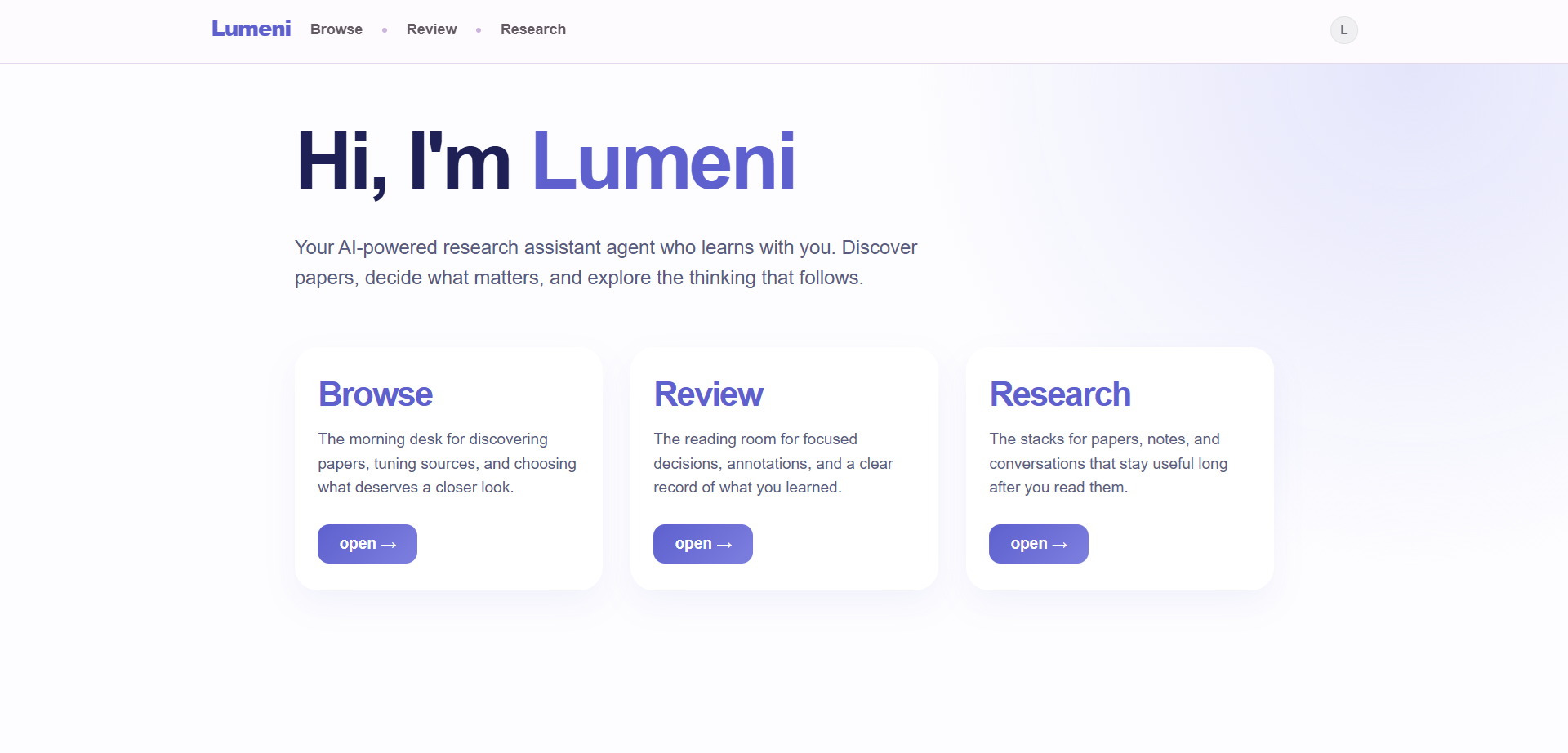
Hi, I'm Lumeni
-
Browse
-
Review
-
Research
Inspiration
In today's current research climate, a researcher does not spend most of their time thinking and exploring, but hunting for the right papers and rebuilding an experiment environment from scratch. Meanwhile, a wave of research on self-referential and self-improving agents showed us agents can do far more than exist as a simple chatbot, and can have meaningful interactions with users. We asked: how can an agent like this help research work be made more efficient and remove the brute work? Our answer is Lumeni, a self-learning agent assistant with context and memory.
What it does
Lumeni will be with users at every step of their research process: browse, review, and research.
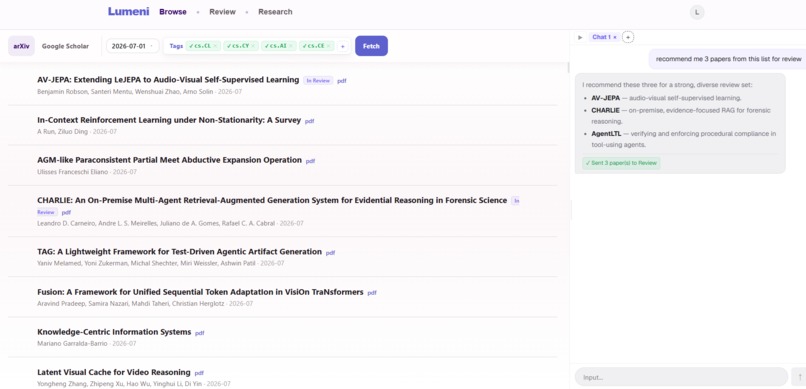
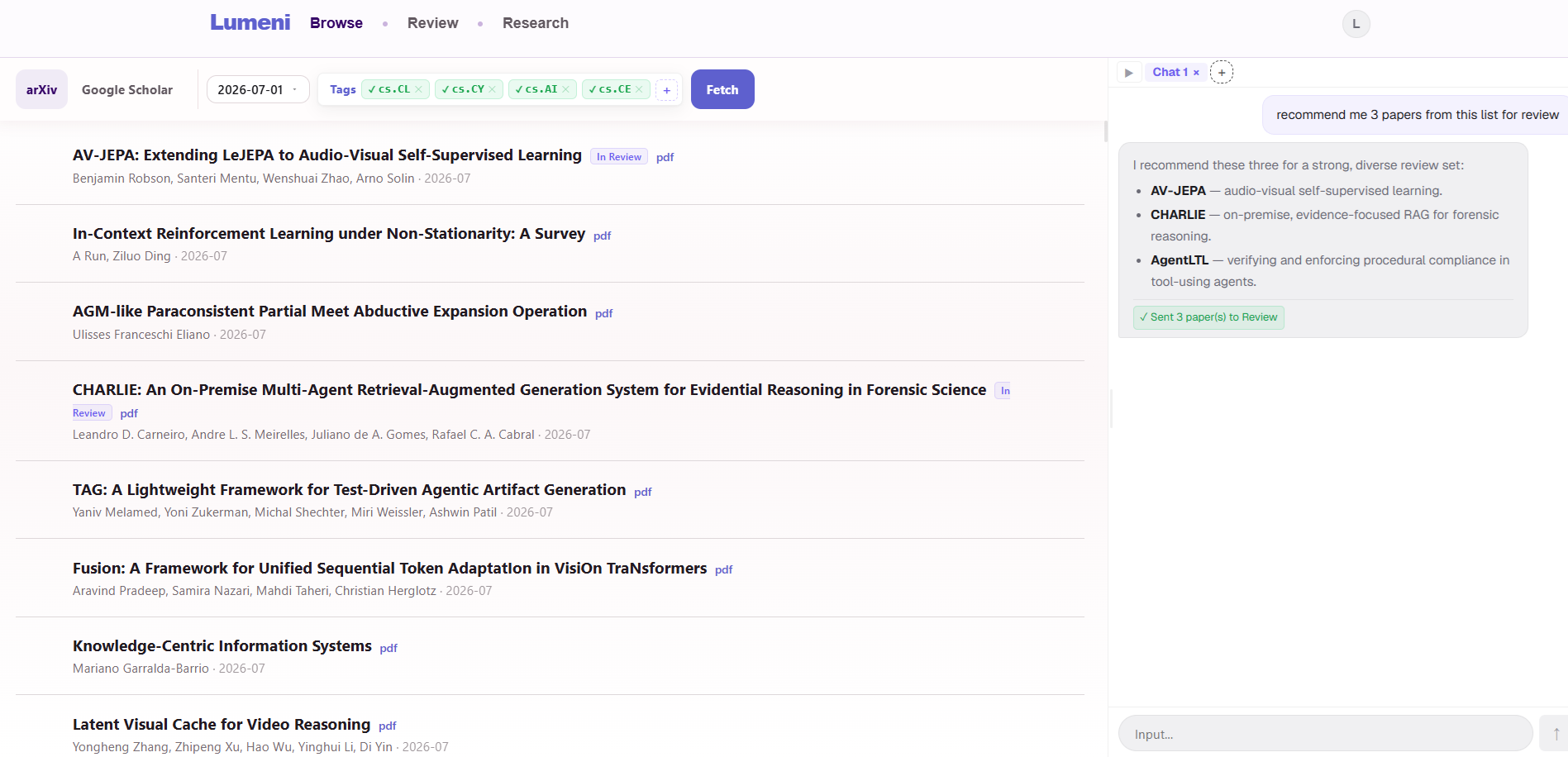
Browse:
- Users can fetch papers from any day on arXiv or search for papers on Google Scholar
- Lumeni will be there to assist users in recommendations for papers
- Users are able to select papers with Lumeni or by hand to send to review
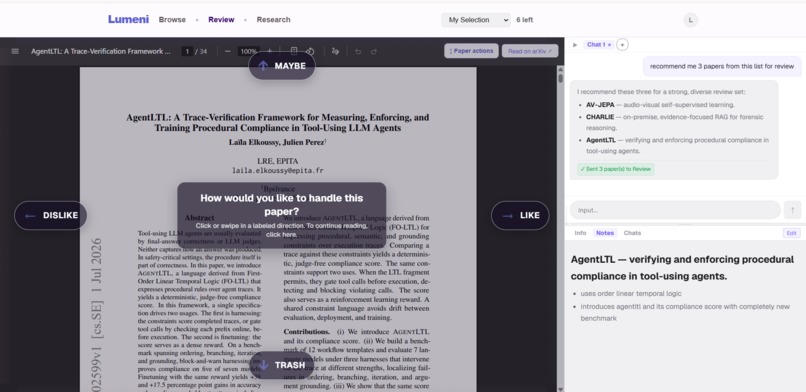
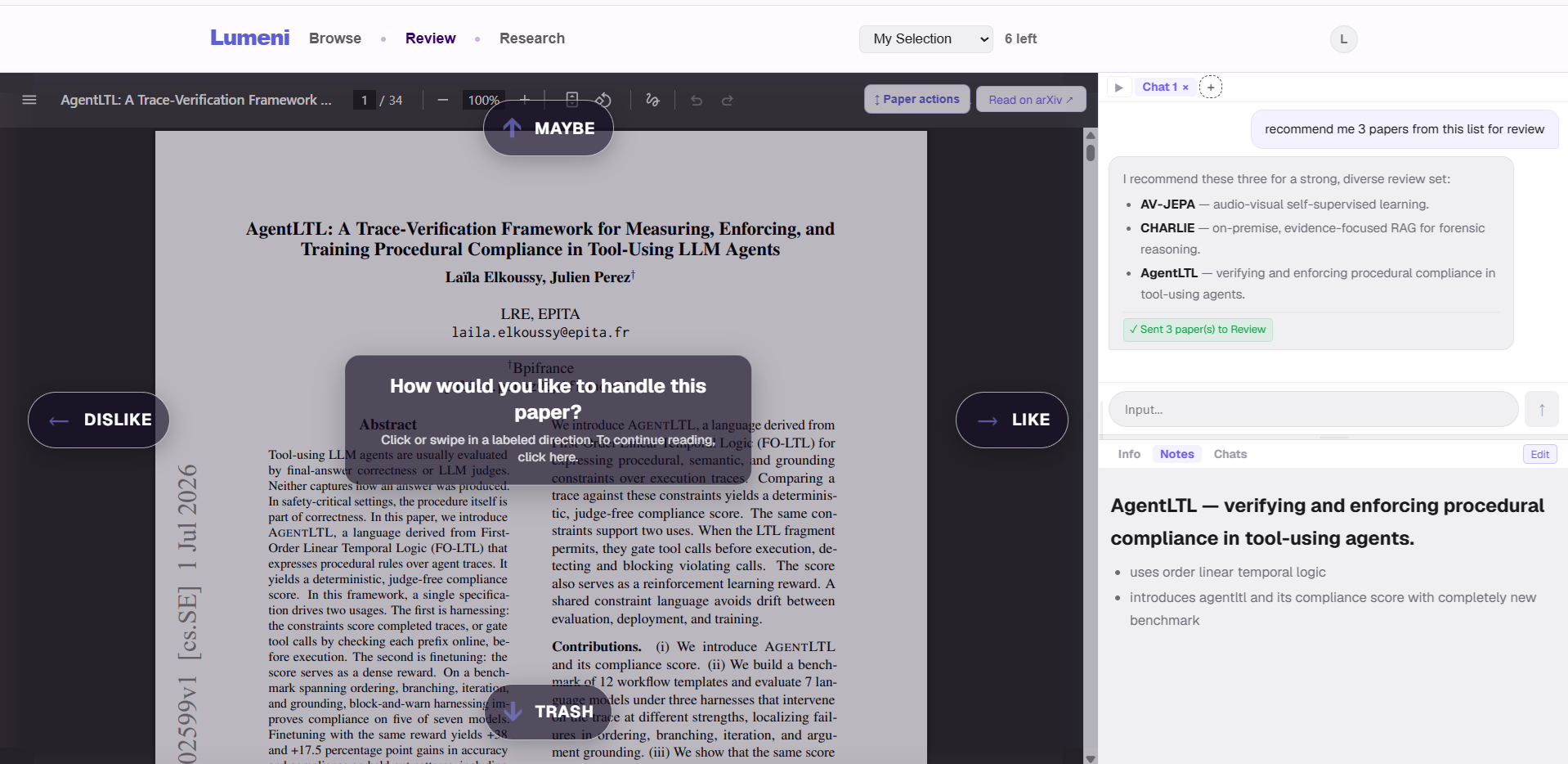
Review:
- Users will review their selected papers and Lumeni will help users take notes and answer simple, clarifying questions to decide which papers are important
- Lumeni will also remember which papers the user liked and disliked, allowing for better paper recommendations in the future
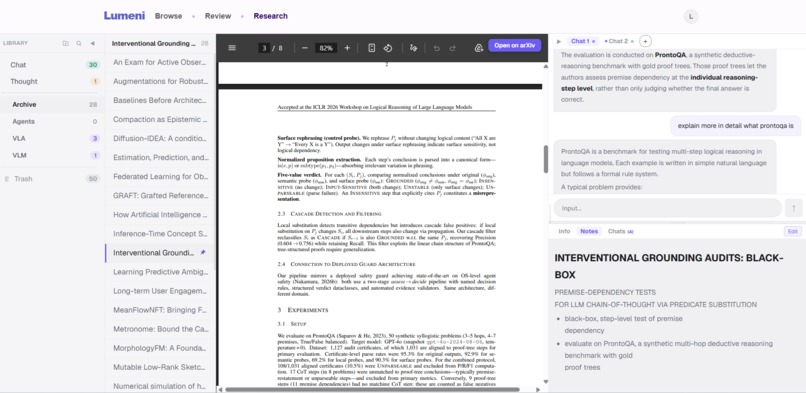
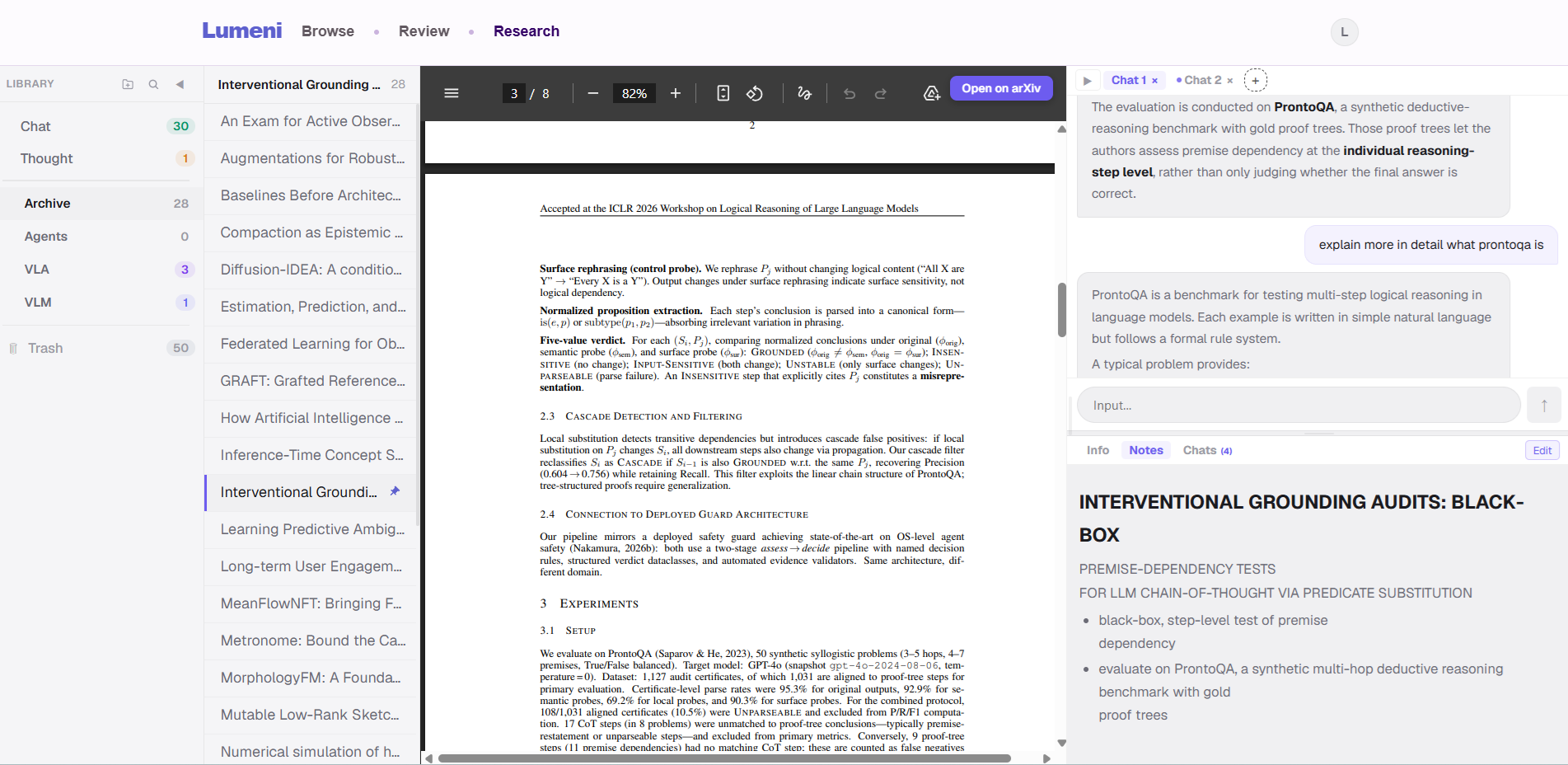
Research:
- Users will find their papers stored in the Archive and organize them in folders
- Lumeni can go in-depth with users about each paper: ask questions, summarize important methodologies, and explore new ideas
- Lumeni remembers each note and conversation it has with each paper — all information will be restored for when the user comes back
- Users can view all their chats in "Chats" and write documentation in "Notes"
How we built it
- Frontend: React 18 + TypeScript, bundled with Vite. Global chat panel that tracks the currently open paper as context
- Backend: Python + Flask, organized into route blueprints over a domain layer for papers, library, and settings. An LLM gateway abstracts over multiple providers with usage metering and automatic fallback
- Coding agent: Codex (GPT-5.6) used directly in the terminal throughout the build to scaffold features and debug the Flask/React integration end-to-end
- In-app assistant: The chat panel's backend route is a pluggable seam that falls back to Codex CLI (GPT-5.6) as the model behind "Lumeni," the in-app research assistant, reusing the same authenticated Codex session as development with no extra API keys for the demo
Challenges we ran into
- The chat endpoint silently proxied every message to an external agent service that was never actually running locally, so the agent always returned a canned "not available" reply (traced with Codex by reading backend logs)
- The default model backend pointed at an unconfigured third-party gateway with no valid key, which required rewiring the fallback path to route through Codex CLI instead
- The frontend already tracked which paper was open, but that context was silently dropped at the backend. The chat only ever saw raw message text, so "summarize this paper" failed. We fixed this by threading the paper/library context into the model's system prompt
Accomplishments that we're proud of
- Created a powerful self-learning agent that has memory and helps the user do tasks (agent skills)
- Successfully demonstrated a full research process (browse, review, research) that a typical researcher will complete
- Designed a modern and clean UI that allows the user to view and access Lumeni easily
- Integrated OpenAI's Codex model seamlessly and proved how agents can be used in many ways
What we learned
We learned that agentic AIs can be used in a much broader sense and that we can design them to help us in many ways. They do not have to be limited to be simple chatbots, but can be used to help analyze and organize all your thoughts. They are also able to learn tailored to each user and can evolve based on the feedback received. They can eliminate much of the brute work that humans do to create a clean workspace for humans to actually explore and think through their ideas.
What's next for Lumeni
We want Lumeni to be accessible for every individual. In the future, we hope to implement:
- Online: allow Lumeni to be accessed through a web browser and users are able to sign in with an email, or connect them through third party websites (ex: Gmail)
- Workspace: a clean working environment separate from the Archive and allow users to open multiple papers/sessions in one sitting
- Mobile app: enhance Lumeni's current "Review" process by allowing users to swipe freely on papers
- Environment: allow Lumeni to run actual experiment environments (i.e. baseline code) and create a full end-to-end working pipeline that completes the full preliminary research work

Log in or sign up for Devpost to join the conversation.