Inspiration
Lumenfold grew from a tension I felt while learning: collecting information is easy, but turning it into durable understanding is not.
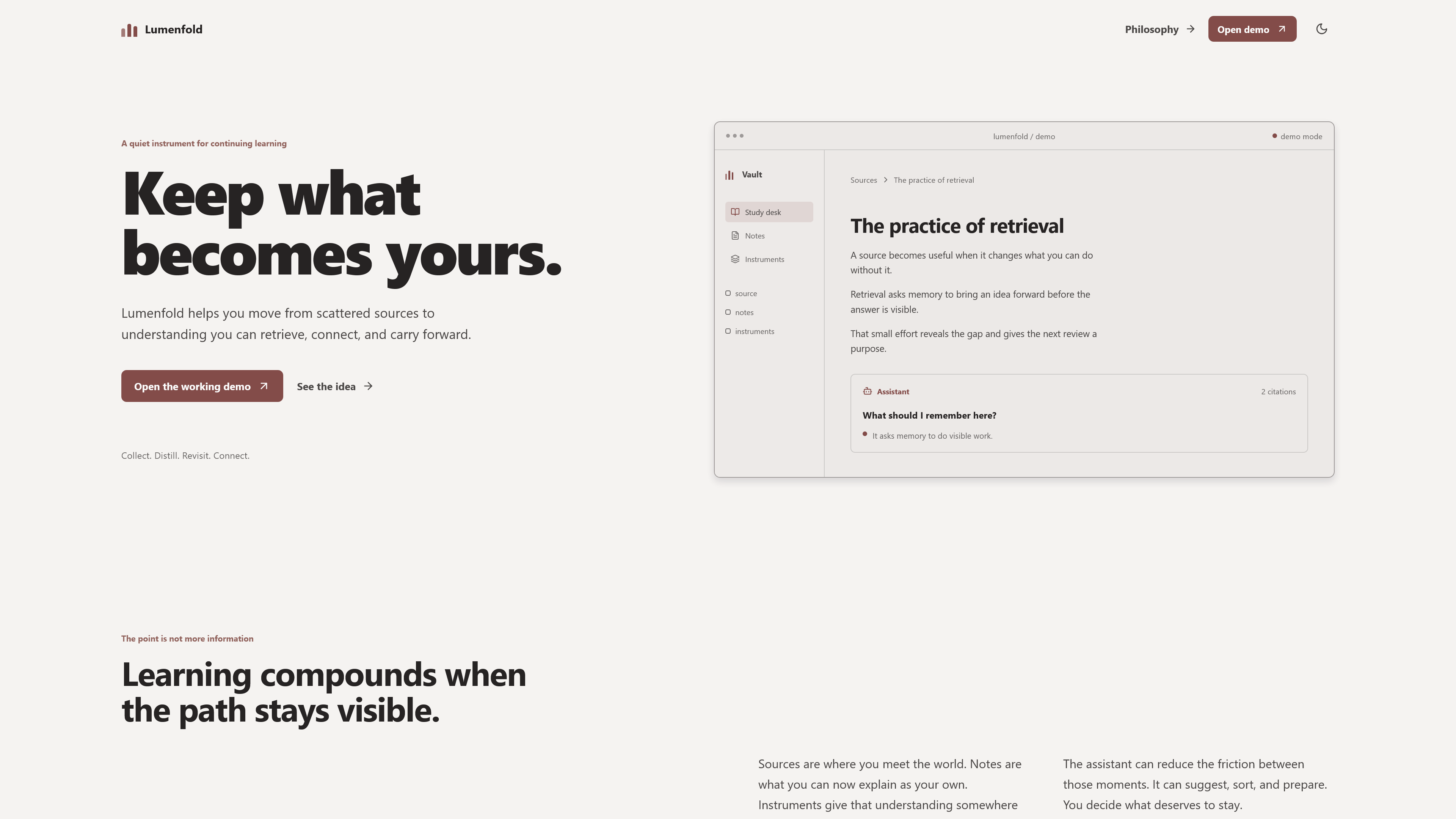
I was inspired by Obsidian's calm, human-readable workspace and by source-grounded tools such as NotebookLM. I wanted to bring those strengths together around a continuing learning loop: collect, distill, revisit, connect, and decide what to explore next.
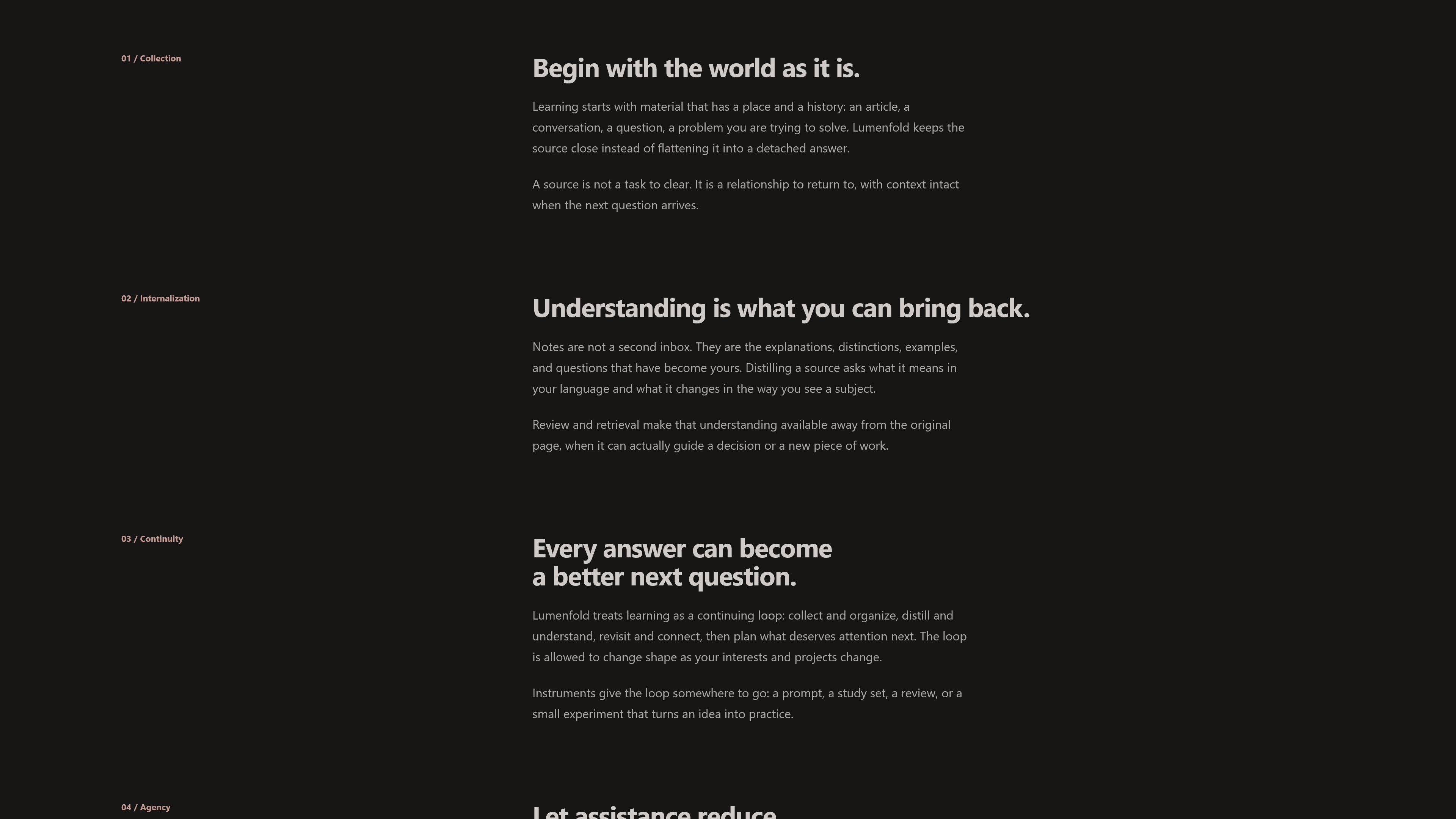
The goal is not to produce another one-time AI answer. It is to help learners build an understanding that remains useful after the original source, conversation, or study session is gone.
What it does
Lumenfold is a browser-based learning workspace for students, lifelong learners, and other self-directed learners.
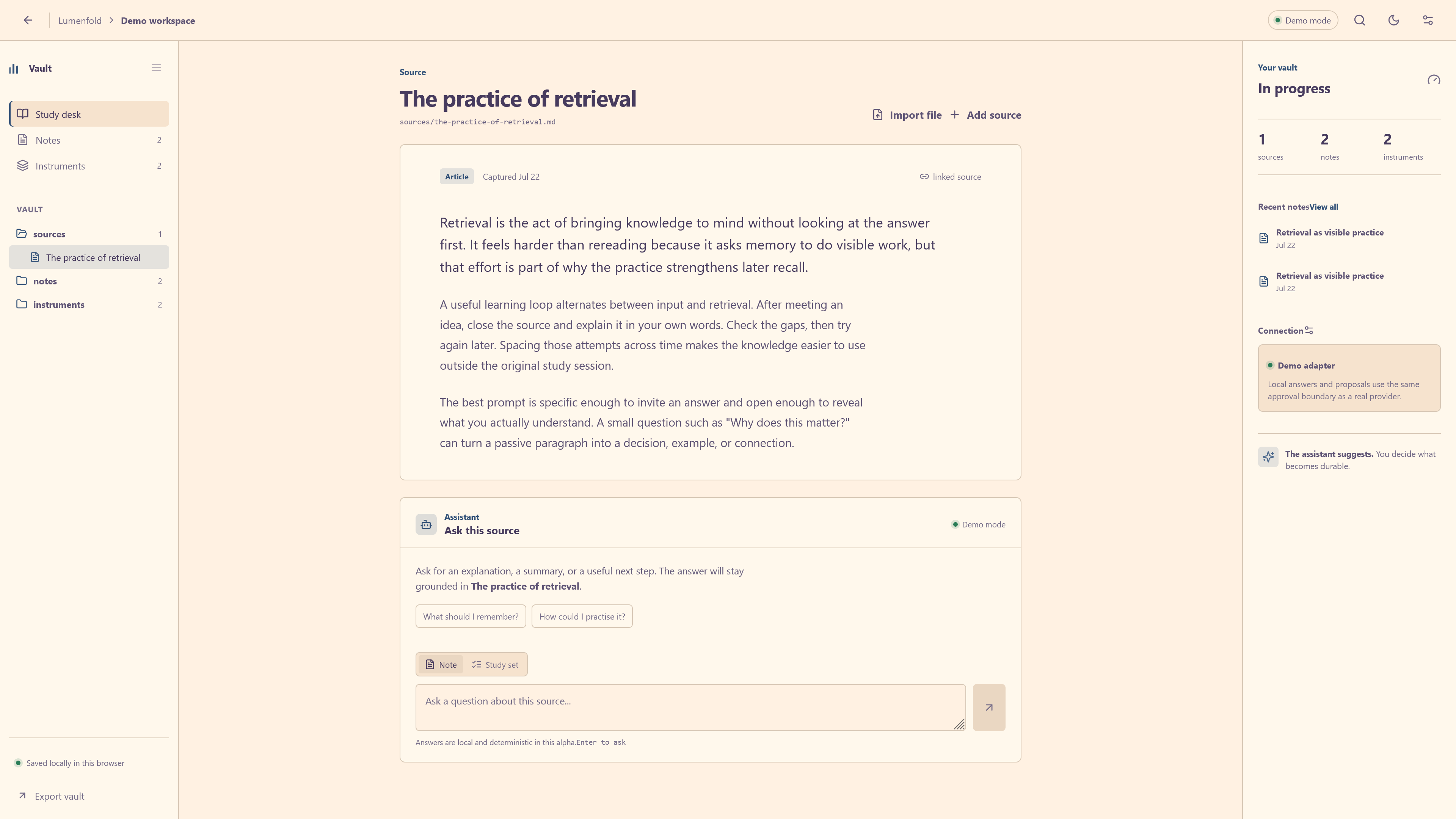
The demo begins with a source. A learner can read it, ask a question, receive an answer with exact citations, and review an AI-proposed Markdown note or study instrument before approving it.
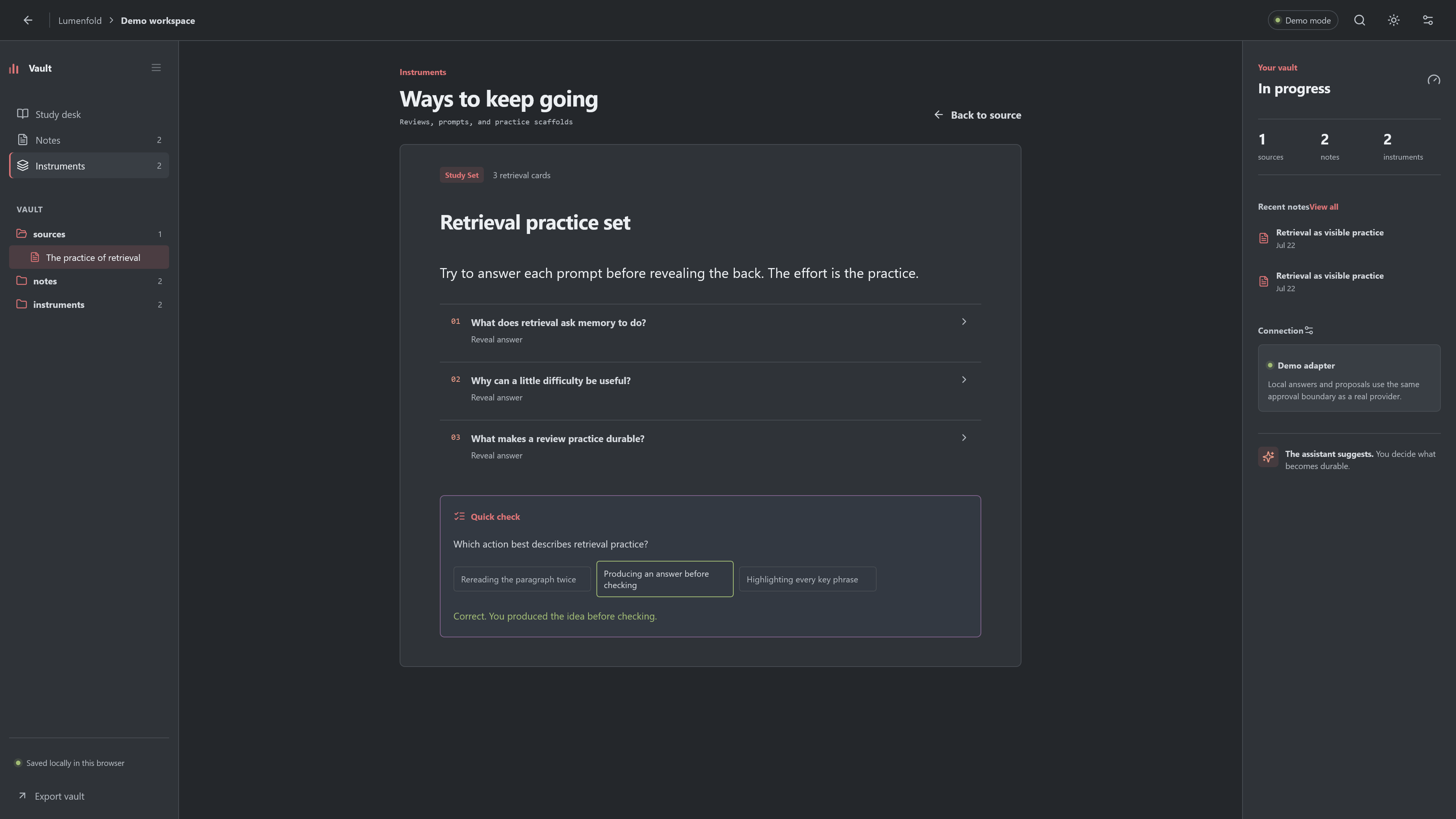
The workspace separates three durable areas:
sources/for material from outside the learnernotes/for explanations and understanding that have become theirsinstruments/for quizzes, review prompts, and other learning tools
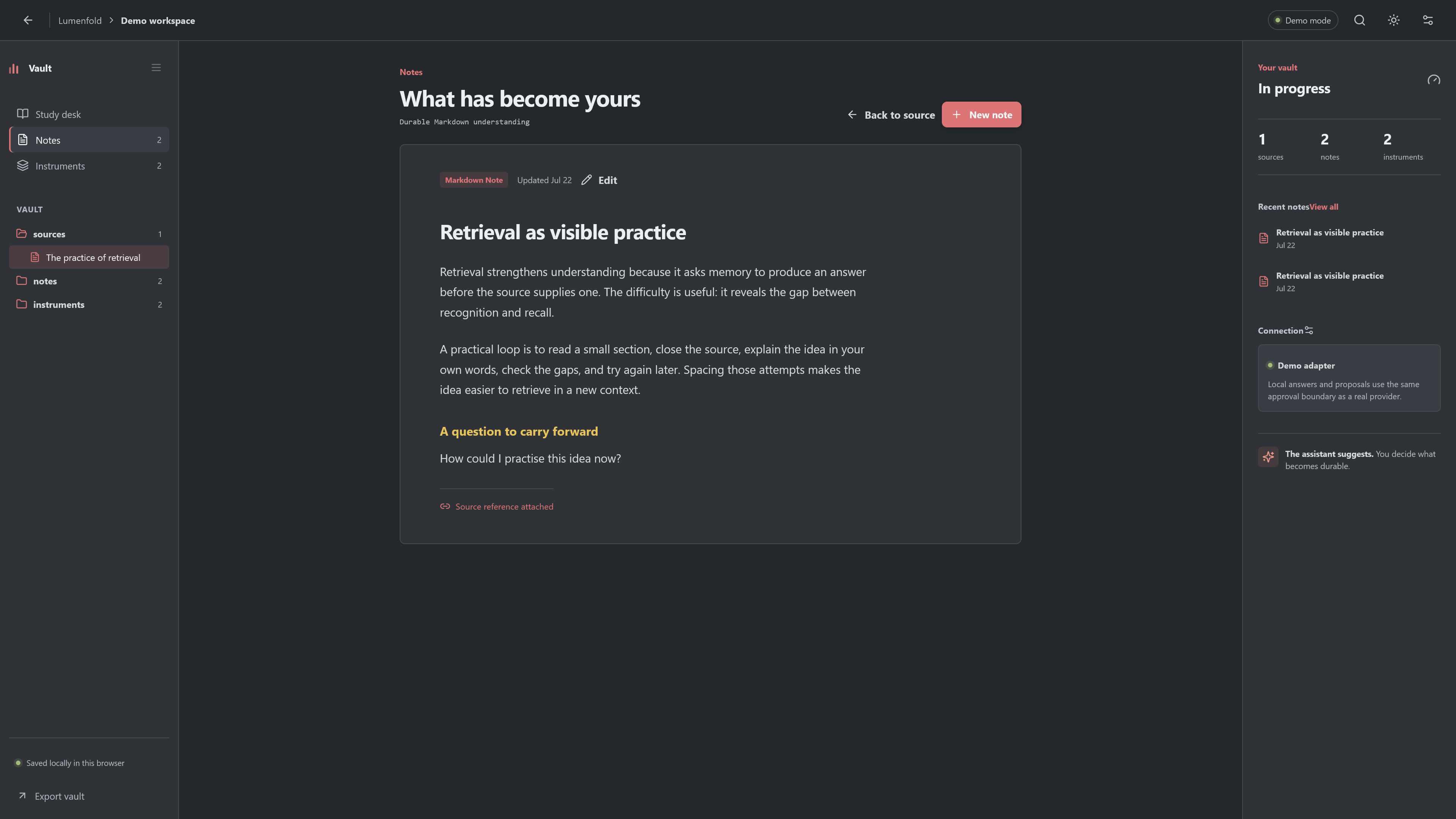
The current alpha also supports importing .md, .markdown, and .txt files, creating Markdown notes manually, editing them, and saving them locally in the browser.
How we built it
We built the prototype with React, TypeScript, Vite, and a small typed domain model for sources, notes, and study instruments.
The interface has two surfaces. The introduction explains the philosophy and learning cycle with a cleaner Braun/Dieter Rams-inspired presentation. The demo stays quiet and functional, following the compact, information-dense feel of Obsidian.
For the hackathon, the assistant uses a deterministic demo adapter so the complete workflow remains reliable without requiring an external provider. Its response shape already includes answers, citations, and typed proposals for notes or study sets.
All changes are treated as proposals. The learner previews and approves a durable artifact before it is added to the workspace. The current prototype persists its virtual vault in browser storage, while the longer-term architecture is designed for a local-first application with portable Markdown files.
The project is prepared for deployment through Vite and Cloudflare Workers.
Challenges we ran into
The largest challenge was deciding what to build within a very limited hackathon window. Lumenfold could easily expand into search, spaced repetition, plugins, graph views, synchronization, and many forms of ingestion.
We narrowed the MVP to one complete and understandable slice: source -> question -> citation -> approved note or instrument.
Another challenge was giving the assistant useful power without letting it silently rewrite a learner's work. That led us to typed proposals, visible previews, explicit approval, and a clear separation between transient assistant output and durable files.
We also had to balance two different design modes: an introduction that can express a larger vision, and a product workspace that should remain calm, modest, and direct.
Accomplishments that we're proud of
We created a runnable prototype that demonstrates the central learning transition instead of only showing a static concept.
A learner can import or select a source, ask a grounded question, inspect citations, approve a Markdown note, create a study set, and continue working with the resulting artifact.
We are also proud that the product's structure is intentionally simple. Sources, notes, and instruments have distinct responsibilities, but they remain interconnected through stable references rather than isolated feature silos.
The interface supports both dark and light themes while preserving the same calm visual language and readable hierarchy.
What we learned
We learned that the most convincing AI workflow is often a small, transparent one. A focused assistant that cites its source and asks for approval can feel more trustworthy than a broad system that hides what it changed.
We also learned that learning is better represented as a continuing cycle than as a single generated result. The value comes from returning to an idea, explaining it, testing recall, and connecting it to future work.
Finally, we learned that visual restraint is an engineering decision. Clear structure, readable files, and quiet controls make the product easier to understand and easier to extend.
What's next for Lumenfold
Next, we will connect the assistant to a Cloudflare Worker adapter that accepts an endpoint URL and provider format while keeping API credentials in server-side secrets.
We will replace browser-only persistence with a local-first data layer, add ZIP export and import, and preserve Markdown as the portable source of truth.
Future iterations will add source search, PDF and other text extraction, backlinks, spaced review, reusable skills, plugin configurations, and eventually a locally installed application inspired by Obsidian.
Lumenfold's long-term aim is simple: make learning easier to continue, not easier to forget.
Built With
- codex-cli
- hermes-agent
- react
- vite

Log in or sign up for Devpost to join the conversation.