-
-
IMG
Inspiration
Virtual reality should allow people to interact naturally with immersive environments rather than simply replicate traditional screen-based controls.
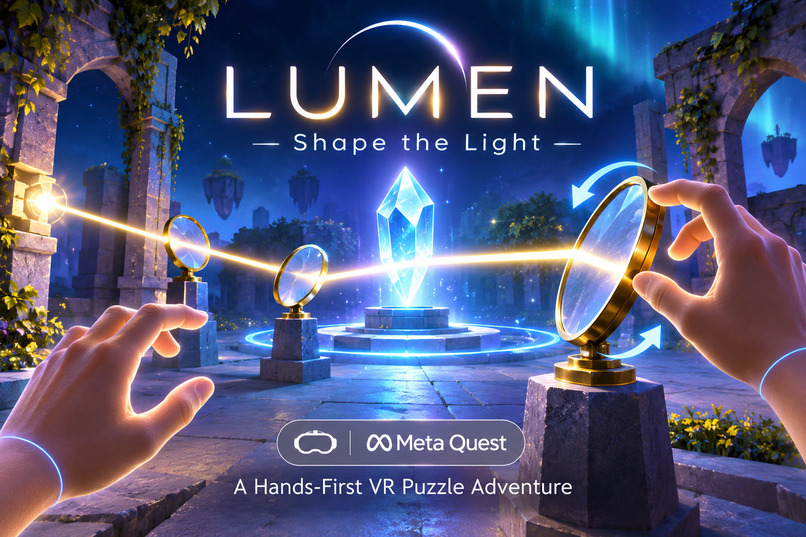
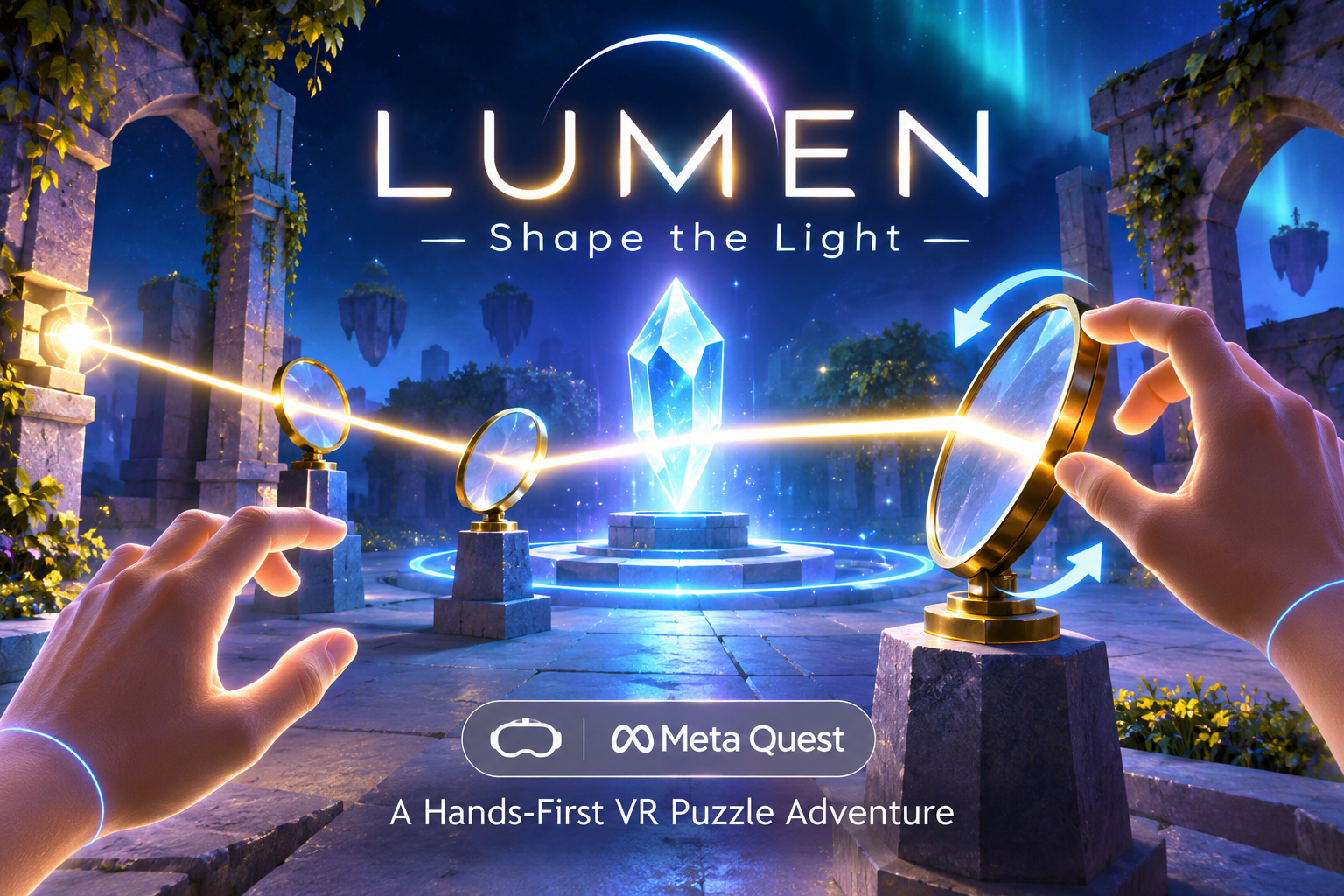
LUMEN — Shape the Light explores this idea through a calm, hands-first spatial puzzle experience where players manipulate light to restore glowing crystals.
Our goal is to make VR interaction intuitive, accessible, and rewarding through a simple mechanic that feels natural in three-dimensional space.
What It Does
LUMEN is a seated-friendly WebXR puzzle game designed for Meta Quest.
Players redirect beams of light by rotating reflective mirrors, guiding the light from its source toward a dormant crystal.
The current playable experience includes three spatial puzzles, each introducing increasingly complex light-routing challenges.
Players receive immediate visual feedback as light reflects between mirrors. Successfully illuminating a crystal completes the puzzle and unlocks progression.
The experience supports:
Controller-free hand-pinch interactions in WebXR.
Gaze-based targeting of interactive objects.
Three playable light-reflection puzzles.
In-world Next, Reset, and Pause/Resume controls.
Desktop interaction for accessibility and development testing.
Seated gameplay with short puzzle sessions.
How It Was Built
LUMEN was developed using JavaScript, Three.js, WebGL, and WebXR.
Its interactive 3D environment includes procedurally constructed mirrors, light beams, crystals, and a spatial puzzle platform.
The light-routing system calculates beam intersections and reflections based on each mirror's orientation. When the beam reaches its target crystal, the puzzle is marked as completed.
Hand tracking uses the positions of the index-finger and thumb tips to detect pinch gestures. Players aim toward a mirror or an in-world control and pinch to activate it.
The game is deployed as a publicly accessible HTTPS WebXR experience on Vercel.
Hands-First Interaction
LUMEN is designed around controller-free interaction.
Players can rotate mirrors using tracked-hand pinch gestures and activate the in-world controls without relying on traditional controllers.
The interaction system supports:
Aim: Look toward an interactive mirror or control.
Pinch: Activate the selected object.
Rotate: Each selection rotates the mirror by a fixed angle.
Progress: Select Next after completing a puzzle.
Manage: Use in-world Reset and Pause/Resume controls.
The hands-first gameplay was successfully tested using Meta's Immersive Web Emulation Runtime (IWER), configured to simulate a Meta Quest 3.
All three puzzles were completed in the emulator using simulated hand-pinch input.
Testing on physical Meta Quest hardware remains pending.
Challenges and Accomplishments
One of the main challenges was ensuring that mirror interaction remained predictable in immersive VR.
We refined the spatial layout of the puzzles to improve target selection and resolved an input-handling issue that could cause duplicate rotations when simulated hand and controller events occurred together.
The resulting prototype successfully completed automated desktop gameplay tests and an end-to-end controller-free XR emulator playthrough.
We also recorded and publicly published a 49-second demonstration of the immersive gameplay.
What's Next
Our next priorities include:
Validating hand tracking and usability on physical Meta Quest hardware.
Improving visual polish, lighting effects, and spatial audio.
Expanding accessibility and comfort options.
Optimizing rendering performance on standalone VR hardware.
Adding onboarding guidance and additional puzzles.
Expanding the game into a more complete immersive experience.
Development Status
Playable WebXR prototype — publicly deployed and tested.
Live game: https://lumen-shape-the-light-vr.vercel.app/
Gameplay demonstration: https://www.youtube.com/watch?v=TH6yqwmlqN0
The video shows gameplay recorded through Meta's XR emulator, not a physical headset. Hardware validation remains outstanding.
Built With
- css3
- javascript
- meta
- three.js
- vercel
- vite
- webgl
- webxr
