-
-

logo
-
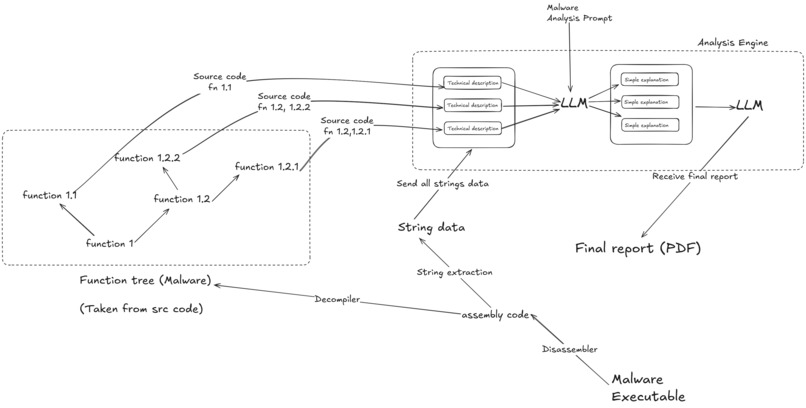
design
-
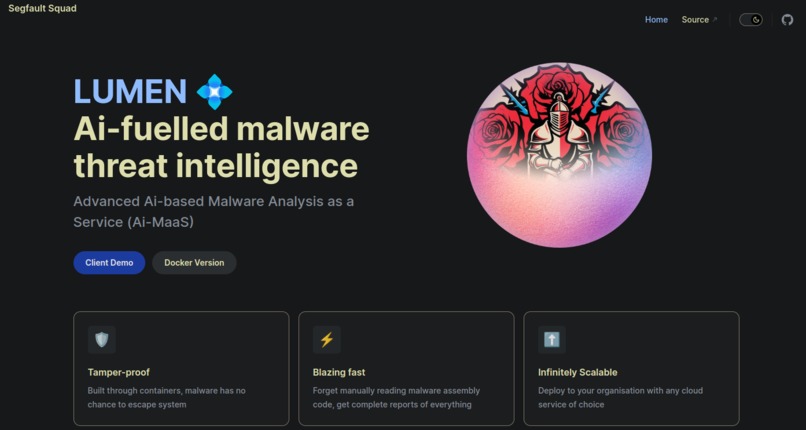
portfolio website
-
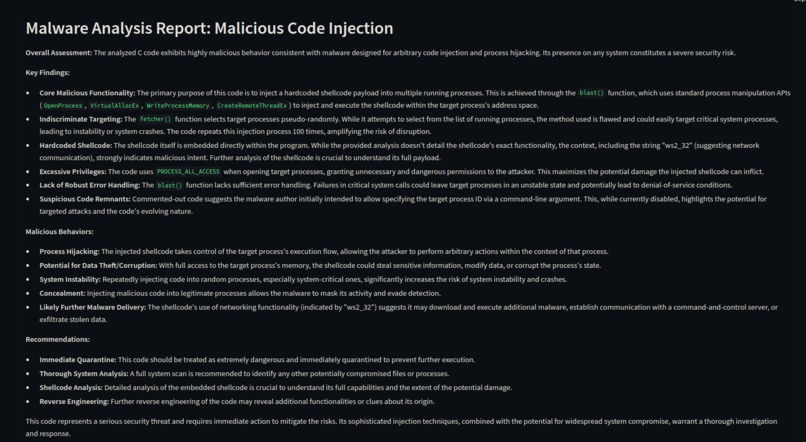
analysis report
-
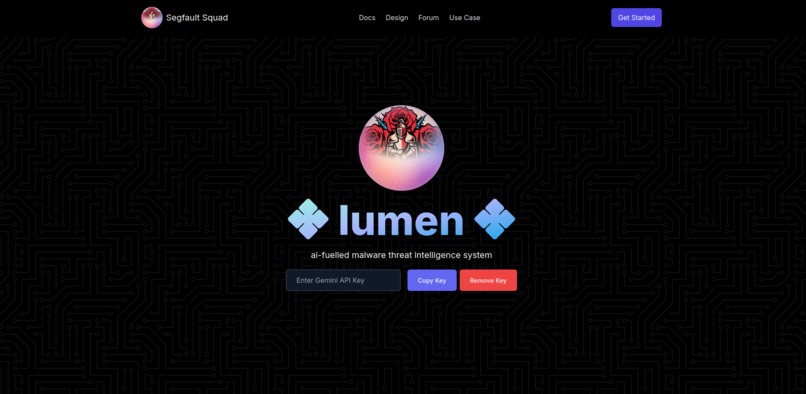
analysis dashboard


Description of the Project
This project provides an advanced framework for malware analysis by leveraging a structured function tree extraction process, string data analysis, and insights powered by a Large Language Model (LLM). The result is a detailed and user-friendly PDF report that aids security professionals in understanding the behavior, functionality, and potential threats posed by malware.
Inspiration
The growing complexity and volume of malware require advanced tools that simplify reverse engineering and analysis. This project was inspired by the need for an automated solution to decode malware functionality while making the findings accessible to both technical and non-technical stakeholders.
What it does
- Extracts Function Trees: Visualizes malware's internal behavior by creating a hierarchical structure of functions.
- Analyzes String Data: Identifies embedded strings that might indicate malicious intent (e.g., URLs, commands).
- Leverages LLMs: Provides human-readable explanations and technical descriptions for malware behaviors and potential threats.
- Generates Final Reports: Compiles the analysis into a detailed PDF report with simplified summaries and technical insights.
How we built it
- Used disassembly and decompilation tools to extract the malware’s source code and string data.
- Developed a function tree representation to visualize relationships between the malware's functions.
- Integrated a Large Language Model to provide detailed technical descriptions and simplified explanations.
- Automated the generation of a professional PDF report for the final analysis.
Challenges we ran into
- Accuracy of Decompiled Code: Ensuring that the decompiled source code accurately represented the malware’s behavior.
- LLM Integration: Optimizing prompts and data formats for effective analysis by the LLM.
- String Data Parsing: Handling obfuscated or encrypted strings commonly used in malware.
- PDF Generation: Formatting the report to include both technical depth and accessible summaries.
Accomplishments that we're proud of
- Developed a scalable workflow for analyzing complex malware.
- Successfully integrated LLMs to generate accurate and meaningful insights from technical data.
- Automated the creation of comprehensive reports for cybersecurity professionals.
- Created a tool accessible to both experts and newcomers in malware analysis.
What we learned
- The importance of creating structured and readable function trees for understanding malware functionality.
- Best practices for extracting and analyzing string data.
- How to effectively use LLMs for cybersecurity purposes.
- Techniques for presenting technical data in a user-friendly format.
What's next for the project
- Enhanced Obfuscation Detection: Implement features to detect and analyze obfuscated or polymorphic malware.
- Dynamic Analysis: Add runtime behavior analysis to complement the static analysis process.
- Real-Time Collaboration: Enable multiple users to work on the same malware analysis project simultaneously.
- Expanded LLM Capabilities: Train LLMs on more cybersecurity datasets for improved analysis accuracy.
- Threat Intelligence Integration: Link analysis results to known threat intelligence databases for automated IoC detection.

Log in or sign up for Devpost to join the conversation.