Inspiration
Teachers today face growing classroom demands. In many cities, including Toronto, teacher shortages and larger class sizes make it increasingly difficult to give every student the individual attention they need.
At the same time, correctness alone does not tell the full story of student understanding. A student may guess the correct answer without understanding the concept, while another may make a small mistake but demonstrate strong reasoning.
We wanted to build a system that helps teachers understand how students think, not just whether their answers are correct.
This inspired Teacher AId, an AI assistant designed to help educators identify learning gaps faster, track classroom trends, and better support individual students.
What it does
TeacherAId is an AI-powered platform for classroom intelligence that evaluates students' logic, categorizes misconceptions, and reveals insights that teachers can take immediate action on.
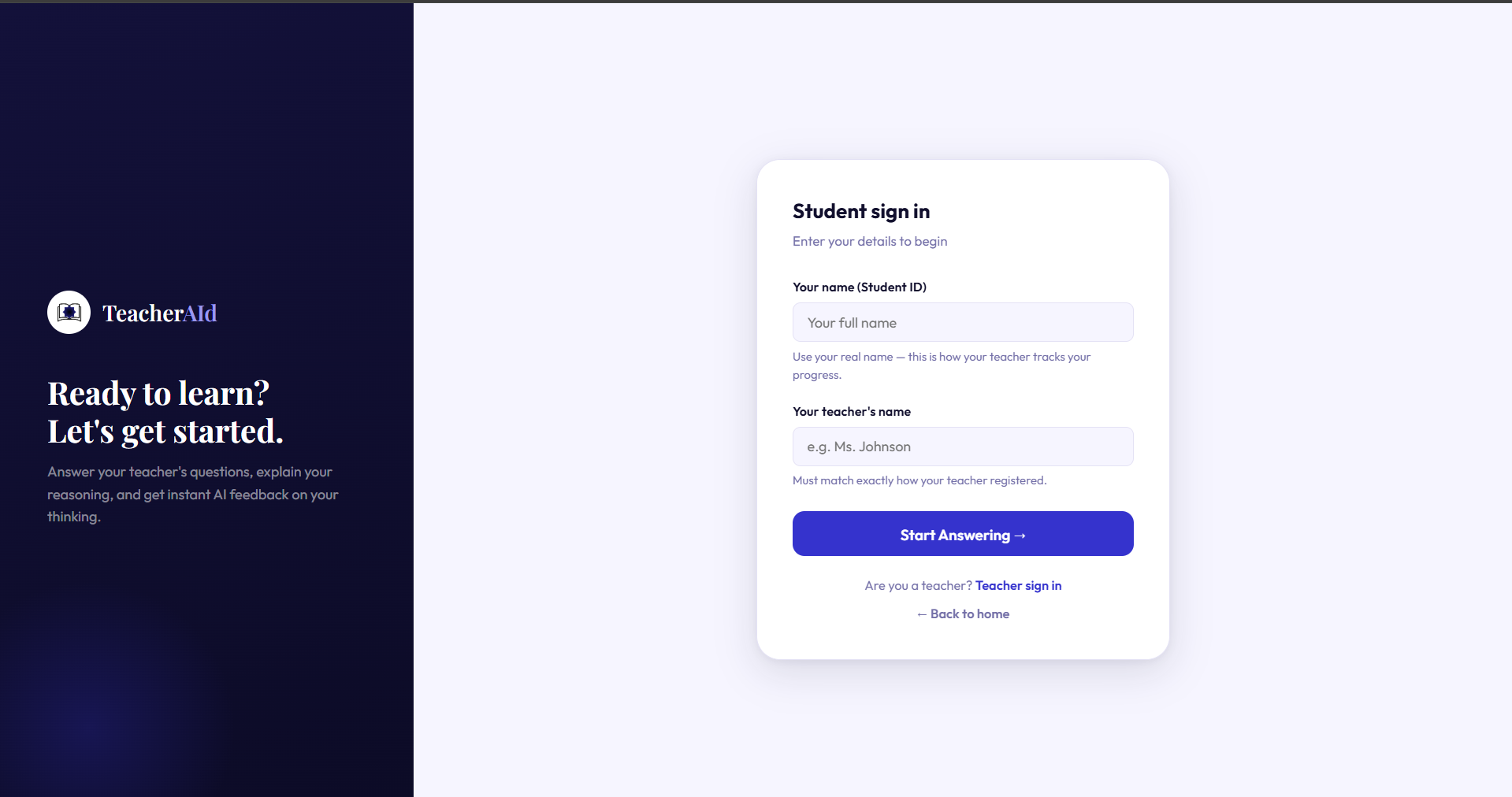
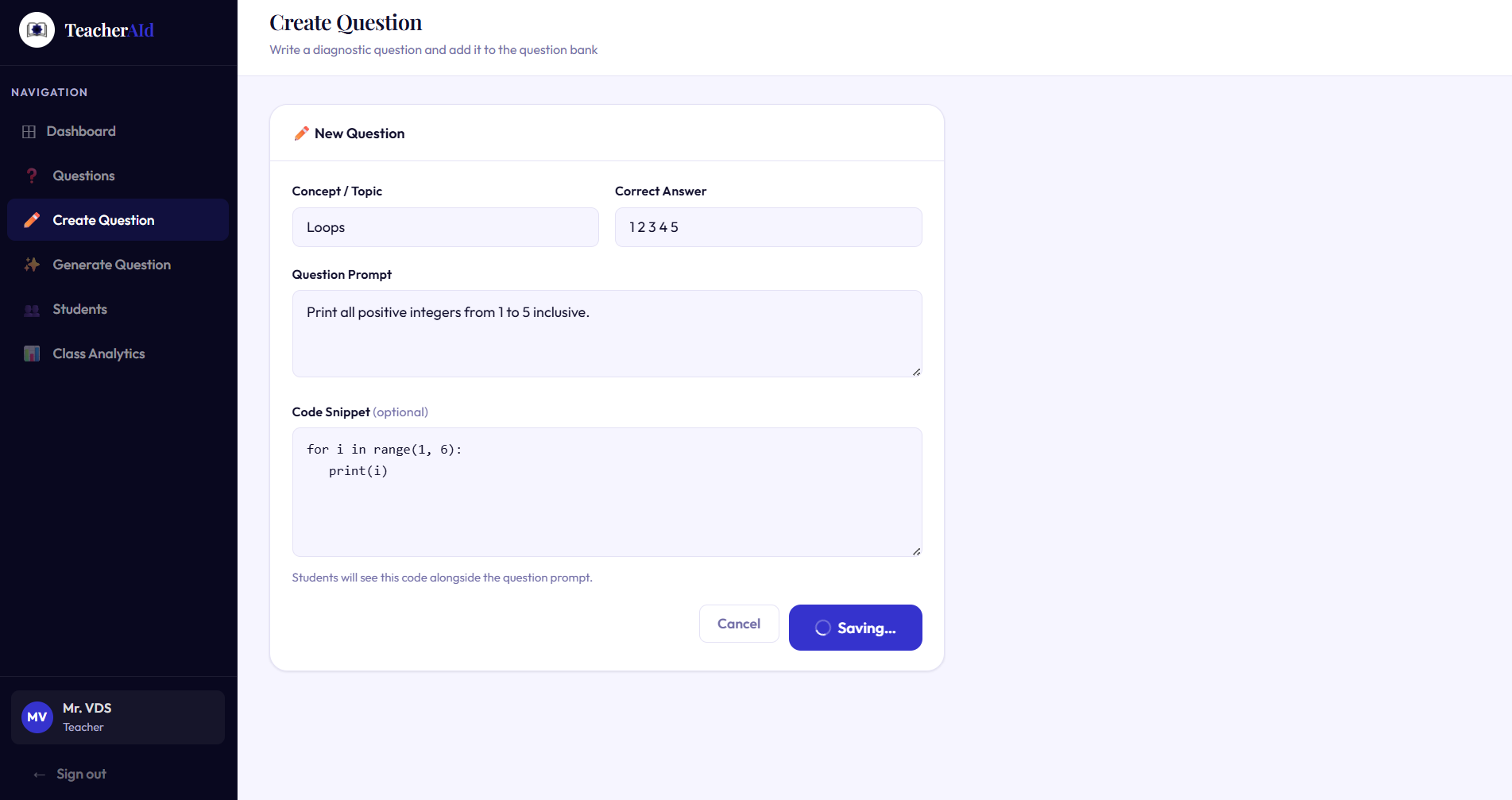
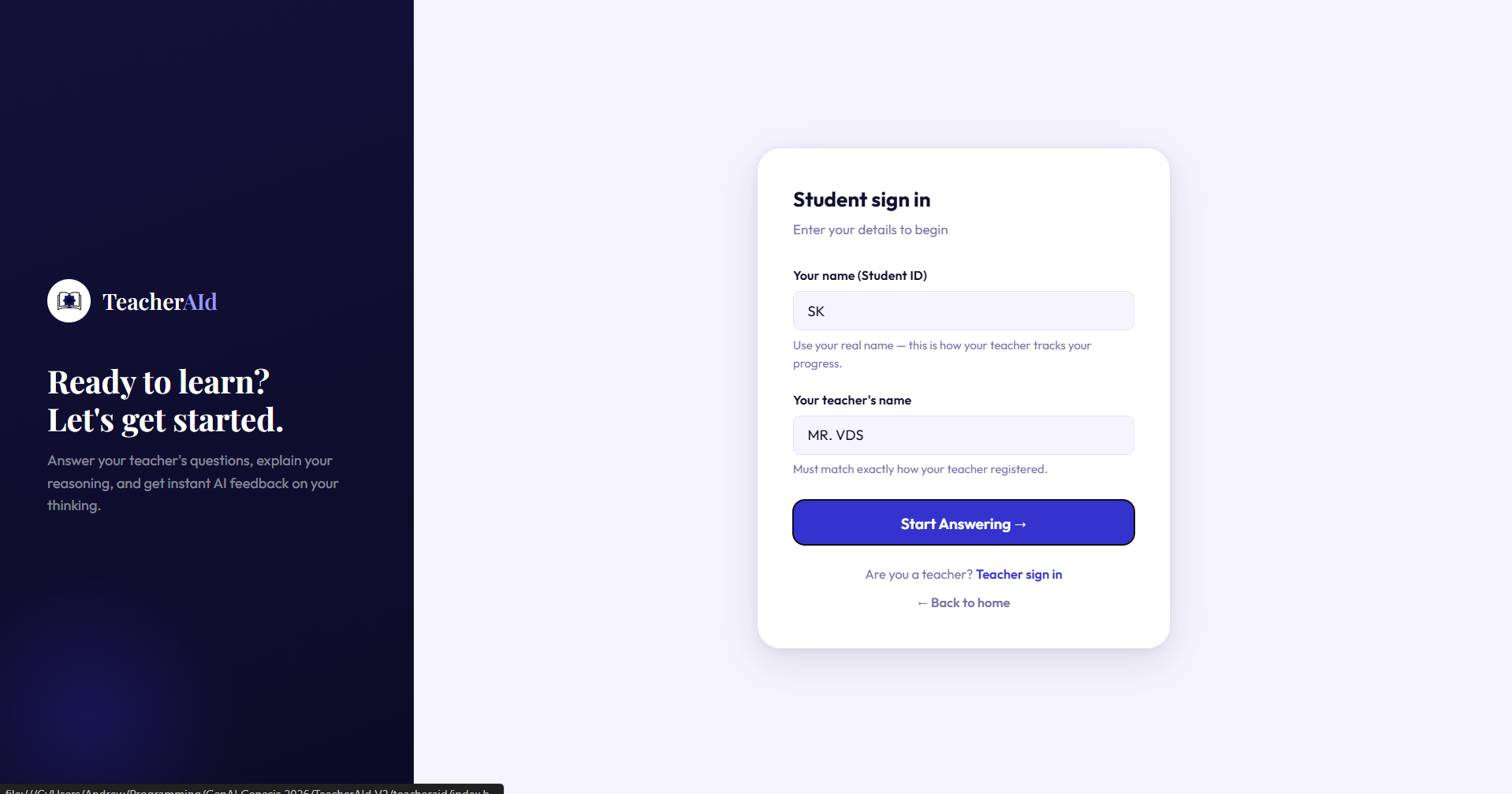
Here is the process: A diagnostic question that focuses on a particular concept is either created by a teacher or produced by AI. Students respond and, most importantly, provide an explanation. After that, the system employs DeepSeek to categorize every response in accordance with a structured misconception classification. This allows it to determine what the student misunderstood and why, in addition to simply marking each response as correct or incorrect. These classifications go into a Moorcheh AI-powered memory system that builds trend data for the whole class and profiles for each student.
Teachers will receive:
- A real-time class analytics dashboard that displays misconception frequency charts, error distribution across concepts, and a ranked breakdown of the class's weakest areas.
- AI-generated intervention recommendations customized for each student, as well as individual student profiles displaying recurrent misconceptions and reasoning patterns.
- Based on what the class is actually having trouble with, the backend generates AI reteach suggestions.
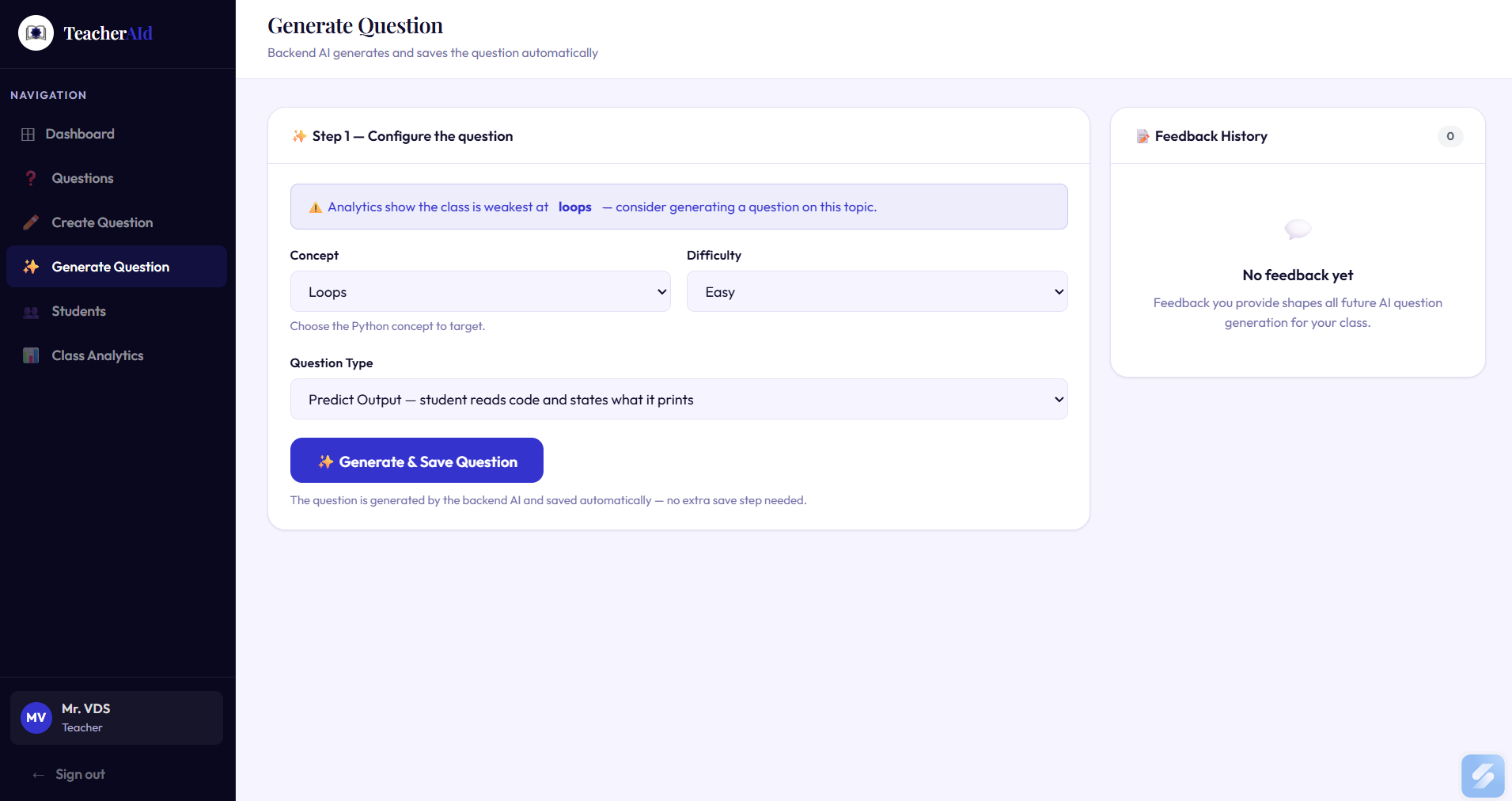
- Adaptive question generation allows the AI to automatically target the class's weakest concept when generating new questions.
The system tells teachers what went wrong and what to do next.
How we built it
Teacher AId combines modern language models with structured reasoning analysis to interpret student explanations at scale.
Student responses are processed using AI models that analyze semantic meaning and reasoning patterns. The system groups similar explanations together to identify clusters of misunderstanding across different concepts.
In our architecture, Moorcheh AI handles large-scale storage and retrieval of student learning data, while the AI agent focuses on reasoning logic, evaluating explanations, identifying knowledge gaps, and retrieving relevant information accurately across a large dataset.
Our vision was to use this capability to build a long-term student learning memory, allowing the system to load past explanations, analyze performance summaries, and retrieve relevant patterns to evaluate new responses more effectively.
Within the prototype, Teacher AId can:
- analyze student explanations
- identify knowledge gaps
- generate performance summaries
- surface representative reasoning examples
Although we did not fully implement the large-scale memory system during the hackathon, our prototype demonstrates how retrieval-based AI memory can support deeper classroom analytics.
Challenges we ran into
One of the biggest challenges was evaluating reasoning rather than simple correctness. Student explanations can vary widely in wording even when they represent the same misunderstanding, making simple keyword matching ineffective. To address this, we focused on semantic analysis to detect deeper conceptual similarities between responses.
Another challenge was AI hallucination. Large language models can sometimes generate confident but incorrect evaluations or suggestions. In an educational setting, this is especially important because teachers need reliable insights. To mitigate this risk, we grounded evaluations in the student's original explanation and surfaced representative examples for teachers to review, ensuring the AI acts as an assistant rather than an authoritative decision-maker.
A third challenge involved scaling memory and retrieval. Our goal was to leverage Moorcheh AI to store and retrieve large volumes of student learning history so that reasoning could be analyzed across time. While the architecture supports this idea, implementing the full large-scale system was beyond the time constraints of the hackathon.
Accomplishments that we're proud of
We built a working prototype that demonstrates how AI can move beyond grading answers and instead analyze student reasoning.
Teacher AId can:
- evaluate student explanations
- detect recurring misconceptions
- surface representative reasoning examples
- summarize classroom learning patterns
We are especially proud of laying the foundation for a long-term learning memory system, which could allow AI to track student understanding across many interactions rather than isolated questions.
What we learned
This project reinforced that AI in education works best when it supports teachers rather than replacing them.
We learned that analyzing reasoning provides much more valuable insight than simply checking answer correctness. We also learned that long-context retrieval and memory are critical for building educational AI systems that track learning over time.
Most importantly, we learned that AI tools must remain interpretable and transparent so teachers can trust the insights they receive.
What's next for Teacher AId
Future development of Teacher AId could include:
- persistent student learning memory using retrieval systems
- personalized AI assistants for students
- dashboards that track concept-level understanding over time
- curriculum suggestions based on recurring misconceptions
- collaborative learning features connecting students with similar misunderstandings
Our long-term vision is for Teacher AId to become an AI teaching assistant that helps educators identify misconceptions earlier, adapt instruction more effectively, and support every student with greater precision.
Built With
- bge-small-en
- css
- deepseek
- html
- javascript
- moorcheh
- ngrok
- python

Log in or sign up for Devpost to join the conversation.