-
-

-
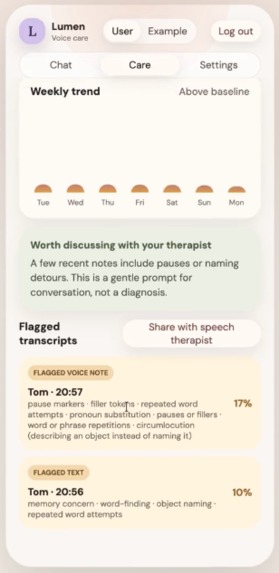
Dashboard
-
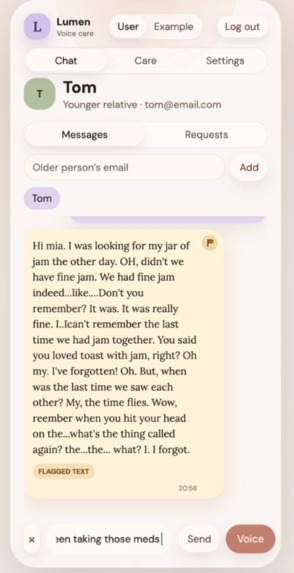
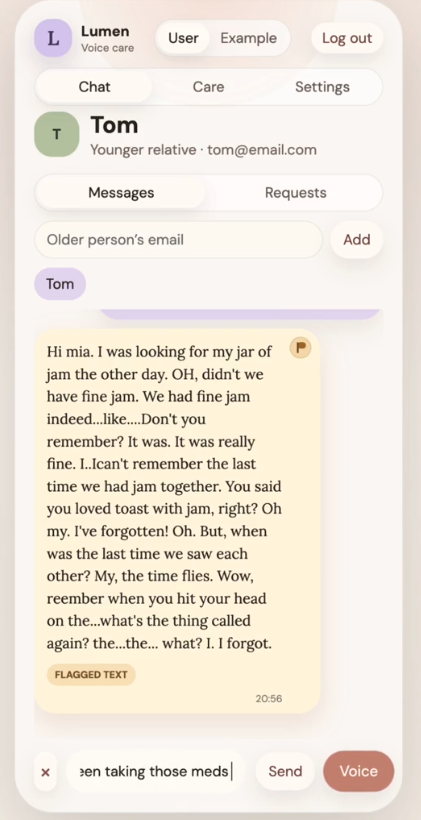
Flagged Message
-
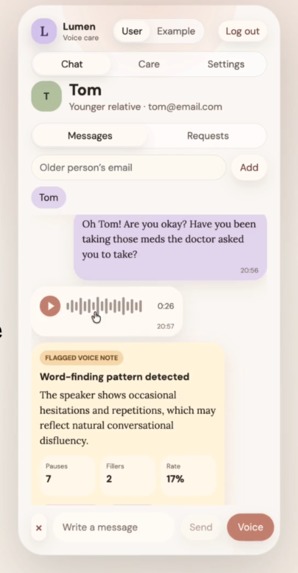
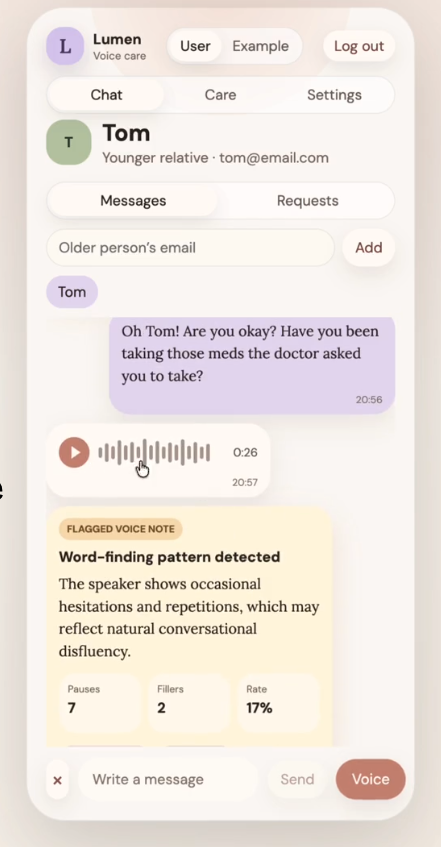
Flagged Voice Note

Inspiration
Lumen began with a simple question: what if the earliest signs of communication change after a stroke could be noticed inside the conversations families are already having? For many people living with aphasia, word-finding difficulty does not arrive as a dramatic moment. It can show up quietly: longer pauses, repeated attempts, “the thing you use to…”, or describing an object by its function instead of its name. Families often notice these changes first, but they may not know what to track, how to describe it, or when it is worth bringing up with a speech therapist. We built Lumen to make that noticing and monitoring gentle, private, and dignified.
What it does
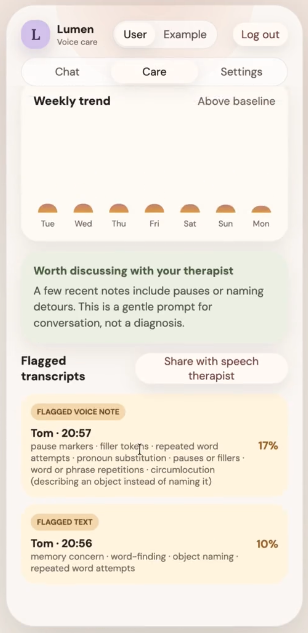
Lumen is a voice messaging app designed for older adults and their trusted relatives. To the older person, it feels like a normal, calm messaging app: they can send texts and voice notes to family without seeing alerts, warnings, scores, or medical labels. Behind the scenes, voice notes are transcribed and analysed for communication patterns associated with word-finding difficulty, such as long pauses, filler words, repeated attempts, circumlocution, self-corrections, and naming detours. The younger relative has a separate Care dashboard where flagged voice notes appear with gentle explanations, weekly trends, pause markers, disfluency rates, transcript highlights, and a “Share with speech therapist” option. These metrics are tracked to ensure that long term support can be delivered in the best way. The app avoids diagnostic language entirely. It is about helping families notice patterns worth discussing, not telling them what is wrong.
How we built it
We built Lumen as a mobile-first React web app with a Node/Express backend. The frontend uses a warm, accessibility-conscious visual identity: linen backgrounds, soft terracotta accents, muted sage states, serif message bubbles, slow transitions, and a calm chat experience designed to feel human rather than clinical.
The app includes real account flows, older-person and younger-relative roles, contact requests, separated message tabs, chat threads, text messaging, browser voice recording, and a live Care dashboard. Voice notes are recorded with the browser MediaRecorder API, then sent to the backend for transcription and analysis.
The analysis pipeline combines deterministic speech-pattern detection with LLM-assisted refinement. We scan transcripts for filler tokens, repeated word attempts, pause markers, function-over-name phrases, pronoun substitutions, self-corrections, and circumlocution patterns. The backend is structured to support transcription and cost-efficient LLM analysis, while keeping API keys server-side.
Challenges we ran into
The biggest challenge was making sure that detection was integrated seamlessly into messaging, without disrupting natural conversation. We also had to think carefully about emotional safety. If the older person sees “flagged” messages or clinical warnings, the app starts to feel like surveillance. If the relative sees too little, the tool becomes decorative. Finding that balance shaped almost every design decision. Another challenge was making detection useful without pretending to be medical diagnosis. We had to write copy that was specific enough to help families act, but careful enough to avoid overclaiming.
Accomplishments that we're proud of
We’re proud that Lumen feels like a care product, not a hospital dashboard. The older-person experience remains simple and familiar, while the younger-relative view provides meaningful context without alarm. We’re also proud of building a complete end-to-end prototype: accounts, role-based access, message requests, chat threads, voice recording, transcription-ready backend flow, analysis logic, flagged transcript details, and a live dashboard based on real messages. Most importantly, we’re proud of the product philosophy: Lumen protects dignity. It does not interrupt the older person, label them, or make them feel watched. It quietly helps trusted family members notice, monitor and care when something may be worth a supportive conversation.
What we learned
We learned that health-adjacent technology is as much about trust as it is about detection. The same feature can feel helpful or invasive depending on who sees it, when it appears, and how it is worded. We also learned that “noticing” is a powerful product category. Lumen does not need to diagnose to be useful. It can help families preserve context, observe trends, and bring better information to professionals. Technically, we learned how quickly a messaging prototype becomes complex once real roles, permissions, persistent data, contact requests, and analysis states are introduced.
What's next for Lumen
Next, we want to make Lumen production-ready: secure hosted deployment, stronger authentication, encrypted storage and robust consent controls. We also want to expand the Care dashboard with longer-term baselines, therapist-ready exports, notification preferences, invite links for nominated relatives, and clearer longitudinal trends. With clinician input, Lumen could support more nuanced pattern categories and better validation against real-world speech therapy workflows. Long term, Lumen could become a bridge between everyday family conversations and professional care: not replacing clinicians, not diagnosing users, but helping the people closest to someone notice changes earlier, describe them better, and respond with more confidence and care.
Built With
- css
- express.js
- mediarecorder
- node.js
- react-native
- vite
- webaudio


Log in or sign up for Devpost to join the conversation.