-
-
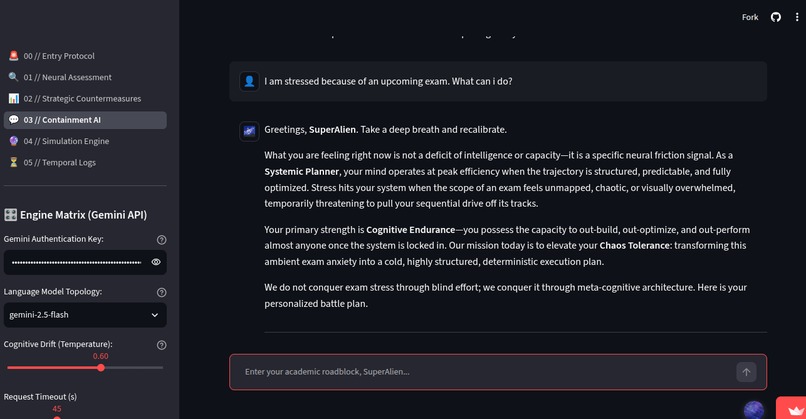
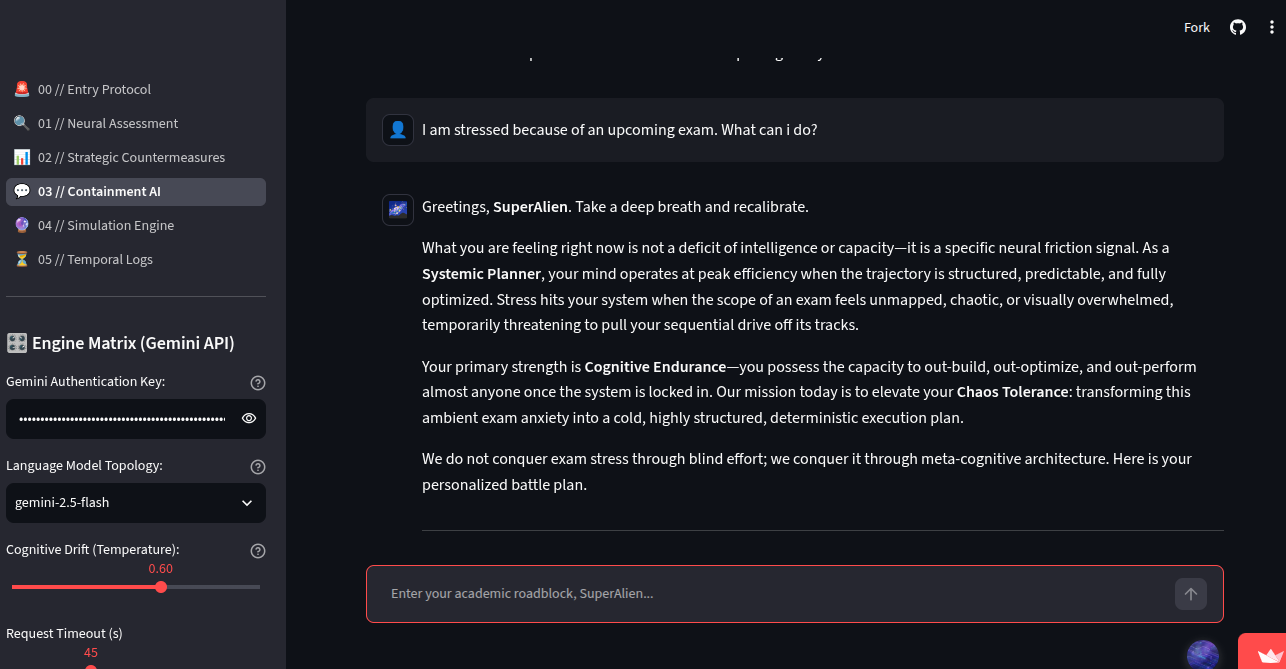
Chatbot
-
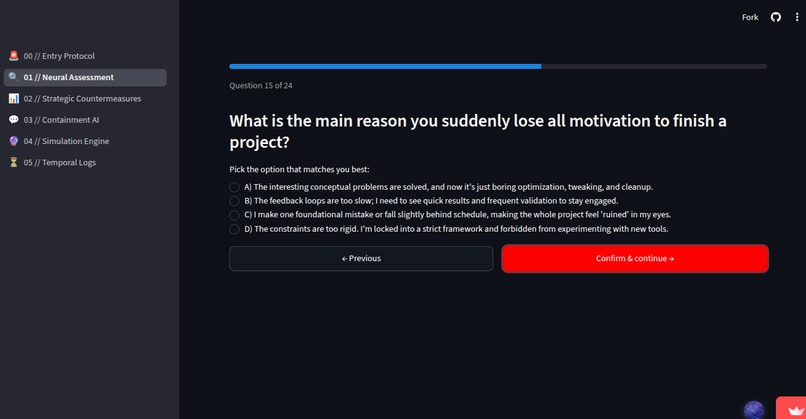
Quizz
-
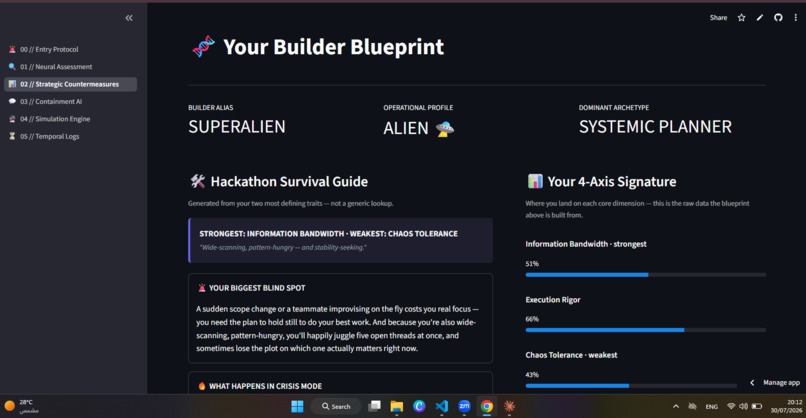
Result
💡 Inspiration
"Most students are told to study harder, but nobody shows them how their brain actually works."
Most educational systems operate on a flawed assumption: they focus entirely on what to learn, assuming every mind naturally knows how to process it. Navigating an atypical educational journey as a self-directed student made a fundamental paradox glaringly obvious to me—you cannot master any subject if you haven't first decoded the underlying mechanics of your own mind.
Generic advice like "just study harder" fails 80% of students. It isn't because they lack intelligence, but because they are running a different cognitive "operating system" without ever seeing their own source code. Without metacognitive awareness—understanding how your mind handles ambiguity, focus, and pressure—learning becomes an uphill battle against systemic friction.
I built LUMEN to give students a diagnostic mirror: shifting the paradigm from passive content consumption to cognitive self-mastery.
🚀 What it does
LUMEN is a 3-step self-understanding engine that maps a student's unique cognitive fingerprint and delivers grounded, actionable strategies instead of empty platitudes.
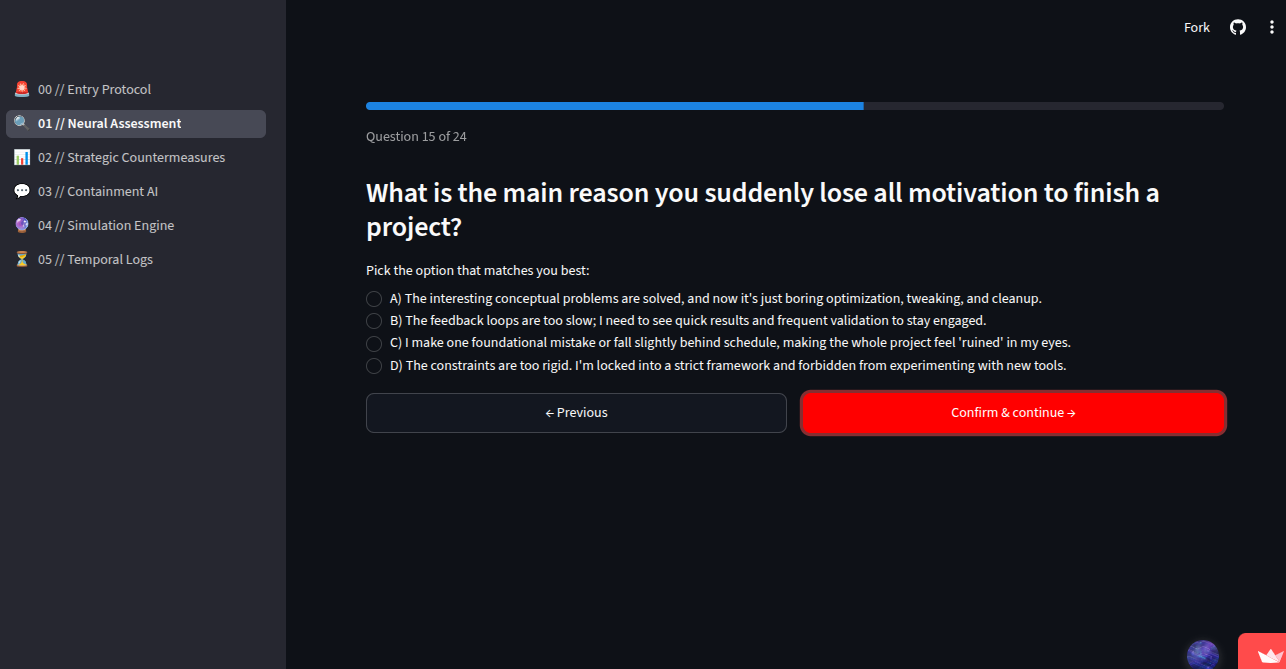
- 1. Neural Assessment: A 24-scenario diagnostic that probes how a user actually reacts under academic pressure, distraction, and cognitive fatigue.
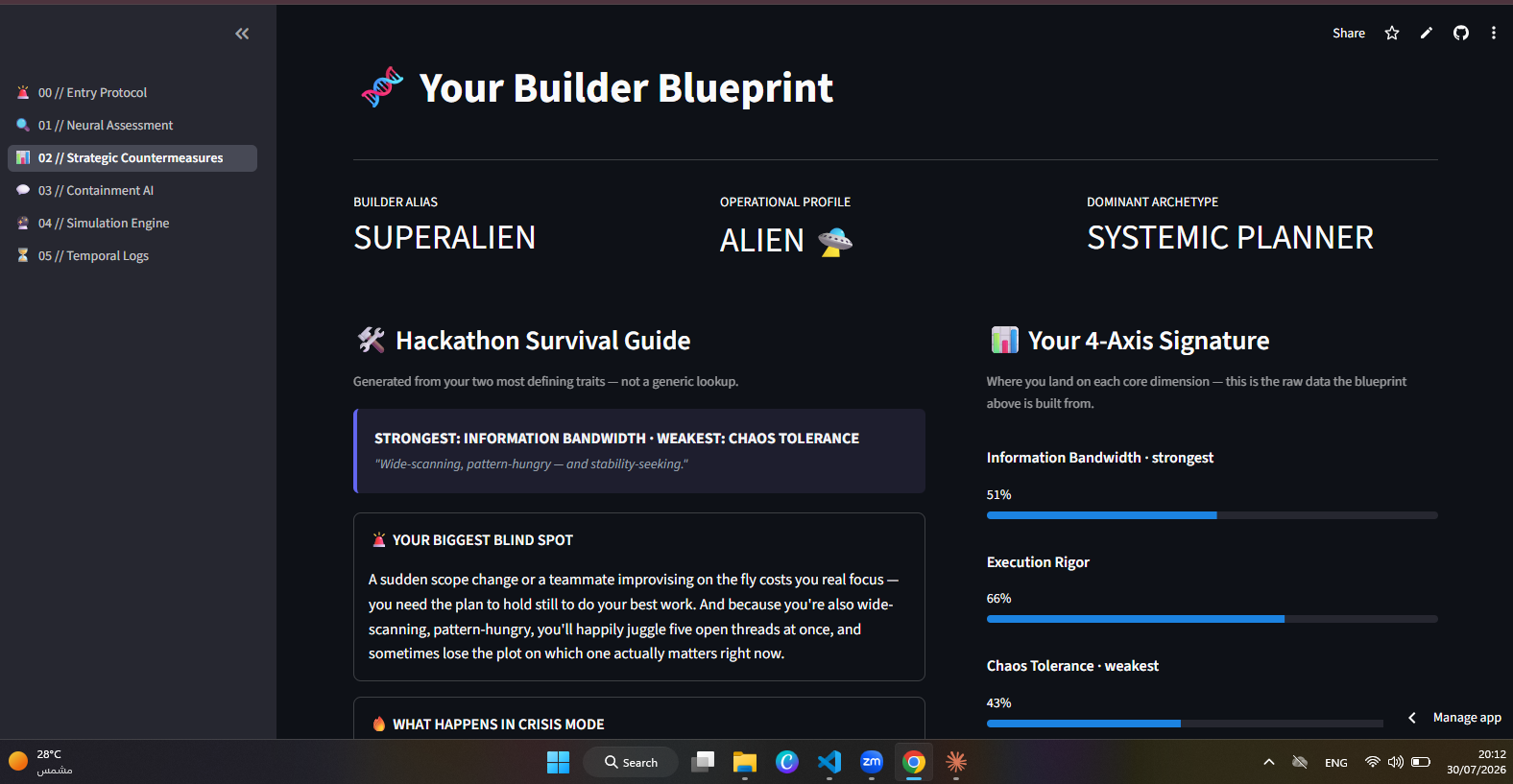
- 2. Builder Blueprint: Calculates a normalized 4-axis vector score (Information Bandwidth, Execution Rigor, Chaos Tolerance, Cognitive Endurance) to identify the user's dominant archetype and match their specific blind spots with proven tactical techniques.
- 3. SYNAPSE Mentor: A LangGraph-powered AI mentor that provides personalized guidance strictly grounded in a verified library of evidence-based frameworks (Feynman Technique, Spaced Repetition, Interleaving, etc.).
- 4. CHRONOS Simulation (Bonus): A predictive "What-If" simulation engine that models how a student's cognitive profile will perform in specific academic environments (e.g., an elite competitive university) using a structured state-machine trajectory (
Opening → Challenge → Resolution).
🛠 How we built it
LUMEN was built with a privacy-first, modular architecture:
- LLM Core: Powered by
Google Gemini 2.5 Flash / Provialangchain-google-genaifor reasoning, mentoring, and simulation. - Orchestration & State Machines: LangGraph coordinates the multi-turn logic:
- For the SYNAPSE Mentor, a deterministic node retrieves techniques based on vector deficits before passing context to Gemini.
- For CHRONOS, a custom state machine manages phase routing (
Opening → Challenge → Resolution) to maintain tight narrative pacing without prompt drift.
- Frontend: Built with Streamlit using a multi-page architecture driven entirely by
st.session_state. - Data & Normalization: Built a custom evaluation engine (
data/question.py) that computes the true theoretical minimum and maximum scores across all 24 questions, normalizing output into precise percentile vectors. - Privacy by Design: Zero database persistence. All state lives strictly in memory for the duration of the browser session.
⚙️ Challenges we ran into
- Eliminating LLM Hallucinations in Pedagogy: Standard LLMs often invent generic or ineffective study advice. To fix this, I engineered a strict retrieval layer (
select_priority_techniques()) that forces Gemini to select only from a hardcoded, research-backed technique library mapped directly to the user's weakest cognitive axis. - LangGraph State Management in Streamlit: Integrating LangGraph's
MemorySavercheckpointer inside Streamlit's reactive execution model required careful session-state isolation to prevent graph re-initialization on page re-renders. - Accurate Vector Math: Scaling 24 non-linear scenario choices into meaningful 0–100% metrics required writing dynamic normalization logic based on theoretical max/min bounds, preventing skewed scores caused by arbitrary scoring curves.
🏆 Accomplishments that we're proud of
- Grounded AI Architecture: Built an educational AI that doesn't just generate text, but operates within deterministic, research-backed boundaries.
- Custom State-Machine Simulation: Designed the CHRONOS engine to handle complex multi-phase academic scenarios smoothly without chaotic prompt behavior.
- Zero Data Footprint: Successfully engineered a deeply personalized experience that requires zero user tracking or data storage.
- Solo Execution: Shipped a full-stack, mathematically grounded, multi-agent application end-to-end within the hackathon timeframe.
📚 What we learned
- Agentic Boundaries Matter: LLMs shine when given high-level reasoning tasks, but strict deterministic routing (like LangGraph state machines) is essential for maintaining control over multi-step workflows.
- Metacognitive Quantification: Translating psychological and learning concepts into computable vector dimensions requires a delicate balance between mathematical precision and practical clarity.
- Streamlit State Control: Mastered advanced state management techniques across complex multi-page Streamlit applications.
🔮 What's next for Lumen
- [ ] Expert Validation: Partnering with a professional psychologist to review and validate the diagnostic scoring and technique mapping for clinical/academic rigor.
- [ ] Profile Export: Adding a one-click exporter to generate shareable PDF diagnostics for students, tutors, and counselors.
- [ ] Preset Expansion: Building specialized CHRONOS simulation scenarios for workforce transitions (e.g., first job, remote software engineering, team project dynamics).
- [ ] Multi-Language Support: Localizing the platform into French, Spanish, and Arabic.
Built With
- chatbot
- langchain
- langgraph
- python
- streamlit


Log in or sign up for Devpost to join the conversation.