Inspiration
LUME was inspired by a simple but powerful realization: every neurodivergent child experiences the world differently, yet most digital platforms expect every child to learn in the same way. Parents often juggle multiple applications for education, therapy, routines, healthcare, and emotional support, making an already challenging journey even more overwhelming. We wanted to build a single, intelligent ecosystem that adapts to each child instead of forcing the child to adapt to the system. Our inspiration also came from working closely with an autistic child during the design process, helping us better understand real-world needs, sensory preferences, and usability challenges. LUME aims to create a safe, engaging, and personalized environment where children can learn, grow, and build confidence while giving parents the guidance and resources they need.
What it does
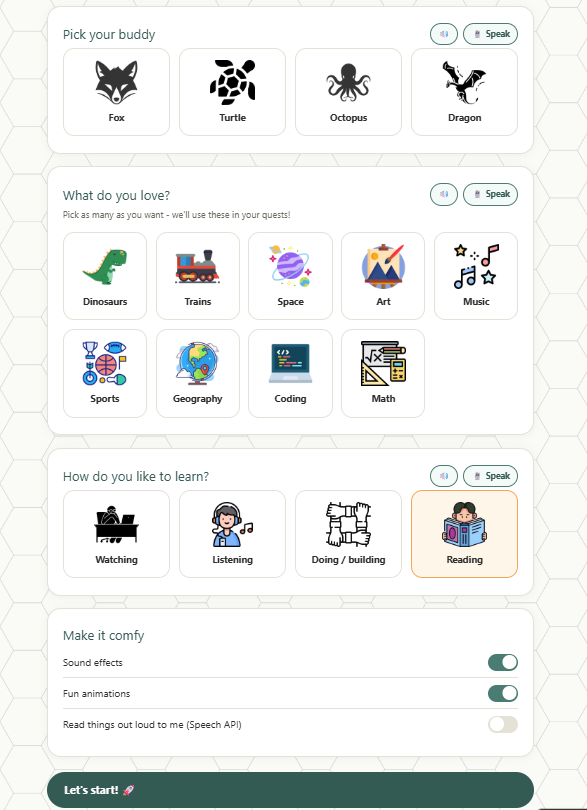
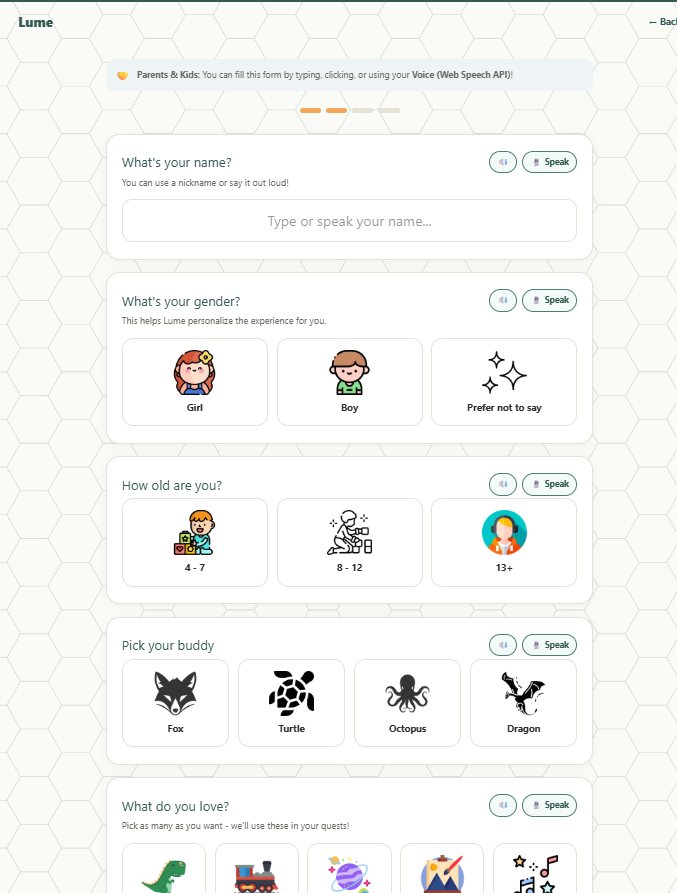
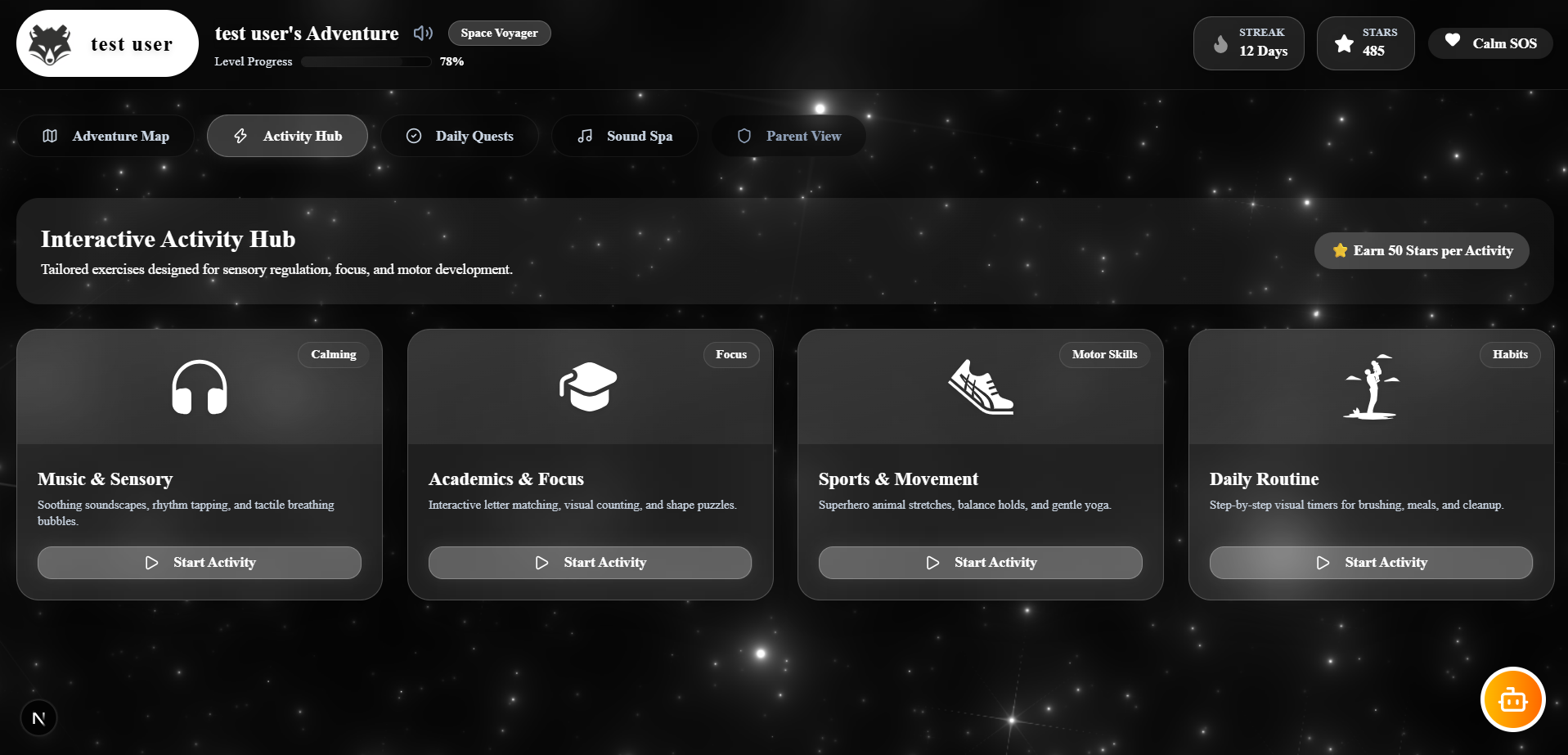
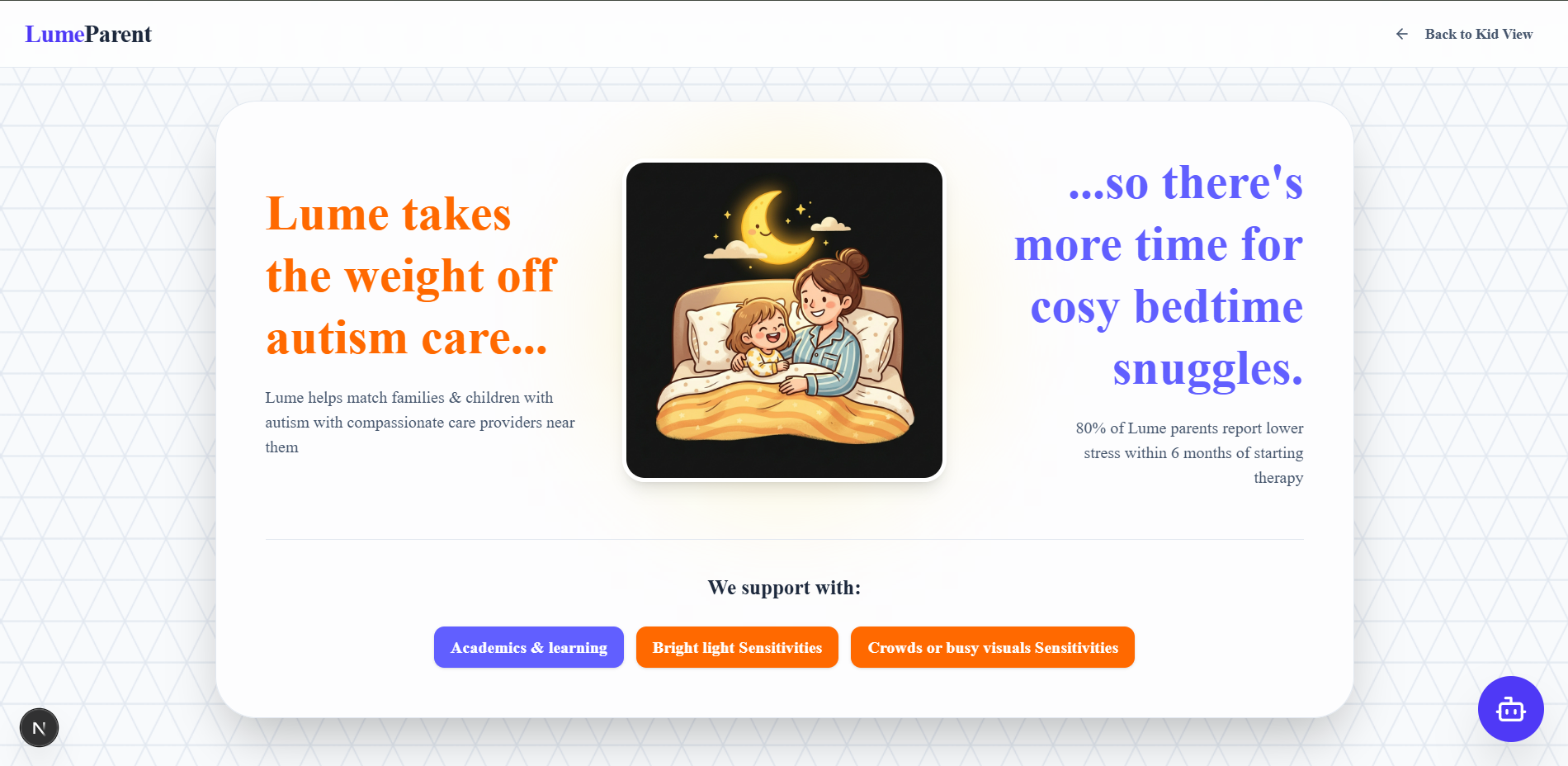
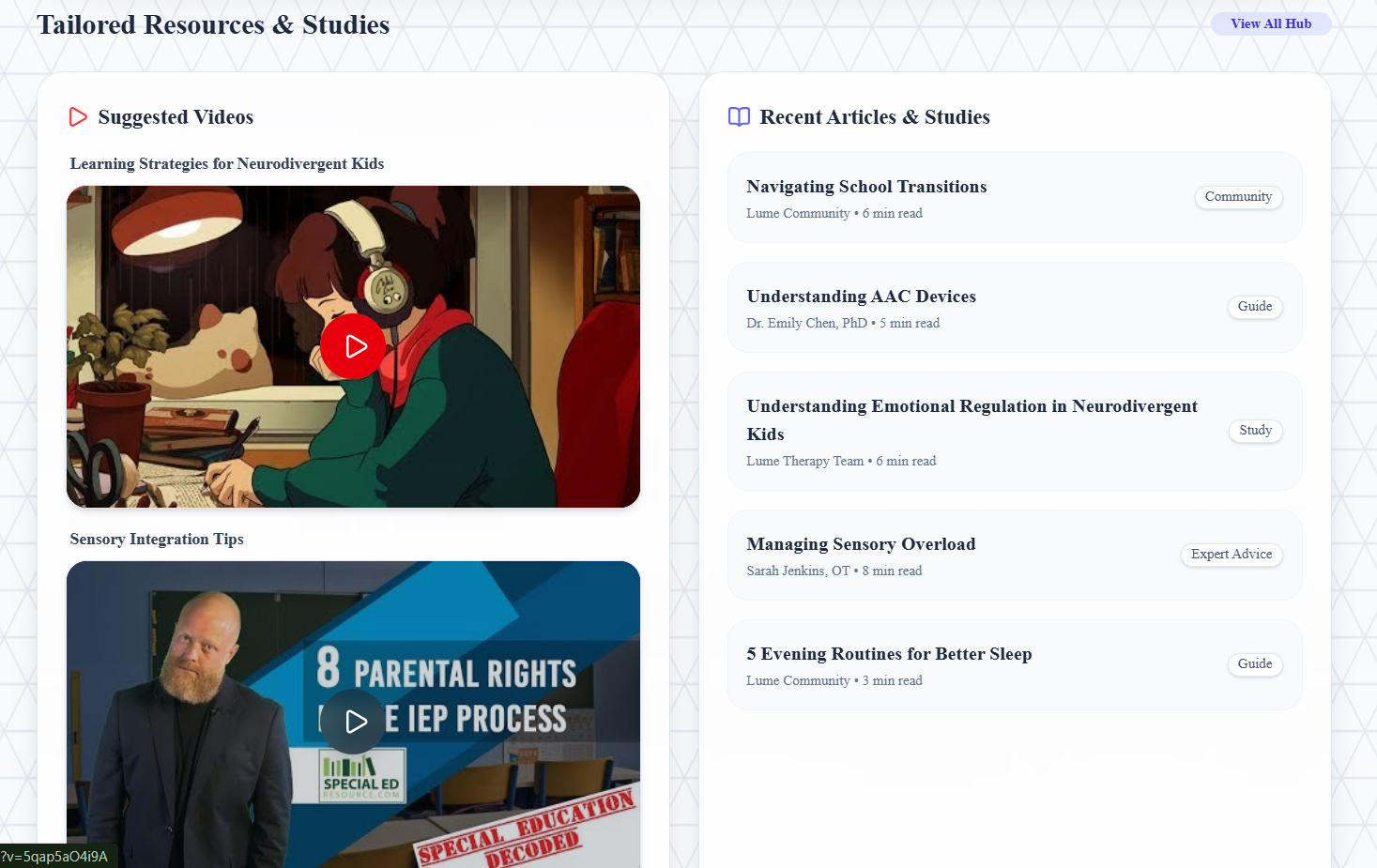
LUME is an AI-powered adaptive companion for neurodivergent children and their caregivers. Through a detailed onboarding process, it learns about each child's age, communication style, sensory sensitivities, interests, learning preferences, current supports, and developmental goals. Based on this profile, LUME creates a fully personalized experience powered by multiple specialized AI agents. These agents provide adaptive learning in academics, interactive music lessons, sports and motor skill activities, personalized daily routines, emotional support, and AI-assisted parenting guidance. Children are accompanied by customizable buddy animals such as a Fox, Turtle, Octopus, or Dragon, making learning more engaging and emotionally supportive. Parents receive progress reports, curated activities, planning assistance, and recommendations for nearby pediatricians, therapists, and community resources. Accessibility features such as adjustable interface sizes, customizable typography, sensory-friendly design, and Web Speech API integration ensure that every child can interact with the platform comfortably.
How we built it
LUME was built as a modern full-stack web application using Next.js, React, Tailwind CSS, and TypeScript to create a responsive and accessible user experience. At its core is a multi-agent AI architecture, where a central orchestration layer coordinates specialized AI agents for academics, music, sports, daily routines, healthcare guidance, and parental assistance. A personalization engine uses onboarding information, user preferences, long-term memory, and contextual data to generate adaptive recommendations and learning experiences. The platform integrates the Web Speech API to provide text-to-speech functionality and includes accessibility controls such as customizable font sizes and interface scaling. We also designed the interface with direct feedback from an autistic child to ensure the application remains intuitive, calming, and sensory-friendly. The system is designed to scale, allowing future integration with healthcare providers, schools, therapists, and government services.
Challenges we ran into
One of our biggest challenges was designing for an audience with highly diverse needs. Neurodivergence exists on a spectrum, meaning that no single interface or learning approach works for everyone. Balancing simplicity with functionality while avoiding sensory overload required multiple iterations of the user interface. Another challenge was designing an effective multi-agent architecture where different AI agents collaborate seamlessly without producing conflicting recommendations. Personalization also required careful consideration, as recommendations needed to remain relevant while respecting user preferences and developmental progress. Additionally, ensuring accessibility through customizable interface sizing, voice interaction, and sensory-friendly design demanded continuous testing and refinement. Finally, building a solution that addresses both children and parents without making either experience overly complex required thoughtful product design.
Accomplishments that we're proud of
We are proud of creating an ecosystem rather than just another educational application. LUME combines academics, music, sports, healthcare guidance, routine management, and parenting support into a single personalized platform. One of our biggest achievements is implementing a multi-agent AI system capable of delivering specialized assistance across different domains while maintaining a unified user experience. We are also proud that the platform was designed with direct input from an autistic child, ensuring that accessibility and inclusivity are built into the product rather than added later. Features such as adaptive learning based on children's interests, customizable interface sizes, text-to-speech support, buddy companions, and caregiver focused resources demonstrate our commitment to designing technology that truly adapts to users instead of expecting users to adapt to technology.
What we learned
Building LUME taught us that designing for neurodivergent users is not just a technical challenge but also a deeply human one. We learned that accessibility extends far beyond screen readers and color contrast, it includes personalization, sensory awareness, predictable interactions, and giving users control over how they interact with technology. We also gained valuable experience in designing multi-agent AI systems that collaborate to solve complex, real-world problems. Most importantly, involving end users throughout the design process significantly improved our understanding of their needs and led to a more thoughtful, practical, and inclusive solution. This experience reinforced the importance of empathy-driven design and continuous user feedback in building meaningful technology.
What's next for LUME
Our vision for LUME extends beyond its current capabilities. We plan to enhance the platform with richer multimodal AI interactions, including voice-based conversations, emotion-aware personalization, and real-time adaptive learning. We aim to integrate wearable devices to monitor activity and routines, provide dedicated dashboards for therapists and educators, and enable collaborative progress tracking between families, schools, and healthcare professionals. Another major goal is to partner with hospitals, educational institutions, NGOs, and government organizations to make early intervention and personalized support more accessible to families across different communities. We also plan to expand multilingual support, strengthen our healthcare network with verified specialists, and continue improving our AI personalization engine so that LUME evolves alongside every child's unique developmental journey. Ultimately, our goal is to make LUME a trusted lifelong companion that empowers neurodivergent children to learn, grow, and thrive with confidence.
Built With
- accessibility
- adhd
- ai
- autism
- companion
- edtech
- neurodivergent


Log in or sign up for Devpost to join the conversation.