Inspiration
Lighting plays a fundamental role in how we experience a space. Yet most smart lighting systems still rely on generic presets such as "Movie Mode," "Work Mode," or "Relax Mode." They understand what someone is doing, but they rarely understand who that person is.
I started thinking: What if the lighting in someone's home could reflect their personality, cultural interests, and aesthetic preferences?
Someone who loves cinematic storytelling, minimalist fashion, contemporary architecture, or particular travel destinations may have a distinctive aesthetic identity. However, translating those preferences into actual architectural lighting decisions is difficult.
That inspired me to build LumaSoul AI: a platform that bridges the gap between cultural identity and personalized lighting architecture.
By leveraging Qloo's Taste Graph, I wanted to explore how cultural intelligence could extend beyond recommendations and become a foundation for real-world design decisions.
What it does
LumaSoul AI transforms cultural preferences into personalized architectural lighting blueprints.
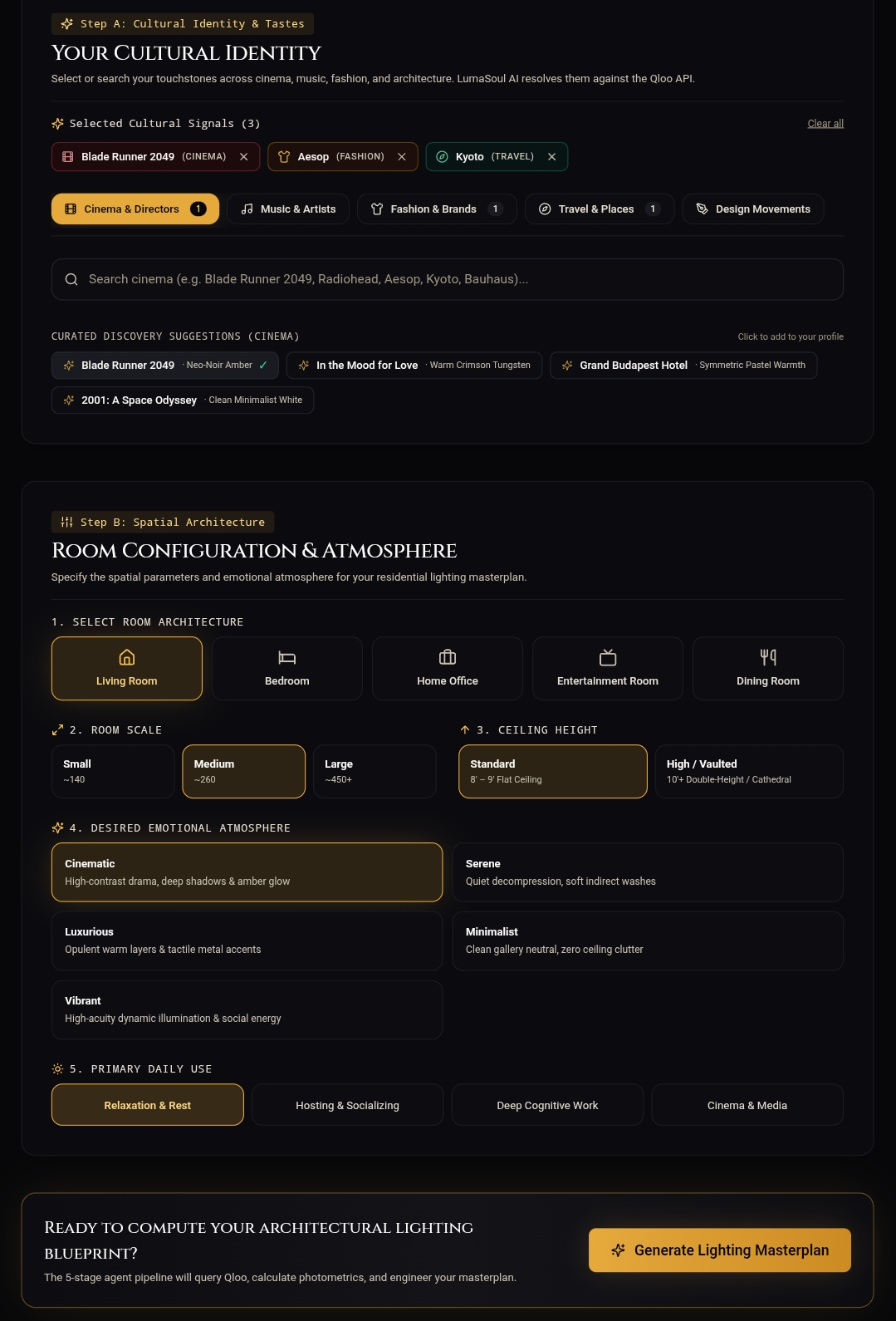
Users can express their tastes through different cultural categories, including:
- Cinema and film directors
- Music and artists
- Fashion and lifestyle brands
- Travel destinations
- Design inspirations
LumaSoul AI uses Qloo's cultural intelligence to discover relationships and affinities across these interests.
It then translates the resulting cultural signals into an explainable lighting design direction and room-specific technical recommendations.
The generated lighting blueprint is designed to include:
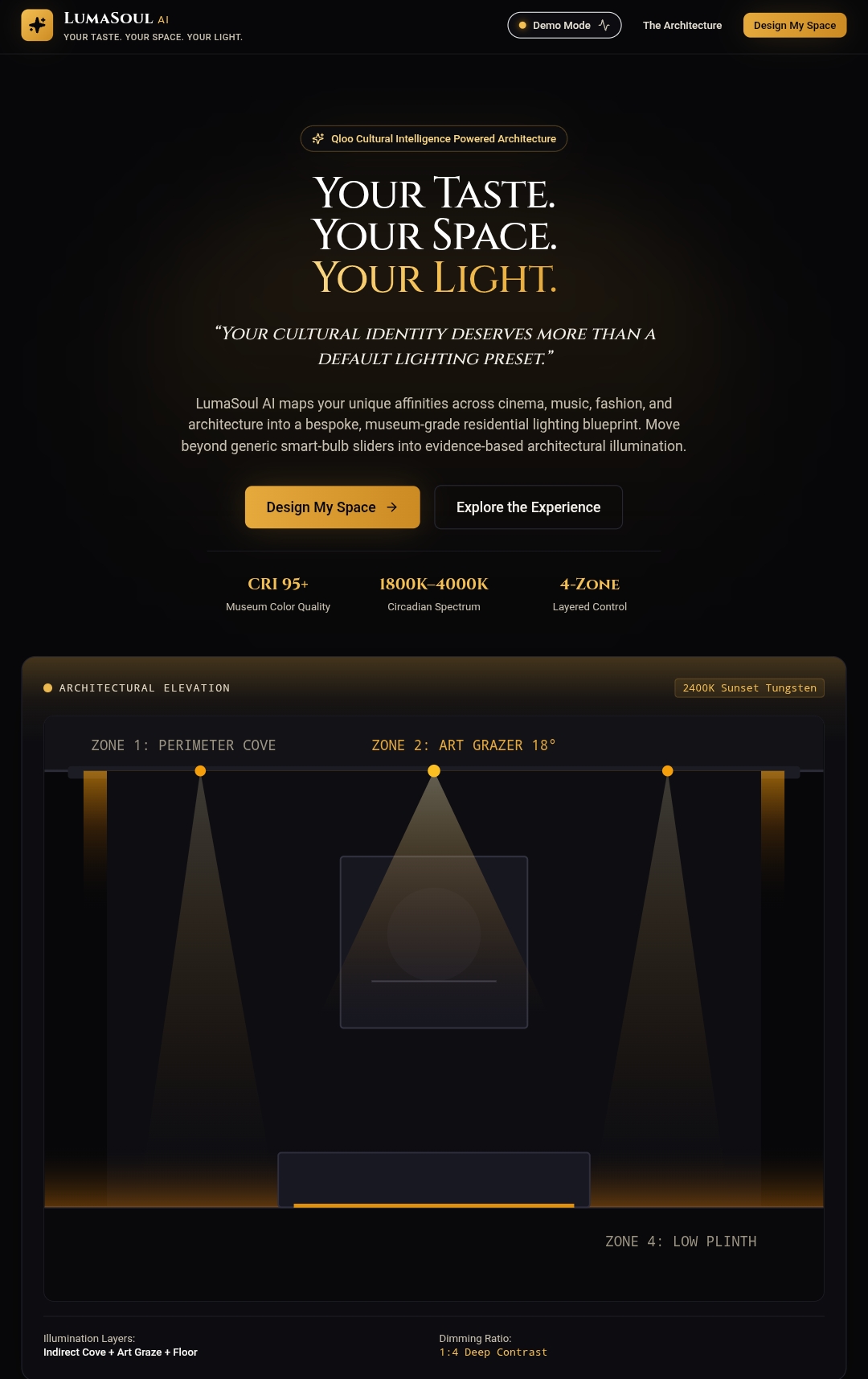
- Color Temperature: Personalized Kelvin recommendations.
- Color Rendering: Recommended CRI targets for different environments.
- Fixture Architecture: Suggestions for pendant lights, recessed downlights, accent fixtures and concealed LED strips.
- Lighting Zones: Ambient, task and accent lighting configurations.
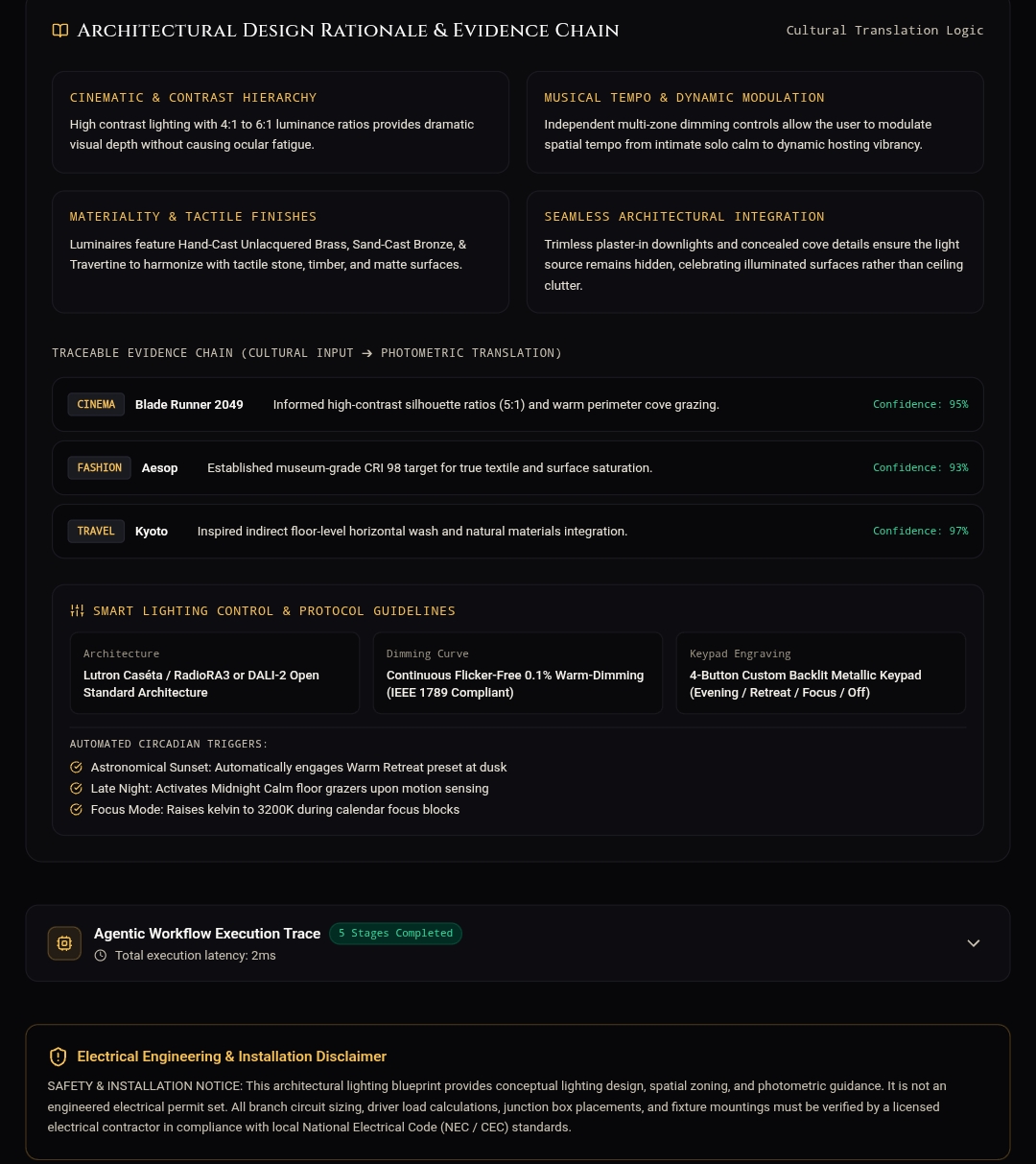
- Smart Dimming: Personalized brightness levels and lighting scenes.
- Design Rationale: An explanation connecting cultural preferences with the resulting lighting recommendations.
The goal is to make lighting design more personal, intelligent and accessible to homeowners, interior designers and lighting professionals.
How I built it
I developed LumaSoul AI using a modern web technology stack, prioritizing modular architecture, secure API integration and an intuitive user experience.
Technology Stack:
- Frontend: Next.js, React.js, TypeScript and Tailwind CSS.
- Backend: Next.js API Routes and server-side processing.
- Cultural Intelligence: Qloo Taste Graph API.
- UI Components: Reusable components and Lucide icons.
- Deployment: Vercel.
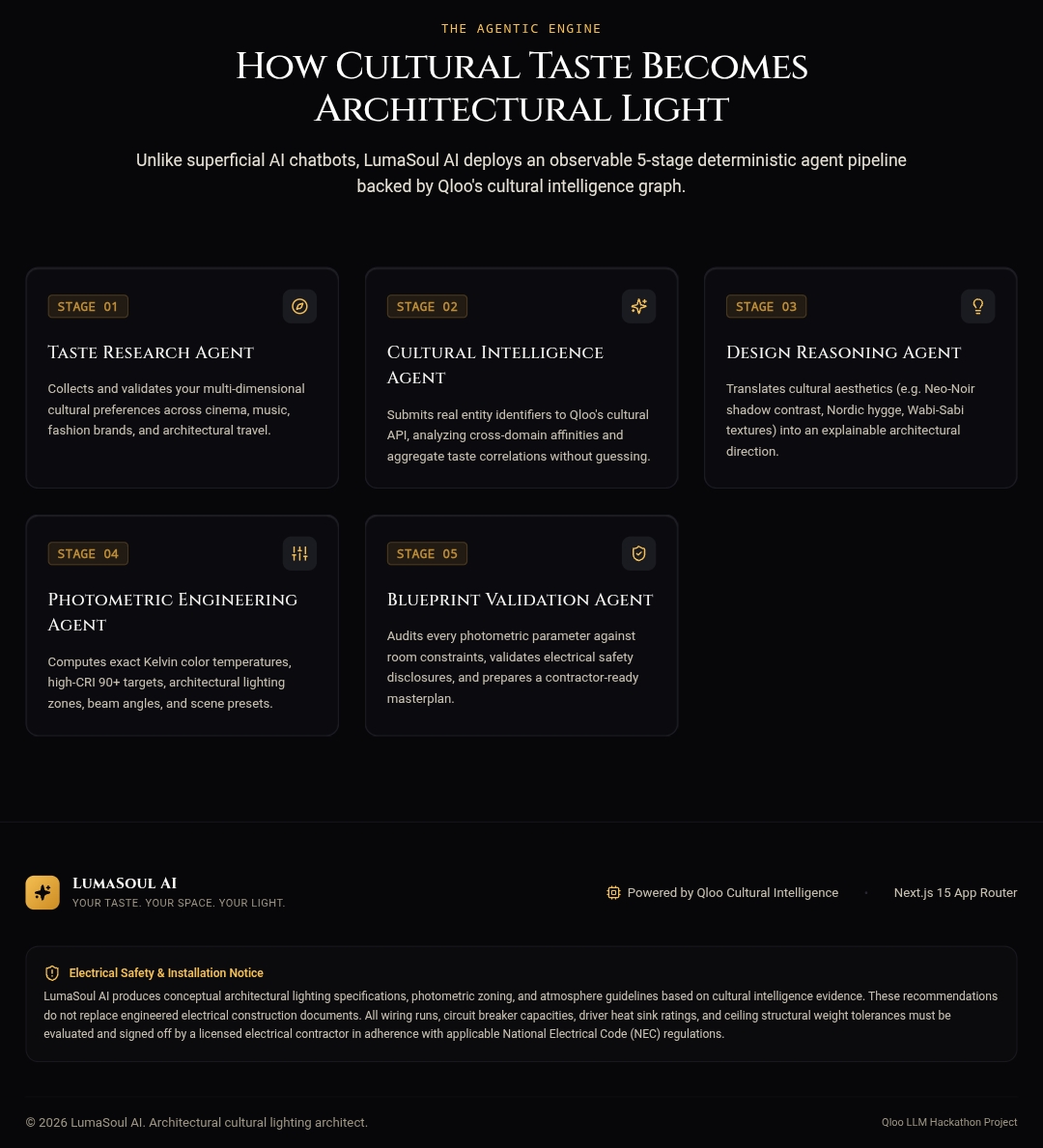
The application follows a modular architecture consisting of four major layers:
1. Cultural Preference Discovery
Users provide their interests across multiple cultural categories. These preferences form the input for the cultural intelligence workflow.
2. Qloo-Powered Cultural Intelligence
Qloo provides the cultural intelligence foundation. Its entity discovery and insights capabilities help connect preferences across different domains.
3. Agentic Design Reasoning
The orchestration workflow processes the cultural signals and translates them into design decisions. Separate reasoning stages handle cultural interpretation, design direction, lighting engineering and blueprint validation.
4. Lighting Engineering Engine
A structured recommendation engine maps the interpreted design direction into lighting parameters, fixture recommendations, room zones and scene configurations.
I focused on keeping the process explainable so that users can understand the relationship between their cultural preferences and the resulting design.
Challenges I ran into
One of the biggest challenges was translating abstract cultural preferences into practical engineering decisions.
Cultural interests are subjective, while lighting specifications require structured and measurable parameters. Bridging these two worlds required designing a clear relationship between cultural signals, aesthetic interpretation and lighting recommendations.
Other challenges included:
- Understanding and integrating Qloo's API capabilities into a practical application.
- Resolving cultural entities across different categories.
- Structuring the agent workflow without making it unnecessarily complicated.
- Mapping aesthetic interpretations into meaningful Kelvin, CRI, fixture and dimming recommendations.
- Designing a professional interface that presents both creative inspiration and technical specifications.
- Managing development time as a solo developer while prioritizing the most important product features.
Another important consideration was ensuring that recommendations remain explainable instead of presenting arbitrary AI-generated lighting values as engineering decisions.
Accomplishments that I'm proud of
I am particularly proud of exploring a different application of cultural intelligence.
Rather than using taste data for conventional entertainment, shopping or lifestyle recommendations, LumaSoul AI explores how cultural affinities can influence physical environments.
Some of the key accomplishments include:
- Developing a concept that connects cultural intelligence with architectural lighting.
- Designing a taste-to-light transformation workflow.
- Structuring an agentic architecture around cultural research, design reasoning and engineering recommendations.
- Creating a technical blueprint concept that connects personalized aesthetics with practical lighting specifications.
- Exploring a new approach to personalized smart-home experiences.
Most importantly, LumaSoul AI demonstrates how cultural intelligence can become useful beyond digital recommendations and contribute to the design of real-world spaces.
What I learned
Building LumaSoul AI helped me understand that the potential of AI agents extends far beyond generating text or answering questions.
An effective agentic system should be able to gather relevant information, interpret external data, make structured decisions and produce useful outputs.
I also learned more about working with cultural intelligence APIs, entity relationships, API orchestration, modular application architecture and the challenges of converting subjective human preferences into structured technical recommendations.
One of my biggest takeaways was that personalization becomes much more meaningful when it influences something tangible in the real world.
What's next for LumaSoul AI
LumaSoul AI is envisioned as a foundation for a more personalized and culturally intelligent smart-home ecosystem.
Future development could include:
- Smart Home Integration: Connecting with Philips Hue, Matter-compatible devices and other smart lighting ecosystems.
- Interactive 3D Room Visualization: Previewing personalized lighting arrangements before installation.
- Professional Contractor Mode: Generating more detailed lighting schedules, fixture specifications and installation-ready documentation.
- Advanced Cultural Intelligence: Expanding cross-domain preference analysis using additional Qloo capabilities.
- Adaptive Lighting Experiences: Creating lighting scenes that evolve according to user preferences, activities and time of day.
- Interior Design Expansion: Extending cultural intelligence into furniture, materials, colours and broader interior design recommendations.
My long-term vision is to make every living space feel more personal by allowing technology to understand not just what people need, but also what they love.
LumaSoul AI: Your Taste. Your Space. Your Light.
Built With
- agentic-ai
- ai-agents
- api-integration
- artificial-intelligence
- css-animations
- css3
- cultural-intelligence
- git
- github
- html5
- interior-design
- internet-of-things-(iot)
- javascript
- lucide-react
- next.js
- node.js
- qloo-api
- react
- rest-api
- smart-home
- tailwind-css
- taste-graph
- typescript
- vercel

Log in or sign up for Devpost to join the conversation.