-
-
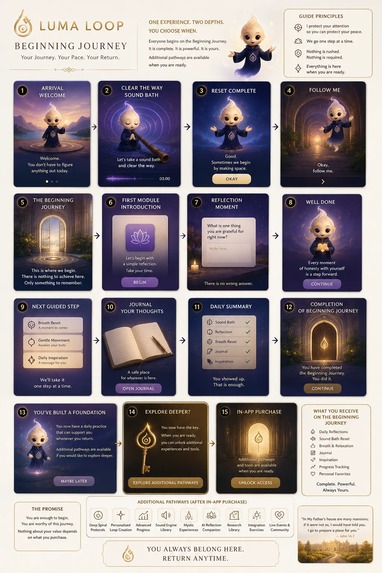
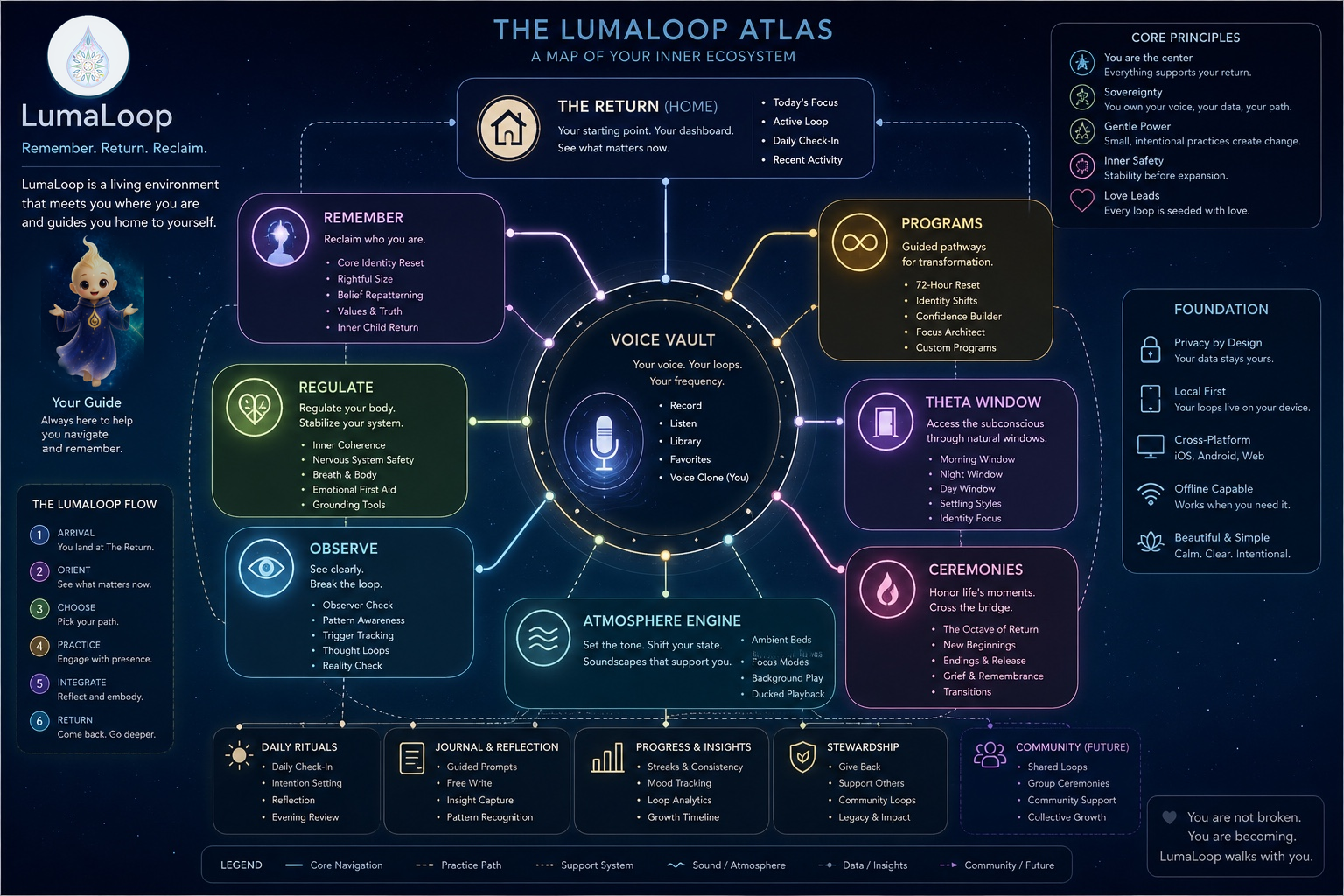
The Flow Chart
-
App Icon
-
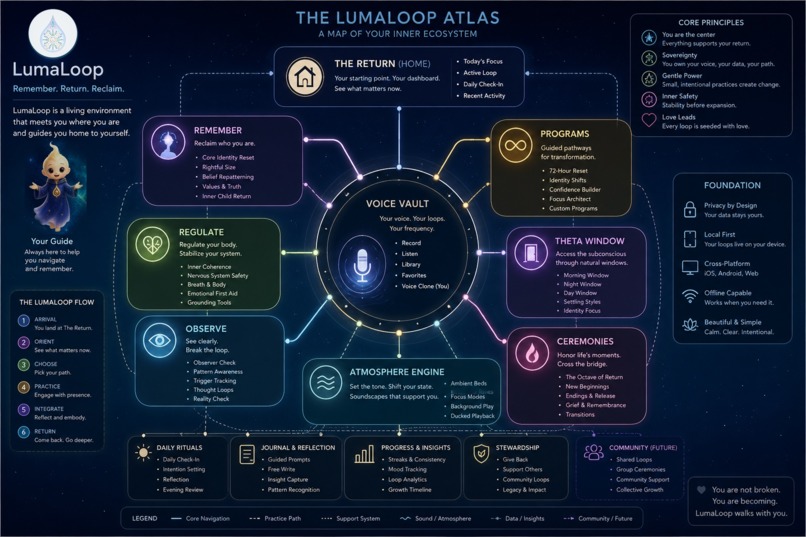
Atlas
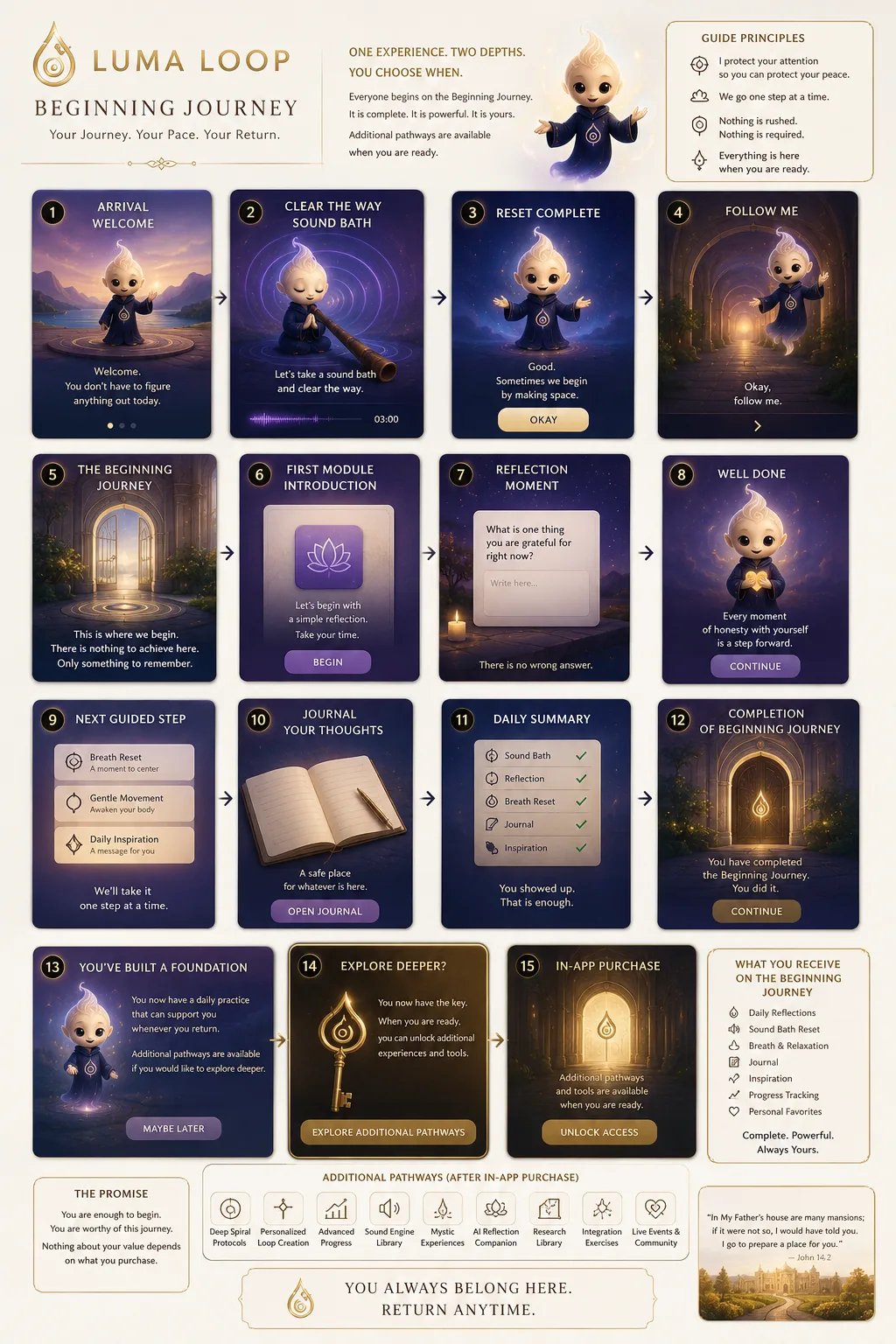
Inspiration
LumaLoop began with an idea from an old friend of mine in Amsterdam. He is still something of a spiritual hippie—in the best possible way—and we spent five memorable years living together there.
During that time, we had countless conversations about identity, habits, emotional patterns and how the words we repeatedly tell ourselves can shape the way we feel and act.
His original idea was simple: what if people could record meaningful words in their own voice and hear them repeated at the moments when they were most receptive?
That idea stayed with me. Eventually, I decided to turn it into a real mobile app.
The result is LumaLoop: a private wellbeing companion that helps people record personalised voice loops, combine them with calming atmospheric audio and use them as part of a deliberate daily practice. https://www.lumalooper.com/
What it does
LumaLoop allows users to create short recordings in their own voice based on the state they want to develop—calm, confidence, focus, motivation, better sleep or emotional clarity.
Users can:
- Record and replay personalised voice loops.
- Combine their voice with atmospheric audio.
- Follow guided pathways and structured programmes.
- Schedule practices for the morning, daytime or evening.
- Receive recommendations based on their current needs.
- Complete daily reflections and track their progress.
- Access free practices or unlock the complete LumaLoop Plus experience.
Recordings remain on the user’s device, keeping the experience personal and private.
How we built it
I built LumaLoop as a cross-platform mobile application using Flutter and Dart.
The app uses:
- Flutter for the interface and cross-platform application.
- just_audio and audio_service for voice and atmospheric playback.
- Hive for private local data storage.
- RevenueCat for subscriptions, entitlements and purchase restoration.
- Firebase Analytics for privacy-conscious product analytics.
- Native iOS and Android integrations for notifications and scheduled practices.
A custom loop engine coordinates the user’s recorded voice with background audio. LumaLoop also includes a recommendation system that considers what the user needs, when they intend to practise and how they prefer to engage.
RevenueCat powers the LumaLoop Plus membership, including monthly, annual and lifetime options. The free version provides a genuine starting experience, while Plus unlocks additional recordings, pathways, programmes and advanced practices.
Challenges we ran into
Audio was one of the largest technical challenges. Voice playback, atmospheric sound, interruptions, background controls and restoring an active session all behave differently across iOS and Android.
Making these pieces feel like one calm, reliable experience required considerable testing and iteration.
Notifications presented another challenge. A wellbeing reminder must arrive at the right moment without becoming another unwanted interruption. I had to think carefully about reliability, timing and what should happen when the operating system restricts background activity.
The most difficult product challenge was restraint. LumaLoop can support many different practices, but presenting everything immediately would overwhelm new users. I repeatedly simplified the onboarding and first-loop experience so that users could understand the idea by experiencing it rather than reading a long explanation.
Monetisation also required balance. The free experience needed to be genuinely useful, while LumaLoop Plus needed to offer clear ongoing value. RevenueCat allowed me to experiment with the packaging while keeping purchase and entitlement handling manageable across platforms.
Accomplishments that we're proud of
One of the accomplishments I am most proud of is making LumaLoop’s Theta Window alarm work reliably.
This feature required going beyond standard Flutter notifications and working directly with native iOS and Android code. I built a bridge between Flutter and each platform’s native alarm and notification systems so that LumaLoop can schedule a practice, wake correctly and guide the user into their chosen loop at the intended time.
This was particularly challenging because mobile operating systems place strict limits on background activity, audio playback and scheduled events. The app also needed to handle different conditions gracefully—whether it was already open, running in the background or being launched from an alarm.
Getting Flutter, native code, notifications, application state and the audio engine to cooperate took extensive testing and many iterations. Seeing the Theta Window alarm finally activate the correct experience reliably felt like a major breakthrough.
It is more than a technical feature. Timing is an important part of the LumaLoop concept, so solving this challenge allowed the original idea to work as a genuine daily practice rather than simply as an audio player.
What we learned
I learned that the most technically impressive version of a feature is not always the version that helps the user most. In a wellbeing product, clarity, pacing and trust matter as much as functionality.
I also learned how important the first few minutes are. Users need to hear their first loop quickly and understand why their own voice is central to the experience. Every unnecessary decision before that moment weakens the product.
Most importantly, I learned that an unconventional idea can become a practical product when it is treated seriously and tested patiently.
LumaLoop started with conversations between two old friends in Amsterdam. Building it turned that memory into something other people can use in their own daily lives.
What's next for LumaLoop
My next steps are to:
- Continue improving the first-loop experience.
- Expand the personalised recommendation system.
- Add more structured wellbeing and performance pathways.
- Improve progress insights without making the experience feel clinical.
- Learn from real users and use their feedback to refine the product.
- Continue experimenting with fair, sustainable subscription options through RevenueCat.
LumaLoop is still evolving, but its purpose remains simple:
Help people use their own voice to practise the state they want to carry into their lives.


Log in or sign up for Devpost to join the conversation.