Inspiration
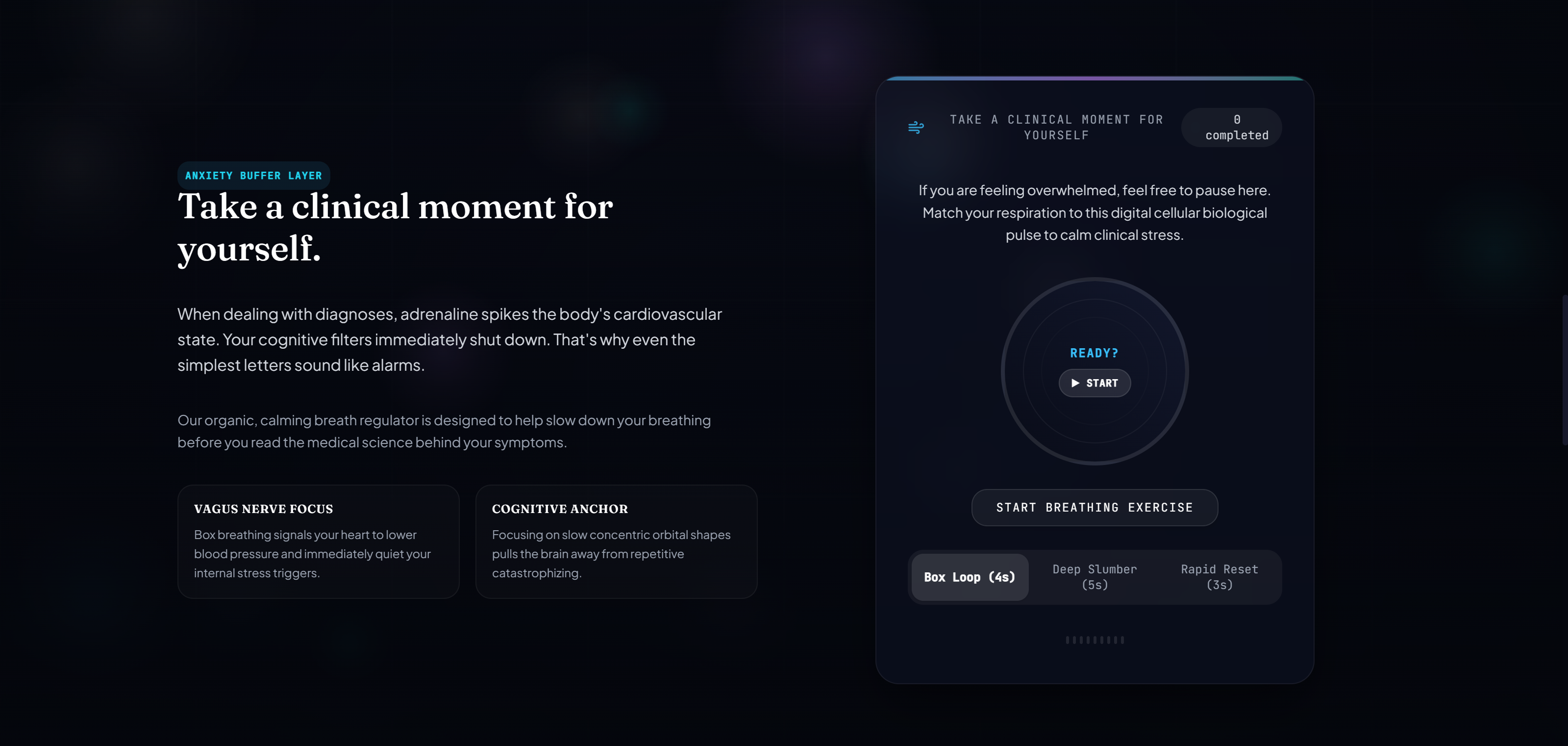
The true barrier to effective healthcare is not medical literacy; it is cognitive processing under stress. When a patient receives a doctor’s letter, a complex diagnosis, or a dense lab report, they are rarely in a calm state of mind. Instead, they enter a state of emotional and cognitive overload—paralyzed by fear, burdened by medical jargon, and socially isolated by the stigma surrounding health struggles, particularly mental health.
Gen Z and young adults are hyper-focused on holistic wellness, yet they face unprecedented rates of health-related anxiety. Traditional Large Language Models (LLMs) solve a purely mechanical problem: they summarize text or translate jargon into simpler words. But a machine-like dictionary does nothing to soothe an anxious mind, restore human agency, or reduce the physical fatigue of a healthcare system on the brink of burnout.
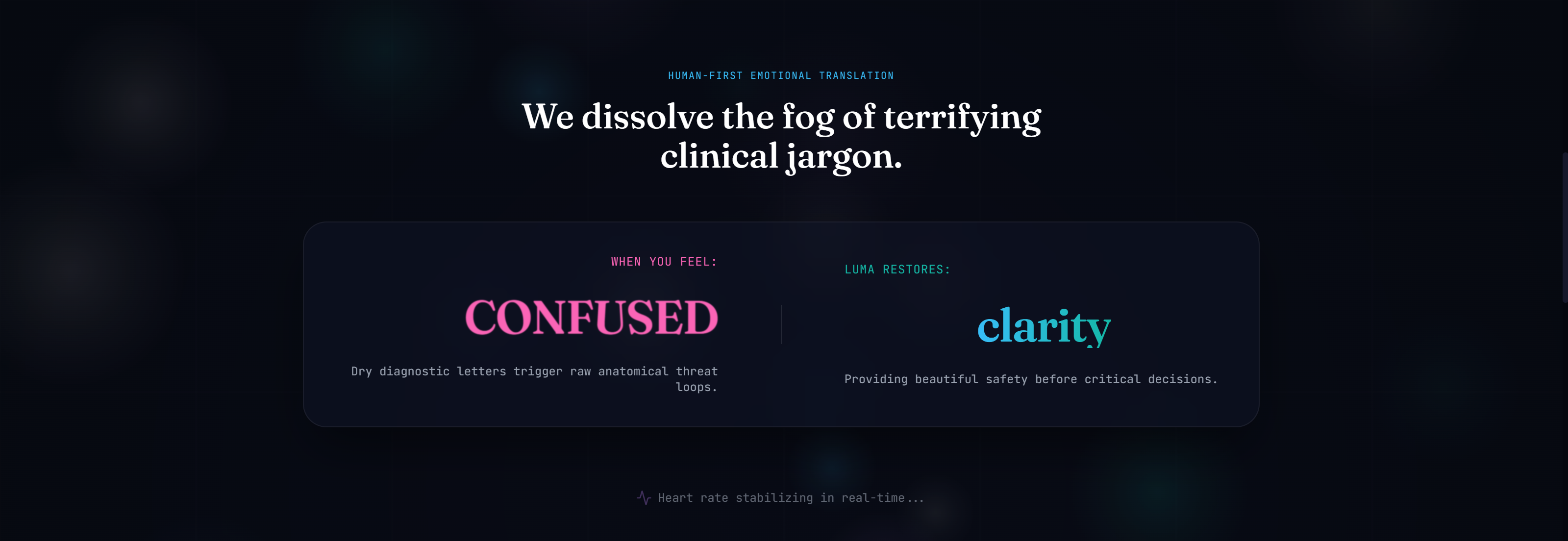
Luma was born from a radical realization: we should not just translate medical language; we must translate the emotional experience of healthcare. We inspired a platform that transforms overwhelming clinical data into a supportive, clear, and proactive journey toward wellness, bridging the gap between cold diagnostics and warm, human care.
What it does
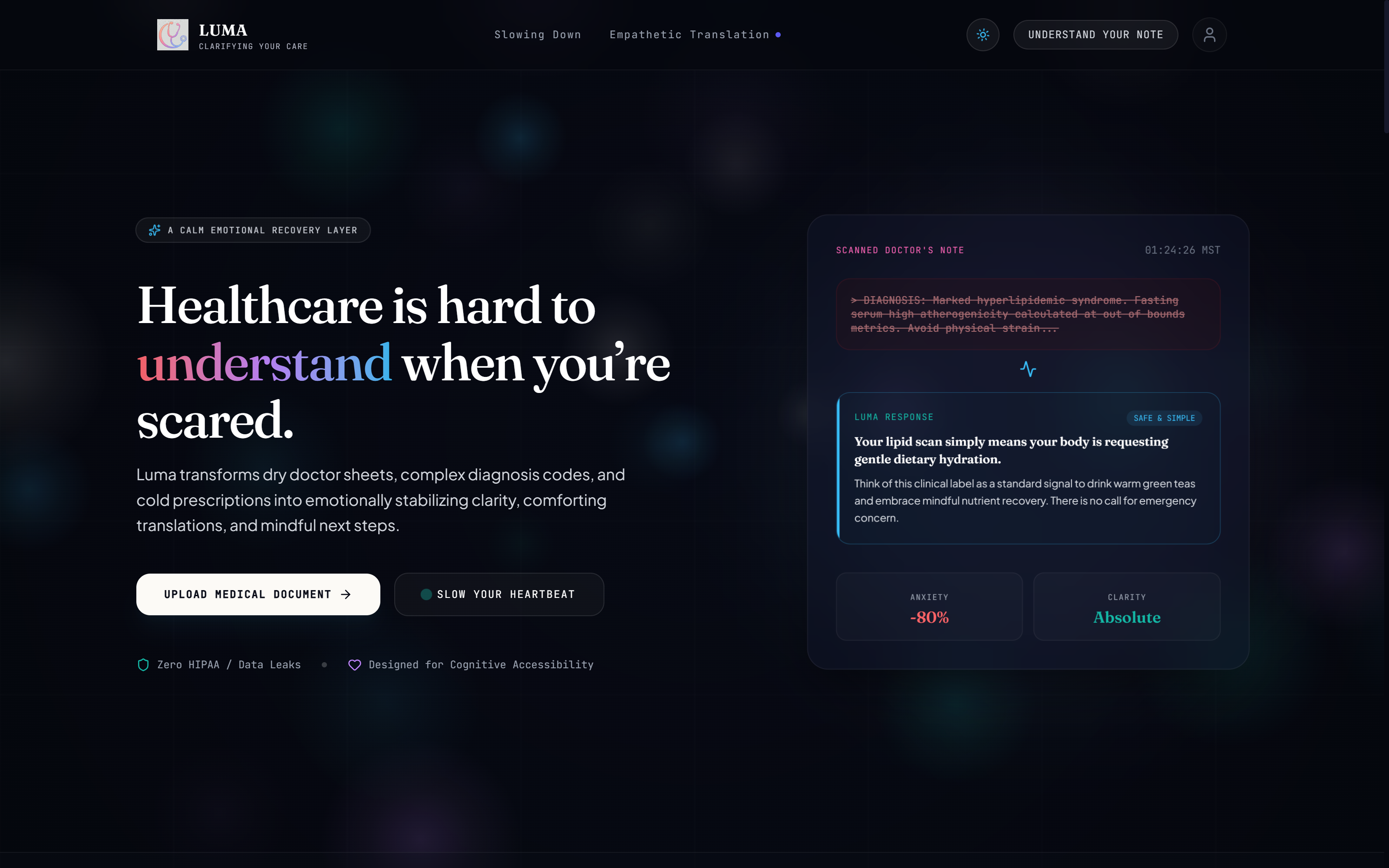
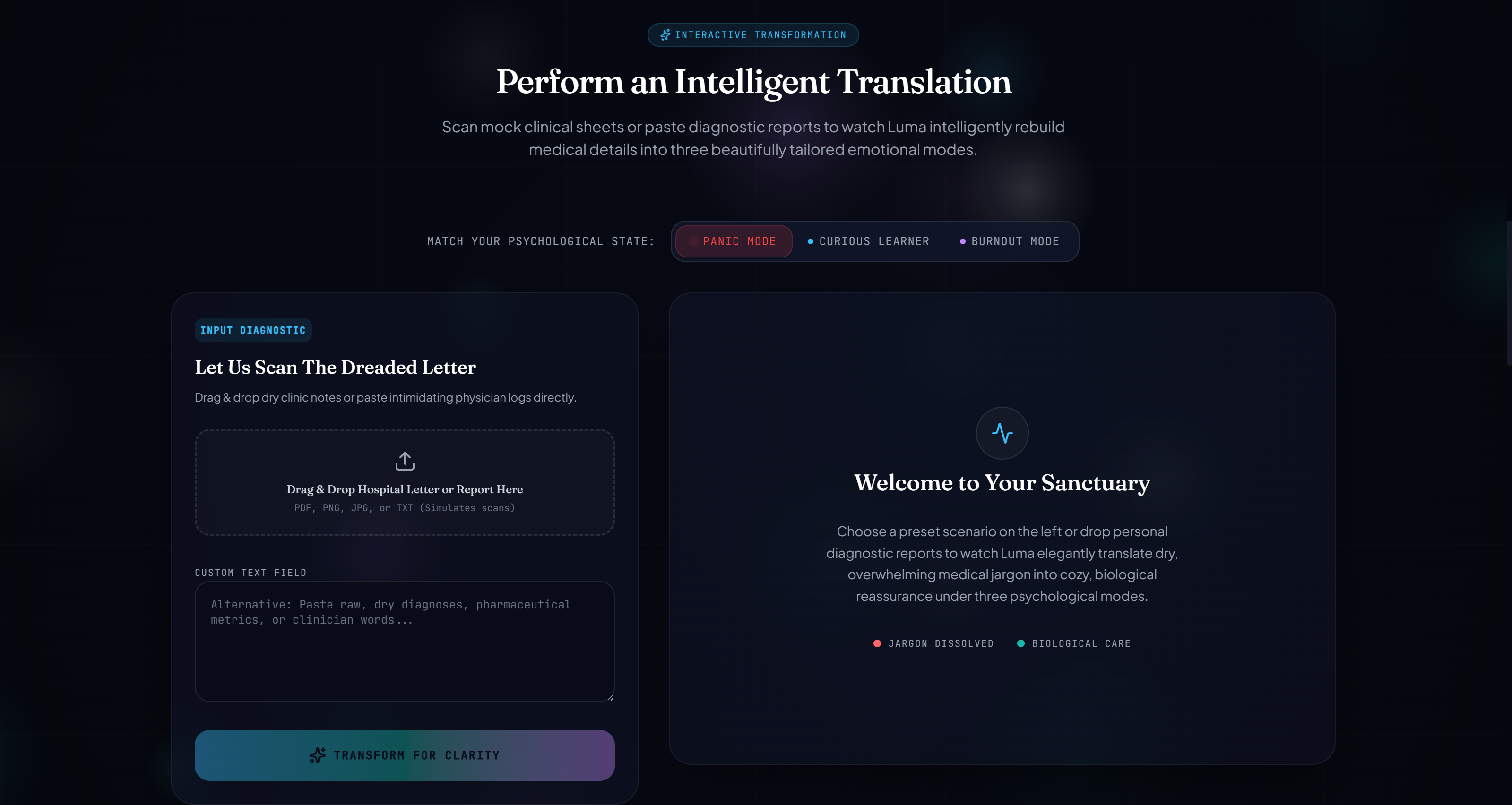
Luma is an AI-powered medical understanding and emotional clarity platform designed for the human experience. When a user uploads a medical document, prescription, or scan, Luma goes far beyond basic translation:
Decoding & Caring: It breaks down complex medical jargon into clear prose while dynamically adapting its tone to the user’s emotional state, reducing anxiety, restoring confidence, and preparing patients for their next doctor's visit.
**Holistic Education: **For the curious or preventative-focused user, it offers optional, expandable modules detailing the lifestyle, nutritional, and genetic risk factors associated with their condition.
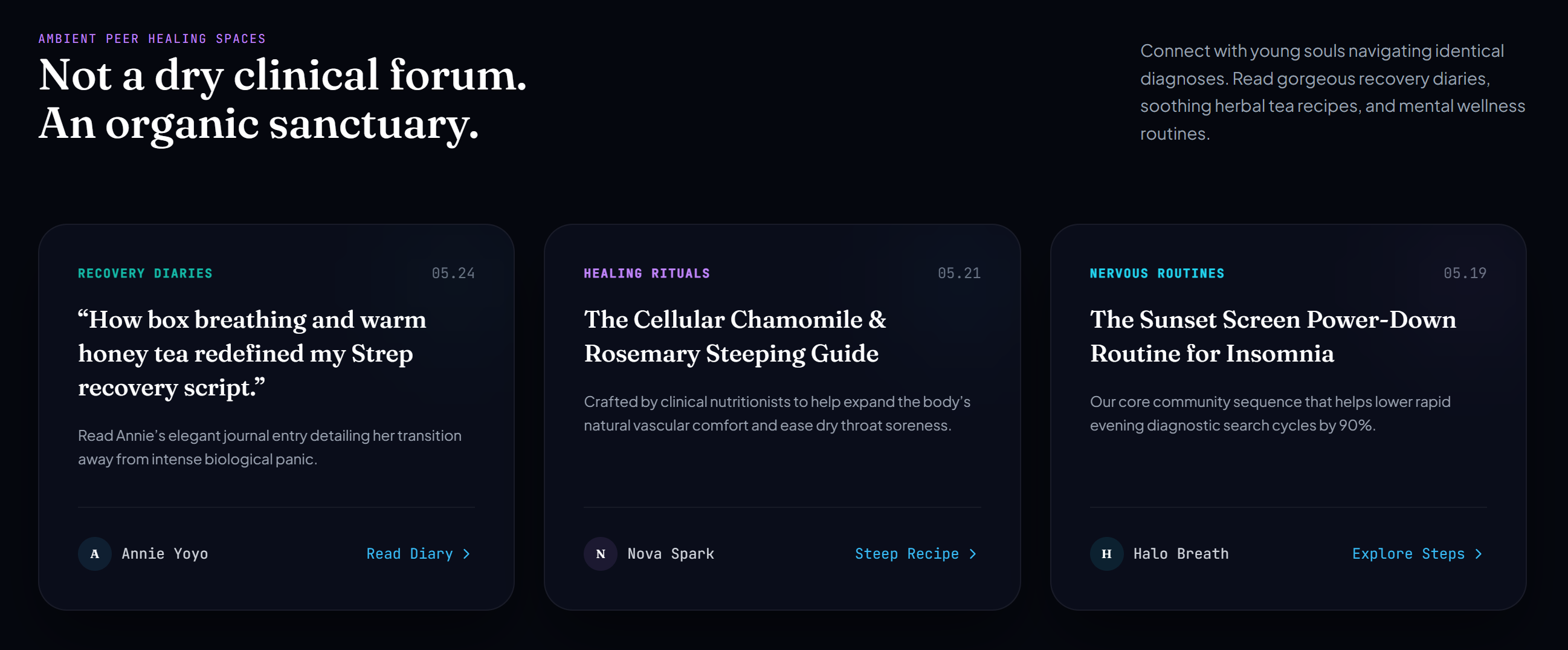
Community & Equity: It integrates a secure, anonymous peer-support ecosystem where users can share healthy living inspiration, find community resources, and access tools to navigate systemic healthcare inequities.
Protection & Action:
It serves as a secure, centralized cloud archive for a user's entire medical history, while integrating location-based services to recommend where to fill prescriptions conveniently and affordably.
How we built it
Luma was engineered using a modern, scalable, and responsive stack designed to deliver instantaneous support:
The Brain (AI Layer): We utilized the Gemini API as our core intelligence framework. Rather than using it for standard text processing, we heavily leveraged its advanced reasoning and context windows to analyze the sentiment and cognitive complexity of medical texts, prompting it to act as an empathetic medical communicator.
**The Backbone (Database & Auth): **We implemented Supabase for our backend architecture. Supabase seamlessly handles our relational data models, coordinates the cloud archive for medical documents, and secures our user authentication and profiles right out of the box.
The Interface (Frontend & Backend Integration): Built on a modern JavaScript framework (such as React or Next.js), the frontend captures document uploads via an intuitive UI. The frontend sends these files to a backend Node.js/Next.js API route. This route acts as a secure orchestrator: it securely pipes the document to the Gemini API alongside an emotional-intelligence prompt, saves the structured output and user metadata into Supabase, and streams the empathetic, decoded results back to the user in real time.
Challenges we ran into
Integrating clinical precision with emotional intelligence posed a distinct architectural challenge. We found that standard LLM prompts often resulted in overly sterile explanations or well-meaning but legally ambiguous medical advice. Fine-tuning Gemini to strike an exact balance—maintaining rigorous scientific accuracy for the "Learn More" sections while ensuring a warm, de-escalating tone for the primary breakdown—required extensive prompt engineering and systematic evaluation.
Furthermore, handling sensitive healthcare documents meant navigating complex privacy expectations. Setting up secure, granular Row-Level Security (RLS) policies in Supabase to ensure that user medical profiles and cloud archives were strictly isolated and encrypted was a technically demanding but entirely non-negotiable hurdle.
Accomplishments that we're proud of
We successfully shifted the paradigm of what health-tech can achieve. We are immensely proud of building an application that doesn't just display data, but actively alters the user's emotional state from anxiety to agency. We created an elegant, high-social-value product that elevates a simple document scanner into a holistic ecosystem featuring community support, geographic resource mapping, and inclusive advocacy tracking. Additionally, by transforming patients into informed, calm self-advocates, we built a tool that effectively alleviates the administrative and communicative burden on doctors, contributing to the fight against clinician burnout.
What we learned
This project taught us that technology is most powerful when it acts with emotional intention. We learned that Gen Z's demand for digital wellness requires a holistic architecture—one that treats mental clarity and physical treatment as inseparable elements. From a technical standpoint, we discovered how to push the Gemini API past its traditional boundaries, utilizing its linguistic agility to perform sentiment transformation and empathetic adaptation, rather than just raw translation.
What's next for Luma
Moving forward, Luma will expand from a reactive translation tool into a proactive wellness partner. We plan to integrate predictive analytics to suggest preventative lifestyle alterations before a user even receives a doctor's letter. We also aim to expand our Supabase database to support end-to-end encrypted, anonymous peer-to-peer forums, fostering safer digital micro-communities. Ultimately, we envision
Built With
- antigravity
- gemini


Log in or sign up for Devpost to join the conversation.