What Inspired Me
In communities across Africa and developing regions worldwide, access to modern AI assistants is severely bottlenecked by two persistent realities: intermittent, high-latency internet connections and expensive cloud API subscriptions. High-performing cloud agents are out of reach for students, everyday users, small businesses, and researchers operating in bandwidth-metered environments.
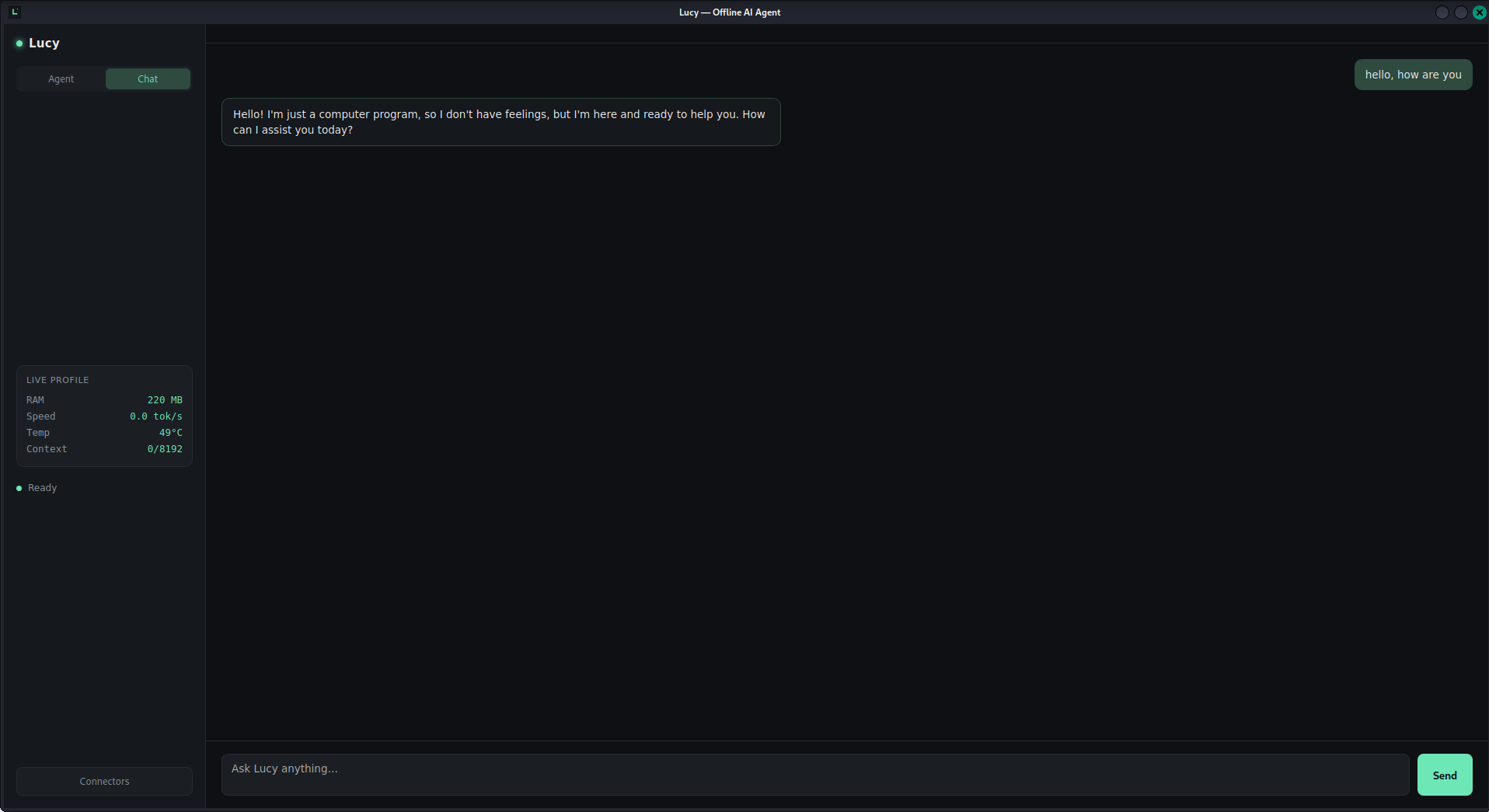
The Africa Deep Tech Challenge 2026 (Laptop LLM Track) inspired me to address this imbalance directly. Instead of wrapping another cloud API behind a GUI or limiting functionality strictly to software development, I wanted to build Lucy: a truly general-purpose, autonomous AI agent assistant. Designed to handle coding, file operations, web browsing, data analysis, and arbitrary external tool orchestration, Lucy operates on a budget commodity laptop with 8GB RAM, integrated graphics, and zero active network calls.
How I Built It
Lucy’s architecture pairs a low-overhead host shell with an extensible agent framework and an optimized local inference stack designed to squeeze maximum performance out of everyday CPU hardware:
- Application Shell & UI: Built using Tauri 2 (Rust) paired with an OS-native webview frontend. Selecting Tauri over Electron saved hundreds of megabytes of baseline RAM by avoiding a bundled Chromium runtime.
- General-Purpose MCP Connectors: To enable Lucy to perform "any and everything," the agent core features native Model Context Protocol (MCP) integration. This allows Lucy to dynamically connect to standard MCP servers—enabling access to local databases, productivity tools, file systems, custom CLI integrations, and external hardware interfaces without code changes to the agent itself.
- Inference Runtime: Powered by a bundled
llama.cppsidecar binary executing a quantized 7B model ($Q4_K_M$). To prevent runtime competition for system memory, the sidecar binary was compiled using aggressive, size-optimized flags (opt-level = "z", LTO enabled). - Autonomous Agent Loop: Designed around a hierarchical sub-goal pipeline:
$$\text{Task} \longrightarrow \text{Plan} \longrightarrow \left( \text{Act} \rightarrow \text{Observe} \rightarrow \text{Verify} \rightarrow \text{Reflect} \right) \longrightarrow \text{Synthesize}$$
- Structured Tool Invocation: Small language models (~7B parameters) frequently produce malformed JSON or hallucinated parameters when executing function calls. Lucy uses dynamic Context-Free Grammar (CFG) decoding compiled per tool state, guaranteeing that $100\%$ of generated tool outputs strictly adhere to expected structural definitions.
- Local Memory & Context Compression: Replaced process-heavy vector databases with an embedded SQLite storage tier leveraging
sqlite-vec. Context size is conserved across long multi-step tasks by passing forward only sub-goal execution summaries rather than raw operational step logs.
Challenges Faced
- Context Window vs. Memory Limits: Running an 8192-token context window alongside KV-cache quantization on an 8GB System RAM budget left minimal room for error. Balancing memory allocations required strict prompt summarization strategies to keep peak Resident Set Size (RSS) strictly below the 7GB memory threshold.
- Reliable General-Purpose Tool Calling: When an agent handles arbitrary tasks (from writing complex Rust programs to executing multi-step data parsing via MCP), small models can suffer from semantic errors (e.g., passing invalid arguments to valid functions). I resolved this by inserting a mandatory post-hoc verification pass (
AgentLoop::verify) after tool execution to detect failed assertions and force the agent to self-correct before proceeding. - Extensibility Without Overhead: Supporting diverse, general-purpose tools through MCP while preserving the strict RAM floor meant designing lightweight JSON-RPC bridges in Rust so that attached tools don't drain host memory resources.
What I Learned
Building Lucy proved that resource constraints foster architectural clarity. I learned that small, locally executed models are not inherently limited to single-domain tasks; when given dynamic tool interfaces like MCP, they can function as robust, general-purpose daily drivers. Combining grammar-guided decoding with deterministic verifiers bridges the reliability gap between cloud-scale models and local 7B models. Most importantly, I learned that high-utility, fully offline AI assistants can be realistically delivered to low-resource devices without compromising on functional autonomy.
Built With
- ai
- aiagent
- llm
- tauri

Log in or sign up for Devpost to join the conversation.