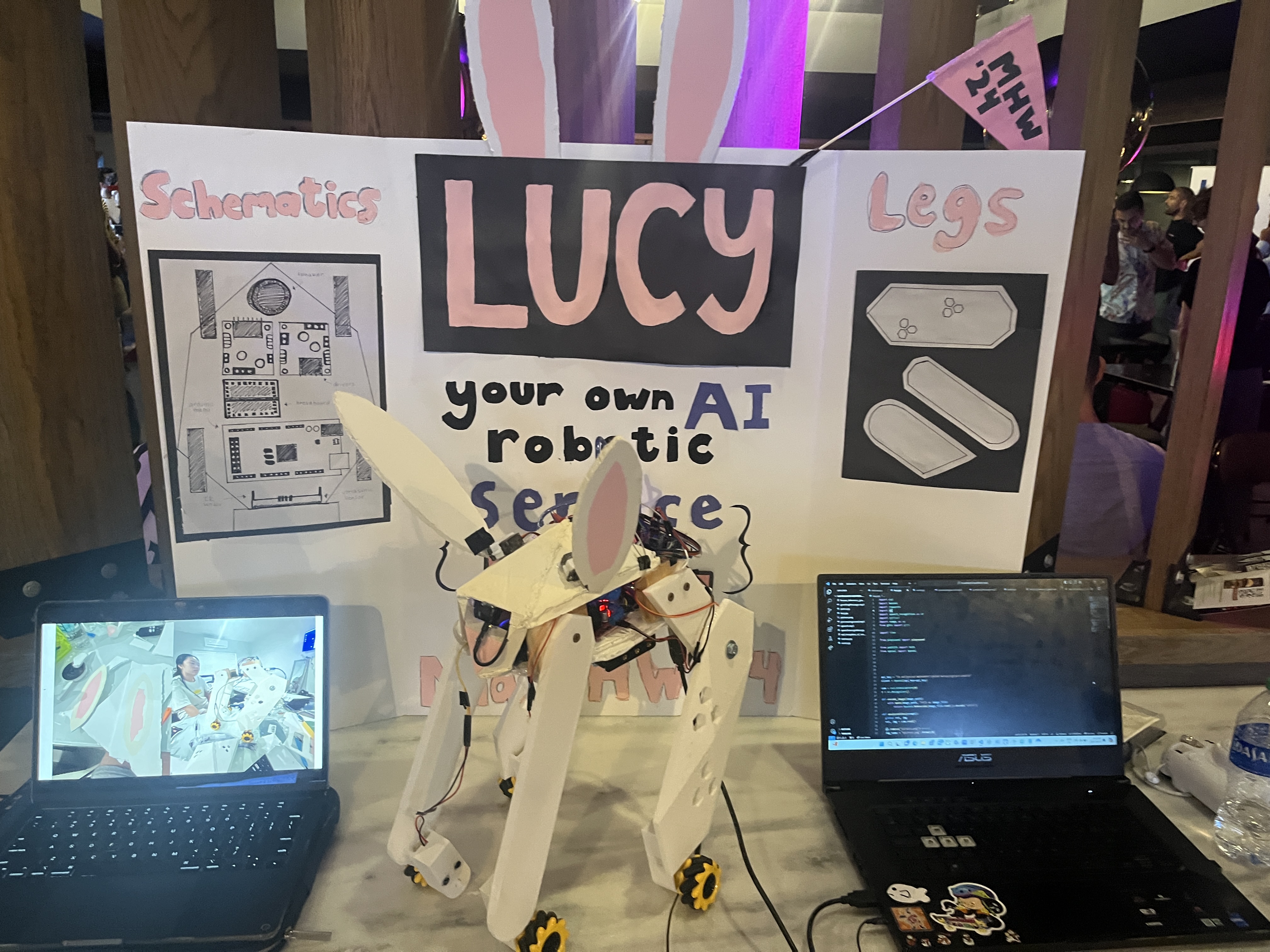
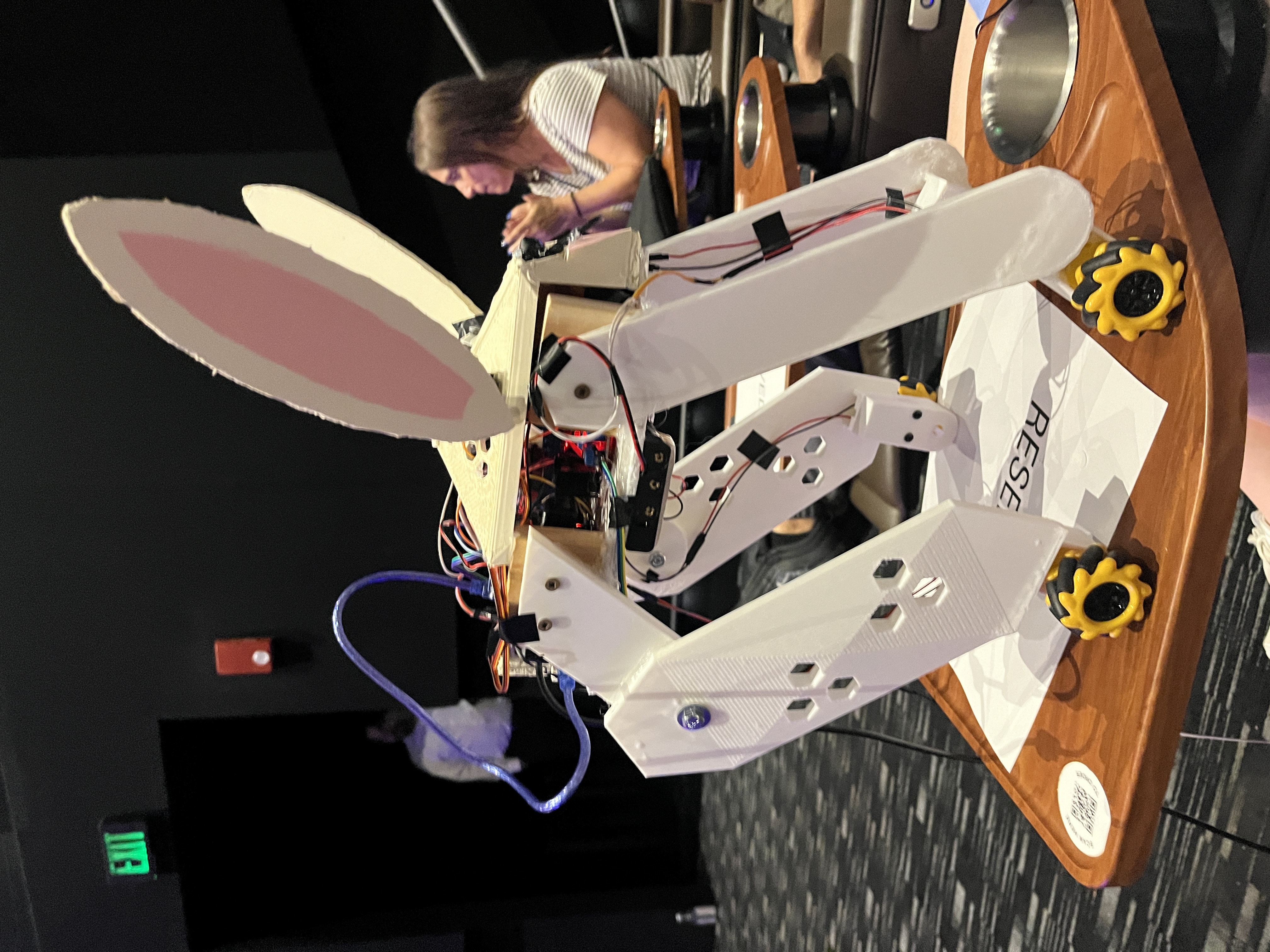
We ended up in a newsarticle! -- https://refreshmiami.com/news/miami-hack-week-2024-parties-meetups-and-innovative-tech-that-won-over-the-judges/
Inspiration
In the U.S., almost 20 million people suffer from visual impairments—but only 2% of these individuals work with guide dogs. Training a service animal can take up to 2-3 years, not to mention the cost of maintenance such as food and veterinary care. According to the National Service Animal Registry, service dogs can cost up to $50,000! With a growing population and people with disabilities, the need for guide animals is becoming more and more critical. We aim to close this gap with Lucy—your own AI-powered robotic service bunny (and companion!).
What it does
Lucy is able to move by detecting the distance between herself and the user—meaning if the user walks forward, Lucy walks forward as well. Lucy remains front at all times, just like a typical service animal does. Lucy is also equipped with a camera in the front and a speaker within its body, which can do an environmental scan to describe it in vivid detail to the user. We used a microphone on Lucy's leash to allow seamless communication.
How we built it
We built Lucy with LOVE! We individually CADed each part of the project—such as protectors for the sensors, shell for the body as well as each piece of the leg. Because our printer broke down and we were unable to have all the finished 3D parts, we completed our design with dollar store foam, glue, and paint which was a truly crafty process! We had to take measurements and cut different materials such as wood for each segment as well. As for hardware components, we used a combination of drivers, IR sensors, ultrasonic sensors, speakers, and a breadboard connected to wires which we coded on an Arduino mega to control its movement. As for software, we used object scanning to send to OpenAI to process and communicate with its user. With the limited amount of time we had, we put together something that we're extremely proud of.
Challenges we ran into
Making Lucy wireless was one of the most significant challenges throughout our project. This was extremely ambitious for us, as we had to use many different parts and we kept running out of batteries during the testing phase. Another challenge was the fact that the 3D printer we used broke down in the middle of printing all of our parts—with no time to spare. Although we were able to construct the legs, we were unable to fully print our CAD models of the shell and body so we had to make the rest using foam and glue from the dollar store. As well, we had to consider the material for each part (e.g. we had to cut up wood for screws to stick into) to compensate for the unfinished parts from printing. We did this in such limited time (and sleep!) as we flew only 2 days before demo day. We also faced some software issues—as one of our team member's laptop had restarted and we lost code for the movement of the robot. We were behind on time before the big demo day.
Accomplishments that we're proud of
We are extremely proud of the fact that we put this project together within a few days and were able to make do with the amount of resources we had. For example, we took apart a speaker from the dollar store to amplify Lucy's audio and embarked on the task of designing Lucy's entire body from scratch. We modeled our parts, 3D printed them, and used screws to attach them. We were able to pick up different crafting materials from nearby retail stores to create the shell and accessories. From the get-go, we knew that this project was very ambitious, and the fact that we were able to pull this together and create something remarkable is how we went out of our comfort zone to challenge ourselves.
What we learned
This was our first time experimenting with a Raspberry Pi, which was one of the most humbling experiences in our entire lives—but also the coolest! As well, this was our first time coding on a TV as a monitor, which we found really funny. 3D modeling and printing was also an interesting aspect that we explored for this project, including considering different measurements and small texture design details. As a team of 3 high school students with midterms right around, this was the most challenging and ambitious project we had ever embarked on. We learned a lot of new things—(including the importance of sleep!)
What's next for Lucy
For our next steps, we want to customize our circuit board to our project. We had to use and test a variety of specific hardware parts such as the Raspberry Pi 4 and 5 with no prior experience, which is a huge risk we were willing to take for this project. Another key feature is implementing rechargeable batteries instead of running on single, store-bought alkaline batteries. We had to make a few runs to Target during our time in Miami (including later at night...) to pick up more batteries to power our project. Another aspect we want to implement is different personalities for Lucy. One of the most important aspect of service animals is companionship—and customizing each Lucy robot to its owner is one of our future steps we are definitely going to look into.


Log in or sign up for Devpost to join the conversation.