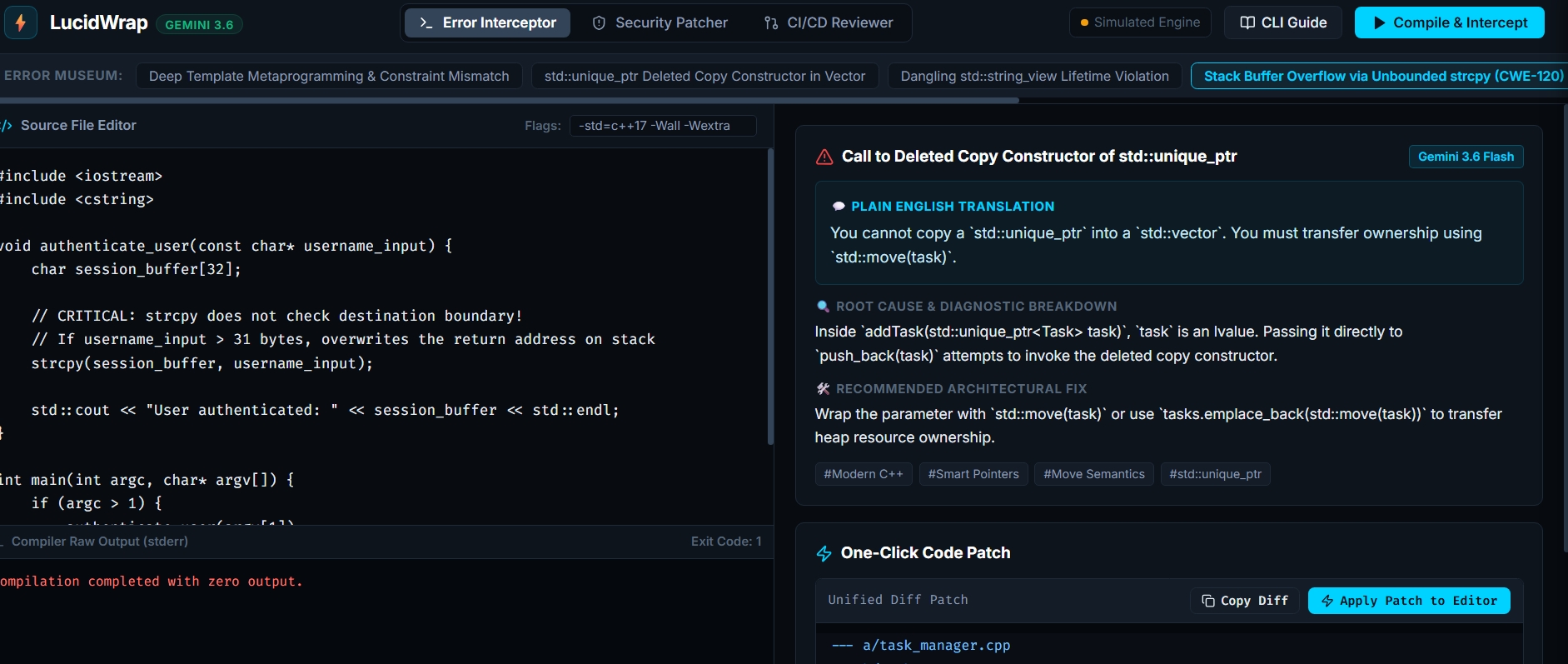
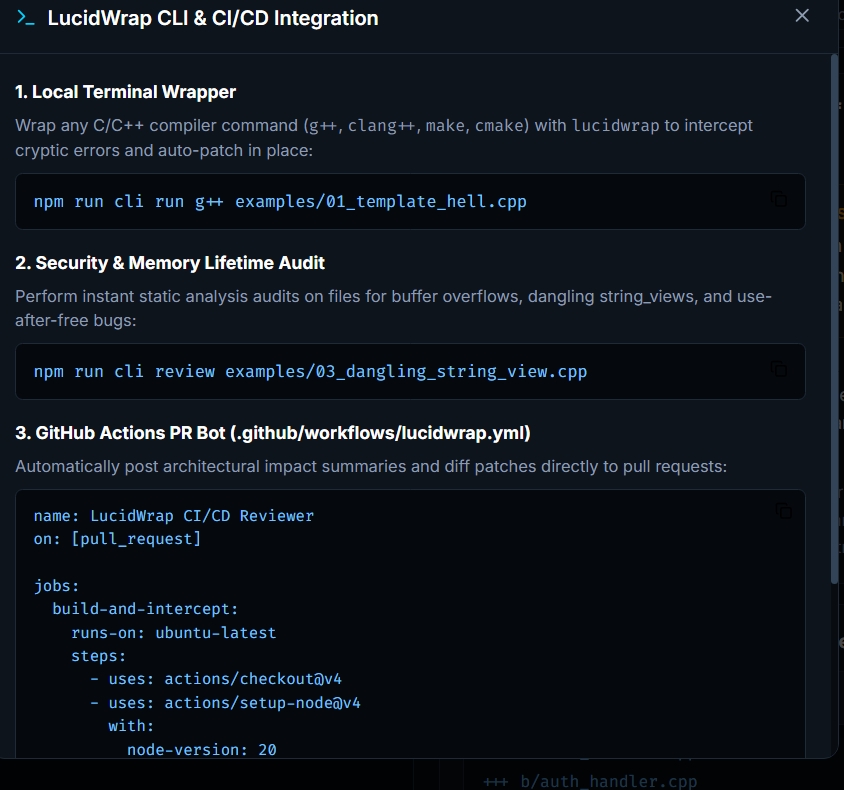
Inspiration: What if the compiler didn't just spit out cryptic diagnostics, but actively reasoned about AST contexts, explained errors in crystal-clear plain English, auto-generated verified unified diff patches, and guarded your CI/CD pipelines? That vision gave birth to LucidWrap.
What it does:LucidWrap is an AI-powered developer toolchain wrapper and DevOps security reviewer powered by Google Gemini 3.6 Flash. It transparently sits on top of standard C/C++ toolchains (g++, clang++, make, cmake, MSVC), intercepts compiler diagnostics in real time
How we built it:
### Compiler Interceptor & Parser Engine (src/core/parser.ts): Built with regex grammar parsers supporting GCC, Clang, and MSVC stderr streams. It extracts error locations, severity levels, caret markers, instantiation trace stacks, and generates high-level AST structural hints (e.g., [TemplateDecl], [ConceptConstraint], [ManualMemoryCall]).
### Gemini Intelligence Core (src/core/gemini.ts): Integrated with the official @google/genai SDK targeting Gemini 3.6 Flash (client.interactions.create). It features specialized prompt schemas enforcing structured JSON output for Error Resolution, Security Audits, and PR Reviews, backed by a resilient heuristic engine for offline development.
### Diff & Patching Engine (src/core/patcher.ts): Implemented using diff to compute line-level unified patches, validate syntax boundaries, and perform atomic in-place file rewrites.
Interactive CLI & TUI (src/cli/index.ts): Built with commander, chalk, and prompts to deliver a zero-overhead terminal wrapper (lucidwrap run g++ main.cpp).
###Web Studio & Backend API (src/client & src/server): Built with React 19, Vite, TypeScript, and Express, featuring cybernetic styling, Lucide icons, AST visualizers, and simulated CI review modules.

Log in or sign up for Devpost to join the conversation.