Inspiration
Online learning can be difficult because students don't always understand a concept when the professor explains it. The professor moves on, while the student is still trying to understand the previous topic.
We wanted to make learning more visual and interactive.
Our idea was simple: what if a lecture could turn into something a student could see, explore, and ask questions about?
That became Lucid 2.0.
What it does
Lucid 2.0 turns lectures into an interactive visual learning experience.
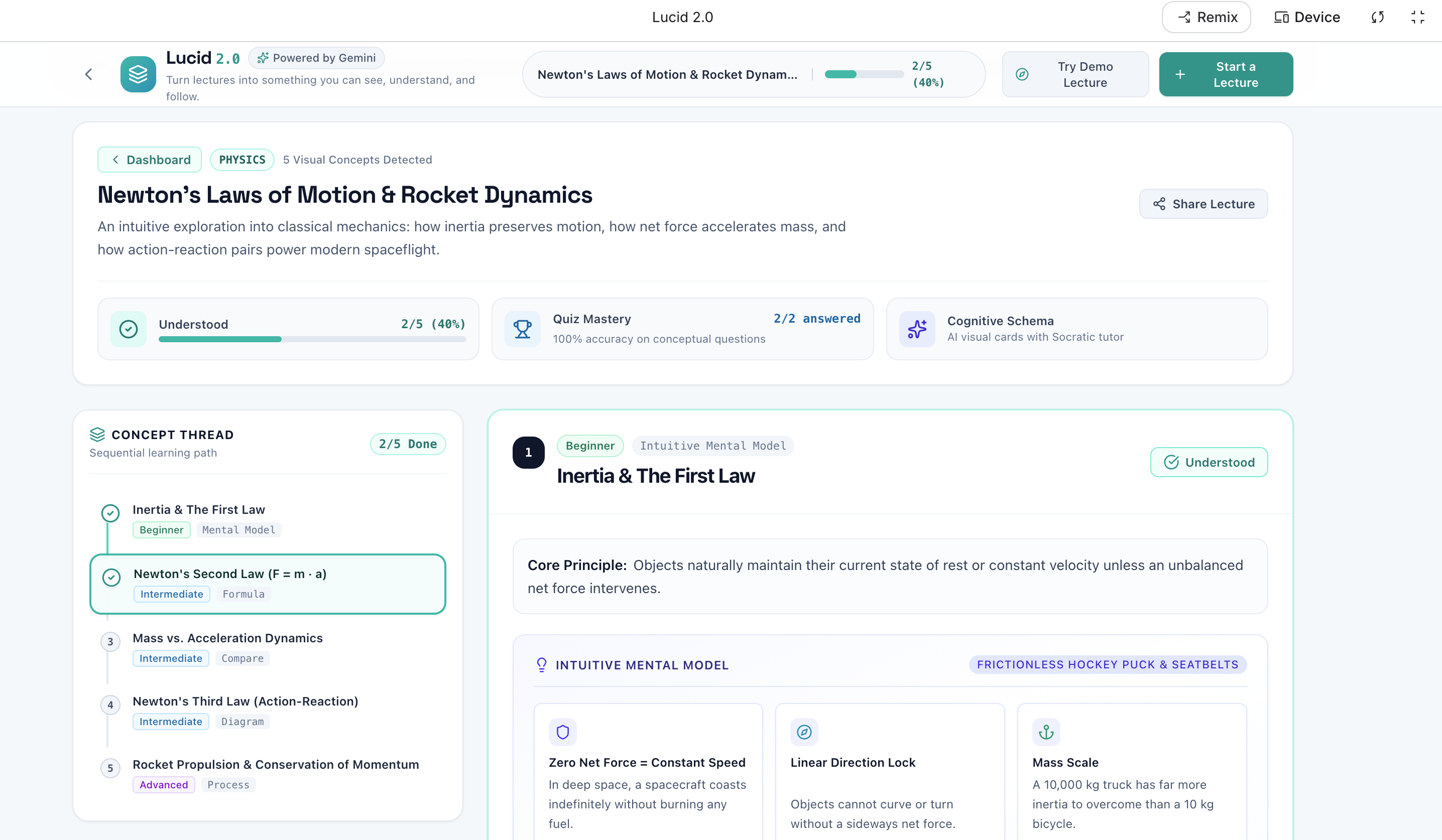
Students can provide a lecture, and Lucid uses Gemini to understand the content and identify the important concepts.
It then creates visual explanations, concept threads, formulas, examples, and key points.
Students can also:
Ask questions about a concept Ask Gemini to explain something in a different way Get simpler explanations or real-world examples Take AI-generated quizzes Review the important concepts from the lecture
Instead of just listening to a lecture, students can see it, explore it, and test what they learned.
How we built it
We built Lucid 2.0 around Gemini.
The lecture is sent to Gemini, which understands the content and breaks it into important concepts.
For each concept, Lucid decides how it can be explained most clearly — through a visual, formula, process, example, or key points.
We also built the Concept Thread, which organizes the lecture into connected topics so students can quickly move between concepts.
Gemini also powers the interactive parts of Lucid, including questions, alternative explanations, and quizzes.
Challenges we ran into
Our biggest challenge was making sure AI-generated content was actually useful for learning.
It is easy to generate a lot of information, but more information doesn't always mean better learning.
We had to think about how to turn a long lecture into simple, useful pieces without losing the important meaning.
Another challenge was making different types of concepts work differently. A formula, a process, and a real-world example shouldn't all be explained in the same way.
So we focused on one question:
“What is the clearest way to explain this concept to a student?”
Accomplishments that we're proud of
We are proud of turning a normal lecture into an interactive learning experience.
The part we're most proud of is that students can go beyond simply reading an AI-generated summary.
They can:
See a concept → ask about it → understand it another way → test themselves.
We also expanded Lucid from the original transcript-to-visual idea into Lucid 2.0, where Gemini is used throughout the learning experience rather than only for generating content.
What we learned
We learned that AI can be much more useful when it adapts information to the learner instead of simply giving them more information.
We also learned that visual learning and interaction can make complicated topics easier to approach.
Most importantly, we learned that building an AI product isn't only about what the AI can generate. It's about creating a simple experience that actually helps someone solve a problem.
What's next for Lucid 2.0
Our next goal is to make Lucid work with live lectures.
Instead of waiting for a transcript, Lucid could listen to the lecture through real-time speech-to-text and build the visual learning board while the professor is teaching.
We also want to improve the visual explanations, support more subjects, personalize explanations based on a student's level, and add stronger learning progress tracking.
Our long-term vision is:
Every lecture becomes something students can see, understand, question, and remember.
Built With
- artificialintelligence
- edtech
- educationtechnology
- gemini
- generativeai
- machine-learning
- naturallanguageprocessing

Log in or sign up for Devpost to join the conversation.