Inspiration
The inspiration for the Low-Cost Myoelectric Prosthetic Arm came from the desire to make advanced prosthetic technology accessible to those who need it most. Prosthetic limbs can be prohibitively expensive, limiting their availability to many people around the world. I wanted to create an affordable alternative that could still offer the functionality and intuitive control of higher-end prosthetics, helping to improve the quality of life for amputees.
What it does
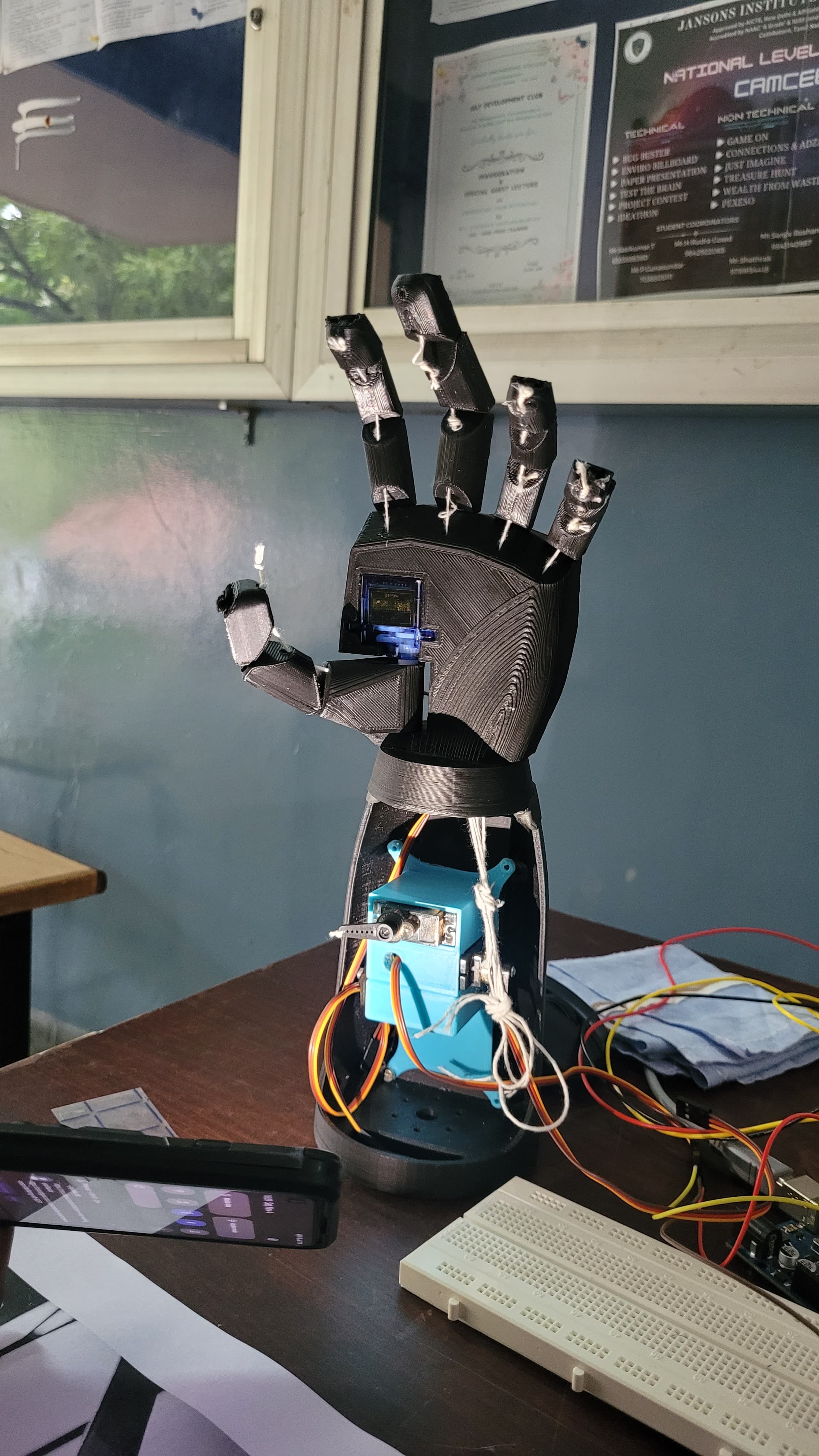
The Low-Cost Myoelectric Prosthetic Arm is a functional prosthetic limb that uses an EMG (Electromyography) sensor to detect muscle signals from the user’s residual limb. These signals are processed by an Arduino controller, which translates them into precise control commands for the servo motors that actuate the arm. This allows the user to perform natural and intuitive movements, such as opening and closing the hand or rotating the wrist, simply by flexing their muscles.
How I built it
I built the prosthetic arm by first designing a simple but functional mechanical structure that could house the necessary components. The EMG sensor was integrated to detect the electrical activity generated by muscle contractions. I then used an Arduino as the main controller to process the sensor data and send corresponding signals to the servo motors, which move the prosthetic’s joints. To ensure the arm's movements were smooth and responsive, I developed and integrated advanced signal processing algorithms that could accurately interpret the EMG signals in real-time.
Challenges I ran into
One of the significant challenges was accurately interpreting the EMG signals, which can vary greatly depending on factors like muscle fatigue, electrode placement, and individual differences. Ensuring the system could consistently recognize these signals and translate them into the desired movements required extensive testing and algorithm refinement. Another challenge was minimizing the cost without sacrificing functionality, which involved careful selection of components and efficient use of resources.
Accomplishments that I'm proud of
I'm particularly proud of creating a working prototype that demonstrates the feasibility of an affordable myoelectric prosthetic arm. The system’s ability to accurately translate muscle signals into natural movements was a major achievement, as was keeping the overall cost significantly lower than commercially available options. This project represents a meaningful step towards making prosthetic technology more accessible.
What I learned
Throughout this project, I gained a deeper understanding of EMG signal processing and the challenges associated with interpreting biological signals for control purposes. I also learned how to balance cost with functionality, making design decisions that kept the project affordable without compromising the quality of the user experience. Additionally, this project expanded my skills in integrating hardware and software to create a cohesive and responsive system.
What's next for Low-Cost Myoelectric Prosthetic Arm
Moving forward, I plan to improve the prosthetic arm by refining the signal processing algorithms to enhance accuracy and responsiveness further. I’m also considering adding more degrees of freedom to the arm, allowing for a greater range of movements. Another goal is to explore the use of 3D printing to produce more customizable and lightweight components. Ultimately, I hope to collaborate with medical professionals to test the arm in real-world conditions and explore opportunities for scaling production to reach more people in need.

Log in or sign up for Devpost to join the conversation.