Inspiration
In the current e-commerce landscape it is very common to have multiple tools that specialize in managing a certain domain. Each of these tools creates data silos, and breaking those silos up usually requires complex projects and a large dev team to implement queues, data streams, transformations, aggregations and so on - just to make some systems communicate to each other. This makes processes inflexible and hard to alter or debug. However, built on the MACH architecture, we strive to build a digital operations platform that is highly configurable in both its data structure as well as its processes. It allows you to configure how the data looks instead of forcing a model on you. Most importantly, all business processes can be modeled to match your needs and without imposing any restrictions from our side.
In this project we wanted to demonstrate the power of the MACH principles by integrating the solution of another MACH alliance member into our platform.
What it does
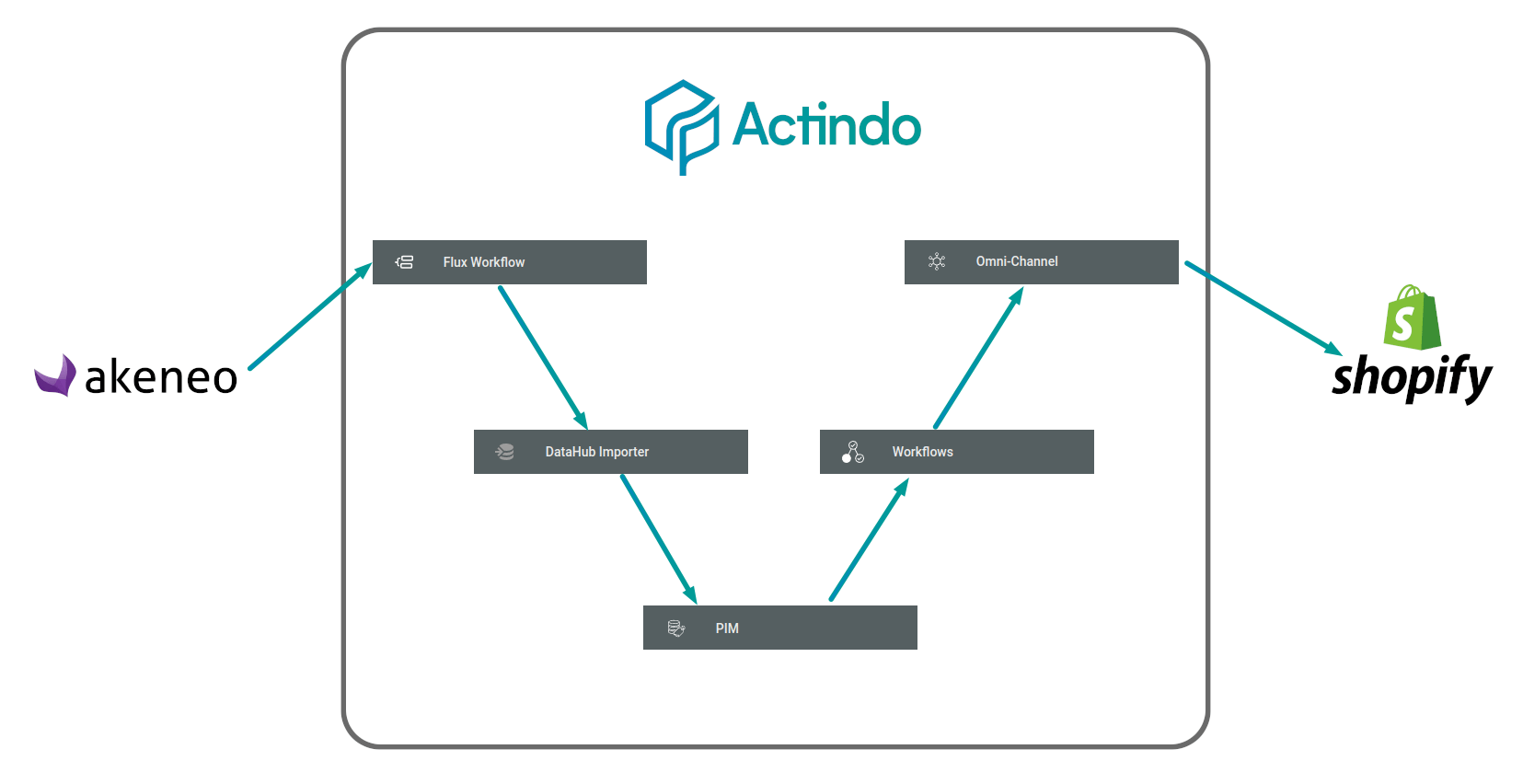
Using (almost) no code, we configure a stream that runs all products that are managed in Akeneo PIM into our platform which allows you to use our platform as hub to further spin them - in this case: publish them on Shopify to start selling immediately.
How we built it
We set this up using four components of our digital operations platform:
- Flux: Our process integration module
- Workflows: Our process orchestration module
- DataHub: Our flexible data store including transformation pipelines
- Omni-Channel and our Shopify integration
We configured them to work together to form a process chain that allows us to continuously collect product data from Akeneo and publish them to a market place.
Challenges we ran into
The complexity of product data requires the Akeneo API to return nested objects to properly reflect attribute values and their relationships to the channels and languages. Translating this structure had to be done using low code since we were not yet able to fully configure it.
Accomplishments that we're proud of
The solution we built is quite complex as we're integrating different platforms and complicated data streams. Yet, almost all of this could be done without the help of a dev team. The setup is also sustainable and automated, the entire pipeline can continue to live as-is to automatically update product data and even publish new products while all involved tools keep their domain focus and authority.
We set a goal to build this scenario with the tools we have at our disposal and we almost went all the way without seeing code.
What we learned
Software built on the MACH architecture allows it to be integrated by any 3rd party system easily and quickly - the barriers to entry are eliminated.
What's next
While the setup works for this demo, the low-code part of it is specific to the data structure we used in the scenario. By eliminating that code to replace it with a configurable system we want to enable anyone to build this using only configuration.
Extended setup demonstration
Built With
- akeneo
- core1
- javascript
- node-red
- php


Log in or sign up for Devpost to join the conversation.