-
Logo
-
Caretaker App Onboarding Demo Video
-
AR Overlay View
-
Caretake App Activity
Loupe
Inspiration
When our team began thinking about the "Lost & Found" theme, our conversations kept returning to something personal: the memory loss my great-grandmother has experienced as she has aged. Early-stage dementia does not erase a life all at once. It works at the edges, beginning with small uncertainties such as whether you have taken your medication, and slowly progressing to larger ones, including the names of the family members and friends closest to you.
Nearly seven million Americans live with Alzheimer's disease, and the early years following a diagnosis are some of the most psychologically difficult. Patients are often aware that they are losing parts of themselves, while the existing tools available to them (sticky notes, whiteboards, and pillboxes) tend to make them feel like patients first and people second. Most assistive wearables currently on the market, including CrossSense, Envision, and OrCam, require the patient to configure and operate the device, which is the opposite of what someone experiencing a decline in executive function is able to do.
Our goal was to design a system that gave the family the responsibility of setup, and gave the patient their world back, quietly.
What it does
LOUPE is a two-part system consisting of a wearable for the patient and a companion application for their family.
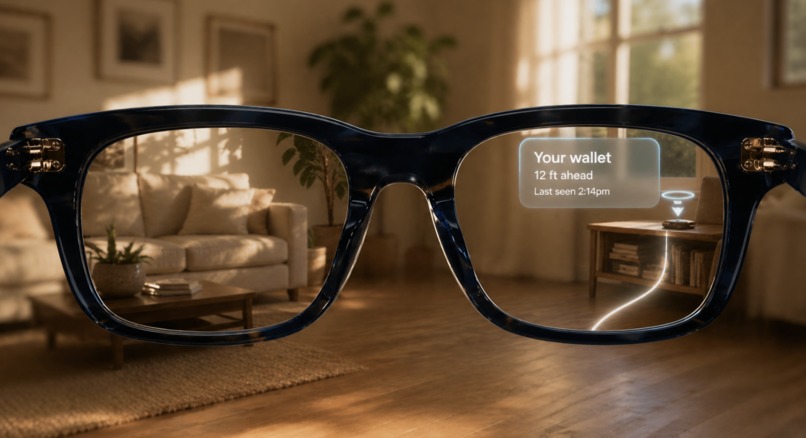
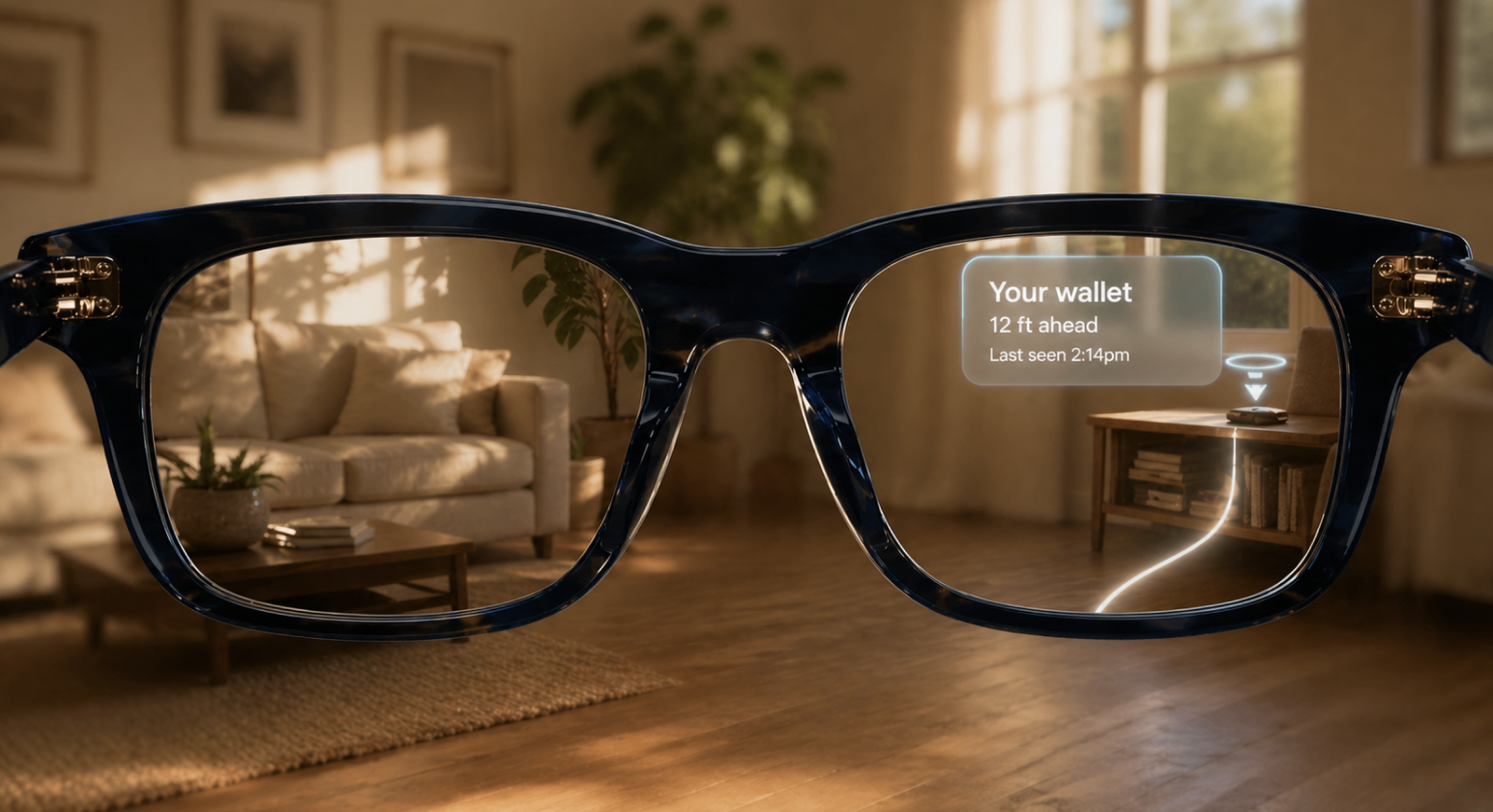
For the AR glasses, Loupe presents subtle, glanceable overlays within the wearer's field of view. A name floats gently above a familiar face. A soft visual guide leads the wearer toward a misplaced wallet or set of keys. A pill icon appears when it is time to take medication. There is no menu, no login, and no notifications to dismiss. The patient is never required to operate the system, as it simply observes what they observe and quietly fills in what they have forgotten.
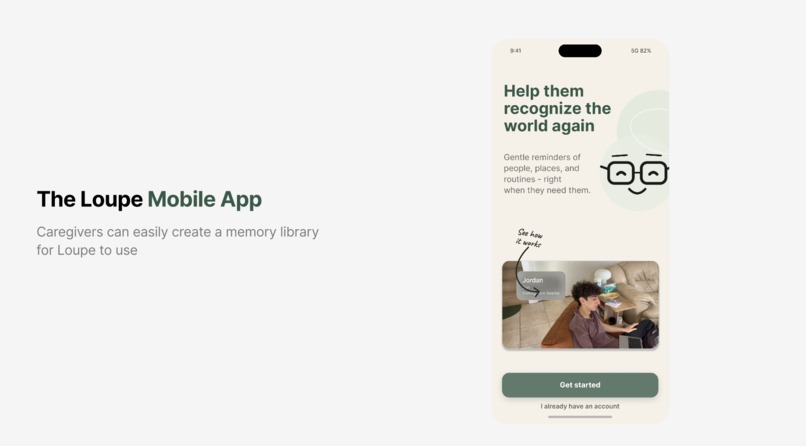
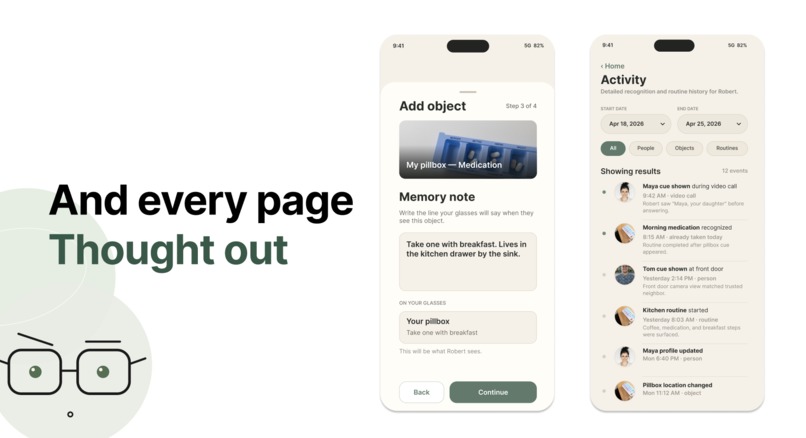
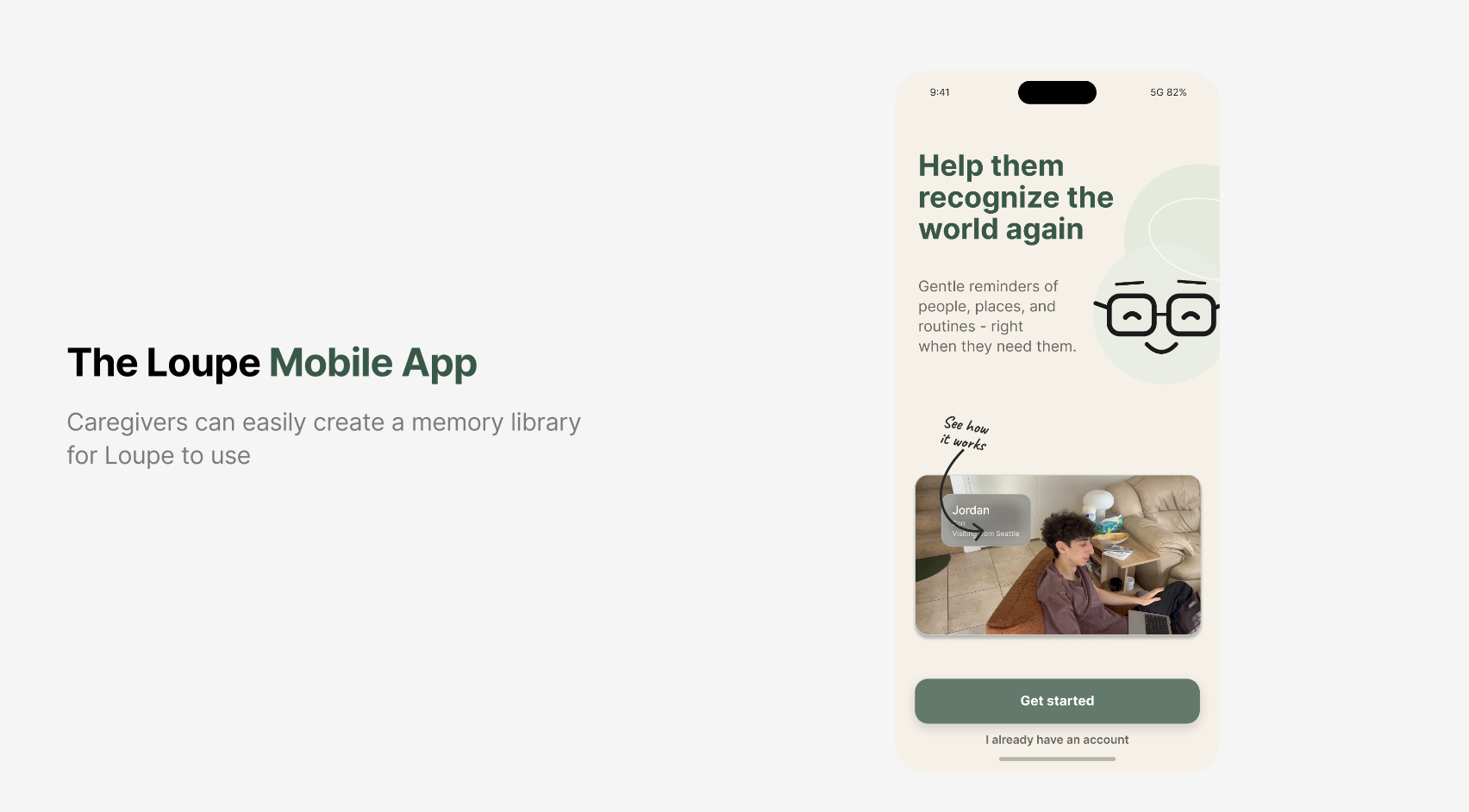
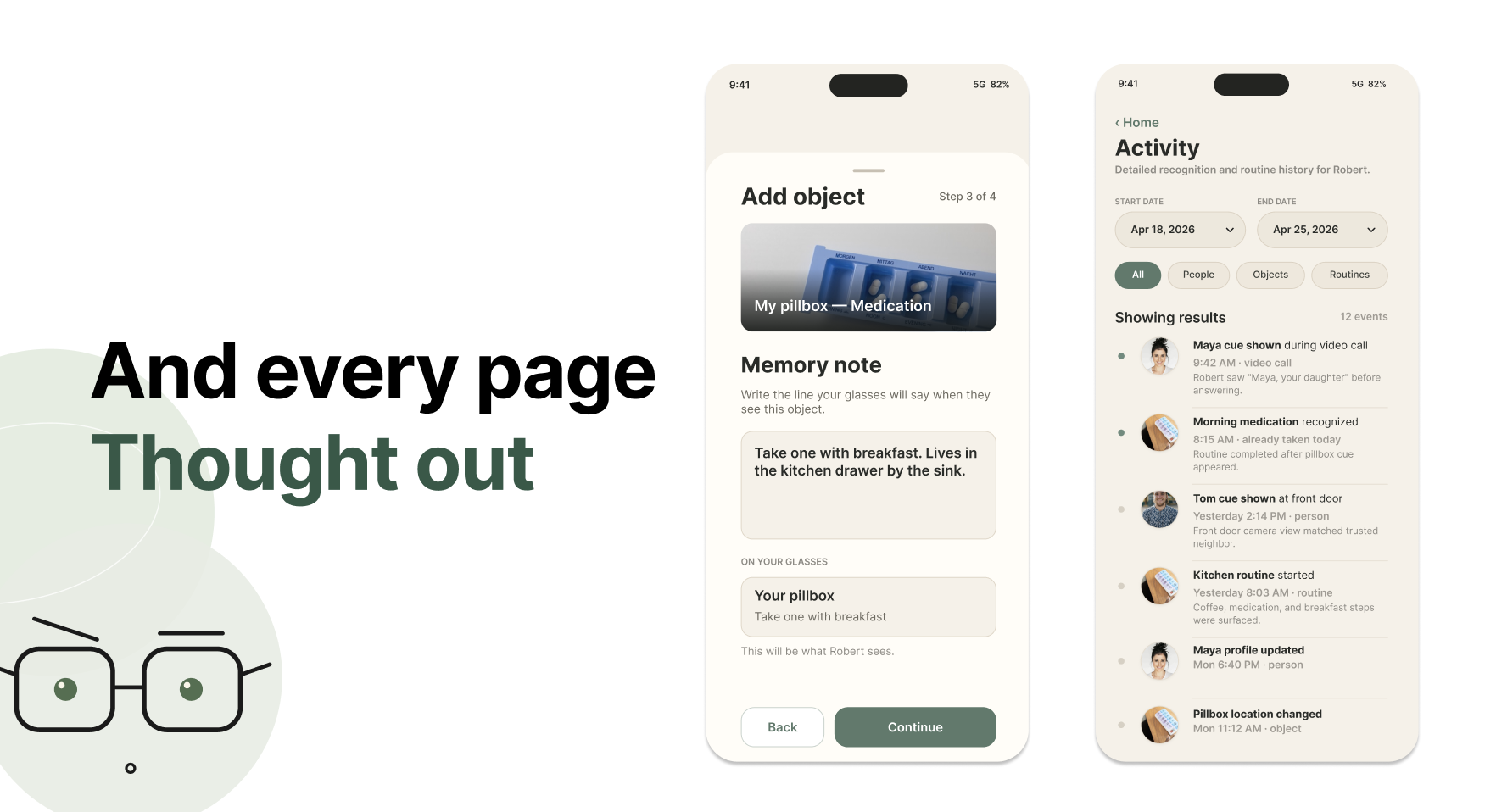
For the family-facing application, a son, daughter, or partner pre-authors the patient's memory layer through a web companion. They upload photographs of rooms in the house with corresponding labels, photographs of family members with names and relationship notes (for example, "Sarah, your daughter, lives in Portland with two children, Mia and Lucas"), and the patient's medication schedule with dosage and timing. With this layer in place, the patient walks through their own home and sees a world that has been gently labeled in their family's voice. The result is not a clinical interface so much as a personalized constellation of recovered context, where things that were lost can be found again by the people who knew them best.
How we built it
UX research process
LOUPE began with the recognition that we were not our users. None of us live with dementia, and none of us are full-time caregivers. For that reason, we relied heavily on research before drawing any screens.
Our secondary research focused on clinical literature surrounding early-stage dementia, particularly the topics of anosognosia (the loss of self-awareness about one's own condition) and the well-documented phenomenon of preserved emotional memory, in which patients tend to forget names while retaining the feelings they hold toward people. This research shaped our entire information hierarchy, leading us to prioritize faces and emotional context above factual labels.
For our user interviews, we spoke with my grandmother who has worked closely with my great-grandmother, who is living with early- to moderate-stage dementia. The single most important insight from this conversation was the observation that patients do not want to feel as though they are being managed. My grandma shared that my great grandmother had refused to wear her medical alert bracelet because of the way it made her feel about herself.
In our competitive analysis, we studied CrossSense, Envision, and OrCam, three of the most prominent AI-vision wearables currently available. While each of these products is technically impressive in object and text recognition, every one of them places the cognitive load on the user, since the patient must initiate, ask, and configure. For a population whose defining symptom is the erosion of initiation, this represents a fundamental design failure. Loupe's competitive wedge is therefore structural rather than technical: the patient never configures the system, because the family does it for them. No competitor in the assistive-wearable space currently separates authoring from use in this way.
Through affinity mapping, we organized recurring themes from our research, including fear of stigma, loss of routine, anxiety around relatives who feel like strangers, and confusion surrounding medication. These four themes directly informed our design priorities in building facial recognition, gentle visuals, and the medication and routine assistance features.
Sketching and wireframing
We began with the AR overlays rather than the dashboard, because we needed to understand what the patient would see before we could determine what the family would need to input. We iterated through tons of drafts before settling on what we now refer to as "ambient labels," which are small pieces of low-contrast, gently floating type that live at the edge of attention rather than its center. Bright interfaces are alarming interfaces, and we wanted the opposite effect.
For the dashboard, we moved to mid-fidelity in Figma, drawing visual cues from the warmth of journaling applications such as Day One and Reflect rather than from the clinical coldness of medical software. The family is often grieving as they use this product, and the interface should reflect an awareness of that.
Designing for dignity
Every interface decision was filtered through a single question: does this make the patient feel more like themselves, or less?
We removed all status indicators from the glasses' field of view, including the battery icon, the sync notification, and the recording indicator. The patient should never be reminded that the system exists. Family-authored notes appear in a soft, easily readable typeface, and we deliberately avoided red, since red is the color of medical alarms and we never wanted the patient to feel alarmed about themselves. Our palette leans into warm neutrals with a soft, dawn-blue primary. Onboarding is designed for the family rather than the patient, and the patient's first experience with Loupe is simply putting on the glasses and walking through their own home.
Challenges we ran into
The most difficult aspect of designing for cognitive decline is that we could not user-test with our actual end user during a thirty-six-hour window. We had to triangulate continuously between caregiver insight, clinical research, and our own design judgment, while accepting that some of our decisions would require validation in a longer pilot.
The second challenge was scope. AR is an expansive design canvas, and every feature we considered (such as the question of whether the system could remind a patient of a conversation they had the previous day) opened new ethical and technical questions. We had to discipline ourselves toward a tight minimum viable product.
Prototyping the AR overlays in Figma was particularly difficult. Figma is not built for spatial interfaces, and getting the ambient labels to feel as though they belonged in a real environment required layering, masking, and video techniques that were new to all of us.
Designing the dashboard presented a final challenge. We kept defaulting to enterprise design patterns such as tables, forms, and dropdowns, and we had to consciously pull our work back toward something a fifty-year-old setting up their father's glasses for the first time would feel emotionally comfortable using.
Accomplishments that we are proud of
We built a system that intentionally hides itself. Designing a product whose highest praise would be "I forgot it was even there" was both creatively challenging and deeply rewarding.
We are also proud of the architectural insight at the core of LOUPE, which we believe no competitor in this space has fully internalized: the patient is not the user of the configuration interface, the caregiver is. Once we made that split clear in our thinking, every other design decision became cleaner.
Finally, as this is our first designathon, we are proud of having built and successfully prototyped this much in Figma within such a short period of time.
What we learned
We learned the difference between accessibility and dignity. Accessibility tells us to make a product usable for people with impairments, while dignity tells us to make it usable in a way that does not remind them of those impairments. The two concepts overlap, but they are not the same, and dignity is the more difficult standard to meet.
We also developed our Figma skills considerably, including auto-layout, components, prototyping interactions, and video overlays for the AR mockups.
What's next for LOUPE
Voice-anchored memories represent a clear next step. We would like to allow family members to record short audio clips that play when the patient looks at a specific person or object. A clip might say, for example, "Hey Dad, this is your favorite chair. You built it in 1992."
We are also interested in developing an adaptive memory layer. The fullest version of LOUPE would evolve as the disease itself does, and we want to research how the memory layer should change across the early, middle, and late stages of dementia, as well as when the system should gracefully hand off responsibility to a human caregiver.
A caregiver "today" view is another priority. This feature would offer the family a summary of what the patient encountered during the day, without crossing into surveillance, and it would help the family tune the memory layer over time.
Finally, we are interested in pursuing hardware partnerships. We would like to validate LOUPE on real AR form factors such as the Meta Ray-Bans, XREAL, and future Apple Vision devices, and to pursue partnerships with neurology clinics to pilot the system with patients in the early diagnostic window.
Dementia is one of the loneliest diseases, and LOUPE is our small attempt to make it a little less lonely, by putting a daughter back in the room and a father back in his own house, for a little while longer.
Built With
- capcut
- figma


Log in or sign up for Devpost to join the conversation.