-
-
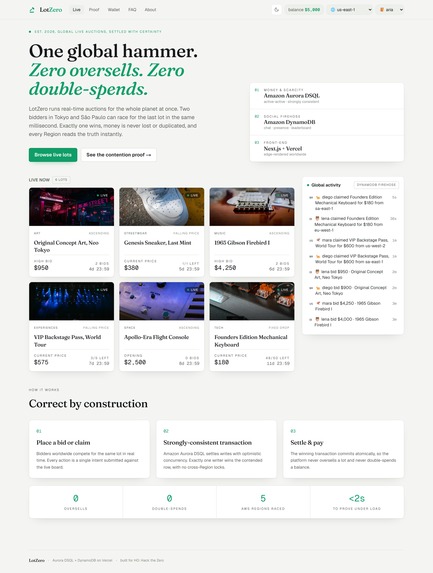
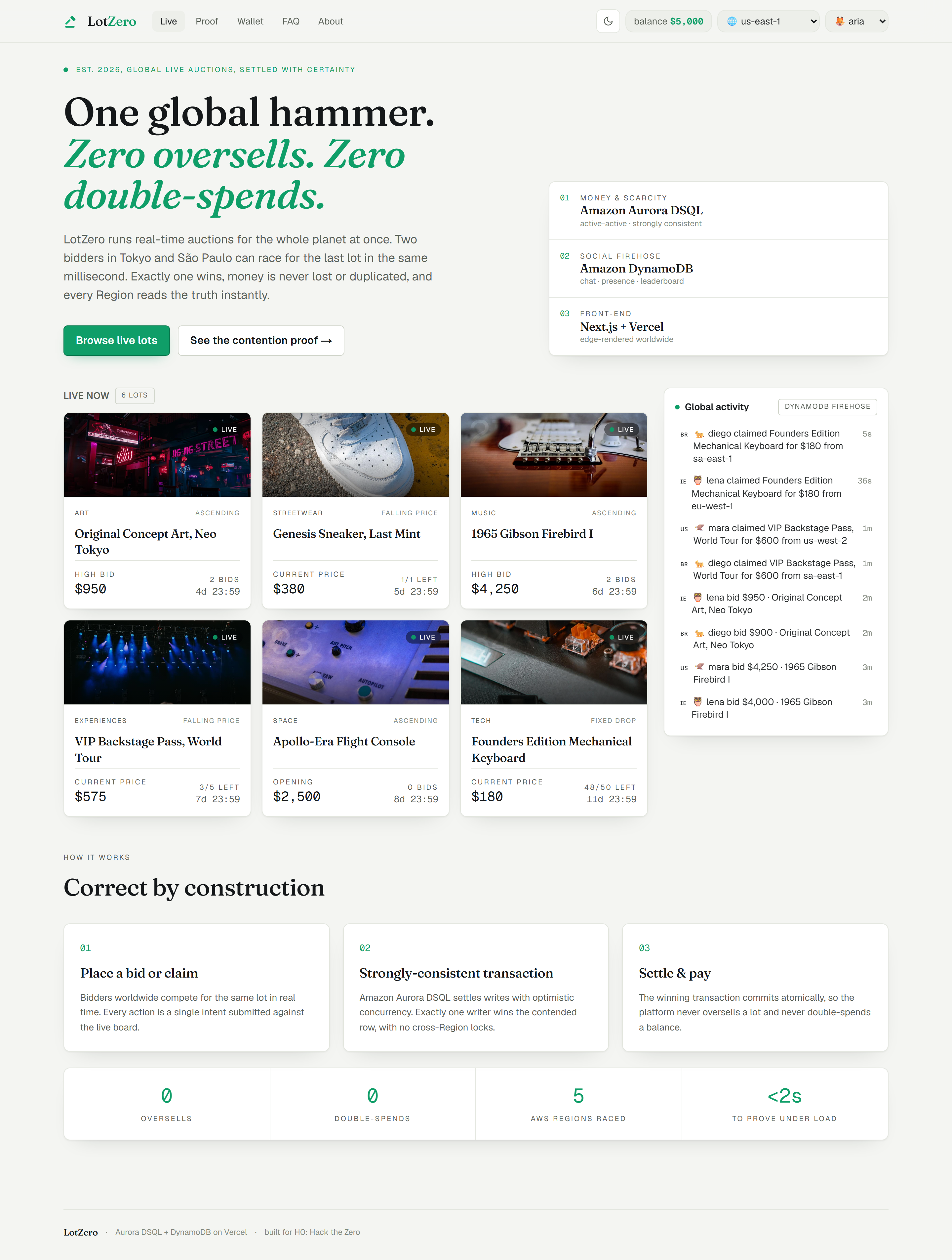
LotZero: live global auctions on real product lots, with a DynamoDB activity feed streaming bids and claims worldwide.
-
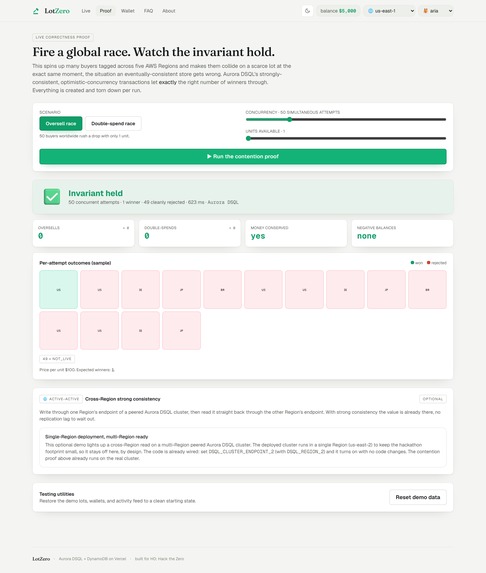
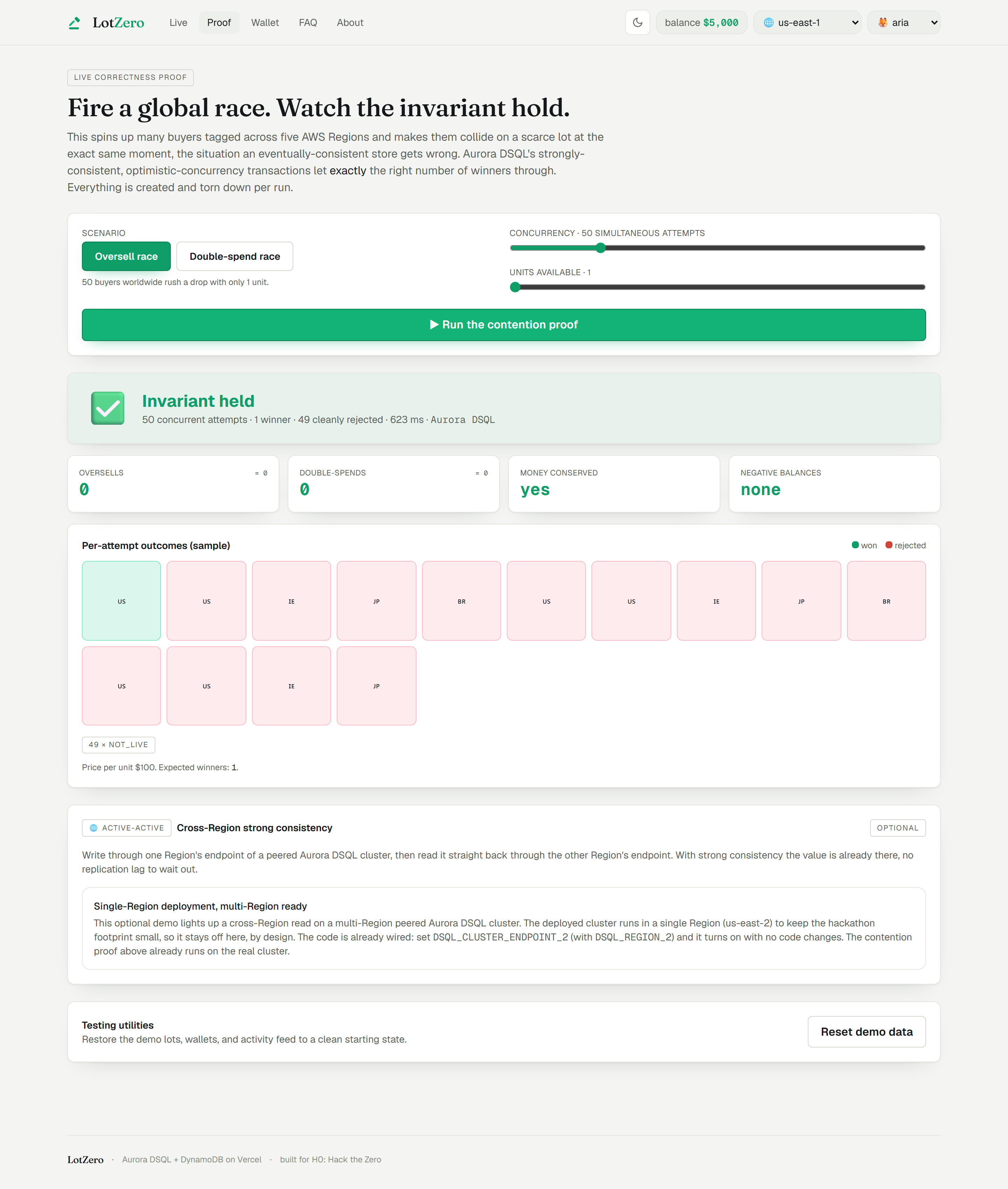
The proof: 200 buyers race one lot on the live Aurora DSQL cluster. 1 winner, 0 oversells, 0 double-spends, every run.
-
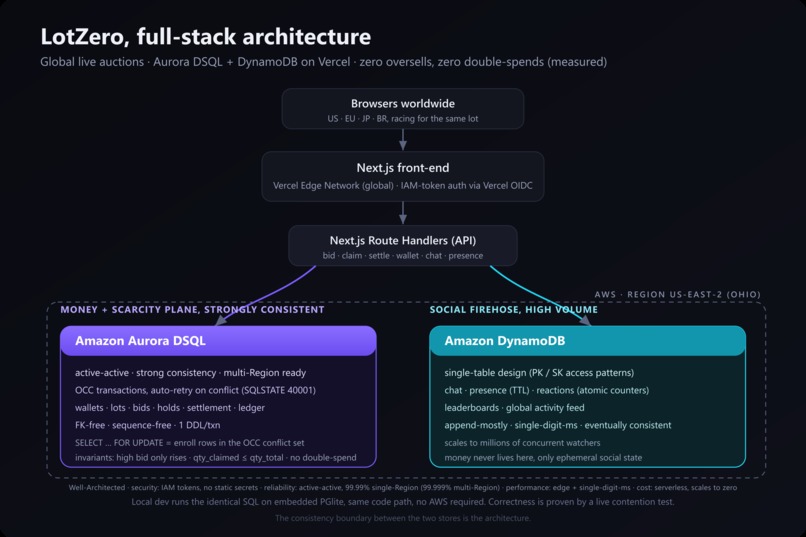
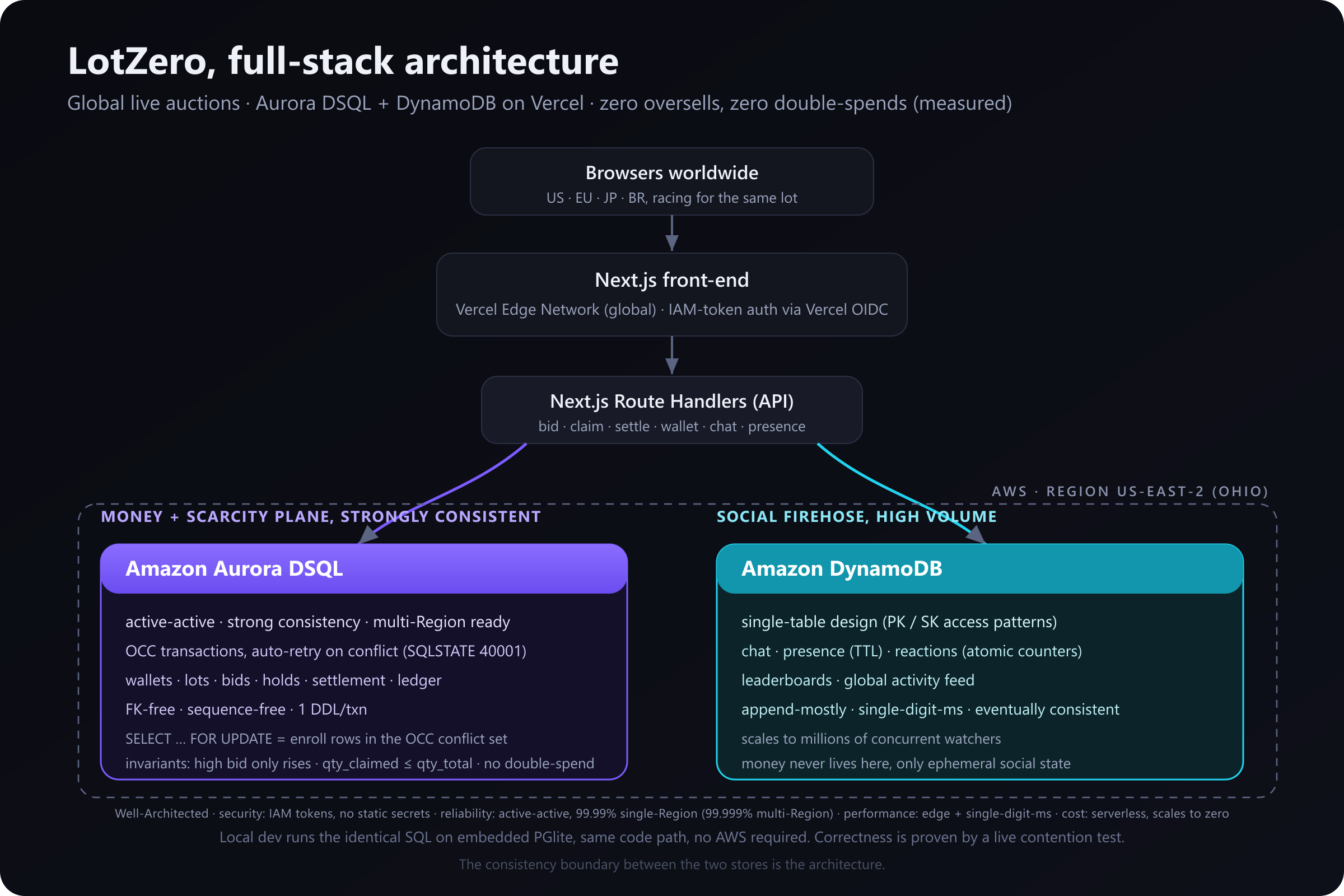
Two planes on one consistency boundary: money on Amazon Aurora DSQL, the social firehose on Amazon DynamoDB, Next.js on Vercel.
-
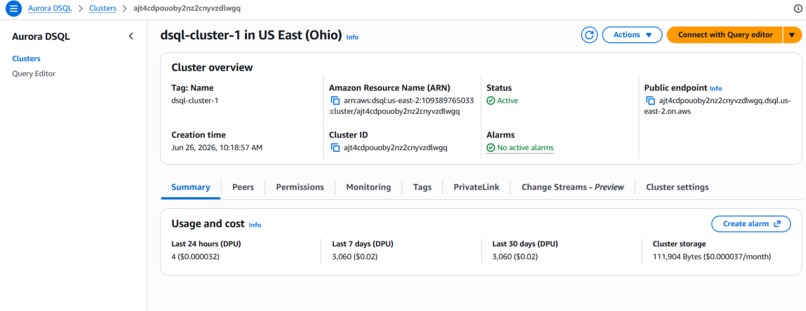
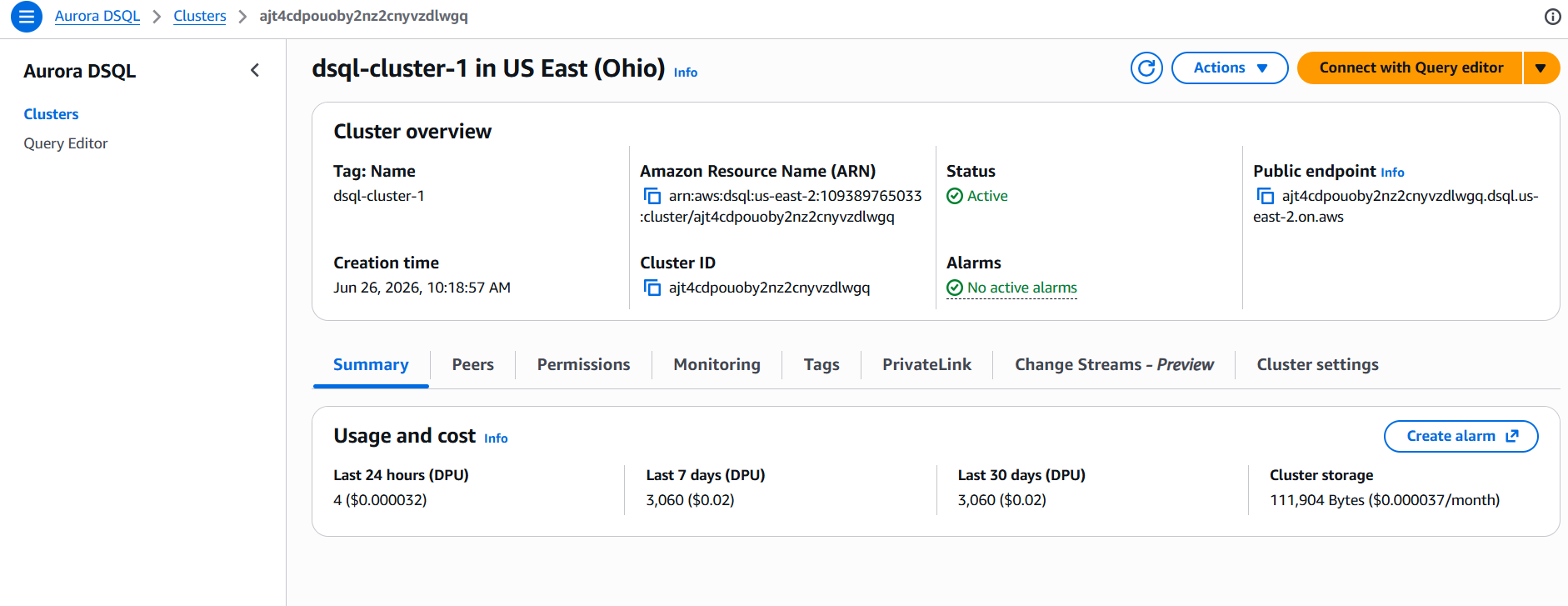
The real Amazon Aurora DSQL cluster (Active, US East / Ohio) holding wallets, bids, holds, settlement and the money ledger.
-
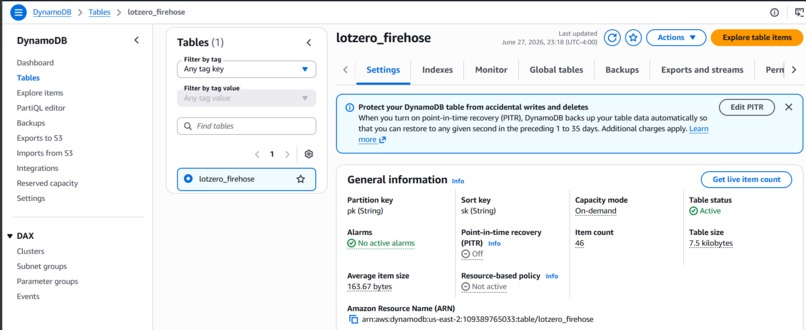
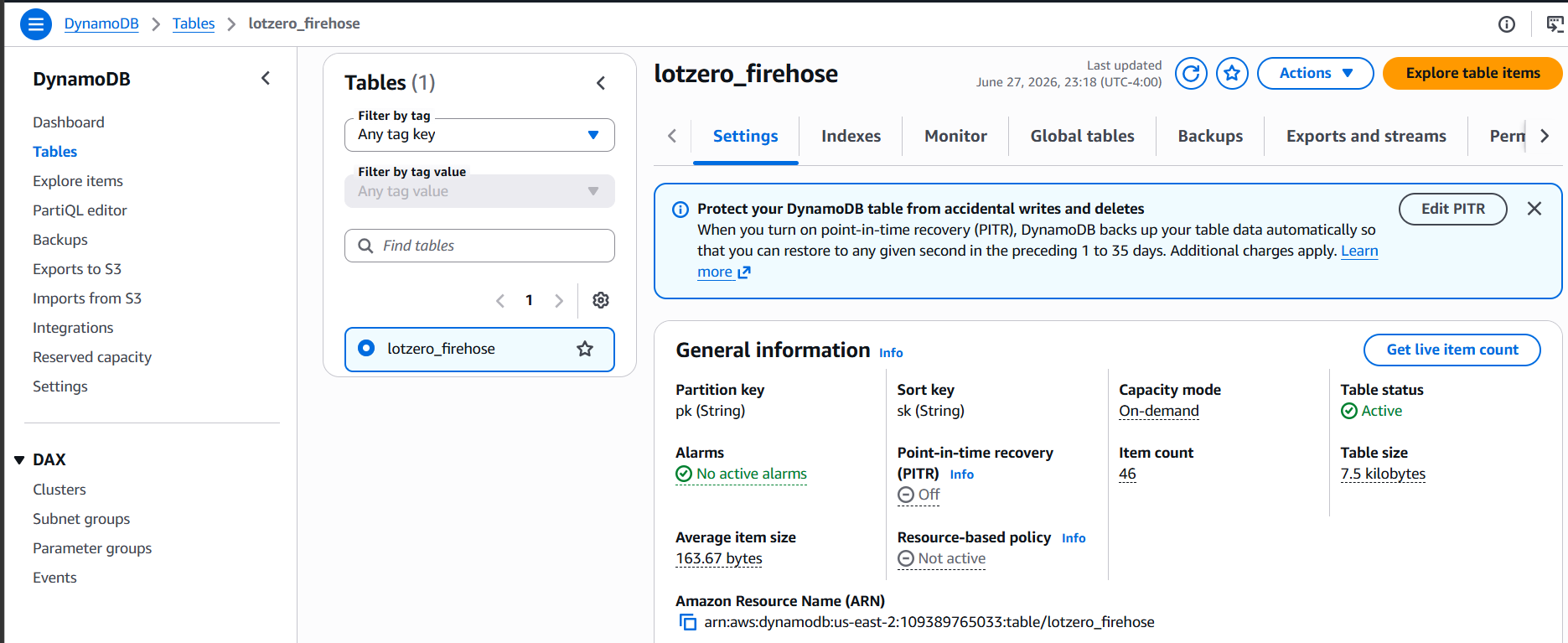
The real Amazon DynamoDB single-table firehose for chat, presence, reactions, leaderboards and the global activity feed.
-
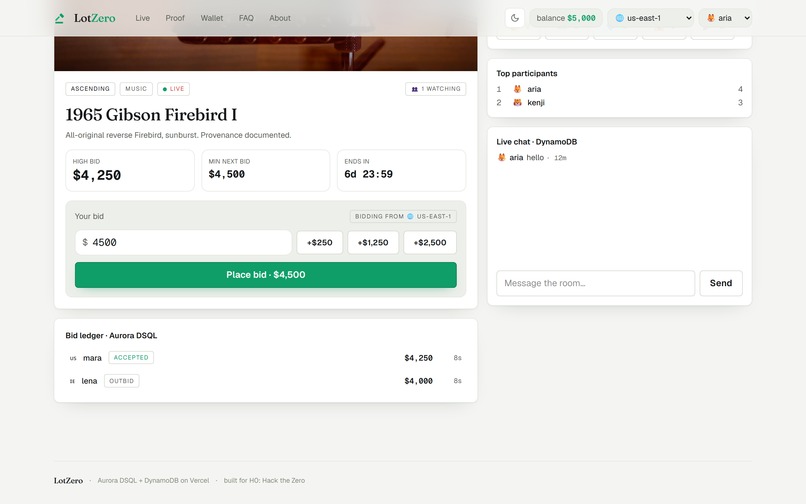
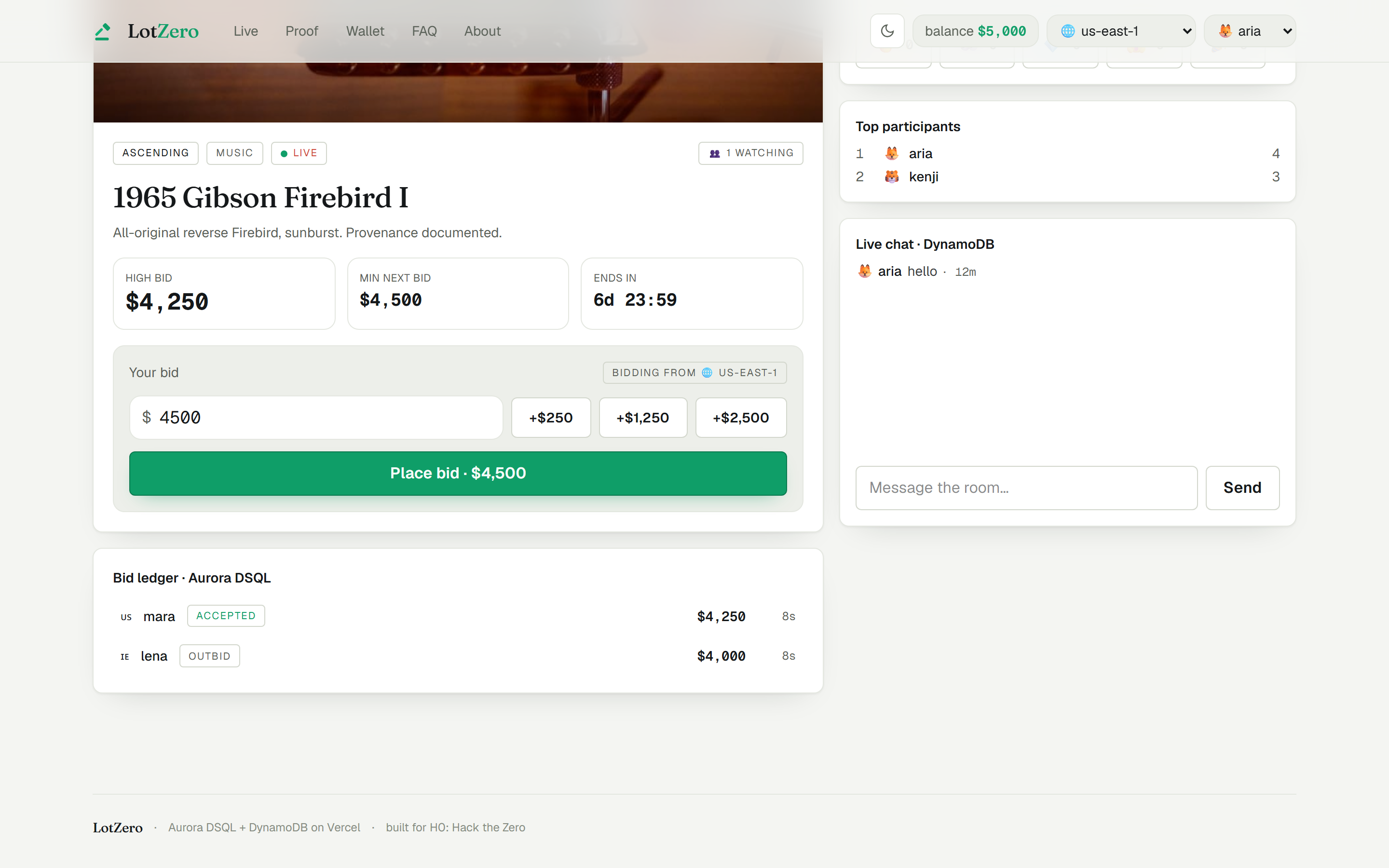
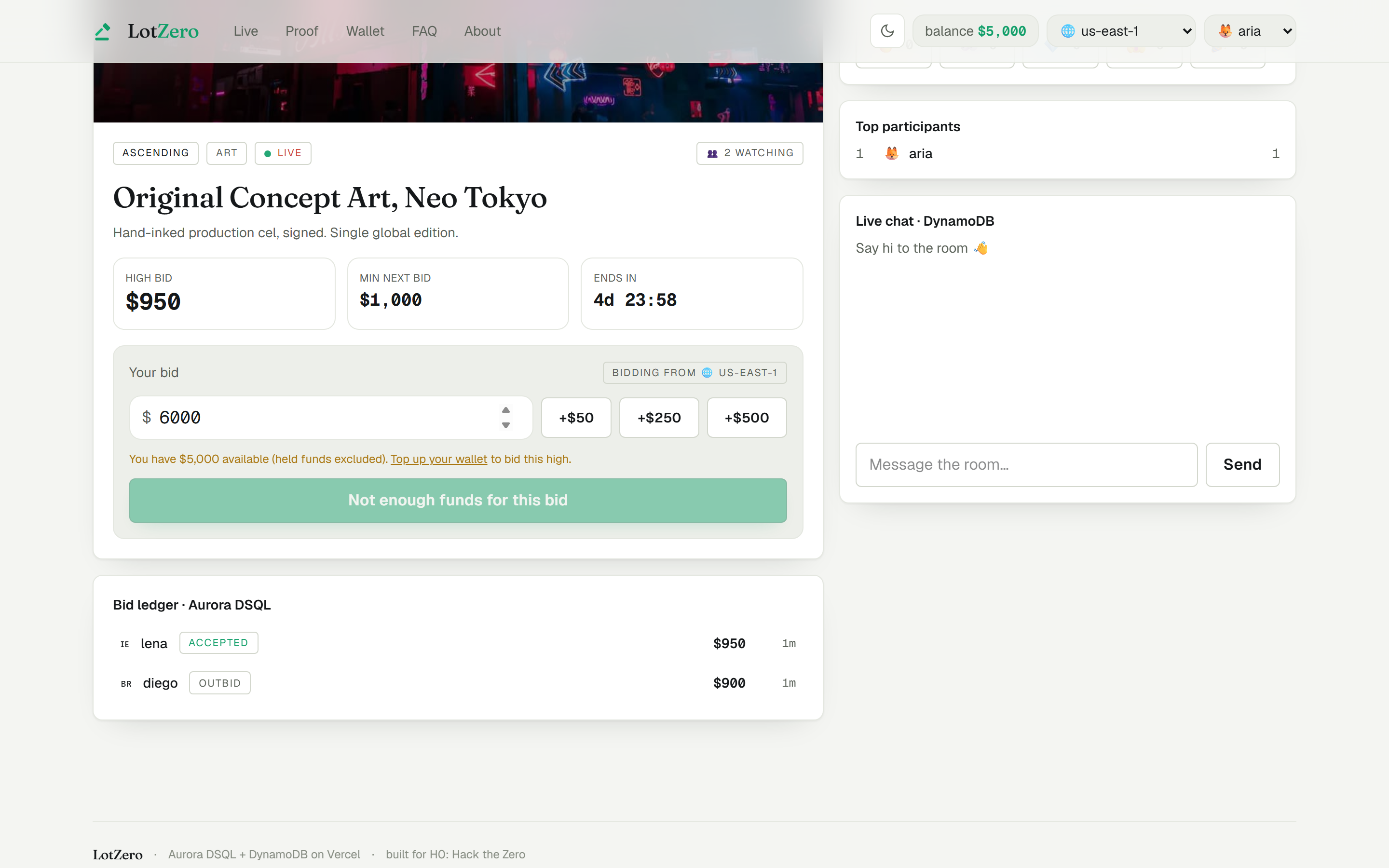
English auction: held funds surface in the wallet and the Aurora DSQL bid ledger updates live as bidders outbid each other.
-
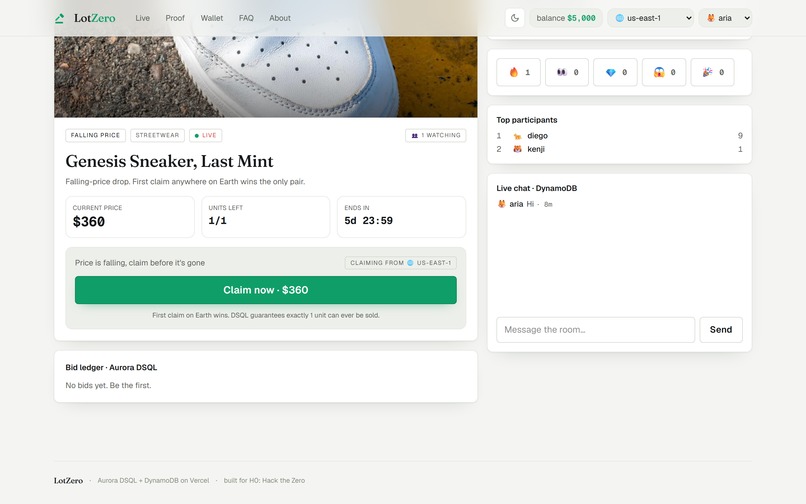
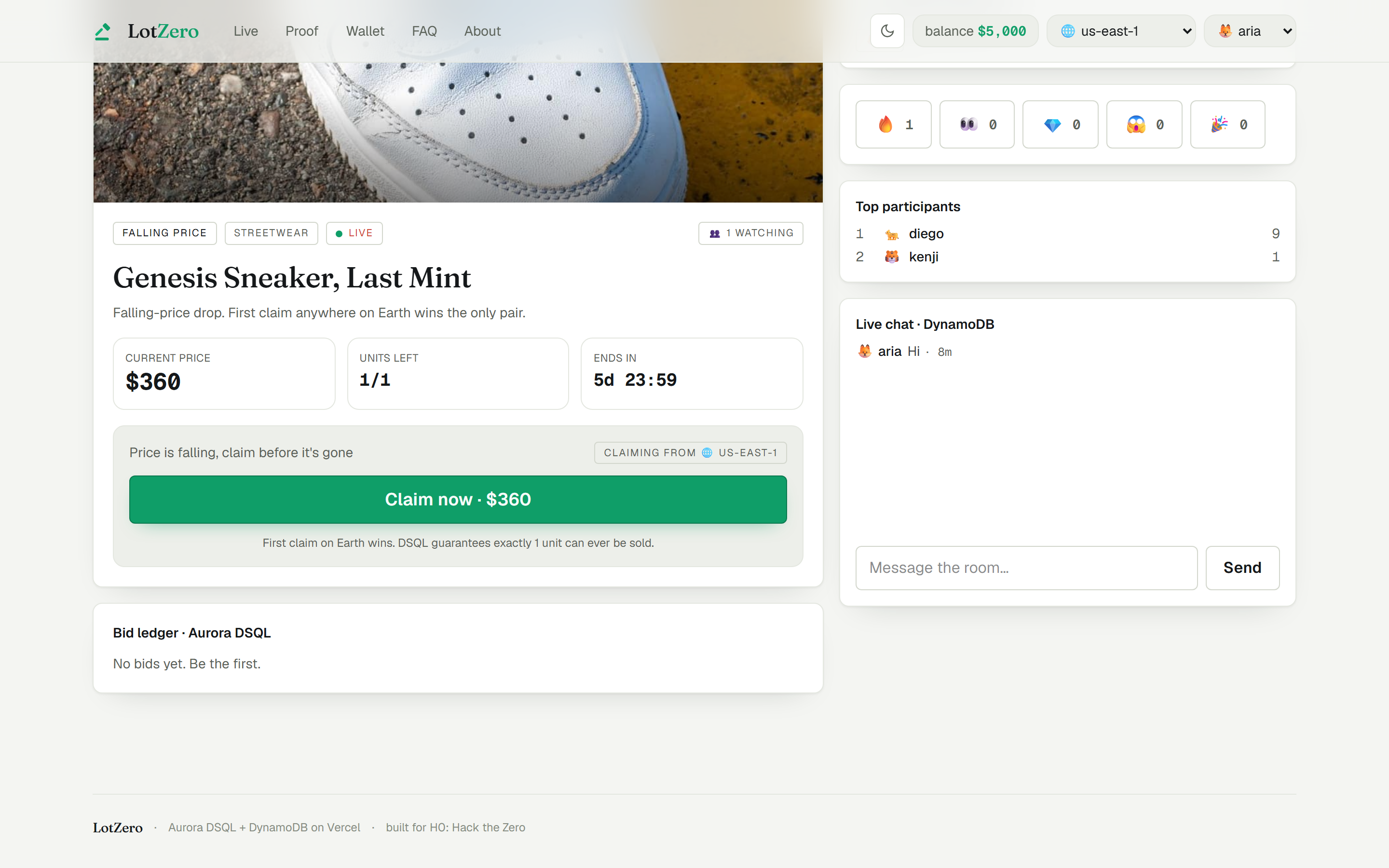
Dutch falling-price drop: the price ticks down and the first claim anywhere on Earth wins the only unit.
-
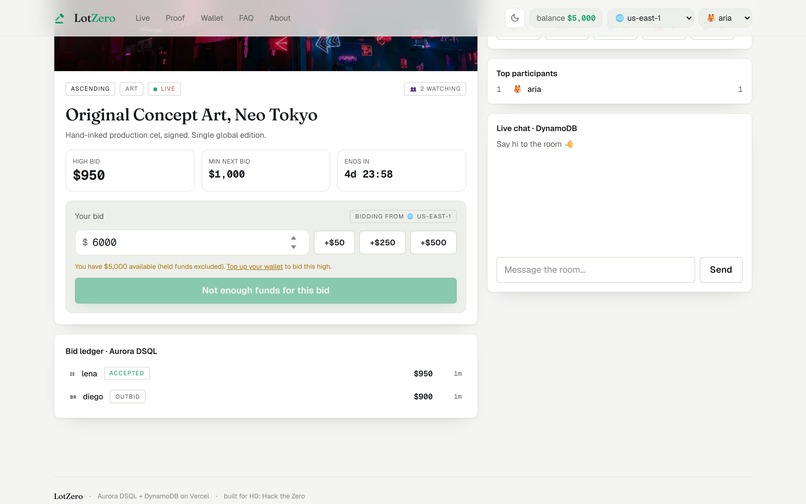
Guardrails: bids above your available balance are blocked up front with a clear top-up prompt, before they reach the ledger.
-
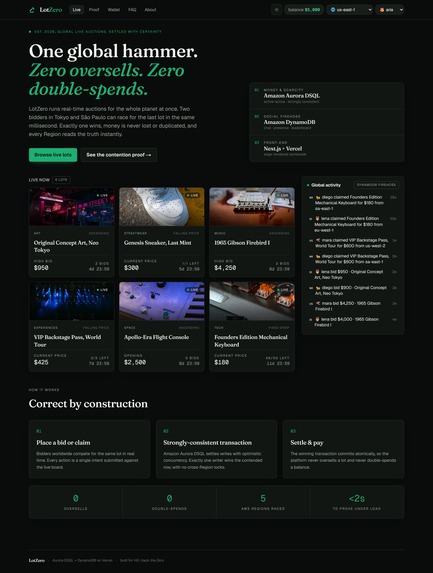
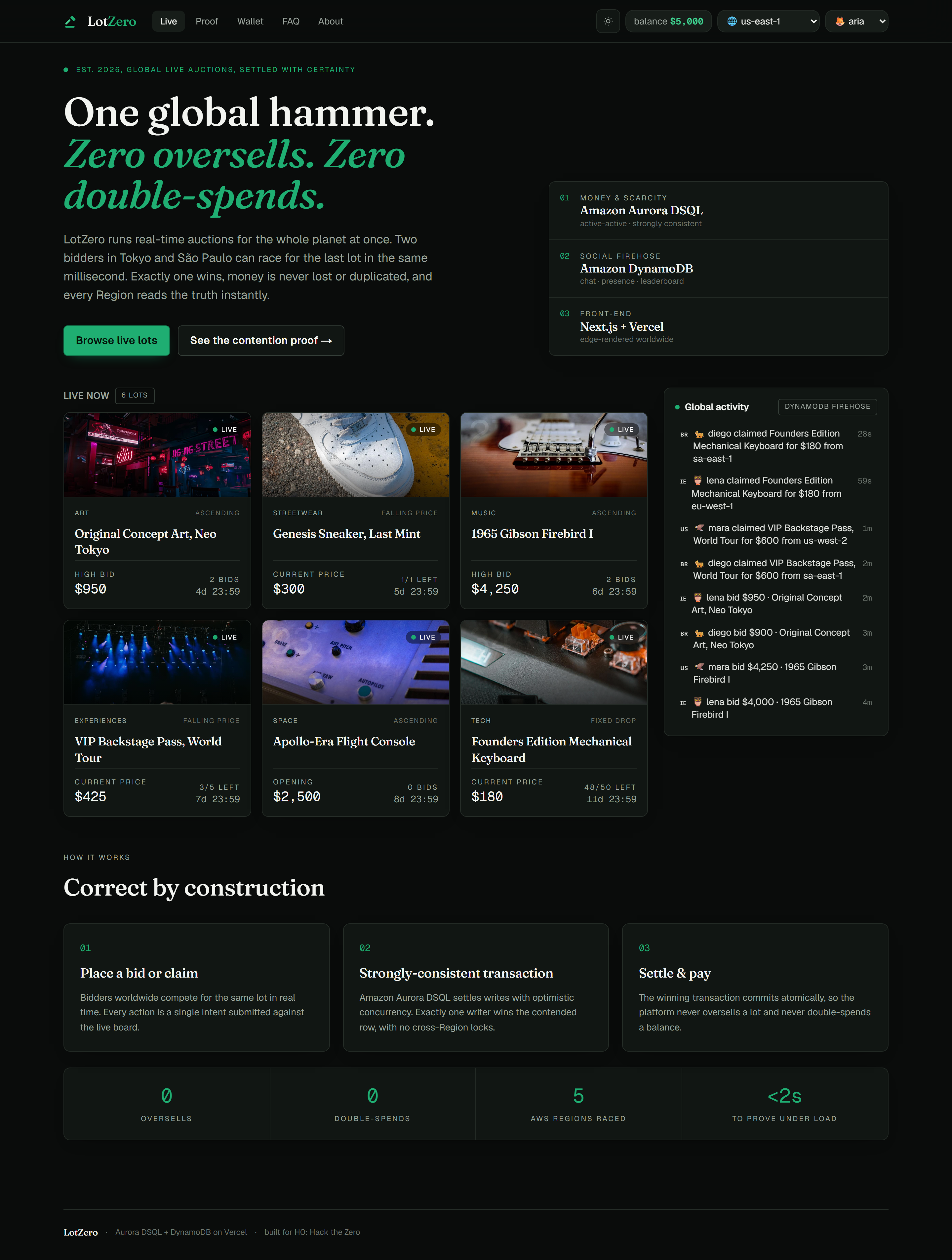
Same app, dark theme. Switch identity and acting AWS Region from the header to feel the contention firsthand.
Inspiration
Real-time global commerce forces a brutal tradeoff. Put your money ledger in a single Region and it is correct but slow for everyone far away. Spread it across Regions with eventually-consistent NoSQL and it is fast but unsafe: two Regions can both sell the last item, and someone gets a refund email. I wanted to build the thing that is supposed to be impossible on a weekend stack: a worldwide live auction where the last lot can only ever be won once.
What it does
LotZero runs real-time auctions for the whole planet at once. Bidders anywhere compete for the same lot in the same millisecond, and the platform guarantees exactly one winner, money that is never lost or duplicated, and a truthful view in every Region. It supports English (ascending), Dutch (falling-price, first-claim-wins), and fixed-price drops, with live chat, presence, reactions, leaderboards, and a global activity feed. A built-in Proof page fires hundreds of concurrent claims tagged across five AWS Regions and measures the guarantee live.
How I built it
A two-plane architecture with a deliberate consistency boundary:
- Money and scarcity (Amazon Aurora DSQL): wallets, bids, holds, settlement and limited inventory run as strongly-consistent, optimistic-concurrency transactions. DSQL's active-active, multi-Region strong consistency means contention resolves correctly with no cross-Region locks and no lost writes.
- Social firehose (Amazon DynamoDB): chat, presence, reactions, leaderboards and the activity feed use a single-table design built for very high write volume, where eventual consistency is fine.
- Front-end: Next.js deployed on Vercel; the home "How it works" section and the About and FAQ pages were built in v0. Auth to DSQL uses short-lived IAM tokens (no static password), and the same SQL runs locally on embedded PGlite and in production on DSQL.
Challenges I ran into
Aurora DSQL is PostgreSQL-compatible but deliberately different: no foreign keys, no sequences, no JSON types, exactly one DDL statement per transaction, and SELECT ... FOR UPDATE is an optimistic-concurrency conflict check rather than a lock. I modeled around all of it: application-generated IDs, referential integrity enforced inside the transactions, automatic retry on serialization conflicts, and async indexes applied out of band. Getting the "exactly one winner under true concurrency" invariant right, and proving it, was the heart of the work.
Accomplishments that I'm proud of
Measured correctness, not claims. Under 200 concurrent global claims on a real Aurora DSQL cluster, the system holds zero oversells and zero double-spends, with money conserved and no negative balances, every run. It is deployed and shippable, and an end-to-end test suite plus a contention load test gate it.
What I learned
Aurora DSQL turns a previously-hard problem (globally-consistent contention) into an ordinary CRUD app, which frees you to pair it with DynamoDB for the parts that just need to be fast and huge. Good architecture here is choosing the right database per job and drawing the consistency boundary on purpose.
What's next for LotZero
LotZero already runs end-to-end on the production stack today. Taking it from a working product to a public marketplace means: real payment rails (Stripe or Adyen) and KYC, anti-fraud and bid-sniping protection, WebSockets and DynamoDB Streams to replace polling, and flipping on the multi-Region peered DSQL cluster (the code is already wired for it).
Built With
- amazon-aurora-dsql
- amazon-dynamodb
- aws-sdk
- next.js
- node.js
- pglite
- postgresql
- react
- tailwind-css
- typescript
- v0
- vercel

Log in or sign up for Devpost to join the conversation.